
For those of you who prefer to read on paper (or e-reader) rather than in your Substack or email app, I have converted this essay into an easily printable PDF.

Last weekend, my wife Hannah and I headed across the country to the Fort William Mountain Festival. This was actually my first time at this festival, and I was looking forward to seeing how it differs from Kendal, which I attend every year.
We had a great time. Caught up with good friends and colleagues in the industry, drank a few beers, watched some amazing films – Find Mor was my highlight of the festival – and went to a few talks.
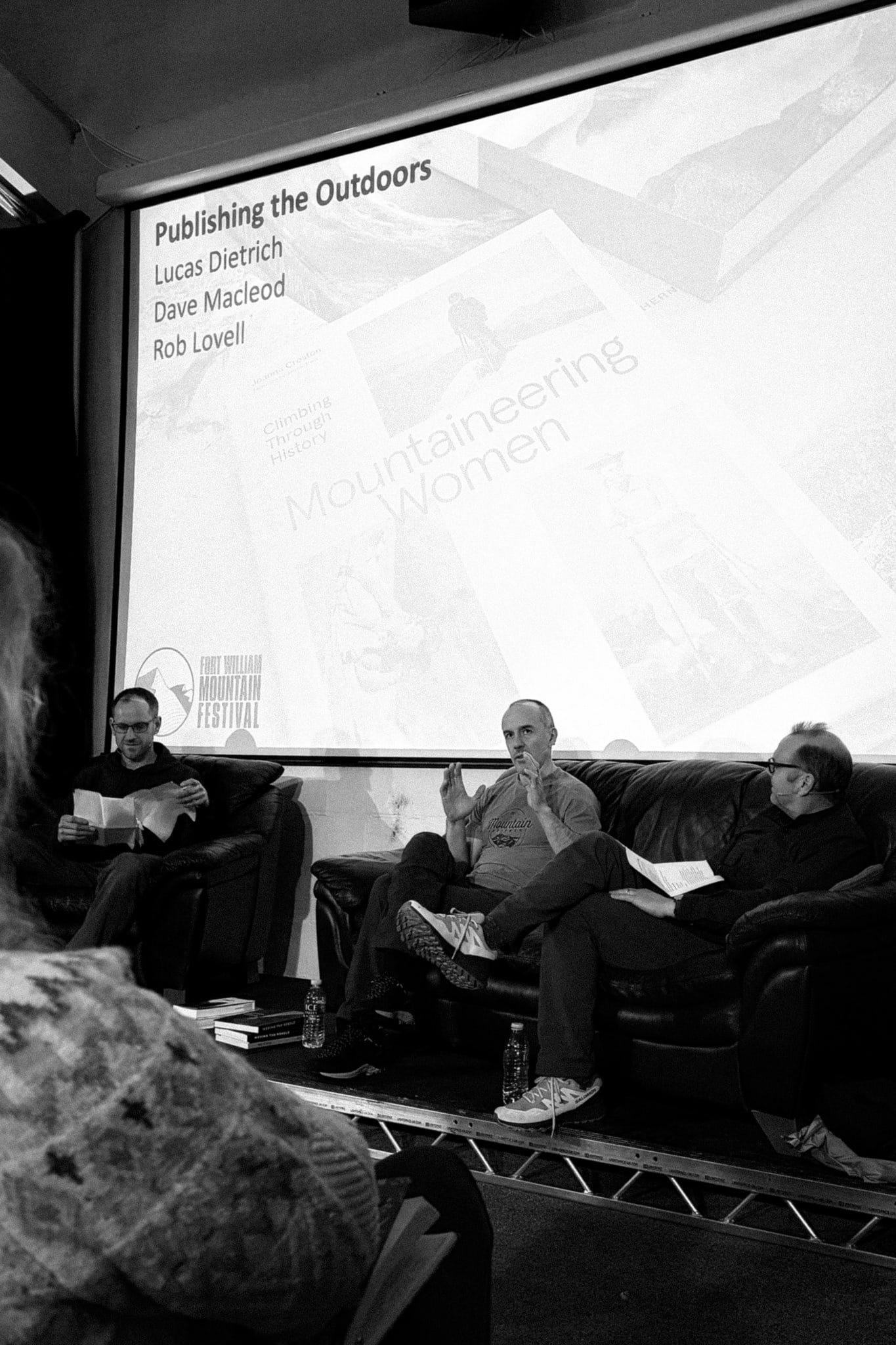
In this post I’d like to highlight an event on Sunday afternoon called ‘Publishing the Outdoors’: a panel hosted by Rob Lovell (Scottish Mountaineering Press), chatting with Lucas Dietrich (editorial director at Thames & Hudson) and Dave Macleod (a well-known professional climber who has been successful self-publishing his books).
The goal of the panel was to compare traditional publishing with self-publishing, specifically regarding outdoor books, but many of the ideas are universal. SMP is a small specialist publisher of outdoor books; T&H is much bigger, but has a growing outdoor imprint.
Much of the audience consisted of aspiring or current authors – a show of hands confirmed this – and the discussion was a fairly high-level one. Some of the audience might have expected more nuts-and-bolts tips on subjects such as how to approach editing and cover design, but to be honest you can get this info anywhere. Of far more value was the unusually candid level of discussion on the fundamentals in this corner of the publishing industry.
For any author, the choice of whether you should self-publish your book or seek a traditional publisher is a big one. Over the course of this discussion, it really came down to a few key questions:
Have you already put in the legwork to build an audience? If not, do you have the time/capacity to build one?
If you have an audience, can you reach them directly?
To what extent have you developed your idea? Is it something your audience actually wants?
If your idea is not already tailored to the specific audience you have cultivated, is it flexible enough to be adapted to broader audiences – and are you OK with the compromises inherent with that?
Could your book benefit from the design and visual skills that publishers possess?
How much control do you want to retain over the process?
Do you want the validation and prestige that still come with a traditional publishing deal?
Of course, there’s more to it than this, but I think such a focus in an event like this makes sense. Especially the first two points. The success of a book has always depended on access to an audience and then creating something they want. Maybe that should be obvious, but it’s more true now than it has ever been. Audience first.
It was refreshing to hear a level of discussion without ego. The publishing professionals in the room were honest and open about the many advantages of self-publishing today, and in fact Lucas often argued in favour of the DIY approach throughout. As someone who has experience of both sides of publishing, and who stands at a crossroads regarding what to do for future books, the chat clarified a few things for me. I can’t say for certain which approach I’ll take next time, but I am thinking a bit more specifically in terms of my own readers and what they are asking from me.
My usual practice in these events is to scribble quotes down verbatim in my notebook, so I’ll let the panelists speak for themselves. Although this can’t hope to present a complete view of the discussion, it does highlight the salient points I noticed. I’ve grouped the quotes by topic rather than in chronological order. Emphasis in bold is mine.
On audience:
Rob: ‘The question is, what is a publisher for if you already have an audience?’
Dave, suggesting YouTube as a useful way to find new niches: ‘Each rabbit hole is potentially an opportunity to sell 5,000 books.’
Dave: ‘I use Patreon, and earn £300 a month [from that] even if I’m not posting content, because my audience wants to support me and knows I will be working on something new.’
Dave: ‘One of the most valuable things is feedback from your audience, telling you what to write. If your readers are consistently asking you for something, listen to them.’
On developing and pitching ideas:
Dave: ‘My first book evolved out of a series of blog posts.’
Lucas, on when to pitch an idea to a publisher: ‘It could just be the kernel of an idea, and if it lands with an editor who believes in it then you never know.’
Rob agreed: ‘It’s nice to see ideas early on.’
Dave, regarding the self-publishing route: ‘Go direct to the audience and test your ideas as you refine them.’
Regarding books that were originally self-published finding a new home with a traditional publisher, Lucas said: ‘As long as we know where we stand, I’m open to republishing books that have already been self-published. Yes, if it works with our list and with the author.’
On publishing models and production:
Lucas: ‘Publishers are B2B, and there are a lot of gateways. It’s an indirect way to get books to people when you think about it.’
Dave, referring to multiple editions of a single book at different price points: ‘Think of your audience as concentric circles, with special packaging books for superfans or gift purchases.’
Rob: ‘A commercial publisher has to watch the fluctuation of costs carefully, but a self-published author [using print on demand] can absorb that to a degree.’
Dave: ‘I use traditional print runs to keep costs down, but also print on demand through Amazon – a mixed model. I also record audio versions.’
On whether you should self-publish or go trad, Lucas said: ‘If you want the validation then that’s one thing, but if you actually want to get your books out there then you should consider all publishing models. These hybrid models can be very interesting for crusty old publishers like us!’
On the paradox of scale:
Lucas: ‘Scale brings costs down, but it can also be a real hassle.’
Lucas: ‘The problem with having an international [large] audience [to market to] is that you have to flatten the subject.’
Dave: ‘I don’t try to go after all levels of reader, but I can use social media to reach that international audience.’
Dave: ‘Scale dilutes your connection with your audience. Your value is your shared connection with your audience, and I spend a lot of time trying to understand that connection.’
On sales and distribution:
Rob: ‘The bulk of Scottish Mountain Press sales are through our own website. Our newsletter readers are great. Instagram’s also important and has the highest engagement. There’s a real willingness for people to support the publisher, the creator.’
Lucas: ‘We’re poor at direct sales and mostly use traditional channels. Our problem is that we are too passive and expect Amazon to pick up the orders. We ought to have changed five years ago.’
On the enduring value of physical books:
Lucas, referring to the ephemerality of digital content: ‘Books are a reminder for people of who they are.’
Rob: ‘Our guidebooks are a true community effort – you’d be amazed at the amount of collaboration that goes into them. We want our books to be nicely designed objects that people want to pick up – a balance of functionality and aesthetics.’
Lucas: ‘Why do we make physical books any more? The physical book is contained within two covers, it’s been curated by experts. That’s not going to die for now.There’s psychological and emotional value in the physical book.’
Your support enables me to keep publishing Alpenglow Journal. I don’t earn a living from this work, but these words, images and feelings are the most personal I will ever share. It takes a lot of time and effort to put it all together. Please consider becoming a monthly paid subscriber to support me directly – or you can always drop me a one-off tip via Ko-Fi. Thank you.
Images and words © Alex Roddie. No AI has been used in the creation of any work on this page. All Rights Reserved. Please don’t reproduce this material without permission.
Comments
Nothing yet. Say the first thing.
Sign in to join the conversation.