
Claude Opus 5 came out today.
Anthropic’s line on it: it “comes close to the frontier intelligence of Claude Fable 5 at half the price.” On their coding and knowledge-work evals, Frontier-Bench and GDPval-AA, they call it “the new state-of-the-art.” With one exception they name themselves: it’s still behind Mythos 5 on cybersecurity tasks.
It’s live right now on claude.ai, in Claude Code, in Cowork, and on the API. It’s the new default model on Max.
Here’s why that matters more than a normal launch.
Twelve days ago I published a routing system for deciding which Claude model gets which job. The whole thing existed to solve one problem: Fable 5 is the strongest model available, it costs $10 in and $50 out, and it eats a weekly limit fast. So you sit there doing arithmetic before you run anything good, and half the time you talk yourself out of it and send the job to a cheaper model that does a worse version of it.
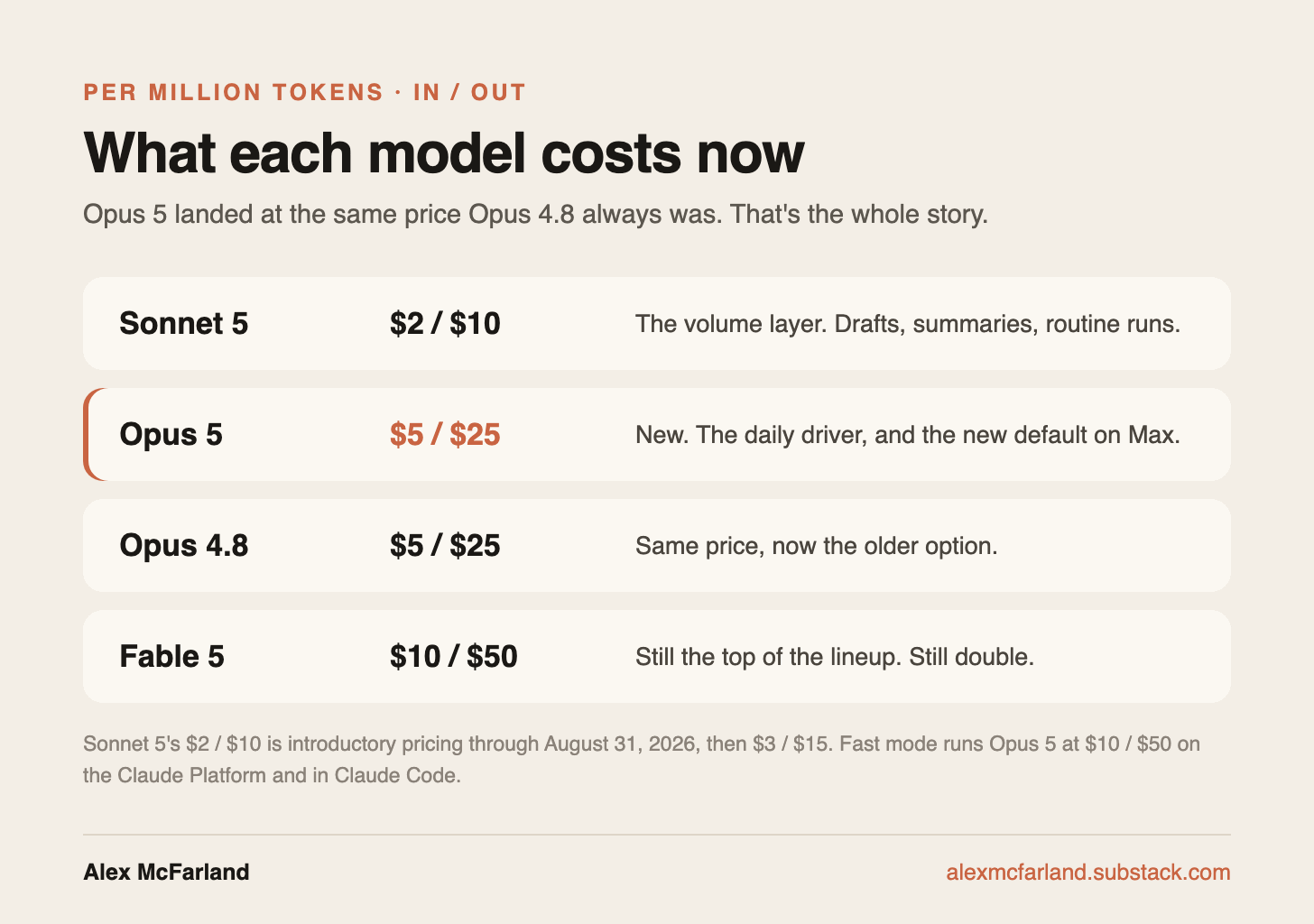
That problem just got a lot smaller. Opus 5 launched at $5 in, $25 out. The same price Opus 4.8 has been all along.
And the price is only half the story. Look at what Anthropic says about cost per task on their own charts:
On CursorBench 3.2, at max effort it lands “within 0.5% of Fable 5’s peak score, but at half the cost per task.”
On OSWorld 2.0, computer use, it goes past “Fable 5’s best result at just over a third of the cost.”
On Frontier-Bench v0.1, coding, it “surpasses all other models” and more than doubles what Opus 4.8 scored, at a lower cost per task.
Read that again, because it’s the actual news. On some of this work Opus 5 isn’t approaching Fable 5. It’s beating it, for a third to half the money.
If someone you know is about to spend a fortune running everything through the top model, send them this first!
Here are 5 things to do right now with the new Opus 5 release:
1. Switch your default to Opus 5
Do this one now, it takes about fifteen seconds.
In the Claude apps, open the model picker and select Opus 5. On Max you’re already there. In Claude Code, run:
/model opusThe reason to do it now is that your default is the model that runs the work you never think about. Every quick question, every routine task, every scheduled job you set up months ago and forgot. That’s the bulk of most people’s usage, and it just got better at no extra cost.
2. Re-run my escalation test, because the list got shorter
The rule from the last piece hasn’t changed: route to the cheapest model that honestly does the job, and escalate only what fails. What changed is where the failures happen.
Until now, a lot of work escalated past Opus because 4.8 came back merely fine and the job needed more. That’s the gap this release is priced into. So before you send anything to Fable prices, ask the same three questions:
Will I re-run this if it comes back mediocre? Two passes at Opus rates cost what a single Fable pass costs, and burn twice the time. Work that has one shot to land is still worth paying up for.
Does a wrong answer cost me more than the tokens? The contract clause a lawyer is actually going to file. The financial model a founder is about to raise on. The patient communication going out from a clinic. The deliverable with your name on it.
Can I even check the output myself? This is the one that matters most and gets asked least. Past the edge of what you can personally verify, you want the most capable model in the room, not the cheapest one that sounds sure of itself.
The questions didn’t change. The answers did. Work that used to fail at 4.8 and get bumped up is worth trying on Opus 5 first, because at $5 in and $25 out you find out for half of what the bump costs.
What I’m still sending to Fable 5, at least until I’ve put a week of real work through this: the deepest research runs with a stack of subagents going at once. Anthropic’s own top-line is that Opus 5 comes close to Fable’s frontier intelligence, and close is a real word they chose on purpose. The wins above are specific benchmarks, not a blanket pass.
But that list used to be long and now it’s short, and everything that comes off it stops costing you double.
One more thing worth flagging, because it matters most to anyone running agents rather than chatting: Anthropic says Opus 5 is “much stronger at verifying its work and iterating carefully until it succeeds.”
Verification is the thing that makes an unattended loop trustworthy. A model that checks its own work before handing it back is worth more to a scheduled job than a model that’s slightly smarter and confidently wrong.
3. Leave fast mode alone unless you have a reason
Fast mode is newer and less talked about, so in case you haven’t run into it: it’s a setting that makes the same model answer you about 2.5 times quicker. Same model, same quality, it just comes back sooner.
You pay for that speed at exactly double the price, $10 in and $50 out, which means fast Opus 5 costs what standard Fable 5 costs. In Claude Code it’s the /fast toggle, it’s available through usage credits, and it’s still labelled a research preview.
The thing to get is that you’re buying speed, not a better answer.
There is a real reason to use it: time-sensitive agentic workflows, a live demo, a client watching you work, anything where a person is sitting there waiting on the cursor. That’s it. For everything that runs while you’re doing something else, and that’s most of what an operator runs, you’re paying double for speed nobody is around to notice.
4. Write it down so you decide this once
This is the part people skip, and it’s the reason model launches feel exhausting instead of exciting. If your routing lives in your head, every release makes you re-litigate every decision, whether you’re running a law practice, a two-person agency, or a clinic’s front desk. In a file, it’s a five-minute edit.
Open your CLAUDE.md and put the routing in it:
## Model routing
- Default: Opus 5. Everyday work, drafts, research,
  builds, scheduled runs.
- Sonnet 5: high-volume and routine jobs I'll review
  anyway before anything ships.
- Fable 5: only after the escalation test — deep
  multi-agent research, heavy system builds, and
  work I can't verify myself.
- Fast mode: no, unless someone is waiting on it.
Then leave it alone until the next launch, which at this rate is a couple of weeks away.
What I’ll tell you in a week
It’s only been a few hours since the release. Every number above is Anthropic’s own, measured on Anthropic’s own evaluations. Every launch-day model feels incredible for about six hours, and then you find the thing it’s bad at. I’ve switched my default and I’m running today’s real work through it. I’ll tell you what holds.
But the price isn’t a benchmark claim. It’s a number on an invoice, and it’s the part that changes your week. The work you’ve been carefully holding back from the good model, because the good model costs double and the limit is real, mostly doesn’t need to be held back anymore.
Stop rationing. Go change your default.
—Alex
PS: Any scheduled routine you set up weeks ago is still running on whatever model you picked back then, every morning, without telling you. Go look at what those are set to. A stale default in the work you never watch is the one that quietly costs you.
Comments
Nothing yet. Say the first thing.
Sign in to join the conversation.