
There’s a mania right now to call everything AI slop. No differentiating, no asking whether the thing actually said anything. Spot the AI tendencies, drop the label, keep scrolling. It’s the same resistance every new technology gets, usually from the same people, and it’s giving AI writing a bad name it doesn’t deserve.
I want to push back on that this week, and I get to do it from an unusual position.
I know slop better than the people yelling about it. I used to make it by hand.
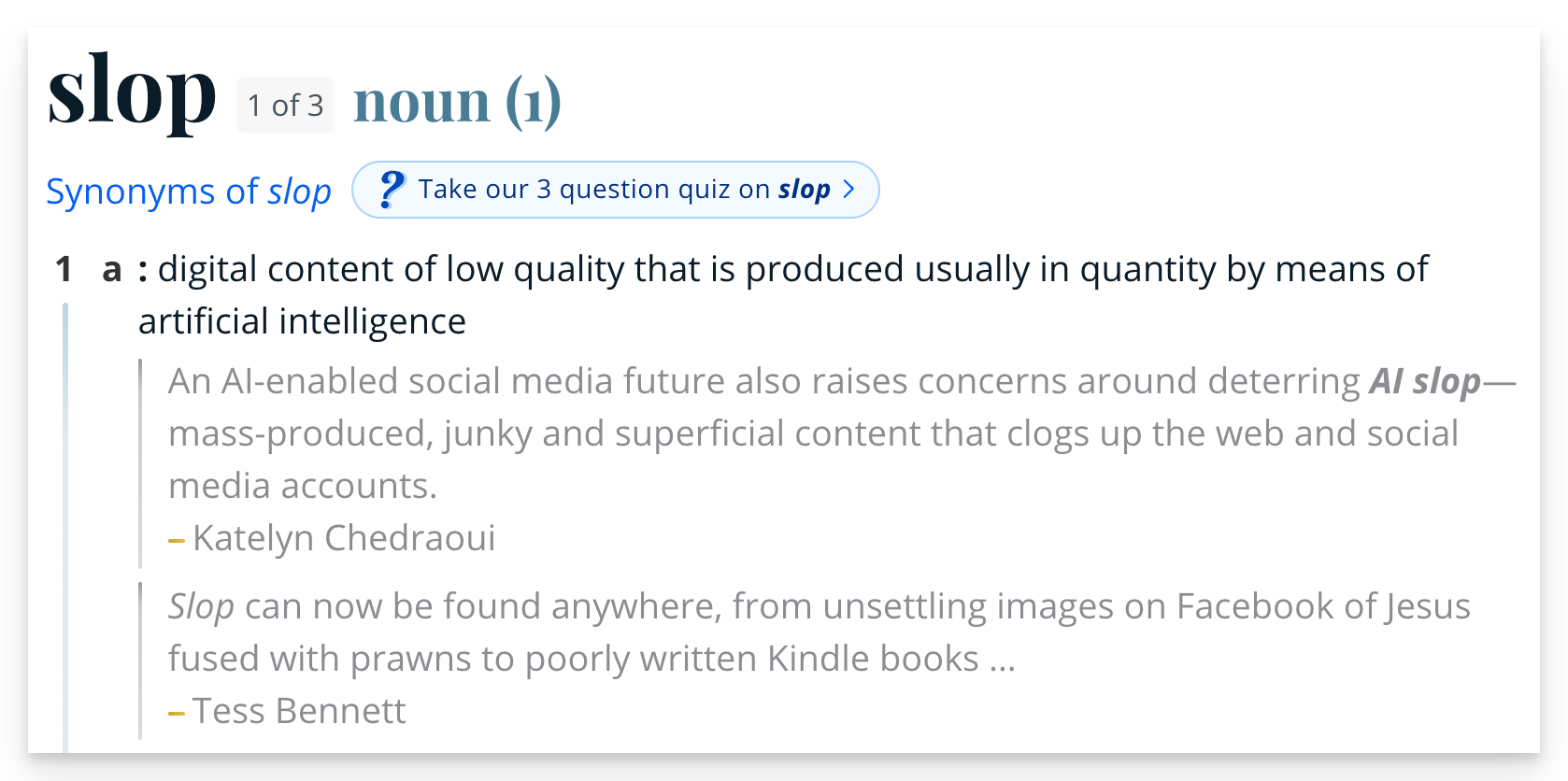
Before the models existed and right after I graduated college, I was freelance writing to make money. Not work I really cared about, not a portfolio I was building. It was how I paid for things. I wrote for a couple of shady operations. One such operation was a blog about horse racing: races, results, betting angles, tracks across the United States and the rest of the world.
The routine never really changed. I would look at the race, read the various results and reports, write it up manually, move to the next one. It got boring fast, and the monotony was the job.
It became a brainless job of putting very little thought into any of it, basically copying and regurgitating the result of a race that had already happened. Then came the part the editors actually cared about: slap a sh*t ton of keywords into it and follow whatever SEO guidelines they sent over that week. The articles were never really meant for the readers. They were for Google. That’s what many of those early blogs were.
I got paid twelve to twenty dollars a piece. So the game was volume. Produce as many as you can, every day, by hand. (You would be surprised at how many horse races actually run daily.)
I was producing slop. I didn't really know it at the time. Or maybe more accurately, I just wasn't even paying attention. I was doing what I was told to do, and I was damn happy I had someone paying me to write.
I mean I barely knew the sport. My entire history with horse racing was one Kentucky Derby when I was sixteen: I made a few picks, my older brother placed the bet, and I hit the trifecta. That was it. That was the guy covering races all over the world. Was I an expert? Did I provide unique value? (Perhaps. I don't know any other 16-year-olds hitting trifectas.)
There was no AI anywhere in the building at the time. It's almost hard to remember what it was like before everything was AI.
The important thing is: slop existed long before the models did. People just didn’t call it out the way they do now. They didn't even know they were reading it. It went by different names: keyword stuffing, SEO manipulation, content farming. The internet was drowning in it a decade before ChatGPT, and nobody was scanning anything. People want to pretend slop was born the day the chatbots launched. I was making it years before the models could.
If someone you know is writing with AI, send them this one.
So the word needs defining, and this week I didn’t want to define it alone. On Wednesday I asked the WriterOps chat: is “AI slop” a real thing, or has the label stopped meaning anything?
There were two answers that I liked, and I think they pretty much sum up the two ways the world looks at AI slop.
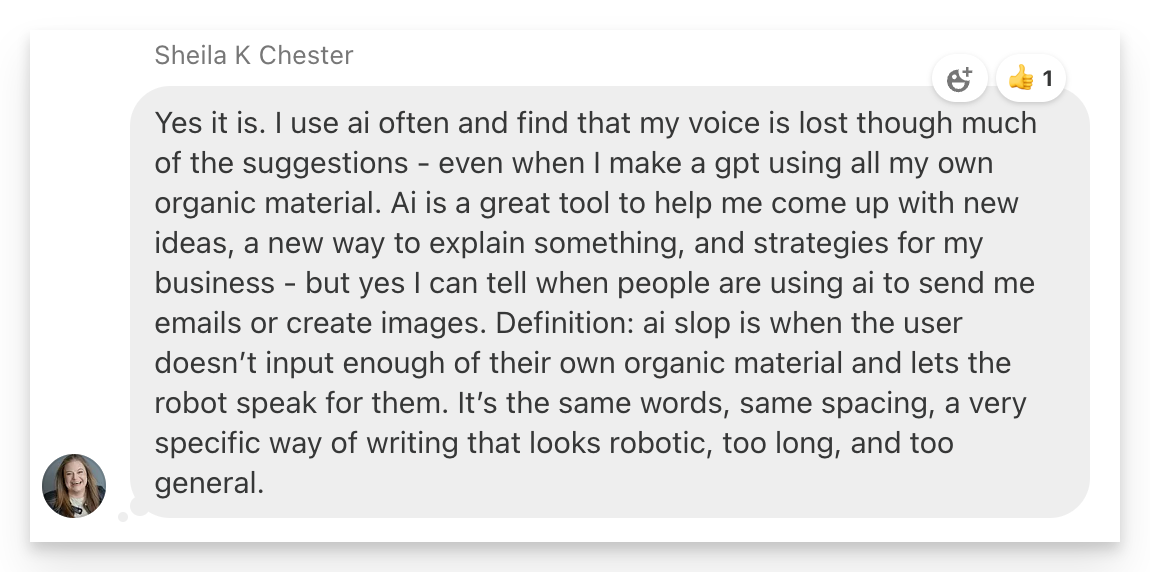
The first definition is about value. Sheila K Chester's version: slop is when the user “doesn’t input enough of their own organic material and lets the robot speak for them.” Nothing of the person in the work, so the machine fills the space with what it would say to anyone.
That definition holds up, and underneath it isn’t actually about AI at all. It's a user problem. A "skill problem,” if you will.
Slop is content with zero value. Volume with nothing baked into it and no unique experience, effort, editing, or finessing the model until it says what you actually meant. It's vanilla.
Isn't that the slop I was making in the horse-racing years, by hand? Even the dictionaries agree with her: Merriam-Webster made “slop” its word of the year for 2025, defined as low-quality digital content, produced in quantity. There’s no AI in that definition. And the fix follows straight from it: provide value, whatever it is you do.
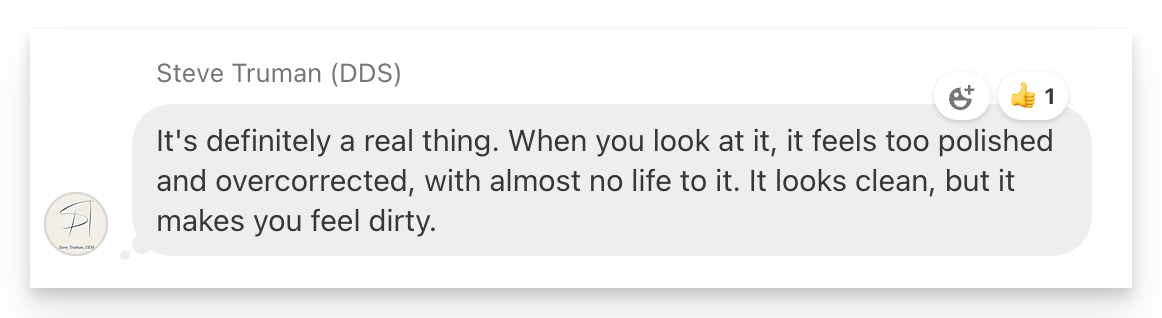
Steve Truman (DDS)'s response made me laugh. It does feel dirty. And for me, even worse is that it's just straight up annoying, and we have enough of that already online.
Now I said there is a mania over AI slop right now, and this is the one the mania runs on. This is slop as a texture. The tendencies: the words every model overuses, the phrasing patterns, every piece shaped like every other piece. In practice I’d argue this is the bigger definition. Most slop calls happen on sight, from the tendencies alone, way before anyone even asks whether the piece said anything. It signals to a lot of people to just disregard what's in front of them and keep scrolling.
And there is real work you can do about this dirty texture. Try feeding the machine your context instead of publishing its defaults. That's the least you can do.
Better yet, interview yourself and harvest your actual views into the system. Dictate your ideas out loud and have the AI organize them instead of inventing them. Keep reference documents that ban the language everybody’s model reaches for; mine block hundreds of words and phrases. This is a real craft. Don't let someone tell you otherwise.
Now the honest part. None of that will get you past the scanners. If the AI is doing the writing, the detectors will tag it, and no amount of technique changes that.
And that is perfectly okay. Roughly half of new articles on the web are now primarily AI-generated. You think every one is worthless? Of course not. If a tag defined slop, half the internet would already be worthless by definition, the argument would be over, and everyone would have lost. A detector can tell you a model was involved. It can’t tell you whether the piece was worth your attention, and it never will, because that was never a machine-readable property.
Don’t let people put you down over a scan result. And they will try. If you’re not a fiction writer, if your essays aren’t meant to be philosophy, if you’re not a Dan Koe and were never trying to be, then some AI tendencies are an acceptable trade for finally communicating well. Writing, for most of the people doing it, is a form of communication. Do what you can about the language. And make sure, above everything, that the work carries an idea or a perspective that isn’t replicable by everybody else. That standard survives both definitions.
Back in the SEO era there were two directions you could take, and I lived both of them.
The first was those shady agencies. They didn’t give a f*ck about the writers, paid us almost nothing, buried us in keyword guidelines, and made us re-edit finished pieces every time Google changed its mind about what ranked. The work didn’t even carry our names. The articles went out under the CEO’s byline, under the leadership’s names. You could call it ghostwriting if you want. I don't. To me it was something else and those businesses didn't last. I watched as every day was a struggle. It didn't look too fun to me, and the arrival of AI only finished what their own model had started. I quit before the end. And I was stressed and broke.
The second direction was the respectable publications I found my way into afterward. Their model was the opposite in every way that mattered. Make the content unique, make it valuable, give the reader something, write from authority and a point of view, and let that do the ranking. Reader over everything. The rest will follow.
AND they put my name on the work. Encouraged it, actually. Wanted the writer visible and proud of the piece, which made me care more about it in return. Those operations blew up into millions upon millions of views a month, and working inside them launched my career. Same writer in both directions. The difference was never the writer. It was what the operation cared about.
Those same two directions exist today, with much better tools.
One group uses AI the way my old bosses used keywords: pump the feeds, game the algorithm, volume with nothing inside it. That’s the equivalent of keyword stuffing today, and I expect it to end the same way, because it already ended that way once.
The other group runs AI as an operating system. The model might be the communicator between me and you, but everything it says passes through a system first. The final writing, even when you can pick up AI tendencies in it, comes from somewhere a generic chat session can’t reach. That’s the actual difference between the two directions. It lies in what the machine was connected to, not whether there was a machine to begin with.
And I want to be precise about where the line sits, because I run high-volume operations myself. Volume was never the crime. Scaled content isn’t slop by definition, any more than one precious hand-typed essay a month is value by definition. Some of the most useful work AI does right now only exists at scale: processing more sources, more data, and more developments than any human could hold in their head, and surfacing connections a person staring at one corner of the field would never see. Getting models to do that reliably, and keeping them on track while they do it, is its own discipline, and almost nobody has really tapped it yet.
The point of view doesn’t have to live in every sentence. It can live in the system: where you point the machines, what you force them to verify, which connections you teach them to hunt for, what you refuse to publish.
The industry is reacting to this flood, and it’s mostly aiming at the tool. They always blame the tool, never the user. In the last month alone: Substack gave readers a Pangram scan button for every post over a hundred words, the EU began requiring disclosure of AI-generated public-interest text unless a human holds editorial responsibility for it, the New York Post launched an AI named Hamilton that is explicitly forbidden from writing the journalism, and Anthropic started watermarking the words Claude generates. Four institutions in four weeks, all building machinery around one question: was an AI involved?
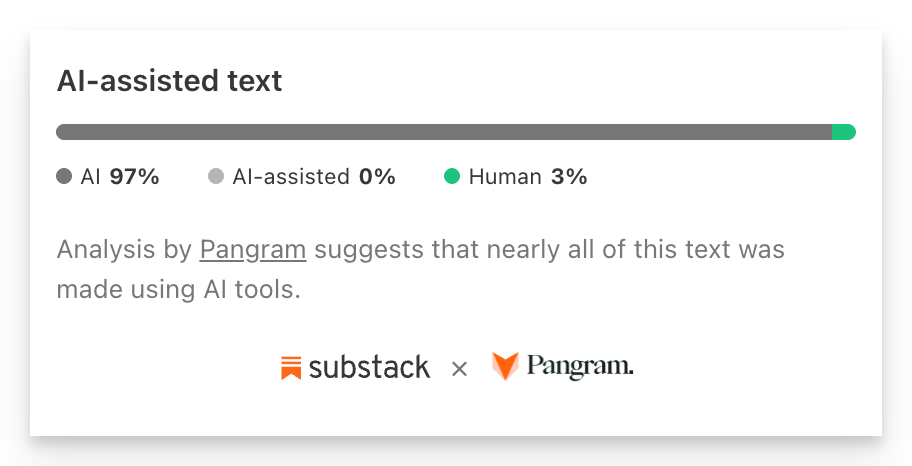
When the scan showed up on this platform, my first reaction was that it’s a gimmick. A few weeks in, I’ve moved some. I don’t hate it, and I’m not against it. I actually think Substack is doing better than most when it comes to fighting AI slop while providing users some control over the process.
The bigger problem is the mania and gatekeeping you see among certain groups. “AI-assisted” should open a question: did this person put anything of themselves into the work? Even though Substack does a good job of letting writers explain their process, I don't know if the people who are most obsessed with this actually care. They see AI, they keep scrolling.
I think it's important to realize that the reflex didn’t come from nowhere. It was the combination of actual AI slop that nobody can handle anymore, and a lot of loud voices in media spending the last two years demonizing anyone who used AI.
I digress. We will cover that another day. Everything I do is based around implementing AI into writing operations (WriterOps). So you know where I stand.
But there are two bigger arguments hiding under this one, and each deserves its own essay later.
The first is the double standard. We hand AI real credit everywhere else: biology, medicine, nutrition, finance, investing, legal work, real estate, images. Nobody dismisses a drug candidate because a model did the folding. Writing is the one domain where the public gives AI zero benefit of the doubt, and nobody stops to ask why the rules changed at the paragraph.
The second is the flip side of the whole panic, and it’s the one I care most about. For the first time, a person with a genius point of view and no writing ability can actually communicate it to the world. That knowledge used to stay locked inside people who couldn’t write it down. Now it doesn’t have to. That is immensely valuable, and right now it gets zero credit. This is a democratization of communication. And if you look closely, you start to see the same pattern we see all over the place when it comes to gatekeeping an industry or a skill.
If you use AI in your writing operations and this mania has you flinching, here’s where to start.
Run the mirror test. Ask what your AI setup actually knows about you. If the answer is nothing, then its output would look identical coming from anyone else on earth. I'm sorry to tell you, but that is the definition of slop. And you're not gonna get any empathy from me or anyone else. Start feeding the machine pieces of yourself or your brand right now.
Ask the pre-publish question. Before anything ships: what’s in this that only I could have written? If you can point to it, the value proves itself. If you can’t, don’t publish it. And if you run an operation instead of a byline, ask it at the system level: what’s in here that only this operation could have produced?
Fix your posture. Whatever you do, don't apologize for the tool. The shame belongs to valueless output, and it always has, since long before the machines showed up. Use AI. Hold your standard. Put your name on the result.
That last one took me the longest, and I learned it in reverse. I spent years producing work that nobody would sign, least of all me. I know exactly what that work was worth.
The scan can read the words. It can’t read whether you did the work.
That part’s yours.
—Alex
No posts
Comments
Nothing yet. Say the first thing.
Sign in to join the conversation.