
Amid the ceaseless fury of surface activity and the accelerating disassociation between words and things, certain images remain. Amid breaking news about wars and ceasefires, and openings and closings of straits, and negotiations that are not negotiations, and insiders making a killing on insider trading, certain images remain. Amid growing signs that our conman Reality TV president is losing a mind he never really had, threatening entire civilizations, claiming he was Jesus and then pretending he was kidding, spouting all kinds of disturbing, scary nonsense that keeps getting more disturbing and scary by the day and hour, while our esteemed congressional leaders stand idly by, smiling like it was nothing, looking away without shame, certain images remain.
As we dig ourselves deeper and deeper into the hole like sorry, shadow-casting pilgrims descending to the next circle of hell, certain images keep recurring again and again.
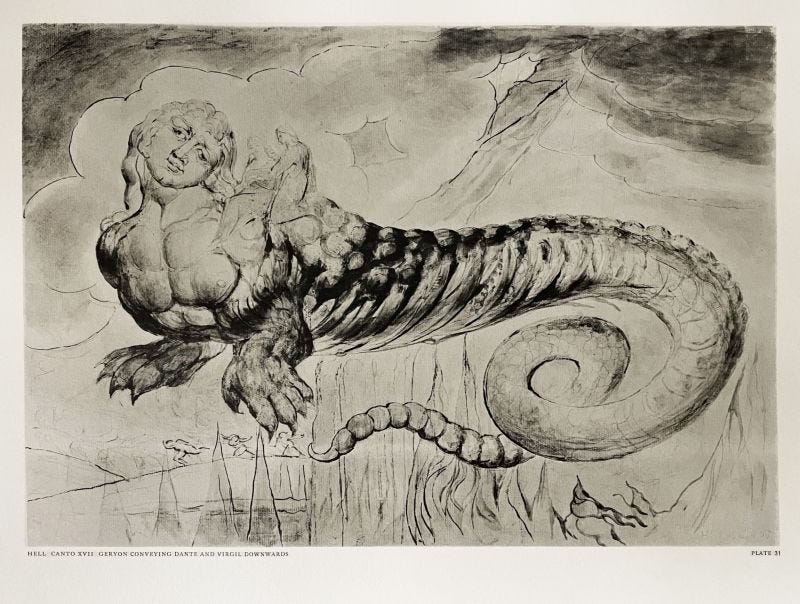
For me, one such image is that of “Geryon” from Dante’s Inferno. He just won’t go away. Like news that stays news through the relentless churn of obsolescent news cycles, Geryon haunts my waking dreams. Nightmares, most people would call them, only it’s not only nights.
I took a class on Dante’s Divine Comedy as an undergraduate at the University of California, Santa Cruz in the early 1980s, with a focus on the Inferno. Apart from the feeling of reading a fantastic revenge fable for the ages, where all sorts of bad people and infamous (in their day) sinners were getting their eternal comeuppance in richly creative, medieval ways that mirrored their crimes and their sins, I don’t remember much. But I do remember Geryon.
Dante repurposes Geryon—a half-man, half-beast winged creature from Greek mythology—as the embodiment of fraud. The classical Roman poet Virgil, Dante’s guide through the Inferno, summons Geryon to ferry the two pilgrims from the 7th to the 8th circle of Hell, where different species of fraudsters swim in excrement, are compelled to stand upside down, and have their heads twisted backwards etc. etc. for all of eternity forever and ever, amen.
It’s worth pausing for a moment here to consider the colorful concrete description Dante gives of Geryon. (Translation courtesy of Stephen Binns1.)
His face was free of any kind of guile,
if benignity and justice met,
under it the body was reptile.
Each arm was hairy to the very pit;
back and breast both had a certain style,
patterned o’er with a kind of a circlet,
and never was a tapestry of flowers
woven by a Tartar’s or Turk’s hand,
by Arachne with her magic powers.
…
so lay this sore beast, and there he’d cling to ledge
which bounds the burning sand with stone.
His tail flicked in the void beyond that ring
thrashed, and he brought up the poison weapon,
like a scorpion’s tail, contains the sting. (bold emphasis mine)
For those who prefer to forgo the florid 14th century latinate poetry and cut to the prosaic 21st century chase, Dante uses the figure of Geryon to describe fraud in a manner that mimics its evolving reality, phase by phase, through time: A person or thing that looks promising and benign up front but then goes through a steady devolution into something first different and then worse than you thought, something quite sinister in fact, something with claws, a reptilian thing that ensnares you and takes you away and prevents you from escaping, before delivering the final coup de grace in the form of a poisonous scorpion sting. First you were deceived by appearances, taken in, and before you know any better or can escape from its clutches, you’ve been stung.
As I think through the Geryon matter further, and consider the self-evident deception, and recognize that the country and even the world is now ensnared in his grip, and that it may be too late to wriggle out of it, I realize it’s the coming sting that most worries me. And I note that Virgil points it out with special urgency and emphasis before they even meet the man-beast creature.
Behold the stinger tail upon that freak! …
Behold the one that makes the whole world reek!
***
For a long time I’ve wondered about when the most prodigious fraud of our time (possibly “the greatest ever”) would finally get his comeuppance. I’ve asked myself and others when the piper would ultimately need to be paid. Pride goeth before the destruction and the fall, it used to be said. Too many times for my own recollection, I’ve scratched my head silly about when a critical mass of Americans and their elected leaders in Congress might finally wake up to the massive, unprecedented, almost unimaginable fraudulent destruction being wrought in our name. I’ve asked myself when we the people would begin to comprehend what was happening, defend ourselves, and strike back. (Many of us have known all along, of course, and never found him the least bit benign or convincing, not even in the beginning.) As we are dragged closer and closer to the edge of the precipice, without even kicking and screaming, on the verge of being able to peer down into the bottomless pit, I’ve wondered with increasing consternation—more like outright panic at times—what form, or forms, the final sting would take.
Not generally prone to wishful thinking, I also recall—or am reminded by others—that con artists don’t tend to fall into their own traps. Fraudsters don’t sting themselves. They’re the lucky ones. They wriggle their way out of the webs they spin, each one more complicated and dangerous than the one that came before, free to home in on the next hapless mark and to prepare the next perfect sting. The same can’t be said for the rest of us.
And I remember, alas, that there is no such thing as divine justice in our world. Not anymore.
https://www.classicalpoets.org/the-monster-geryon-canto-xvii-of-dantes-inferno-translated-by-stephen-binns/
Comments
Nothing yet. Say the first thing.
Sign in to join the conversation.