

Friday, August 28. 6:30 PM – 7:30 p.m. Senate House State Historic Site. Keynote, Voices of Revolution 250th series.
Tue, Sep 15. 6:30–8:00 p.m. Center for Brooklyn History. In conversation with Jesse Wegman to celebrate his new book, The Lost Founder.

Jennifer Szalai, the nonfiction book critic for The New York Times, has written a perfectly brutal review of Thomas Meyer’s Hannah Arendt: A Life of the Mind in the Book Review. I’m dwelling on it here because Szalai, by way of Meyer’s 539-page biography, dismantles one of my discipline’s more vainglorious claims: the source is new, therefore the history must be.
“Seemingly every record, every scrap of paper, gets its own exegesis,” Szalai writes. Meyer appears to believe that exhaustive research obliges indiscriminate narration, as though every source he consults becomes a debt the book must repay. Importance be damned: a novella by Ann Birstein featuring a condescending character based on Arendt receives two pages of minute plot summary; her 1933 arrest and detention by the Nazis, one paragraph.
The deeper problem is that Meyer struggles to distinguish among three very different achievements: finding new evidence, extracting new meaning from it, and changing the larger account. While pages accumulate, the argument stays put. “Any glimmers of insight,” Szalai concludes, “are mostly swallowed up by the rest of the book.” His central “reassessment” does not reassess enough.
Meyer argues that Arendt’s work with Youth Aliyah—helping relocate 120 Jewish teenagers to Palestine—constituted a “staunch Zionist’s battle for the survival of her people.” Szalai effectively asks: reassessed from what? The established interpretation already accommodates Arendt’s work for Zionist organizations as a means of saving Jewish lives, followed by her later criticism of Zionism. Unless Meyer’s records reveal a new motive, contradiction or chronology, they expand—another favorite descriptor—the evidence without changing its meaning.
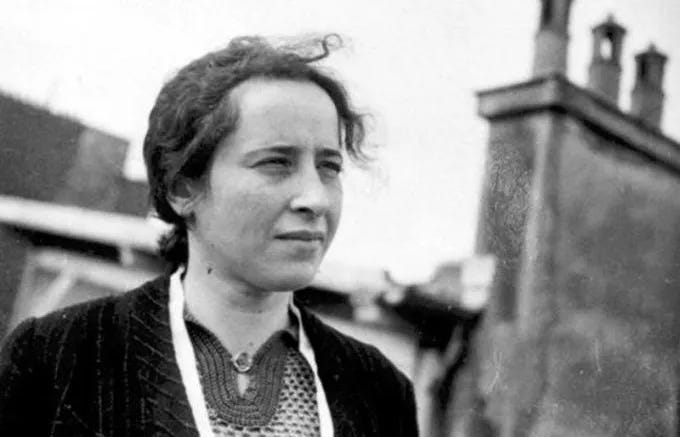
For authors who do not command Chernow- or Larson-sized legions of readers, a mean review (which this is not) is much easier to survive than a persuasive one (which this very much is), but if you’re beginning to feel sorry for Meyer, take solace in the knowledge that his publisher will almost certainly strip the review for spare parts: “Interesting nuggets … incisive commentary.” —The New York Times. Szalai indeed credits Meyer with one consequential discovery: Michael Musmanno, who savaged Eichmann in Jerusalem in the Times Book Review, had served as a judge at one of the Nuremberg trials and testified for the prosecution at Eichmann’s—a conflict the assigning editor apparently recognized. Meyer’s archival work earns its place: the discovery changes how the review must be read.
In the final kicker, Szalai recommends Lyndsey Stonebridge’s We Are Free to Change the World, which uncovers no new archival material but “reinterprets and redescribes what we assumed we knew.” It’s the entire review in miniature: Meyer found new evidence, but Arendt wrote the new book.
See you soonish! In the meantime, you can find me on Instagram and, on occasion, Bluesky and Twitter. My books are at Bookshop, Amazon, and your local bookstore or library. If you’d like me to sign or personalize my books, purchase copies from Oblong Books.
Comments
Nothing yet. Say the first thing.
Sign in to join the conversation.