
Welcome to Small Wins: The Fundamentals — a series of single-subject primers with foundational recipes, exclusive to paid subscribers. Each one covers the principles and techniques that actually matter, nothing that doesn’t.

Let me level with you: I don’t make ice cream as much as I should, but every time I do, I wonder why on Earth not?! Cooling on a hot day, nostalgic in the best way and indulgent without being too heavy — isn’t ice cream just one of life’s loveliest pleasures?
There’s a misconception that making ice cream is technical, or faffy, when it’s actually pretty straightforward and doesn’t require a huge amount of hands-on time. Crucially: you don’t necessarily have to have an ice cream maker!
Ice cream is fundamentally dairy + sugar + flavourings (and sometimes eggs), frozen.
Typically it is churned — but with the right ingredients, you can achieve the same smooth result without this process. This primer, then, is split into no-churn and churned ice cream sections, depending on what equipment you have at home.
As ever, I’ve done the research, reading and practicing for you, so that you get only the most valuable insights without any filler. If you’ve ever wondered why your ice cream turns out icy, or whether gelato is really all that different from ice cream, this primer gives you the scoop.
–Alexina
In this primer: the ice cream family tree, from lightest to richest; a formula for no-churn ice cream, plus recipes for an EVOO version and a roasted apricot semifreddo; 4 tips for smoother scoops; my ‘flavour stacking’ technique; plus recipes for the classic flavours — vanilla, strawberry, choc — all with a ‘lil twist.
Why is ice cream so damn pleasurable??
Ice cream is so inherently exciting to our palates because it gives us temperature and texture changes in one mouthful: the ice cream goes from frozen to melted on the heat of our tongue. As this happens, the texture changes from solid and slightly chewy to smooth and liquid. This encapsulates the concept of dynamic contrast (aka ‘the ice cream effect’!):
the moment-to-moment contrasts we experience from foods whose properties are changing as we eat them
Dynamic contrast typically increases how palatable foods are to us, and is the reason that the experience of eating ice cream is so compelling1.
The ice cream family tree: Is gelato the same as ice cream, and other queries
There are many more types of ice cream than you would ever imagine — uber-stretchy Turkish dondurma, anyone? — but here are the main ones, sorted from lightest to richest.
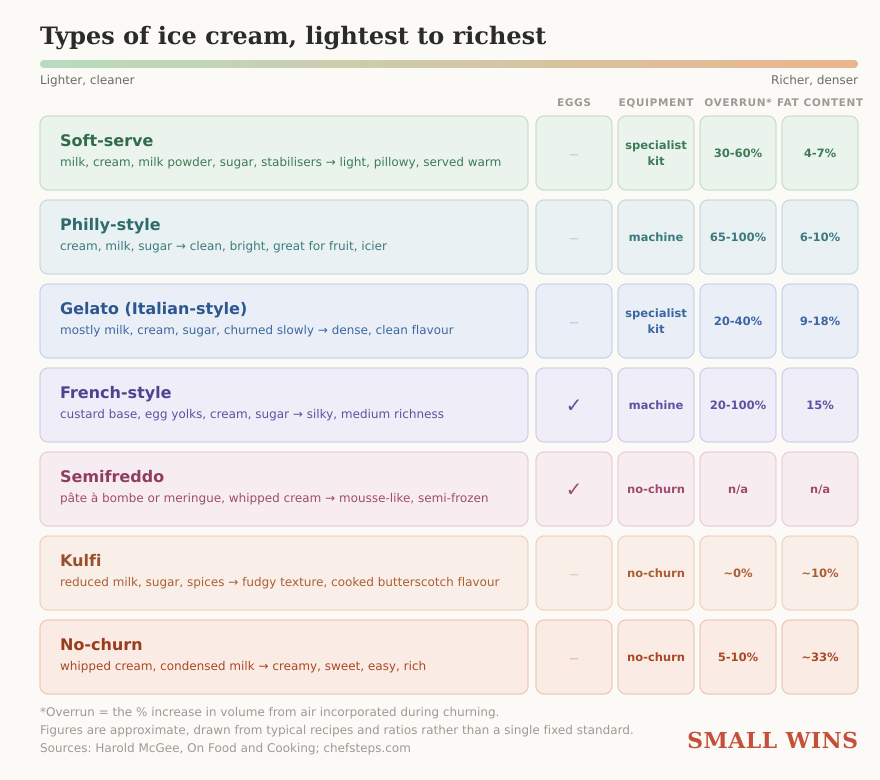
The richness of an ice cream is an interplay between two factors:
Comments
Nothing yet. Say the first thing.
Sign in to join the conversation.