
Hello! Welcome to this free edition of my fortnightly newsletter, Small Wins. Thank you so much for being here. For more, check out the recipe index.
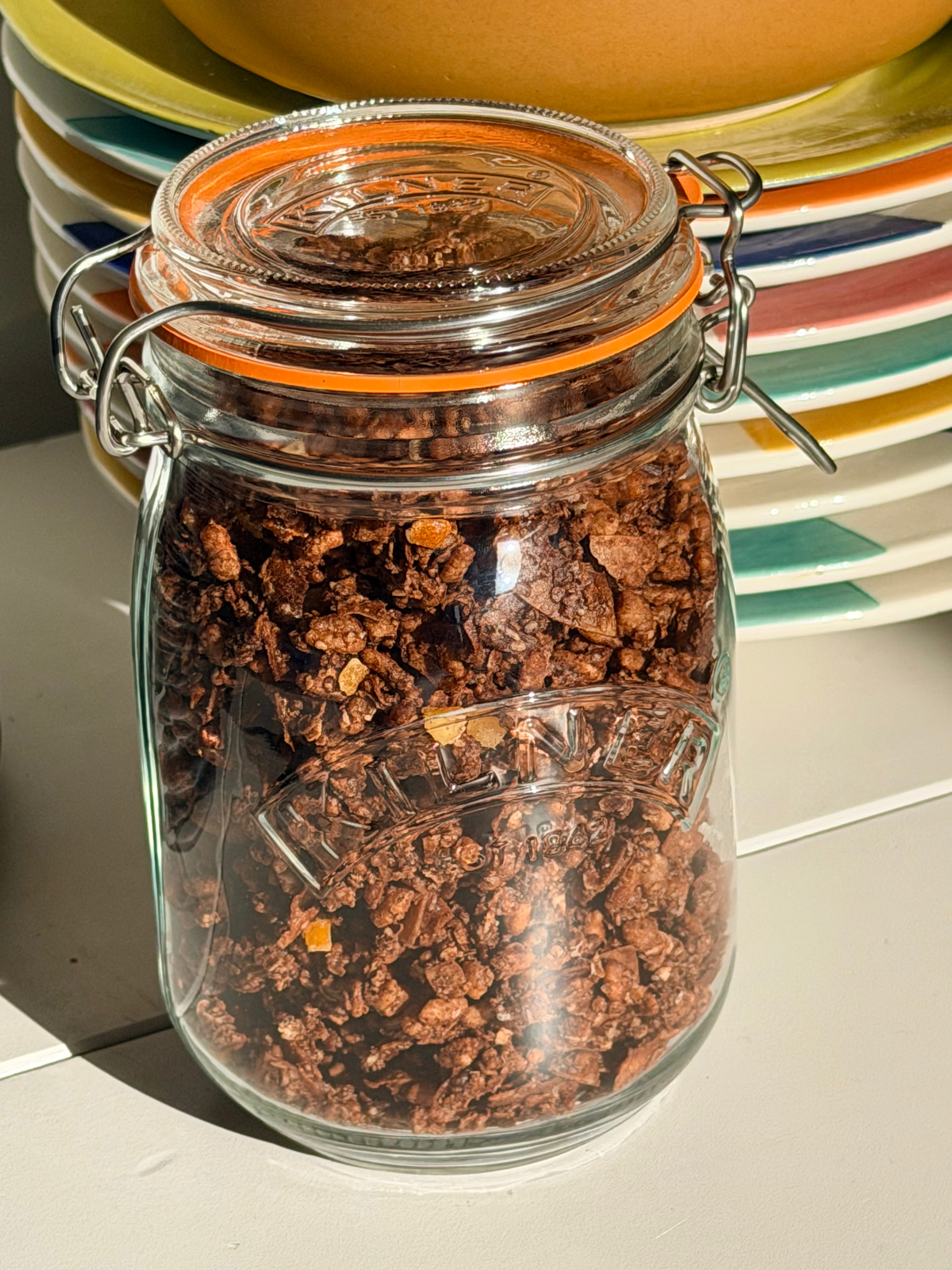
I have eaten this granola for breakfast, as a mid-morning snack, straight from the jar at 11pm, and once, memorably, instead of lunch. It is a problem — but a delicious one.
Think ‘Coco Pops for grown-ups’ and you’ll have the measure of it: chocolatey, crunchy but with true depth from actual dark chocolate and cocoa powder, and big, satisfyingly chonky (new favourite word) clusters. It’s just really good — do make it!
I’ve taken to adding cocoa nibs and finely chopped candied peel because I believe with all my heart in the combination of chocolate and orange (do not ever talk to me about chocolate and mint) — but these additions are very much optional and best left out if serving to kids.
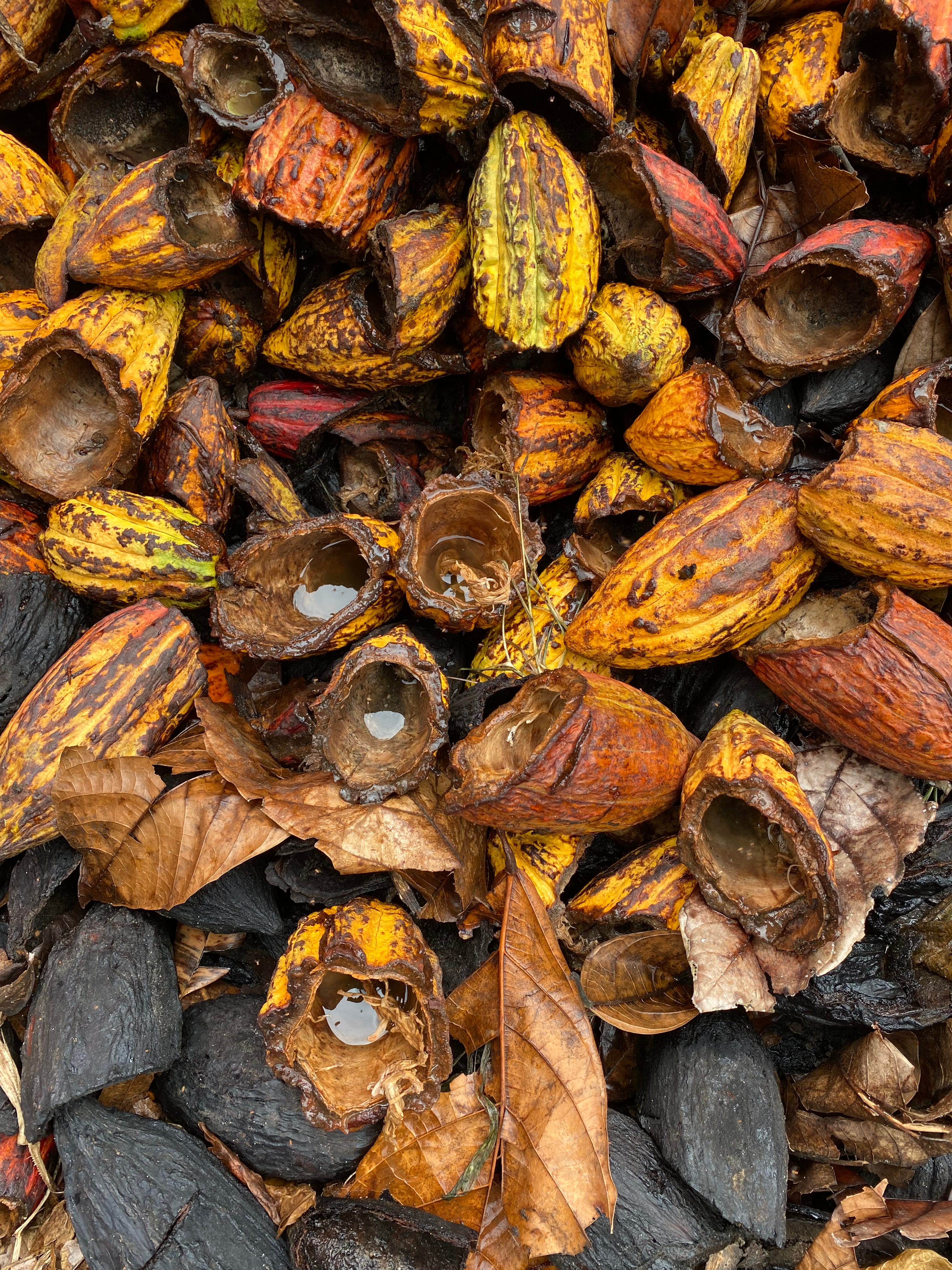
Chocolate is strongly associated with joy for many of us but it’s far from a simple pleasure — something that I’ve been thinking about increasingly over the last few years, much guided by Jennifer Earle (Jen) 🍫🥐, who has been teaching about chocolate for 20 years and is, frankly, the expert on all aspects of it. So before we get to the recipe, let’s talk about where chocolate comes from — not only because it’s worth knowing, but also because it has profoundly changed how I consume (and shop for) this most delicious of foods.
Love,
Alexina
Coming up — Your new favourite, actually-satiating salad; better tzatziki (plus salted cucumber gimlets); the little French cakes that everyone ought to know how to make (quick! easy! perfect for coeliacs! unbelievably delicious!)
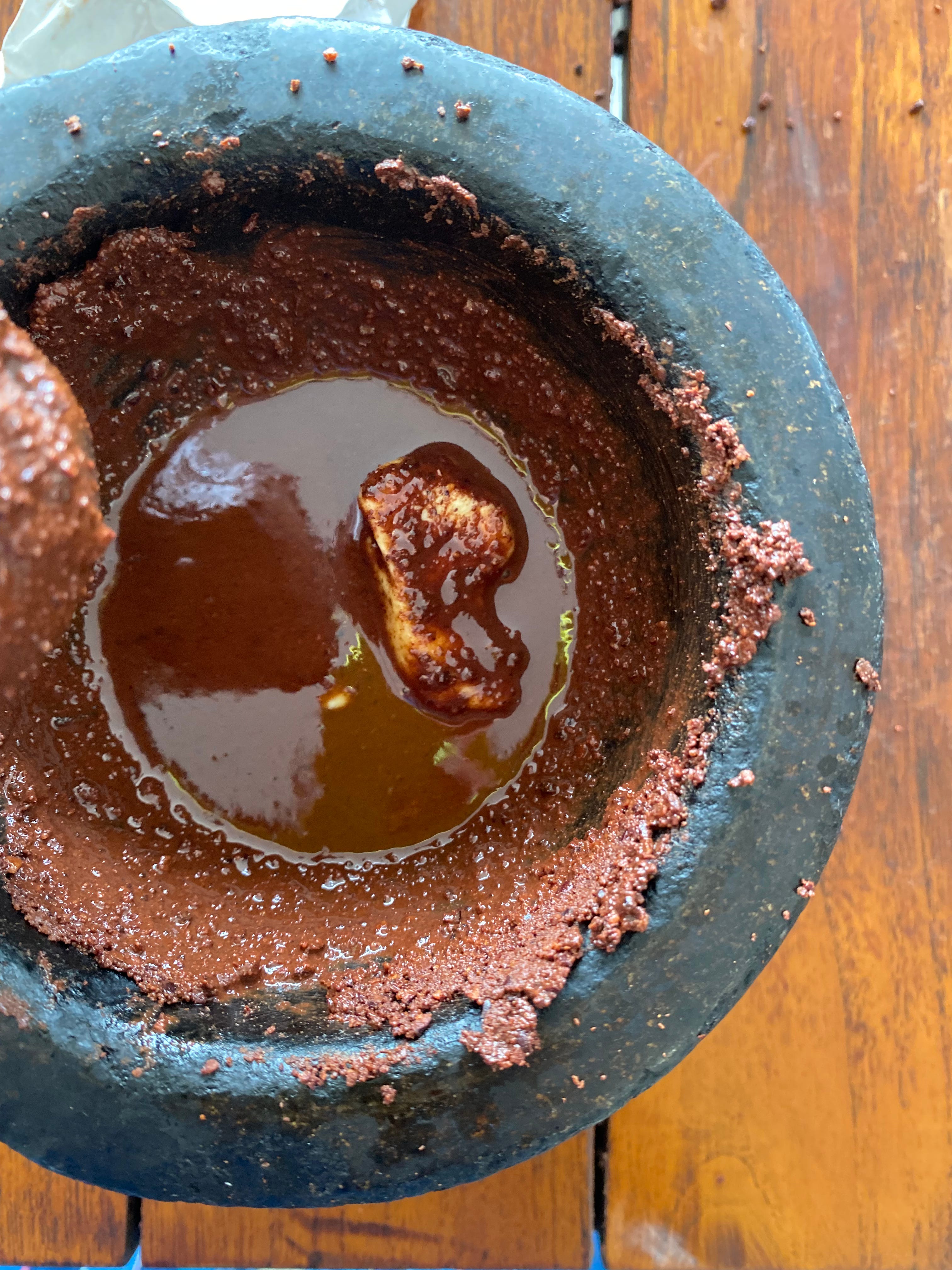
Few things are as reliable, as universally pleasing, as a square of something dark and glossy at the end of the day — or a bar eaten absent-mindedly somewhere between 4 and 6pm (a dangerous window). Chocolate is comfort, ritual, reward. It is, in many ways, perfect.
And yet the more time you spend thinking about food — where it comes from, who grows it, how it travels — the more you realise that some of our most everyday pleasures are built on systems that are at best opaque, and at worst deeply troubling. Chocolate sadly falls firmly into this category.
Most of the world’s cocoa is grown in West Africa, primarily in Côte d’Ivoire and Ghana. It is grown by smallholder farmers, many of whom earn far below a liveable income. The price of cocoa is volatile and largely dictated by global markets rather than the realities of farming (unpredictable weather, disease, rising costs): it’s a vicious predicament.
You’ll often see child labour mentioned in relation to discussions about chocolate. Not all work done by children is inherently exploitative — helping on a family farm is one thing — but there is well-documented evidence of hazardous and forced labour within cocoa production. It all forms part of a system that produces much of the cheap chocolate that we consume without thinking twice.
So where does that leave us?
Standing in the supermarket, holding a £2.50 bar in one hand and a £4 bar in the other, you might wonder if the answer is simply to spend more money and call it a day. Well, kinda, but also: it’s not quite that simple (is anything?!).
A few years back, Jennifer recorded a great podcast about how to identify ethical chocolate in which she shared five indicators — one of which is, yes, price. To increase your chances of consuming ethical chocolate (though it’s by no means a guarantee) Jen’s threshold is a price of £5/100g. But adjusting for inflation plus the huge volatility in cocoa prices over the last 3-4 years, that figure might look more like £7/100g now.
Meanwhile, certifications like Fairtrade or Rainforest Alliance are a step in the right direction in theory — they aim to guarantee certain standards around pay and working conditions — but they are not perfect solutions. They operate within the same global system, and while they can improve things, they often don’t go far enough to ensure that farmers are earning a genuinely viable income.
On the other end of the spectrum, you have ‘bean-to-bar’ chocolate: smaller producers who source cocoa more directly, often paying higher prices and having closer relationships with farmers (here’s Jennifer’s full list of such producers within the UK & Ireland). The chocolate is usually more expensive (for good reason), and you’ll notice it tastes different too: more layered, less sweet. The chocolate that these small producers create also tends to be much better for you (richer in polyphenols etc.) as a result of the way that the cocoa beans have been processed — but again, it’s not a silver bullet because ‘bean-to-bar’ isn’t a regulated term.
Getting to the bottom of things requires a bit of research, an extra dose of curiosity and even real, in-person conversations with bean-to-bar producers to understand their pipeline and processes — frankly, it’s more effort, but at the same time, it’s also more delicious, more interesting and more fun. Hanging out regularly with Jen and going to her chocolate tastings has really shown me just how transcendent excellent chocolate can be.
I know that food ethics can start to feel overwhelming — you just wanted something sweet, now you’re apparently responsible for global supply chains. But to be clear, the answer isn’t to hold yourself to some impossible standard of purity — instead, I think it’s about paying attention where you can, making small shifts where they feel doable and accepting that it’s an ongoing process rather than a one-time decision. Try and buy less, but better (excellent chocolate is more satiating anyway). Look for transparency over buzzwords. And most importantly: explore! Maybe at some point this year make it your mission to go and visit a bean-to-bar producer based near you and find out more about their chocolate? Small steps. Small wins!
Adapted from Alexandra’s Kitchen
Rolled oats — 150g
Rice Krispies — 75g
Flaked coconut — 40g
Cocoa powder — 3 tbsp
Coconut oil — 60g
Dark chocolate — 45g — I used Islands Dark Chocolate Buttons
Maple syrup — 135ml
Flaky sea salt, to taste
2 to 3 tbsp citrus peel, finely chopped (optional)
1 to 2 tbsp cocoa nibs (optional)
Equipment: 1 very large or 2 standard-sized baking trays, lined with greaseproof paper (or a silicone mat — check what size you need for your baking trays before buying!)
Preheat the oven to 130C/110C fan/270F/gas 1/2.
Stir together all the dries (oats, Rice Krispies, flaked coconut, cocoa powder) in a large bowl.
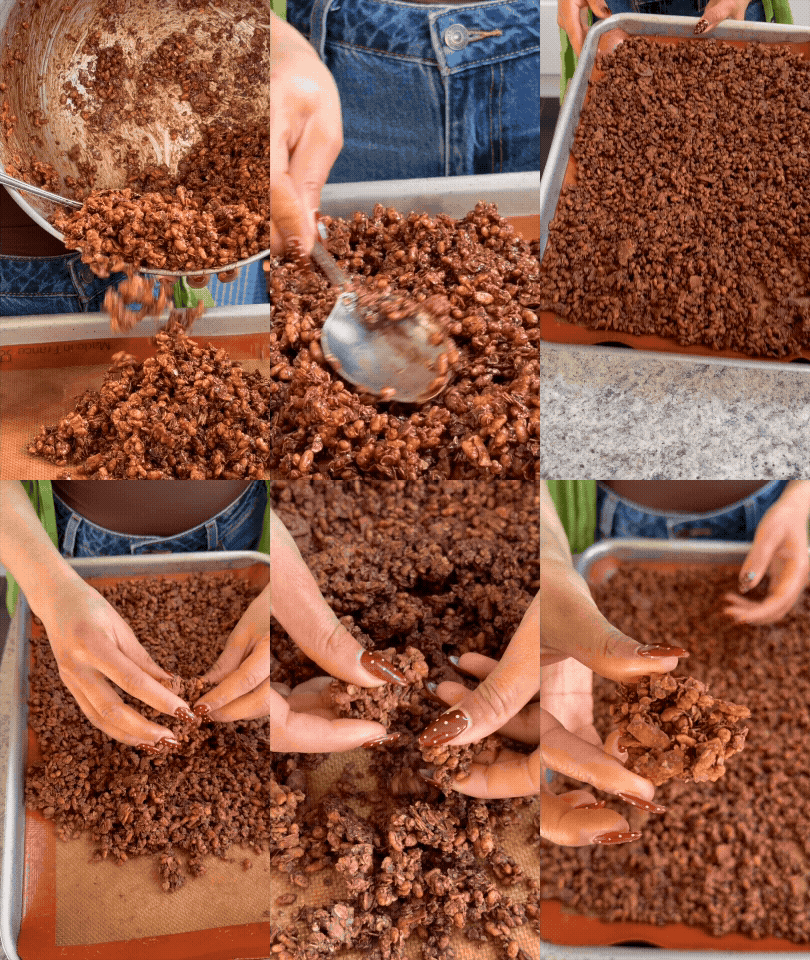
Gently melt the coconut oil in a pan over a low-medium heat, then take off the heat, add the chocolate and whisk until smooth (briefly place back over a low heat to fully melt the chocolate, if needed). Whisk in the maple syrup. Pour this liquid mix over the dries and stir until thoroughly combined, adding flaky sea salt to taste (I like it quite salty!).

Spread it out over your lined baking tray(s) into a thin, compact layer: Bake for 35 minutes, undisturbed, then remove from the oven (if using two baking trays, swap them over halfway through). Leave to cool completely before breaking up into chunks of your preferred size.
Stir through the citrus peel and cocoa nibs, if liked. Store in an airtight container — it will last several weeks, but good luck with that.
BIG CLUSTER ENERGY!
The key to big clusters is to:
Spread the granola into a thin, compact layer
Avoid touching it whilst it’s baking (this is why you have to bake it at a low temperature, so that it cooks evenly without the need to move it around)
Allow it to cool completely before breaking it up into clusters
An additional trick when making granola, though I don’t find it to be necessary with this recipe, is to fold through a single whipped egg white just before baking — this helps to bind the mix together more but does lessen the shelf life of the granola so it is a trade off.
FURTHER READING + NOTES
Some of my favourite ethical producers include Pump Street, Islands (available on Ocado) and Original Beans.
I wrote about how cocoa is grown and turned into chocolate in this previous newsletter:
Cocoa Runners are also a great source of information on ethical, craft chocolate. They also have a great monthly subscription service if you’re keen to try different chocolates but don’t have the time to research it all yourself!
Comments
Nothing yet. Say the first thing.
Sign in to join the conversation.