
I have spent years studying and teaching happiness. I still believe in taking care of ourselves. But I no longer believe healing is only an individual pursuit. Increasingly, the evidence suggests it is also relational.
One study changed the way I think about self-care.
Researchers studying the body’s response to kindness looked beyond feelings and into gene expression. They measured the Conserved Transcriptional Response to Adversity (CTRA), a pattern of immune-related gene activity associated with chronic stress, inflammation, and social adversity.
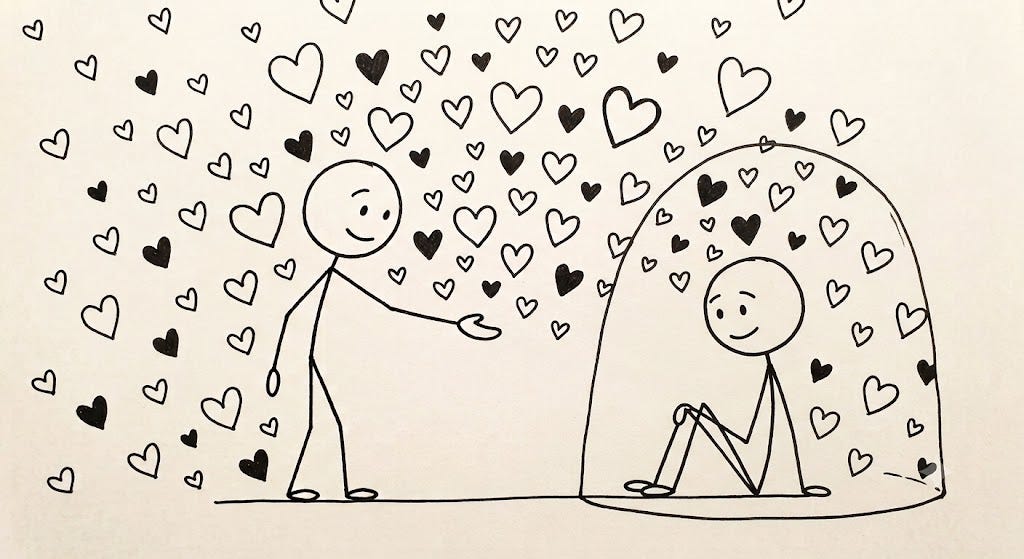
In a randomized controlled trial, participants were assigned to perform acts of kindness toward themselves, toward other people, or a control activity. The people who practiced kindness toward specific others showed measurable reductions in CTRA gene expression. Their biology reflected a lower stress-related inflammatory profile. The self-kindness results were more complicated; participants practicing self-kindness did not show the same consistent biological shift. The finding challenged the assumption that turning inward is always the strongest path to wellbeing (Regan et al., 2022).
The message is not that self-care is wrong. Rest matters. Boundaries matter. Recovery matters. But the science suggests something we may have forgotten: human wellbeing is deeply social. Our biology responds when we are connected, when we matter to someone, and when we actively care for another person.
The modern self-care movement gave us important permission to recover from exhaustion, but it also narrowed our understanding of wellbeing. Wellness became something to optimize alone. Yet, at the same time, loneliness has become one of the defining public health challenges of our era.
The U.S. Surgeon General’s Advisory on loneliness identified social connection as a critical component of health and warned that social isolation carries significant health risks, comparable to other well-established risk factors such as smoking (Office of the U.S. Surgeon General, 2023). Connection is not simply an emotional experience. It is a biological one.
Research continues to point in the same direction. A five-year study of older married adults found that providing support to a spouse was associated with lower mortality risk, suggesting that giving support may have health benefits beyond receiving it. A meta-analysis of 14 studies examining adults over 55 found that volunteering was associated with approximately a 24% lower mortality risk compared with non-volunteers (Brown et al., 2009; Okun et al., 2013).
Our brains seem designed for this. A functional MRI study found that charitable giving activated the ventral striatum, a region involved in reward processing. Researchers described this as a “warm glow” response—the internal reward we experience when we help others (Moll et al., 2006). Helping another person is not simply a moral act. It is something our nervous system appears prepared to reinforce.
Charles Darwin is often remembered primarily for competition, but in The Descent of Man, he argued that sympathy and cooperation were central to human survival. More than a century later, neuroscience, psychology, and public health continue to reach similar conclusions. Human beings survive and thrive through one another.
Somewhere along the way, we turned “put your own oxygen mask on first” into a philosophy of living. We learned to protect ourselves, but sometimes forgot to participate.
We say we want stronger relationships, but we often avoid the small actions that create them. We scroll past messages because we are too busy. We attend meetings but stay behind our screens. We say we want to be valued, but we do not always take the time to recognize someone else’s effort. We complain that people are not there for us while failing to notice how often we are unavailable to others.
We have become skilled at protecting our own time, energy, and priorities, but sometimes we forget that relationships are built through investment. Connection is not created by waiting to be chosen. It is created by choosing others.
Connection requires vulnerability. It requires walking into the room, starting the conversation, offering help without keeping score, and showing up before we know whether we will receive anything in return.
The loneliness crisis is not simply about a lack of people around us. It is about a lack of meaningful participation with one another. We can be surrounded by colleagues, friends, and networks and still feel disconnected when we are only present for what we can get rather than what we can contribute.
The research gives us a simple challenge: practice intentional kindness. Not a vague belief that the world should be kinder. Not waiting for someone else to make the first move. Choose one person. Reach out. Offer encouragement. Share your time. Make someone feel seen. Because connection is not something we find. It is something we create.
Maybe the future of wellbeing is not about learning how to stand alone.
Maybe it is remembering how to show up for one another.
Brown, S. L., Nesse, R. M., Vinokur, A. D., & Smith, D. M. (2003). Providing social support may be more beneficial than receiving it: Results from a prospective study of mortality. Psychological Science, 14(4), 320–327. https://doi.org/10.1111/1467-9280.14461
Moll, J., Krueger, F., Zahn, R., Pardini, M., de Oliveira-Souza, R., & Grafman, J. (2006). Human fronto-mesolimbic networks guide decisions about charitable donation. Proceedings of the National Academy of Sciences, 103(42), 15623–15628. https://doi.org/10.1073/pnas.0604475103
Office of the U.S. Surgeon General. (2023). Our epidemic of loneliness and isolation: The U.S. Surgeon General’s advisory on the healing effects of social connection and community. U.S. Department of Health and Human Services. https://www.hhs.gov/sites/default/files/surgeon-general-social-connection-advisory.pdf
Okun, M. A., Yeung, E. W., & Brown, S. (2013). Volunteering by older adults and risk of mortality: A meta-analysis. Psychology and Aging, 28(2), 564–577. https://doi.org/10.1037/a0030997
Regan, A., Fritz, M. M., Walsh, L. C., Lyubomirsky, S., & Cole, S. W. (2022). The genomic impact of kindness to self vs. others: A randomized controlled trial. Brain, Behavior, and Immunity, 106, 40–48. https://doi.org/10.1016/j.bbi.2022.07.159
Comments
Nothing yet. Say the first thing.
Sign in to join the conversation.