
Click here to use AlexAI to send a personalized letter to your Representative opposing the ethanol mandate expansion.
The corn lobby, joined by many oil lobbyists, is pushing a bill to expand the ethanol mandate by 1) loosening air quality rules and 2) imposing the mandate on small refineries. This will raise fuel costs.
Stop corn + oil lobbyists from permanently expanding the ethanol mandate!
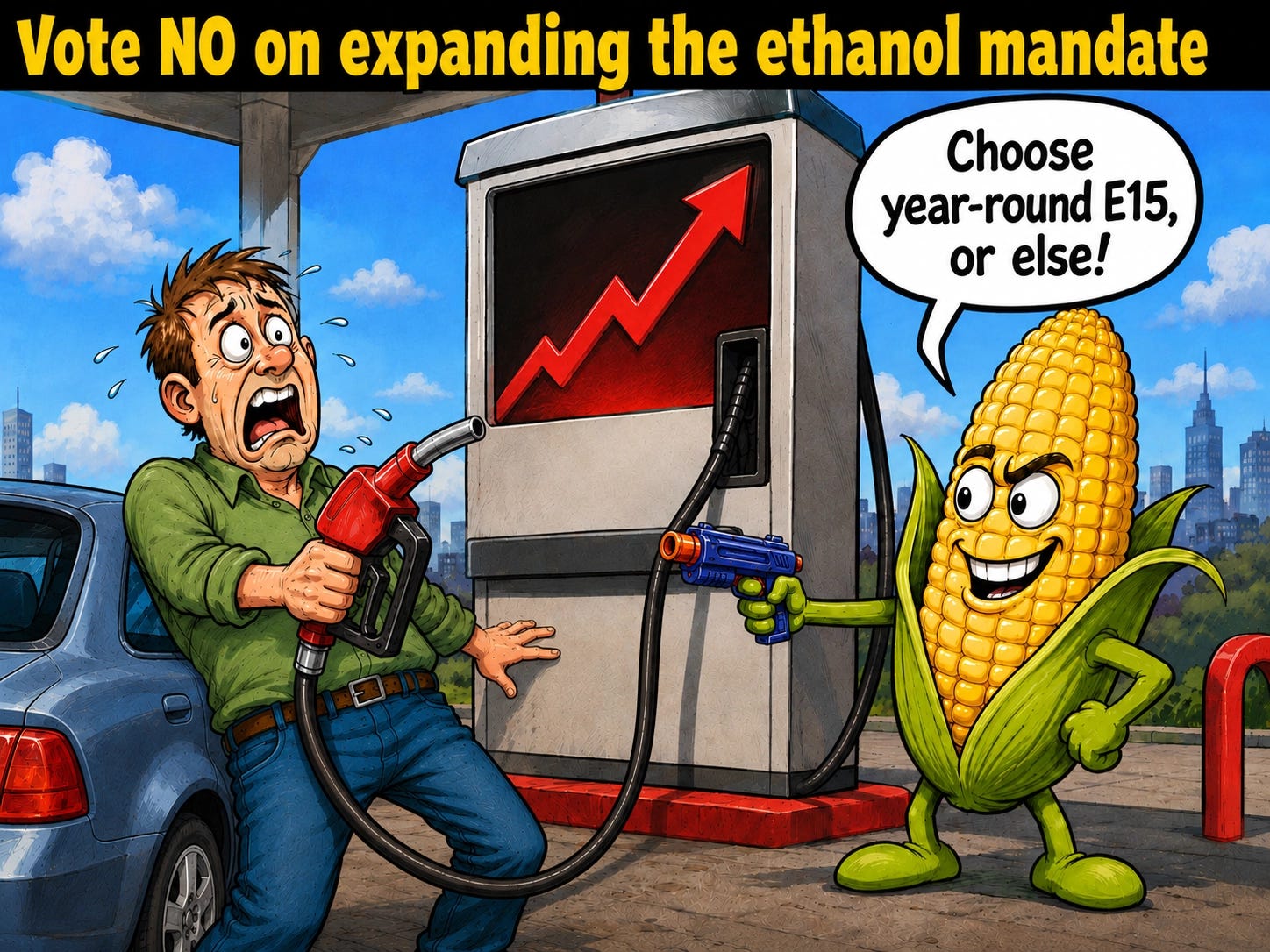
Tomorrow, Congress is voting on the absurdly-named “Nationwide Consumer and Fuel Retailer Choice Act,” which expands the government’s immoral and costly mandate that we consume billions more gallons of corn ethanol than we would freely choose to.
The new bill permanently expands the ethanol mandate by
Congressionally loosening the air quality rules that currently serve as a check on how much ethanol can be forcibly injected into our cars
forcing more small refiners to comply with the mandate by significantly reducing their “small refinery exemptions.”
Advocates of expanding the ethanol mandate not only have the gall to pretend they are increasing freedom when they are reducing it, they are also pretending they will lower fuel prices when in fact expanding the ethanol mandate can only raise prices.
Here’s why the ethanol mandate increases fuel costs while providing no benefits (except to corn farmers and lobbyists), and why expanding it will only make fuel costs worse.
Note: I use “the ethanol mandate” as shorthand for the Renewable Fuel Standard, which mandates the use of ethanol as well as certain other biofuels.
The ethanol mandate forces around 7.5 billion gallons of ethanol into gasoline each year that would likely not be used in a free market (assuming most gasoline would be E5 in a free market). Thus, when ethanol is more expensive than gasoline, the mandate raises costs by 7.5 billion times the price differential of ethanol and gasoline.1
In 2025, when ethanol was roughly 40-50 cents per gallon more expensive than wholesale gasoline (after accounting for ethanol’s lower energy density), the ethanol mandate could be estimated to add replacement costs of over $3 billion, or over 2 cents per gallon.2
Supporters of the ethanol mandate like to point out that ethanol can be cheaper than gasoline when oil prices are high—as is the case right now.
But any modest benefit from cheaper ethanol would occur in a free market in fuel with no mandate—because retailers and consumers could freely choose higher ethanol blends when they were cheaper. Yet the corn lobby has repeatedly rejected fuel freedom proposals.
A new E15 law would make no difference to prices this year, since current law already lets the federal government allow year-round E15 on a case-by-case basis—and it has already done so this year.
Ethanol lobbyists don’t want Congressional year-round E15 for any other reason than to permanently expand the ethanol mandate so we always have to pay for a lot of ethanol—no matter how expensive it is.
The ethanol mandate has demanded significant investments from refiners into ethanol transport systems and ethanol blending equipment, on the order of billions of dollars so far. To accommodate E15, some gas stations would be required to make upgrades ranging anywhere from $13,000 to $71,000.3
Smaller refiners, who often can’t afford the expensive infrastructure to blend ethanol, are forced to buy biofuel credits called RINs from refiners that blended extra ethanol. These biofuel credits become a compliance cost, much of which is passed on to consumers through higher fuel prices.
A small refinery producing 60,000 barrels/day (920 million gallons/year) might be required to “retire” roughly 140 million biofuel credits. At recent biofuel credit prices of $2, that would cost $280 million. The refinery might only have a $200–400 million net income, forcing it to pass a significant portion of the cost on to consumers.4
A recent study found that attaching biofuel credits to a biofuel increased its price by almost the same cost as the credits. At today’s biofuel credit prices, this implies the ethanol mandate may add up to 30 cents per gallon to gasoline.5
EPA currently grants “Small Refinery Exemptions” from the ethanol mandate to some small refineries on the basis that they would face significant economic hardship from having to buy enough biofuel credits to comply.
In 2025, EPA retroactively granted 63 full and 77 partial Small Refinery Exemptions from the ethanol mandate for the years 2016-2024. The exemptions totaled 5.34 billion biofuel credits—about 3% of the biofuel credits mandated over that period.6
The “Nationwide Consumer and Fuel Retailer Choice Act” significantly reduces the number of small refineries that can get exemptions from the ethanol mandate, and makes it nearly impossible to get a full exemption. This may put small refineries at risk of shutting down, reducing refining capacity and competition and thereby increasing fuel prices.7
The ethanol mandate adds vehicle incompatibility costs because tens of millions of vehicles and engines on the road and sea (including cars and trucks before model year 2001, most motorcycles, and most boats) are not built for fuel blends above E10 and may be damaged or lose warranty coverage if forced to use them.8
The ethanol mandate adds time costs because ethanol contains about one-third less energy per gallon than gasoline. As a result, E15 gets about 1.5-2% fewer miles per gallon than E10 and 3-4% fewer than E5.9
The ethanol mandate adds food costs by diverting large amounts of corn from food and animal feed into fuel production. One 2021 analysis estimated that in 2019, the mandate cost livestock farmers about $3 billion in lost revenue and increased consumer costs by 1.1% for beef, 1.2% for pork, and 1.8% for poultry and eggs.10
Corn lobbyists have long wanted to expand the ethanol mandate because it means more demand for corn. But this time, many larger oil companies have decided to join with corn lobbyists on an ethanol mandate expansion that reduces “small refinery exemptions” that are sometimes “reallocated” to them.
One of many unjust components of the ethanol mandate is that when it gives small refineries exemptions from the obligations of the mandate it allows (not requires) the government to “reallocate” those obligations to larger refineries—often at huge cost.
Both large and small refineries are against “reallocation,” and would support a bill to abolish the practice. But the corn lobby wants as much “reallocation” as it can get, since that means more government-dictated ethanol.11
Since larger oil companies don’t think they can get a bill to eliminate reallocation, they have chosen (in my view improperly) to join forces with the corn lobby to support a mandate expansion that drastically reduce small refinery exemptions—so that they have less risk of having to pay for “reallocated” ethanol obligations.
It is also not lost on them that reducing small refinery exemptions is extremely harmful to their competition, which can mean higher fuel prices and ripe acquisition targets.
Large oil companies have, above all through the powerful and well-funded American Petroleum Institute, decided to spend a lot of money and political capital on an ethanol mandate expansion that will protect them from some unfair “reallocation” but also unfairly harm their smaller competitors.
While this move is understandable, it is absolutely not a good move for American consumers—and all the claims that it is are self-serving propaganda.
E15 supporters have said it’s “not a mandate” (Rep. Derek Schmidt) and “it’s ultimately about retailers engaging with consumers” (Rep. Adrian Smith)—but they continue to reject proposals to allow all blends of ethanol and gasoline in exchange for phasing out the ethanol mandate.12
Legislating year-round E15 would absolutely expand the ethanol mandate. The mandate already forces US gasoline to be about 11% ethanol, which is pushing the limit of today’s E10-dominated market. If Congress passes year-round E15, EPA will have the green light to force US gasoline consumption to be 15% ethanol or even more in the future.13
The right position is to let all fuel blends compete freely on an open market without mandates or subsidies. If ethanol supporters genuinely believe their product is competitive, they should welcome fuel freedom via the repeal of the ethanol mandate. Insofar as ethanol is truly competitive, it doesn’t need a mandate.
Click here to use AlexAI to send a personalized letter to your Representative opposing the ethanol mandate expansion.
Michelle Hung, Daniil Gorbatenko, and Steffen Henne contributed to this piece.
Popular links
EnergyTalkingPoints.com: Hundreds of concise, powerful, well-referenced talking points on energy, environmental, and climate issues.
My new book Fossil Future: Why Global Human Flourishing Requires More Oil, Coal, and Natural Gas—Not Less.
“Energy Talking Points by Alex Epstein” is my free Substack newsletter designed to give as many people as possible access to concise, powerful, well-referenced talking points on the latest energy, environmental, and climate issues from a pro-human, pro-energy perspective.
No posts
Comments
Nothing yet. Say the first thing.
Sign in to join the conversation.