

In high school, while I was squeezing my head hard enough to understand algorithms, I sometimes happened to get in my dreams the solutions to exercises I couldn’t solve in class.
Back then, there was no internet at our fingertips—no Stack Overflow, no AI assistant to generate code for us. We had only textbooks and a few hours per week on a shared computer in class.
We solved problems mostly on paper, sketching out pseudocode long before we got to run it through a compiler. We spent so much time thinking through solutions that our brains kept working on them even as we slept.
And sometimes, by morning, the answer was just… there.
If only we could consciously tap into this ability—queue up complex problems in the background and wake up with ready-made solutions—now that would be a superpower.

The brain is, without a doubt, the most wonderful and complex machinery ever created. How it fully functions is still a mystery to the science community.
However, this didn’t stop scientists from noticing the brain's behavioral patterns and discovering ways to supercharge it or trick it into removing its biological limitations.
In this newsletter, I’m especially interested in one such behavior: the Zeigarnik effect. It describes a state in which the brain won’t stop thinking about a task or challenge until it reaches the solution or achieves some kind of closure to take it off its mind.
Our capability to focus on a task until it is done is good because it helps us start working on something and keeps us focused until we finish it. I’ve tapped into this idea before when I talked about how you can use open questions to turn on your brain's solution-looking mode.
Similar to my experience in high school, if you think deeply long enough about a problem, you might even get the solution in your sleep.
However, this great asset turns out to be one big flaw in our mental inner workings. When we deliberately want to pause thinking about an incomplete task, the brain refuses to detach from it.
I experience this most frequently when I want to call it a day at the office but have unfinished tasks on the table. This makes me constantly think about the work I still have to do, affecting the quality of my personal life.
Although I left my computer hours ago, my mind is still there, lingering for solutions to that nagging bug, the feature that’s only half-baked, or what to write in the email for my client.
My family can smell me from a mile away when my mind is still connected to work, and this is frustrating for them as I’m not fully present in the conversations.
Snapping out of this state is not that easy. However, I am working on a solution.
Since the brain won’t stop thinking about a task until it reaches some sort of closure, the workaround is to trick my brain into thinking I have finished all my ongoing tasks.
Here is how it works.
At the end of my working day, I block a 10-minute sign-off slot.
Firstly, in my notebook, I list all the tasks I have on my to-do list, including the ones I’m working on. Then I go over each item and ask myself:
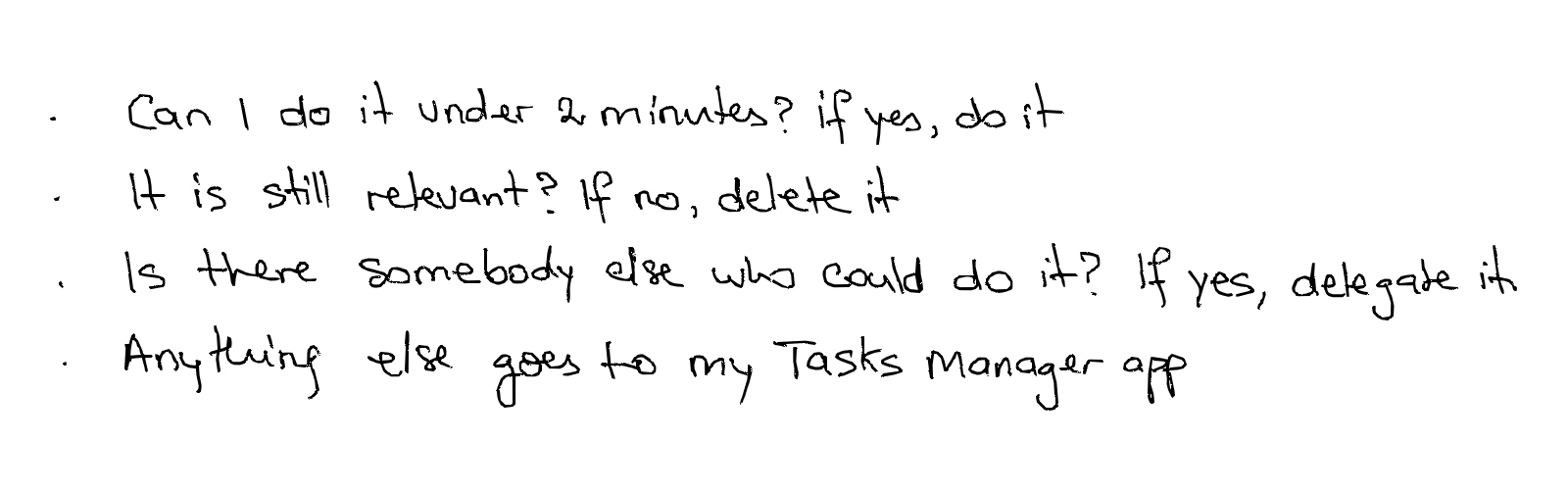
Can I do it in under 2 minutes? If yes, do it.
Is this still relevant? If not, delete it.
Is there somebody else who could do it? If yes, delegate it.
Anything else goes to my Tasks Manager app.
For this to be effective, I make sure to dump on paper also the tasks I have on my mind but did not manage to add them to my to-do list. This way, I make sure I’ve got everything off my mind.
If the task can be completed in under 2 minutes, then I will simply do it.

For example, I might have to inform a client about my work status. It takes me a few minutes, so I would be better off if I did it now.
Or there might be a pull request I could open so my team can review it first thing in the morning. I just do it.
This way, my mind doesn’t have to think about writing to the client or opening the pull request, and it has more bandwidth for the more important things, like being present while I’m with my family.
If the task has become irrelevant, then I delete it.

I like to do it physically in my notebook by striking the item with a line. This helps reinforce to my brain that I don’t have to think about it anymore.
If somebody else can do the task more efficiently, then I delegate it.

I mark the task with the » (fast-forward) symbol, meaning it was delegated. Then, I make a copy of the task in my Tasks Manager app, where I mention the person I have to talk to about the handover details.
The remaining tasks, the ones that were not marked as done, deleted, or delegated, are then deferred.

I mark the task with a ‹ (moved or migrated) symbol and move it to my Tasks Manager app. Then, the task enters the typical lifecycle of all my other tasks.
When our minds hang on to an ongoing process that is far from being done, it negatively impacts our attention and capacity to present at the moment.
One way to shortcut our brains to let go of the running process is to trick them into thinking the process has finished.
The simplest way to do this is to dump all the things in progress on a piece of paper and make one of the following decisions: do, delete, delegate, or defer.
—Alex
Comments
Nothing yet. Say the first thing.
Sign in to join the conversation.