
If you had access to the entire human knowledge, what would you like to know?
I’ve recently realized that, in a way, the LLMs (large language models) that power tools such as ChatGPT are exactly this: the closest we can get to having the entire human knowledge at our fingertips.
These models are trained on massive and diverse datasets composed of publicly available and licensed content. They learn by reading a little bit of everything — from encyclopedias and classic books to science journals, help forums, and blogs that people use every day.
In short, LLMs read, if not everything, almost everything that was ever published online and available in digital form.
How much knowledge are we talking about?
More than 10 million books
Tens of millions of web pages
Decades’ worth of articles, papers, and documentation
For a single person to grasp all these, you would need at least 15.000 years, without taking a single day off.
This moment of wonder made me think about the harsh truths in different aspects of my life that could alter my overall perception.
For the sake of keeping things simple, I thought of sharing what I found within the stepping stone topics of this newsletter — mastery, productivity, and well-being.
Mastery isn’t glamorous. It’s not a highlight reel. It’s long hours of deliberate repetition, mental anguish, and unrelenting self-inquiry.
Those who endure it don’t have more talent—they just refuse to quit.
Here are five brutal realities about achieving true mastery that every serious learner must accept—or risk quitting long before their potential is realized:
Initial talent is wildly overrated—what matters is obsession-level consistency.
You’ll feel like a fraud for a long, long time.
Plateaus are not a sign of failure—they’re the training ground for breakthroughs.
Mastery demands sacrifice—time, ego, comfort, even relationships.
You’ll suck for longer than you think—and still feel behind even when you're great.
To unlock your true productivity, you must abandon the myth of unlimited energy, let go of perfectionism, and build your life around rhythm, focus, and systems, not hustle.
Otherwise, you’ll confuse motion with progress and spend your life exhausted but unfulfilled.
Here are the five brutal truths about human productivity that everyone must accept—or risk burnout, wasted effort, and never reaching their true potential:
You can’t outwork your biology.
Willpower is a poor strategy.
Busyness is a form of laziness.
Motivation is overrated; momentum is everything.
Perfect is the enemy of done—and growth.
If you chase happiness, crave ease, follow the crowd, avoid pain, and wait for purpose, you’ll miss the very things that make life worth living.
Flourishing is not the absence of hardship, but the presence of meaning, depth, and authenticity in the midst of it.
Here are five counterintuitive truths about human flourishing that many overlook in pursuit of happiness, only to find themselves empty or restless despite achieving conventional success:
Happiness is a byproduct, not a goal.
Comfort is the enemy of growth and joy.
Success without self-knowledge is failure in disguise.
Positive emotions are not the peak of the good life—wholeness is.
You don’t find meaning—you make it.
What struck me most about these ideas is that they were not in any sense new to me. I’ve encountered them multiple times in different forms in various sources — books, articles, or YouTube videos.
But this is no surprise, either, considering the same sources are used to grow the LLMs’ knowledge base continuously.
However, this is a reminder that much of the complexity of life can be reduced to an index card of principles to guide us.
It is the same wisdom that ancient thinkers first took note of, philosophers later pondered upon, and modern researchers dedicate their lives to understanding the mechanics at play.
Do one push-up more than yesterday
Do nothing …
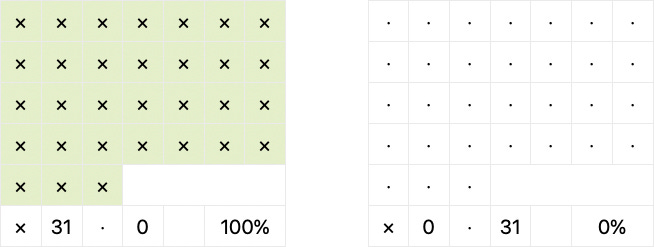
In July, I had only one monthly challenge: do one push-up more than I did yesterday.
I got challenged by one of my friends, and it was as simple as this:
On the first day of the month, I did a push-up.
On the second day of the month, I did two push-ups.
And so on until the 31st day of the month, when I had to do 31 push-ups.
Honestly, I didn’t think I could actually push myself to do 31 push-ups in one session, but to my surprise, I succeeded. I haven’t done so many push-ups in a session since high school.
For August, I’m challenging myself to start my day with a meditation session and to read for at least 10 minutes, taking notes on what I read.
I started June with an injury to my left foot’s thumb, and that put me on a break from running for the entire month.
And because bad news comes in pairs, my Apple Watch also stopped working at the beginning of the same month.
The lack of exercise and my primary health tracker device not working made me feel like whatever I had built for my health in the last year was about to crumble while I was waiting for my thumb to recover.
But I tried to make the most of it:
I challenged myself to do push-ups every day, and
I researched a new watch that would help me get back on track after I recover.
Although it was very hard to detach from the Apple ecosystem, I decided to go with the Garmin Fenix 7 Pro Solar for my new primary health device and fitness tracker.
The deal-breaker feature that made me switch was its capability to measure my stress level, since managing stress will become my main health priority for well-being in the upcoming 6 months.
My other areas of growth—productivity and mastery—were on hold in July. However, I decided that in August, I will focus on forging a learning plan to adopt AI into my life.
I’m a firm believer that AI will not replace humans, but humans mastering AI will replace humans. In the end, AI is yet another tool that, whether we want to or not, we must learn to adapt in this fast-changing world.
Automation is not new to us. It happened before in other domains. Take, for example, the horse industry in the early 1900s, which was soon replaced by the care industry in a couple of decades.
The key difference is that the knowledge workers industry is now the one affected, and the rapid pace of change. We’re only a few years into the AI revolution, and I already feel like I'm falling behind.
So, I have to do something about this.
In July, I (re)started an old initiative where, (almost) every day, I share a photo from my collection.
I call it Lumeere—from the French lumière. It’s about the joy of capturing light in all its forms and giving it new perspectives.
If you’re a photography enthusiast, why not check it out?
—Alex
Comments
Nothing yet. Say the first thing.
Sign in to join the conversation.