
I just simply sat down to write. I can’t remember the last time I wrote something afresh rather than take an old unpublished piece. A couple of years ago, I had the aching frustration of too many unpublished things I’d written over a decade and I set out to share them all: a reservoir of unpublished articles, essays, thought-pieces and case-studies. Many of them morphing together into longer articles that now live on Substack. I was afraid. Of saying the wrong thing; of being misunderstood, reduced to one sliver of my identity or experience that didn’t at all cohere with who I am really. It’s been a long road, recovery.
This is not where I write about what I am recovering from; I think that’s for somewhere else. As I write this quite sporadically, to see what bubbles up, or more to sense what needs to still be said at this stage of chaotic, progressive flow that life has been becoming for me. It’s more to explore with myself to understand how my purpose may have changed. Writing has been a way I figure myself out, and I find a place in the world around me since I first left England 16 years ago. I realised I neglected this critical practice that had kept me intact and intrinsically rooted, especially since my last employed role, and becoming a father.
How I explain my purpose, and the impact I want to have, is becoming more and more a part of my daily reality, since the business I claimed to want to build, is now actually growing and emerging in to what they call a ‘tech-enabled impact start-up’. More specifically the term a community manager at Norrsken House Amsterdam used to describe us when we had our welcome call earlier in the summer.
I am not entirely sure yet if this is the right vehicle for the purpose and impact I have in my mind and heart; the ‘Why’ as Sinek put it – no, I don’t recall doing the pyramid exercise – mostly because I am very much my 4-year-old daughter’s father – an obstinate bastard. An obstinate bastard who has decided that his pessimism, depression and intense, circumspective nature, is well overdue for a refreshment of mind, and dare I say it, spirit. (I have really tried not to be all ‘love-and-light’ these last years, knowing that Mindfulness is an industry coloured in the dyes of capitalism). To find the positive, amidst the detritus and cacophony of our current moment is challenging, but I try to start small. Rather than grandiose, and in my view, rather tech-bro centred tropes of Why-ness, move fast and break things entrepreneurship, my vision is in part reliant on years of following adrienne maree brown’s emergent strategy (which I've written about elsewhere on this Substack). The principle I prefer to practice on, that ‘small is beautiful’ helps me find the gems in the noise. Usually this revolves around meaningful, interpersonal impact in my family, neighbourhood, and, increasingly, in the team and organisation I am trying to grow in a deeply developmental way.
I am 39 now. I cannot justify the level of cantankerousness I have to my shame these last years emitted. That, and my dysregulation, has cost me dearly – it is not quite sufficient to say personal transformation. I have thought to myself that to understand how to navigate larger transformations in complex systems, it seems quite accurate, and necessary, to successfully get through a personal one too – this is also what the latest science and practice says (see the Inner Development Goals network). But, of course, when you ask a question to the universe, all it throws back at you is experience; indecipherable, innumerate, beautiful. I digress; I am still young, and have remembered in fits and bursts, that to feel better is real and possible when I let this happen. It is a mindset.
I used to rail against people who would spurt that word out at the suffering and struggling, like telling someone who is besides themselves to just ‘calm down’ as if those words are magic and have the intended impact their meaning conveys. Nope. I am awed, often, at the new experience of having capacity and agency, when before, there just seemed to be a constant, relentlessly negative balance of chronic burnout and maladaptive coping and survival strategies. I hadn’t realised for how long I had run, how hard I had pushed, and against which forces, that readily also push back. That was a psychological debt that I am still repaying; although, it cannot be rendered into such economic terms. Ironic that slipped in there – none of us immune from being shaped by what we try to shape and change – as Octavia Butler wrote in the Parable of the Sower and the Parable of the Talents.
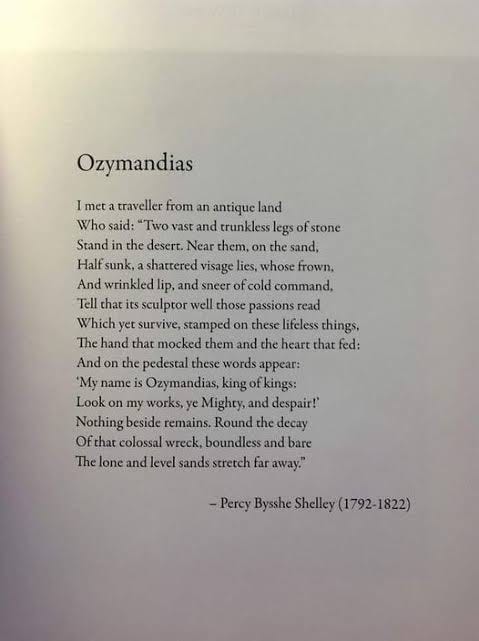
Speaking of economy, I know now, that what my organisation best resembles are two things that are known in the business, impact and higher education worlds; a social enterprise, and, perhaps less well-known, a knowledge enterprise. I had to think on this; let it percolate. Am I by nature, more social entrepreneur, less researcher? Can I be both? Why not. We are more than the neat, commodified little categories that society has trained us to fit into. That never went too well for me. So, I found myself, committed to being there for my daughter’s crucial early years, and trying to earn the trust of the partner I love back, practically un-hireable, with nigh on two decades of training and experience to boot. I’ve thrown all my chips into the enterprise I conceived ten years ago, that actually started as a word, a name, a poem: Ozymandias.
The audacity. Yes, I know. You might think that I’m beginning to sound like just the kind of startup founder type, with his supposedly unique story, idea, vision and mission; enamoured and enslaved by his drive to impact his own version of how things should be better on everyone and everything around him. I’ll bring up that obstinacy I raised earlier; I actively resisted reading Sinek, Jobs, Gates, and all the others, for no other reason than that this was what friends, colleagues and family were all banging on about. I have always resisted trends being pushed on me – simply because I cling to autonomy and agency as the life-rafts that kept me afloat and sailing away from the deadly shores behind me. I moved house 13 times, and schools 7 times before I turned 10, without much say in the matter. I was uprooted and jarred into a new reality every couple of years. That indelibly created a sense of internal resistance - to constantly question, and inquire, and often, when I let it go too far, to second-guess and over-interpret - deep in my psyche. I often think that will never leave me. Other times I find a space behind that place I inhabit, that I assume is so rigidly a part of me, and what opens up in these golden moments is a sense of not quite ease, but flow. In my internal practice I try to remember to find that space.
Back to entrepreneurship tropes. I could not see a reason to choose these leaders, thought leaders over the countless others I’d come across in the grassroots, movement world of social impact and climate action. I am not saying there are not elements of insight in how Jobs used to present, or how Gates tried to redirect his finances for the better, despite the contradictions many a journalist and activist have since justifiably pointed out.
There was another reason. This was 2014-ish; I didn’t like them. I couldn’t put my finger on it. Something was off in the same way I knew something was off growing up. My response was the same: what seemed to be reasonable questions. Why? Who were they to lead thoughts? Did they do everything themselves? Self-made men my arse. What about the team they relied on? What about who helped them on the way? Etc. Groans, disregard, disdain, disbelief. How could I not be a believer. ‘Just get an iPhone and you’ll see how cool it is!’ (he writes having just inherited a 2022 MacBook hand-me-down from his partner - irony is hilarious sometimes).
You could say I was disenfranchised too early and had already lost faith in how things were meant to work; but actually, the more I learnt and researched, the more I found different scientific disciplines essentially showing exactly how things were not working for all, and by design. I always knew I was on the money when I got a disproportionately strong pushback to my questions; especially the ones that became more about me and less about what I had just said. I tried that one out in my own family system first, before experimenting with this thing that I later learnt was called action inquiry (Torbert, 2024).
This brings me back to the why of Ozymandias Intelligence: Because we kept losing ground – every one hard-fought step of progress forward met with violence, oppression, dark money, lobbying, abuse and counter-intelligence. The worst of humanity pushing back against our resistance to infinite, cancerous growth, within safe, secure, biophysical, and for sure, also, psychological limits. There is not a chance in hell of a safe space to operate so long as organisations like (for me in 2016) Cambridge Analytica, (and now) Palantir, the Heartland Institute, and many many others can operate as a network of counter-intelligence against those who dedicate their lives and souls to protecting ecosystems and all peoples who depend on them, and regenerating our Planet to a state of hospitability and sustainability.
This is not a climate and sustainability piece. I’ve said all that already. What I am trying to get through here is how I see my place in amongst all the wreckage and overwhelming noise of compounding crises and stressors our age is inflicting on those who dare to stay open and actually give two flying shits. Numbness, I have come to understand, becomes a reasonable and evolved response to such overwhelm. Pathologies multifarious expunged from scarred minds and bodies. Psychoses, fissures from reality into more comforting distortion fields now enabled by our trusty ‘thinking partners’ and AI assistants. Not just the tech worlds’ dopamine engine alone anymore; now there are entities communicating with our intrinsic cognition with mad men at the design helm who have the hubris to accuse empathy of being 'suicidal', the fundamental weakness of Western civilisation. Projecting much Elon?
When our minds and bodies are overwhelmed by traumatising events, and technologies for that matter, our system freezes the experience’s real signals; we cannot process in the moment. We store it. We keep going. Our subconscious directs us forward; we cannot afford to slow down. We do not have the luxury, so we think. But, on the contrary, the further and faster and more frenetic we move – got to keep up, I’ll miss the boat! – the worse the train crashes later. The deeper down that dark hole I know all too well.
We are afraid, deep down, of going back to that moment that hurt us. That made us feel small and powerless. Unable to help. Unable to stop the death machine of carnage, ecocide and genocide. The trauma comes day-to-day. Minute-by-damned-minute in some cases, when we let our tech-doped minds go with their bad selves. Whether directly for those of us caught in the black, abominable cross-hairs, or for those of us who are brave enough to keep witnessing, lest it be forgot.
I have had to remind myself that I am actually, still, a writer. When I do not write, like this, with a crisp white page, and no interruptions or scroll magnet trying to commodify my attention, my hunger to create, to see the shape and contours of my actual thoughts (the conscious and the unconscious ones to be unearthed) builds and congeals. Bogging me down. Caught in between the drive, stresses, and needed presence of parental and entrepreneurial life – I put it to the back of my mind. My body reminded me. The sensations. Somatically-visualised pulses: coagulation of the lower left part of the torso; the knotted wire-cloud occupying my ribcage; the buzzing of my ears (I live with tinnitus; an unwelcome guest in my neurology since the pandemic – could have also been before...). I breathe. I feel the cascade of connecting back with myself running down the bottom of my head, to both sides of my neck and shoulders. When I started to meditate in 2018, after a while I would notice the lack of the low-end bristling of my nervous system on the right side. This has gradually returned the last 18 months or so. To my relief. Although I do not know exactly why; I think it is because I always found symmetry pleasant.
You might think my subject meandering. If you know my work, which is after all a conduit and synthesis of the works of a great many others inspired into me over the years, then you will know I do not separate inner and outer, above and below, large and small, macro and micro, like other people. I used to be bewildered that other people did not get that. I would visualise this happily in workshops and watch what I thought were doubting faces look back at me as I connected with what I felt in the room; years later, and with a close team telling me that this is not something most people actually see easily - the way the systems pulses, cascades, structures upon lattices upon nodes and bundles – I realised there were stunned, eyes opened, and when I did it right, this would stay and they would see the wood for trees partially. My goal achieved.
This illumination also fulfils a deep longing: to feel connected with people. And to connect people to how I see the world, my inner world and therefore myself through the two-way conduit of understanding how they see the world in turn. This, I later learnt from Gabor Mate’s The Myth of Normal, is an artefact of a new inter-disciplinary cluster of science called interpersonal neurobiology, after Dan Siegel’s work.
This is how I help. I always moved my work to where I could best help and now. I know that my anxiety against over-selling – a remnant of that first so-called job I landed after the global financial crisis in 2009 at a multi-level marketing agency – was well-founded. I refined this instinct in the early 2010s studying critical perspectives on sustainable development (see Wolfgang Sachs, Planet Dialectics - terrific starting point on sustainability in general) and capitalism, trying to find my place in the world.
Now, at Ozyntel - the first vehicle of shaping change in the long-term vision of reclaiming intelligence for people and planet - we are building a simulation environment that effectively helps in the same way I have learned to help, and refine a craft with science and art in equal measure to do so. There was no me per se in this; like I said earlier, the word that best fits is conduit; I am very good at synthesising, intuiting and sensemaking. My 2025 co-founding team (Lily Pepper, Charline Baker-Friesen, Liisa-Maija Malinen) also helped to make the case for building a technology intelligence platform on the action research I’d practiced since 2016; I was initially sceptical (for the reasons I shared above), but was able to trust they knew the work and principles it would need to be built on and embody. I find trust hard; this is also something rooted in my past I have had to learn to grow and recover from.
That is the only thing that is new here. This sense of place, position and vector in a larger, often oppressive complex system is the essence of the trade. To help teams and leaders with action research of how transformation unfolds and can be navigated through structured, emergent decision-making under complexity and uncertainty. I therefore know that my urge to help avoid trauma and pain from failed transformation is something I can be very sure of. Guaranteed and concrete. Organic, and with powerful tools added to interdependence, I would hope that this develops into a powerful tool that tips the balance back a way of life of respect and care. As long as this undergirds our solutions, and that we hold each other accountable, and are held externally accountable in turn, then we might just find a new path.
There is this Swedish expression that I have had on my wall since 2016: det är de som går vilse, som hittar de nya vagarna. It is those who get lost who find new ways. Indeed, but never alone. We come back to knowing our true selves as a wider part of the whole, paraphrasing Eliot. Yes, I am that kind of pretentious bastard.
The poet is dead. Long live the poet.
Comments
Nothing yet. Say the first thing.
Sign in to join the conversation.