
Paid subscriber salon: I’m hosting a live Zoom conversation around this essay on Thursday, July 23, from 11am to 12pm PDT. If you want to sit with these ideas in community, become a paid subscriber and join us. A monthly subscription is $15.
A quick note before the essay, because Exposing Roots turns one this week and I want to mark what this first year has been. If you want to skip straight to the piece, it begins below the first image.
When I started this publication last May, it was called Tending the Wild Root. I was writing about descent, the underworld, spirituality, the body, empire, and the old myths starting to rot. That was the current I came in on.
In February, while I was in Berlin, I changed the name. That feels important because Berlin has always been the most honest mirror of place I have ever encountered, for better or worse. The writing had already started shifting and I realized the work was not tending anything. It was exposing what could not be seen.
I follow signal in life. I always have. When writing, I do not sit down with a content strategy and decide what would be good for the platform. I sense for what is alive, what is moving through my body, what keeps pressing on me until I have to put language around it.
So after hearing that, it should surprise absolutely no one that back in September, when I read a post from about pruning his Substack, I lit up. He had written about deleting subscribers who were not reading his work, and I remember thinking, wait, you can do that?
I had a little over 400 subscribers at the time. I went into my list, found everyone with zero or one star engagement, and hit delete. It was 207 people. Substack gave me the little warning. Are you sure you want to do this? You cannot undo it.
I shrugged. Yep. Delete.
Later that week, I told a friend what I had done, and they looked at me like I had just thrown a perfectly good piece of chocolate cake in the garbage. “You really don’t know how to build a platform, do you?” I cackled because no. I absolutely do not.
I had been off social media since 2011 before coming here. No Instagram, no TikTok, no Facebook, no LinkedIn, no Twitter, none of it. Substack is still the only place I am. So yes, this year has been a growth edge. I have been learning myself here, learning how to be in contact with people on the internet, how visibility moves through my body, what kind of attention I want to cultivate, and what I have no interest in feeding.
Most of what you read from me comes from more than a decade of living, practicing, experimenting, working with clients, cultivating deeper pattern recognition, and building a body of work underground.
I may not know how to build a platform. I do know how to make contact with life and follow the work.
Which brings me to the new essay below.
I did not set out to write an anniversary essay. I was following what was alive, as usual, and at some point I looked down and realized this piece was holding so much of what this first year has been about: spirituality, the body, descent, feminism, gender, empire, the sacred, the political, the old stories disintegrating.
For those of you who came here through the early spirituality/descent writing, this one is for you. For those of you who found me through the feminist work, this one is for you too. And for those of you who have been here long enough to feel that those were never really separate currents, yep. Exactly.
Exposing Roots turns one this week. And at the time of writing this, there are 1,963 of you subscribed here. For someone who has no fucking clue how to build a platform, I am deeply proud of what has grown here.
Let’s keep exposing the roots and turning the shit into soil for the worlds we’ve only imagined.
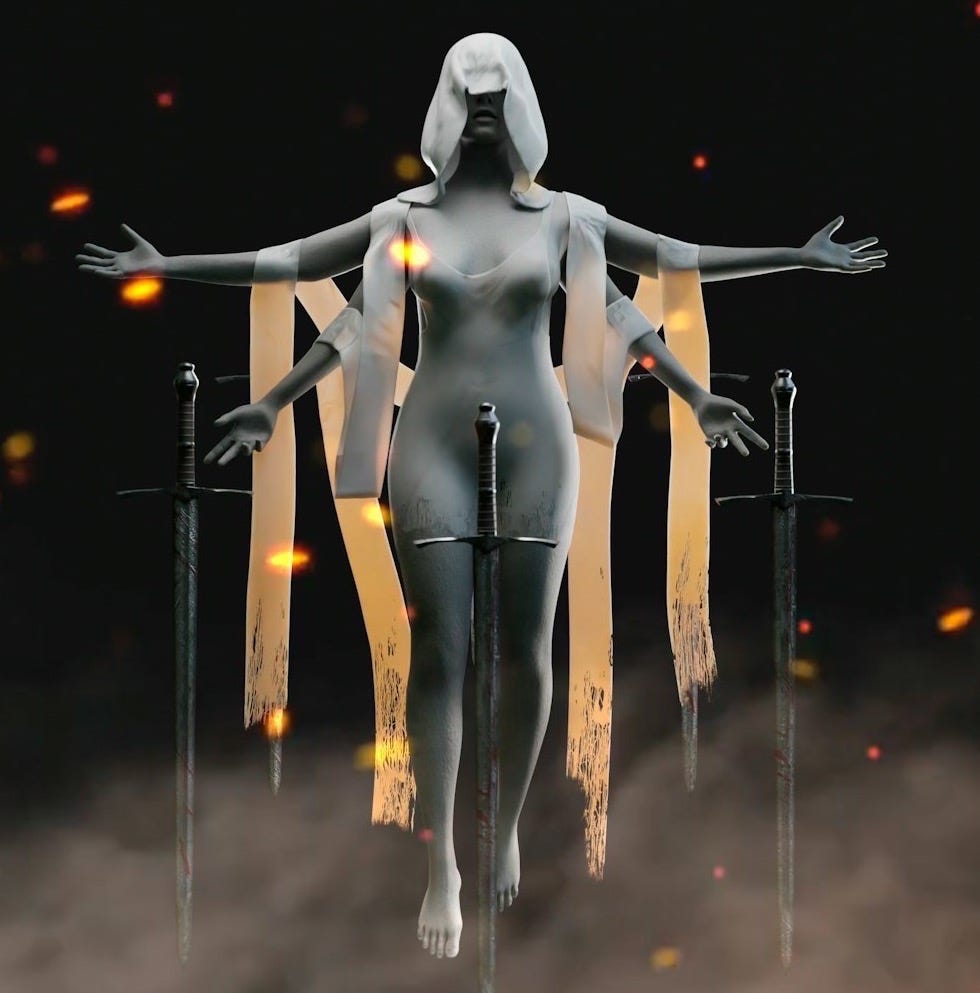
I don’t know how to talk about Catholicism without talking about the body.
I mean I could talk about the church itself, the Mass, the kneelers, the confessionals, the priests, the rules, the particular suffocation of being told there was one true religion and it happened to be the one I was born into. I could talk about my father making sure I went to church, got confirmed, confessed, received communion, stayed inside the structure. All of that is predictable and boring as hell.
The real story lives somewhere more complicated.
It lives in the particular trap of being socialized as a girl inside Catholicism: having a body that was becoming sexual while being taught that sexuality made me impure, wanting things and doing things and feeling things while carrying the sense that God was watching all of it.
Fucking creeper.
From the time I was fifteen until I was almost eighteen, I went to confession almost every Saturday night. I would sit in front of a priest and tell him the same things. “I lied to my parents. I drugged and boozed. I had premarital sex. I was sorry for my sins.”
Then I would say my penance, stay for Mass, leave, and I would do it all again.
Every. Single. Week.
I had several rotating boyfriends, desire, a life outside the church, and a teenage body doing what teenage bodies do — reaching, experimenting, wanting contact, wanting freedom, wanting to feel something that belonged to me. And alongside all of that, I had this other thing living inside me. This trained belief that my body was now marked by what I had done with it. That sex had changed something about me. That I was less clean, good, innocent, worthy.
And here’s the thing: I had no intention of ever getting married1. When I would voice my disgust for the institution of marriage, my dad would start daydreaming about me becoming a nun. Like, no man, if you only knew what I was doing on the weekends, you’d know I wasn’t available for that kind of commitment either.
That is the part people miss about religious training. You can rebel against it and still be shaped by it. You can hate the doctrine and still feel its hand around your throat. You can be out drinking, getting high, having sex, lying to your parents, and still be terrified that God knows. God as surveillance, punishment, and the invisible authority who sees what your father cannot.
My friends used to ask why I even went. They would say, “Just tell your dad you went to church.” And I couldn’t. I could lie about anything else. But I could not lie about going to church.
That was where the fear lived. Being raised Catholic and being socialized as a girl were not separate things for me. They braided together. The Church gave the shame a cosmology and girlhood gave it a body to be lived through.
I learned that my body could be desired, but that desire made me dangerous. I also learned that girlhood under Catholicism meant being handed shame before I was handed language, taught to fear my own appetite before I even understood what appetite was. Purity was never really about God. It was about making sure my body belonged to someone else before it ever belonged to me.
When I was twenty-one, I fled to Colorado.
I choose the word fled deliberately. I did not simply move or leave because I had a neat plan for my life and some polished vision of who I was becoming. I got the fuck out.
I left the coal region of Eastern Pennsylvania, a place that felt shaped by compression from every direction. Catholic guilt was part of it, but it was not the whole thing. The church was one room in a much larger house of suppression and denial. Where I grew up felt depressed, traumatized, close-minded, and heavy with working-class endurance that you did not question. There was this sense that life was something you survived more than chose. You got through it, did what you were supposed to do, carried what had been handed down, and learned not to want too much.
From a young age, I knew I wanted more for my life but didn’t know exactly what was possible.
Once I got to Fort Collins, a whole world opened. I met people who were more open-minded than anyone I had grown up around.
The witch thread had been there since childhood, though I had learned to treat it like contraband. Colorado did not make me a witch, and I still would not fully claim the word out loud for many years. That came later, around thirty-five, after I had moved to the Pacific Northwest and something in me finally had enough ground to stop whispering it.
But Colorado did give that hidden thread a cosmology. My sense of not belonging to the Catholic Church finally had somewhere to go.
And inside that world, I found the Goddess.

After Father God, the Goddess felt like relief. After sin, confession, shame, purity, obedience, and surveillance, I had found a spiritual world that spoke of the body as sacred. Divinity was no longer a distant Father watching from above like a voyeur, but something with hips and blood and rage and sexuality and intuition. The Mother stood where the Father had been, earthy and wild and old, promising that the body I had been taught to fear might actually be sacred.
Of course I wanted that. It felt like goddamn liberation.
And in so many ways, it was. Goddess spirituality helped me pry Catholicism out of my body. Through it, I could imagine the sacred outside male authority, curse without flinching, and feel less alone in my rage. It opened stories older than the Church and wider than the house I had grown up in. For a while, the Mother felt like home.
But a home can still be built from the same architecture that once tried to trap and domesticate you.
exposing roots is a reader-supported publication. To receive new posts and support my work, consider becoming a free or paid subscriber.
What I could not see then was that goddess spirituality did not actually return me to my body. It gave me a different story about my body. One that felt alive after Catholicism. One that brought me toward nature, cycles, sexuality, blood, inner knowing, and the earth. I absolutely needed that. And it was still a story, and the body inside that story had already been gendered before I had a chance to feel it directly.
I was assigned female at birth, socialized as a girl, and moved through the world in a body other people read as female, and at the time, I did not yet have language for the fact that this reading was not the same thing as truth. So when goddess spirituality told me my body was sacred because it was feminine, that made a certain kind of sense. I could step into the role and use the language of the divine feminine. I could make meaning from it because the world had already conditioned me to understand myself through that frame.
For years, I immersed myself in this mythology. Through the rest of my twenties and throughout a good portion of my thirties, goddess spirituality and white feminism braided together in me. I believed there was an ancient feminine wisdom patriarchy had buried, that the feminine was rising, the Great Mother was returning, and the old goddesses had something to teach us about power, body, sex, death, rage, intuition, and the earth.
What I still trust is the body, the earth, rage, sex, death, intuition, grief, and the strange intelligence that moves through living things. What I no longer believe is that any of it needs to be organized through “the feminine” in order to be holy.
Because even then, even while I was inside that world, femininity never felt like an essence to me. It felt like something I could put on. Sometimes I could wear it well, make it beautiful, and even enjoy the performance of it. But it never felt like the deepest truth of me. It felt like a costume I had inherited and altered until it looked more like me, though it never felt like skin. I did not know that yet. Not fully.
In my late thirties, deep therapeutic somatic work began pulling the whole thing apart. Actually feeling the body is very different from having spiritual ideas about the body. I had spent years in spaces that used the language of embodiment, but a symbolic body can be elegantly decorated and still be completely unfelt.
When I began tracking sensation, impulse, contraction, expansion, bracing, collapse, softening, anger, grief, desire, yes, no, maybe, enough, something else came online. The body was no longer an idea I could arrange into spiritual meaning. It became immediate. Specific. Queer. Honest. And it was far less interested in my spiritual identity than I expected.
Once I could actually feel my body, my gender started to unravel.
Not all at once. Nothing that deep comes apart politely. But the question started pressing on me from the inside: what is this thing I have been calling woman, and where does it live inside me?
I looked for womanhood in my body and found unfamiliar sensation, wells of grief, portals of rage, electric erotic charge, spiraling madness, feral animal instinct, sensual tenderness, spooky intuition, forgotten memory, and a whole lot of refusal.
I did not find gender.
By the time I started this Substack in late May 2025, I was already out as nonbinary2, after years of deconstructing my gender and about a year of naming it publicly. I came here after a three-and-a-half-year descent that had already began dismantling my spirituality, among many other parts of my identity. I have always been a feminist, but the more I wrote from the body, the harder it became to keep gender at the edge of the work. I did not pivot into feminism in my writing. I followed the descent far enough down that concept of gender was waiting there for me.
The divine feminine. The sacred masculine. The Great Mother. Womb wisdom. Feminine receptivity. Masculine direction. Sacred union. Polarity. The more I listened, the more I could hear the machinery underneath the floor boards.
It was the gender binary again.
Softer, yes. More beautiful, maybe. Easier to sell at a retreat, abso-fucking-lutely. And underneath it was the same old sorting system: the insistence that bodies mean something because of the categories placed on them, that masculinity and femininity are cosmic truths rather than political assignments, social trainings, erotic scripts, survival strategies, and aesthetics spiritualized so thoroughly people mistake them for essence.
I am not critiquing something I never touched. I am critiquing something I loved enough to let it shape me. That is why I know what it costs to question it.
That was when the Mother stopped feeling like home.
And I need to be honest about what that cost. Catholicism was the cosmology I did not choose. Goddess spirituality was the one I gave myself to. I chose the books, the language, the myths, the Goddess, the Maiden-Mother-Crone, the divine feminine, the matriarchal dreams, the priestess threads, the darker goddesses I could make more livable than all the love and light versions of sacred womanhood that made my skin crawl.
And then, almost twenty years later, I had to look at that whole world and say: this does not fit either. Fuck.
Even writing this, I can feel the heaviness in my heart.
Under patriarchy, especially in feminized bodies, we are taught to endure relationships long past the point where our bodies know something has ended. It is already hard enough to leave dynamics that are abusive, toxic, or openly harmful. What we are rarely taught is how to walk away from something we loved because it has reached the edge of what it can hold, and staying would require us to become smaller than what we now know ourselves to be.
I deeply loved her and still had to say goodbye.

And this is where the personal becomes political, because the gender binary is not a misunderstanding. It is infrastructure: one of the load-bearing systems that teaches bodies where to stand, what to give, who to serve, who gets to define reality, and who gets called sacred for surviving subordination.
This is why I have no patience for white spiritual feminism that wants to dismantle patriarchy while keeping the gender binary intact. You cannot liberate people from the king’s castle while preserving the floor plan. You cannot take the same old split, masculine over here, feminine over there, active over here, receptive over there, mind over here, body over there, authority over here, nurture over there, and then call it revolutionary because this time the women get the altar.
That is patriarchy learning how to survive its own critique.
I know the language because I lived inside it: the Great Mother is returning, the divine feminine is rising, the womb remembers, the earth is mother, women are the portals, the creators, the keepers of life.
That is still a cage decorated with ivy and velvet no matter how you try to spin it.
It sounds reverent because reverence is often how subordination gets dressed up when obedience has lost its market appeal. Instead of telling feminized bodies to submit, it praises them for holding, nurturing, birthing, forgiving, absorbing, performing eroticism, and remaining open. The body is never freed from the role. The role is made to feel cosmic.
That is the trick. And a damn good one at that.
Patriarchy has always known how to “worship” what it wants to use. It worships mothers while abandoning them. It worships women’s bodies while legislating them. It worships the feminine while punishing actual women, femmes, queer people, trans people, nonbinary people, and anyone else who refuses to stay useful inside the story. So when white spiritual feminism starts telling me the Mother will save us, I hear the old story adapting so it can keep its power.
Because which Mother? Whose Mother? And what happens to those of us who do not experience the sacred as mother, womb, feminine, fertility, softness, receptivity, or return? What happens to the bodies punished by these categories, deemed too much, too hard, too dark-skinned, too barren, too masculine, too queer, too trans, too angry, too sexual, too unfeminine, too far outside the pretty little circle of acceptable sacredness?
The reassurance is always inclusion. Trans people are included. Nonbinary people are included. People without wombs are included. Everyone can access the Mother. But inclusion inside a violent architecture keeps the violence intact. It only makes the invitation sound kinder.
If the center remains Mother, womb, woman, feminine, fertility, receptivity, and sacred polarity, then queer and trans people are being invited into a structure that has already misnamed some of us: added after the theology has already been built, footnoted into belonging, given a little room inside a cosmology that never bothered to ask what the sacred feels like when gender is not the organizing principle.
And that is why this is political.
The gender binary does not stay in myth. It moves into law and medicine. It moves into bathrooms, sports, prisons, marriages, birth certificates, reproductive control, family systems, spiritual communities, therapy rooms, bedrooms, retreat spaces, and the unconscious assumptions people make about what a body means before that body has spoken.
The gender binary is not just a belief. It is a border. And borders are enforced.
So no, I am not moved by a white linen version of patriarchy that calls the cage a temple because women are finally allowed to decorate it and rearrange the furniture. I am not moved by womb mysticism with an inclusion statement. I am not moved by the fantasy that the divine feminine will rise and save us from the very structures being reproduced in her name.
I am also not here to police what anyone believes. I honestly do not give a shit what anyone believes. Pray to who you want. Build whatever altar helps you survive the night. What I care about is whether you are willing to look at where those beliefs came from. Did you choose them from sovereignty, or from conditioning dressed up as choice? Are they freeing your body, or giving it another societal role to perform? Because survival can look like devotion when you are still inside the structure that trained you.
exposing roots is a reader-supported publication. To receive new posts and support my work, consider becoming a free or paid subscriber.
Hate to say it. No one is coming to save us. No Mother. No Father. No gendered God with better politics and a softer voice. If we want liberation, we have to stop sacralizing the system that trained us to disappear inside roles and then call those roles essence.
And I think this is where people get nervous. Because if the Father does not hold the world, and the Mother is not coming to save it, then what are we left with?
Goddamn responsibility.
Which is probably why so many people prefer a parent God. A parent God lets us stay children: obeying, rebelling, confessing, praying, surrendering, waiting, blaming, hoping, asking to be forgiven, held, rescued, wreaking havoc with no accountability. Meanwhile, much of what is destroying us was built by human hands and is being maintained by human hands.
At some point, I want to ask: have we learned nothing?
Look at the world without the spiritual filter for five seconds. The politicians are not coming. The billionaires are not coming. The institutions are not coming. Father God is not coming. Mother God is not coming. The divine feminine is not going to descend in a flower crown and clean up the wreckage. Rescue is magical thinking, and rescue keeps us waiting for change instead of embodying it.
White spiritual feminism keeps mistaking a change in divine imagery for a change in power, as if the problem was the gender of the savior rather than the hope of being saved.
Meanwhile, the world is on fire. People are still legislating bodies, bombing children, denying racism while reproducing it, gutting the earth, criminalizing and murdering trans existence, controlling reproduction, protecting wealth, and selling spiritual escape routes to people too exhausted to look directly at the grotesque machinery.
I do not want another parent God. I want us to stop waiting for someone else to interrupt what humans keep choosing. Nothing is coming that gets us out of participation. That is the part nobody wants to hear.
This is why the altar matters — what we worship, we reproduce.
And I can already hear it from people. Well, what should we do next then?
Because that is what we do. The old story cracks and we immediately go looking for the new one: the replacement myth, the cleaner framework, the next thing to believe so we do not have to feel the terror of the floor falling out. And maybe that impulse is part of what keeps fucking us up. Maybe the rush toward answers is one of the ways we avoid the violence of the questions.
Start with the body you keep talking about but may not actually feel. Start with the gender you keep treating as truth. Ask what it means to be a cis man or a cis woman without reaching for the same tired traits drilled into us for centuries. Those are scripts, assignments, political trainings dressed up as essence and sold back as nature, romance, ancient wisdom, religion, spirituality, and self-knowledge.
When the script goes silent, notice what is actually there. Where does gender live in your body? Can you feel it, or are you mostly feeling the roles you were rewarded for performing and punished for refusing? Look at what you have eroticized because it was familiar, what you have spiritualized because calling it sacred made obedience easier to keep.
That is where this gets uncomfortable. Good. The discomfort is information. So is the blankness, the irritation, the urge to defend the old language, the reflex to say “but feminine and masculine are just energies,” the need to make the binary softer instead of questioning why you need it at all.
We are programmed all the way down: family, religion, race, class, capitalism, patriarchy, white supremacy, cisheterosexuality, romance, pornography, purity culture, motherhood myths, father myths, fairy tales, spiritual teachers, therapy language, and every market that knows how to make identity profitable. None of this lives only in the head. It lives in posture, desire, attraction, shame, sex, labor, silence, caretaking, fantasy, and the tiny contractions we mistake for truth because they have been with us for so long.
I do not have a clean answer for what replaces Father God, Mother God, the divine feminine, the divine masculine, womb wisdom, sacred polarity, or the Great Return.
Clean answers are often how the next cage gets built.
What I trust more is the terrible honesty of staying in the question long enough for something less programmed to emerge. What is earth when it is allowed to be earth, alive and relational, without being turned into the endless giving Mother? What is the cosmos without Father, law, order, penetration, protection, or authority?
What is creation when it no longer has to come through wombs to be sacred? What is care when it is no longer feminized into destiny? What is the body before the world gets its hands on it and names it into service?
What becomes possible when queerness is lived as movement, relation, refusal, and changing shape rather than turned into another category to defend? What lives outside polarity, outside the old demand that everything be split into two and made to complete itself?
I do not think we know. That is the point. The mystery is not another answer waiting behind the curtain. It is the place we enter when the inherited answers finally stop working and we resist the urge to replace them with another polished lie.
We need less comfort and performed certainty. We need to stop building gods out of our programming and then acting surprised when they keep asking us to defend and obey.
In goddamn responsibility,
Alexandra Winteraven 🖤
Writing note: I draft wide, then forge the final shape to techno. This piece was cut with a set by Lobster at Der Hintergarten, Amsterdam. Bass up. 🔊
Thanks for reading Exposing Roots.
You can become a paid subscriber, which helps sustain the time, energy, and heart I pour into this work. Currently offering a 30-minute Zoom call for a chance to connect and ask me anything to all new annual paid subscribers. Link to schedule in welcome email.
Or, if a one-time gift feels better, you can always buy me coffee. Every bit of support helps me continue tending this space with depth and integrity.
Whether you give financially or not, I’m grateful you’re here. Your presence is felt.
The work burns faster in relation. Like, comment, share, restack, repeat. 💞
Alexandra Winteraven (they/them) is a queer, nonbinary somatic depth psychotherapist working at the intersection of somatic process, depth psychology, structural analysis, and cultural emergence. Their work focuses on interrupting inherited patterns at the level of the body, where the psyche continues to organize itself despite insight.
They are known for naming incongruence with clarity and care, and for working with people who are no longer able to live inside familiar shapes that no longer fit. Their approach is relational, embodied, and uninterested in performance or bypass. Their work supports internal structural reorganization rather than symptom management, and is oriented toward honesty, the cost of real change, and collective transformation.
If you’re curious about working with Alexandra use button below.
This was not youthful rebellion. I knew in my body that marriage was a no-go for me, and that knowing has never left. I have never been married, by choice, and I remain deeply grateful to my younger self for clocking that early.
I use nonbinary because people need a word, and it is the closest one I have. Agender is probably more accurate, though it is strange to use a word with gender in it to describe the absence of gender. Internally, I do not experience myself as having one. The truth feels more like absence than identity.
Comments
Nothing yet. Say the first thing.
Sign in to join the conversation.