
A paid subscription is one way to enter into deeper reciprocity with this work.
These essays take time, attention, and a lot of heart and heat to make. Your subscription helps sustain the work behind Exposing Roots and supports The Underground, the more intimate room growing underneath this publication.
Paid subscribers become part of The Underground community and receive raw voice notes, monthly post-essay reflection questions & Zoom salons, reader questions taken into the work, selected archive and paywall pieces, and more experimental threads. Voice notes are where I think out loud from my own life and practice as a way of taking the work deeper. Reader questions are answered in a voice note or a short subscriber-only write-up.
A monthly subscription is roughly fifty cents per day. Annual subscriptions are 33% off compared to paying monthly and include one 30-minute Zoom call with me to connect and ask me anything about the work — honestly, my favorite paid subscriber perk!
If a paid subscription is not the right fit, you can also support the work through my Buy Me a Coffee link.
Likes, shares, restacks, and comments are appreciated ways to support the work too.

The other day, I realized I had ghosted my spirit guides.
There had been no falling out. No crisis of faith, no dramatic moment where I cleared the altar, threw the tarot cards into a fire, and declared myself finished with the unseen realm. I simply stopped asking them questions. The conversations became less frequent until, at some point, they disappeared altogether. I had been moving through my life, making choices, following what felt alive, changing direction when something stopped fitting, and apparently it had never occurred to me to check in with the celestial advisory board.
This surprised me because there was a time when I asked my spirit guides about everything.
I asked for signs before making decisions, signs after making decisions, signs to confirm the signs I had already received. Sometimes the answers came with such absurd specificity that I still struggle to explain them. I would ask for something exact and then watch it appear in my field, often quickly enough to leave me laughing, crying, or standing somewhere with my mouth hanging open.
Then I would ask for another one.
I used to joke that my guides were gathered somewhere in another dimension, smacking their foreheads in disbelief and saying, damn, bitch, how many signs do you need?
Apparently, the answer was always one more.
I grew up Catholic, which meant I learned early that the answers lived somewhere outside and above me. God held the plan and the authority to name what was right. My role was to listen, obey, and confess whenever my own desires pulled me beyond the boundaries he had set. I left the Church long before I stopped believing that some invisible authority knew more about my life than I did.
When I left the Church, the structure followed me into spirituality. I turned to tarot, synchronicity, intuitive messages, and conversations with guides, all of it gentler and more expansive than the religion I had left behind. Still, I was looking beyond myself for access to a truth I did not yet trust myself to hold.
Catholicism was only one part of that training. I had also been socialized as a girl and conditioned toward womanhood, which meant learning to treat my own perception as something requiring outside verification. I was trained to remain exquisitely attentive to everyone else’s needs, moods, judgments, and reactions while approaching my own knowing with suspicion. Discomfort could be explained away. Anger required softening. Desire needed a defense. Even a clear no was expected to present evidence.
That training creates a person who checks the room before trusting what is happening inside their own body. It teaches you to override the first response, revise the second, and wait for someone else to confirm that what you felt was real. Spiritual guidance entered a body already trained to seek permission. No shit I wanted signs. They gave me more than information; they protected me from the old accusation that my own read was excessive, unreliable, selfish, dramatic, or wrong. I could trust myself more easily once I believed the universe had agreed with me first.
For a long time, this felt like freedom. After the surveillance and punishment of Catholicism, spirit guides felt warm, playful, and personal. They seemed invested in my un/becoming rather than my obedience.
The signs were often weirdly specific. On two separate solo road trips in 2018, I passed the same box truck, once while driving south and again while heading north. Something about the tribal fish painted on its side pulled at me. The second time, I took a picture and said aloud that someday I would understand what the truck meant. Then I never saw it again.
Six years later, I was considering a move to Portland and went there to look at apartments. After viewing one place, I asked aloud for a sign so clear I could not deny it. When I returned to see the apartment a second time, the truck was parked directly in front of the building.
When I was trying to decide whether to go to Berlin for the first time, David Bowie began appearing everywhere. Berlin had been one of the places where he remade himself, and for much of my life I had used the question what would Bowie do? as a private compass.
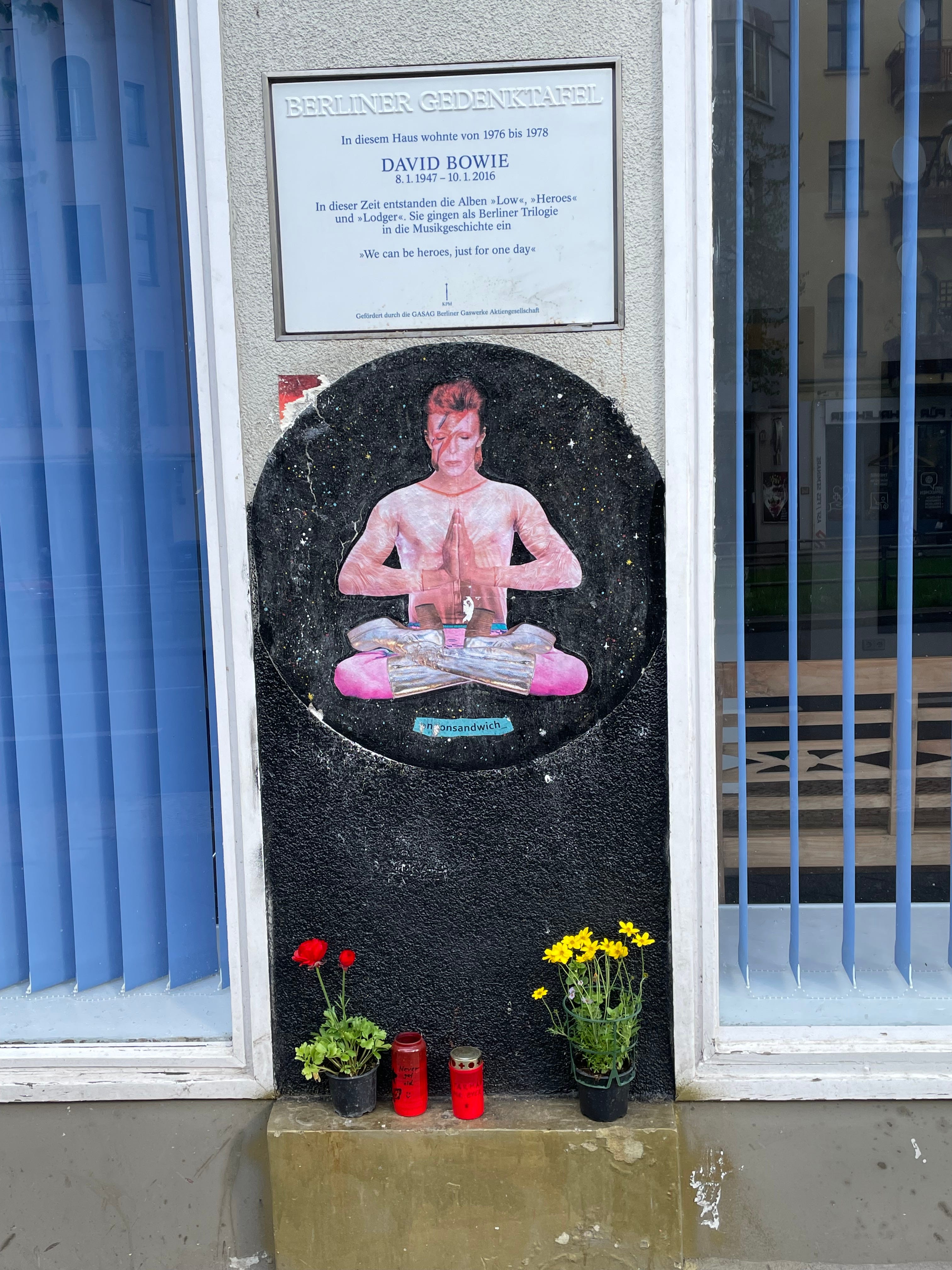
Three years later, while deciding whether to return for a third trip, SoundCloud resurfaced a DJ set from my first visit, one I had actually been in the club for, along with a notification that I had somehow made its top-listener leaderboard. I had no idea what that meant. I knew exactly what I wanted it to mean.
The timing could be so precise that the world seemed less like a backdrop and more like an active participant in the conversation.
I still believe the world speaks. What changed was my belief about what the speaking was for.
I once treated signs as answers. More accurately, I treated them as permission. If I could receive enough confirmation, perhaps I could make a choice without having to experience myself as the person making it. The universe would have approved the decision in advance. The guides would have stamped the paperwork. Whatever happened afterward could be placed inside a larger story about destiny, alignment, divine timing, or the mysterious wisdom of the path.
The sign offered something more seductive than guidance. It offered relief from responsibility.
Even the clearest signs could never give me what I was actually asking for, because the question beneath the question was always the same: can you promise me how this will end?
The universe, to its amusement, refused.
Somewhere in the past few years, my relationship to choice changed. I began making decisions based on what I could feel, what I knew, what I wanted, what I was willing to risk, and what the moment seemed to require. I became less interested in locating the perfect choice and more capable of making an honest one. I would choose, watch what followed, and adjust from there.
This thought arrived on a walk recently, and as soon as it did, I thought of my father.
My dad taught me how to play poker when I was a child in the late 1980s. On Friday nights, while my mother was working as a waitress, he would make hamburgers and french fries in the oven, put Bob Seger on, and deal cards across the table. My mother was the worker bee in our family, out earning money while my father stayed home with me. I grew up inside a reversal of the gender arrangement most people expect, with my father feeding me, playing music, and teaching me games while my mother carried the family’s labor outside the home.
My father loved hamburgers, and I inherited that love so completely that they remain my favorite food. Even now, a hamburger can carry the whole atmosphere of those Friday nights inside it: the oven warming the kitchen, the smell of potatoes, my father sitting across from me, a pile of pocket change between us.
We were a poor family, so we played with what we had. Pennies, mostly. Sometimes nickels and dimes made their way into the pile, which felt like serious money to me. My father told me that whatever I won, I could take to Jay’s the next day and spend on candy.
Jay’s was a little market within walking distance of our apartment, and it had bins filled with penny candy. Gummies, chewy things, bright pieces of sugar I could choose one by one and drop into a bag. Two hundred pennies meant a bag so full I could barely imagine carrying it home. A nickel was five. A dime was ten. When those coins began collecting near my cards, I could already see myself walking into Jay’s and filling the bag. The candy made the stakes enormous.
At first, I was terrible at poker. Whenever I had a good hand, my whole face lit up. When the cards disappointed me, my mouth fell into a frown or recoiled with disgust. I revealed the value of my hand before I ever placed a bet. My father could read me from across the table, and he used every piece of information I gave him.
He never let me win.
My father brought his own patriarchy into our family, and I have no interest in cleaning him up for the sake of a beautiful story. He had demons that affected all of us. He also respected me. He treated me as intelligent, capable, and worth teaching. At the poker table, being his daughter never meant receiving a smaller version of the game. He could have thrown a few hands, passed me a pile of pennies, and sent me happily down to Jay’s the next morning. Instead, he watched my face, took my money, and waited for me to learn.
One night he said, “Alexandra, you have too honest of a face when you’re playing the game.”
Then he asked whether I ever knew what kind of hand he had.
I studied him and realized I had no idea. His expression looked the same whether he held a winning hand or complete garbage. He told me to watch him. I did. I kept watching through game after game, trying to find the flicker that would give him away.
My father had an exquisite poker face. Eventually, he taught me how to have one too.
At the time, I understood the lesson in the simplest terms. A player who broadcasts excitement becomes easy to beat. A player who collapses at the sight of a bad hand gives away the game before it has been played. I had to learn how to hold the cards without letting the cards possess my face.
Only now can I see how much of life he was teaching me.
When I had a strong hand, I was already spending the winnings. The pennies had become gummy candy before the final card was dealt. I had walked to Jay’s, stood in front of the bins, counted every piece, and tasted the sugar while I was still sitting at the table. My father could see exactly how much I wanted the future I had invented, and the wanting changed the way I played.
This is what attachment to an outcome does. We begin inhabiting the result before reality has finished moving. The possibility becomes a promise, and every favorable card starts looking like proof. We stop playing the hand in front of us and begin playing for a future we have already spent.
A good hand is information, not a promise.
My father taught me that years before I had any language for attachment, discernment, nervous systems, or spiritual authority. He taught me to create space between what I had been dealt and what I decided it meant. A promising card could bring excitement without becoming prophecy. A disappointing card could change the odds without becoming a verdict. The hand still required a move.
Once I learned to keep my face steady, I started winning. I became good enough to beat him, which was the point. My father had no interest in remaining the permanent authority at the table. He taught me until I could read him, protect my own hand, bluff when the moment called for it, and take his money.
The point was never to let me win. It was to teach me well enough that eventually I could beat him.
That lesson carries a form of love I understand differently now: trusting my frustration, allowing me to lose the candy I had already imagined, and treating disappointment as part of learning rather than something to prevent. The game remained honest enough for skill to develop.
A great deal of modern spirituality turns outcomes into spiritual report cards. When something works, we call the choice aligned. When it falls apart, we search backward for the moment we missed the sign, ignored our intuition, acted from fear, or failed to trust. Winning becomes proof of wisdom. Loss becomes evidence that somewhere along the way, we betrayed ourselves.
Poker offers a harsher and more merciful truth. A person can play a hand beautifully and lose. Someone else can play recklessly and get lucky. You can read the table, assess what you are holding, make the strongest move available, and watch the final card change everything. The outcome carries information. It is rarely an indictment of the choice.
Self-trust begins somewhere beyond certainty. It grows through choosing, meeting the consequences, and remaining in relationship with yourself afterward. Self-trust is not knowing you will win. It is knowing a loss will not turn you against yourself.
For years, I wanted spiritual guidance to protect me from that possibility. I wanted the sign to guarantee that future me would never look back with regret, embarrassment, grief, or rage. I wanted the universe to certify the hand before I placed the bet.
No sign could ever do that.
The signs may have been real. The synchronicities may have been meaningful. My spirit guides may have accompanied me through years when I needed to experience the world as responsive and intimate after being raised beneath the distant gaze of a judging God. I have no desire to flatten the mystery simply because my relationship to it has changed.
Perhaps my guides belonged to a particular season of my life. They helped me move from obedience toward authorship while my own authority was still becoming legible. Their presence mattered. So did the moment I stopped needing them to certify every move. At some point, I stopped calling because I could finally hear myself.
I began reading the hand in front of me. I noticed desire without treating it as prophecy. I listened for fear while refusing to grant it complete control. I made decisions without requiring the future to assure me that I would be rewarded for making them. Some choices opened doors. Others cost me. A few did both.
No matter what, I stay at the table.
The strange thing is that I spent so many years searching another realm for someone to teach me this. I asked invisible guides for signs, confirmation, and direction. I pulled cards, watched numbers, followed symbols, and begged the universe to make itself unmistakably clear.
Meanwhile, my father had already given me the lesson on Friday nights, through hamburgers and oven fries, Bob Seger, pocket change, frustration, and the promise of candy. Every time he refused to rig the game in my favor, watched my face reveal exactly what I wanted, and took the bet anyway, he was teaching me how to stay present when desire could offer no guarantee.
The lessons have continued arriving long after the nights themselves ended, an inheritance hidden inside ordinary memory, waiting until I had lived enough life to understand what he had placed in my hands.
I thought he was teaching me poker.
He was teaching me how to live without knowing the final card.
I spent years asking invisible guides to tell me what my father had already taught me: look at the hand, place the bet, and stay for what happens next.
Without knowing the final card,
Alexandra Winteraven 🖤
P.S. I usually write and edit my essays to underground techno, but this one was written on the plane to Berlin. So for this piece, I’m leaving you with David Bowie’s “Heroes,” recorded here in Berlin.
There will be no paid subscriber Zoom salon this month while I’m here. We’ll gather again next month. I look forward to seeing you all on the other side.
The work burns faster in relation. Like, comment, share, restack, repeat. 💞
Alexandra Winteraven (they/them) is a queer, agender body-led deconstructionist, writer, teacher, and facilitator working at the intersection of inherited systems, structural analysis, cultural emergence, and tracking pattern at the level of the body.
With more than a decade of experience as a somatic depth psychotherapist, Alexandra brings a trained eye for body, relationship, and the deeper structures shaping human experience.
They are known for naming incongruence with clarity and care, and for working with people who are no longer able to live inside familiar shapes that no longer fit. Their approach is relational, no bullshit, and uninterested in performance or bypass. Alexandra’s work is about what actually changes when insight becomes embodied, relational, and lived. It is oriented toward honesty, responsibility, the cost of real change, and collective transformation.
Comments
Nothing yet. Say the first thing.
Sign in to join the conversation.