
Welcome to orientation for the Accademia of Selvascura. In this course, History 339, you will be learning about events surrounding the aftermath of the Raids that partially demolished the noble structure and System of Values that had guided society on the Speranza Peninsula for nearly 1,000 years prior.
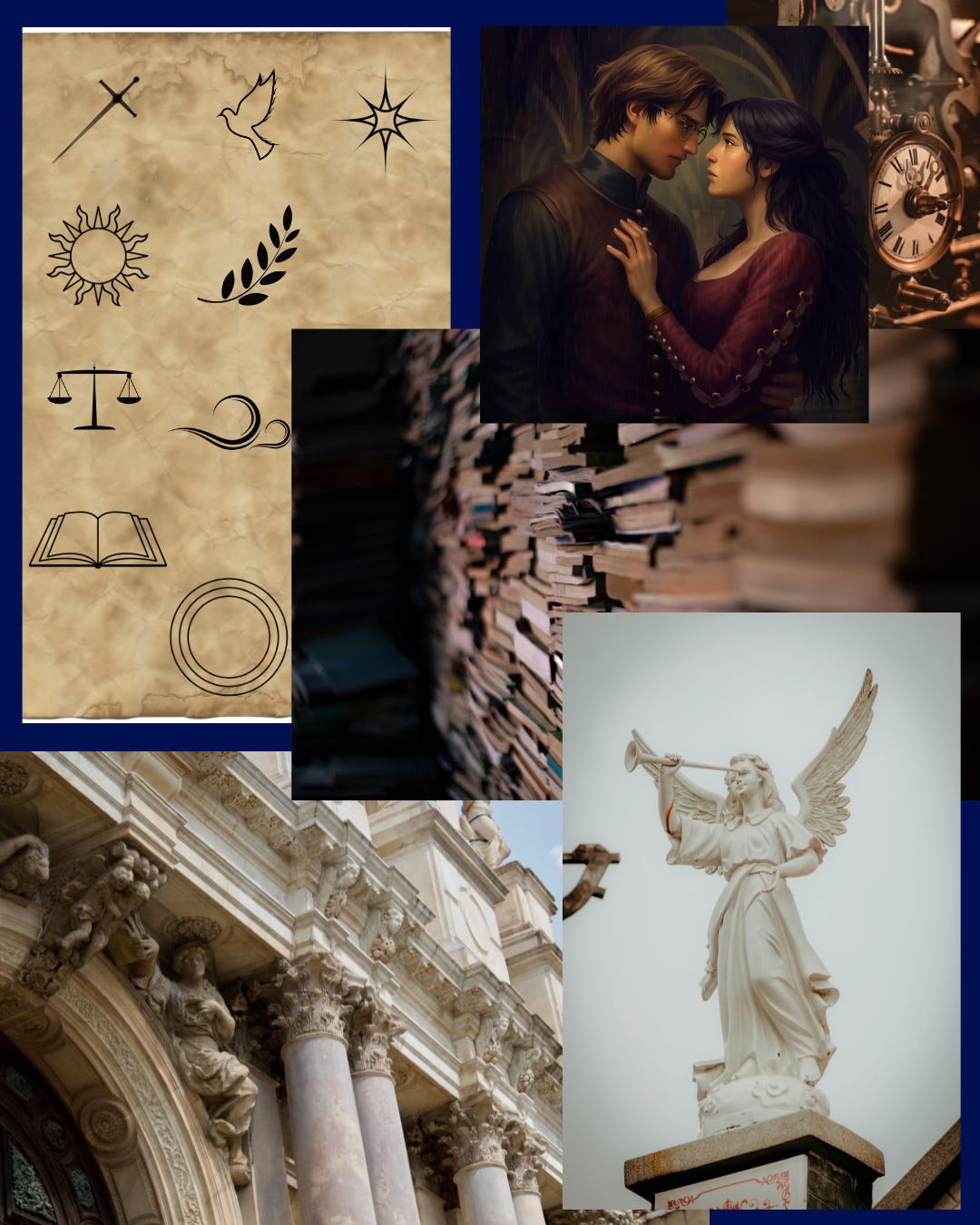
Each lesson will include a chapter on this history, more specifically the Heist of Year 990, involving the following historical figures:
Clemenza Giudice – 27 years, dispossessed noble of the Guerriera line, profession at time of event: clockmaking
Gianpaolo Velia – 29 years, noble of the Ambizioso line, profession at time of event: architect
Helori Compostezza – 32 years, dispossessed noble of the Speranza line, profession at time of event: [redacted] lecturer’s note: notorious smuggler and con
Caterina Compostezza – 32 years, dispossessed noble of the Speranza line, profession at time of event: pleasure house worker lecturer’s note: indentured worker
Benigna Donato – 30 years, former merchant class, profession at time of event: clockmaker
Gryphus Accardi – 26 years, unknown origins, profession at time of event: [redacted] lecturer’s note: Helori’s assistant
Below is the “author’s note” from the compiler of this history. Please read carefully. At the end, along with all lessons, you will find supplemental material. To get the most out of this course, please engage in the comments section and share so more people can join in on the seminar.
Thank you.

Of Constellations and Clockwork is, first and foremost, a work of fantasy, but there was still much research and thought that went into not only the historical inspirations, but also the metaphysical and ideological components. I am firstly grateful for my master’s program in Italian Renaissance art at Syracuse University Florence, which sparked my interest in fifteenth-century Italy, mysticism, and philosophy. The opportunity to conduct research while in residence in Florence was unparalleled.
When I was in the preliminary stages of researching and writing, I called upon a former graduate school professor mine for reading suggestions on humanist and Neoplatonist thought in the Italian Renaissance. He recommended James Hankins’s book Virtue Politics. Along with providing greater insight into the politics of the period, it helped crystallize my ideas on designing a society that was governed and sustained by a system of values.
I do not pretend to have created—or even attempted to create—the ideal, reformed, virtuous rulers that Hankins posited as the goal Italian humanists were working toward in the Renaissance. Indeed, part of the point of the political system in my story is that no one can achieve perfection in virtue. I was searching for a different lens by which to view what has become in the field of Renaissance studies a beaten horse, and Hankins magnificently provided that in his book. Hankins was concerned with the educational intentions of the humanists, the kinds of virtues a ruler should have, and the shift in concern from ideal regime types to (as he argues) reform of character in the Renaissance. Meanwhile, the questions I put to myself in constructing my world was what if nobility meant something different from the outset? What if nobility were inherently defined not by wealth or family lineage alone, but by the character of the person, the way in which he or she upheld a system of moral values?
Later on, while working on the second draft, I came across C.S. Lewis’s The Abolition of Man. Like Hankins’s work, this too put a voice to much of what I was thinking about while writing. (I also must credit Michael Ward’s After Humanity: A Guide to C.S. Lewis’s The Abolition of Man for providing clarity on a surprisingly dense little book). Lewis presents a haunting and convincing analysis of natural law and objective morality, and the nihilistic consequences of rejecting parts—or ultimately all—of it.
As with Hankins’s book, I didn’t intend for Of Constellations and Clockwork to be a direct response to The Abolition of Man. That would firstly put too much pressure on someone with no formal training in philosophy. Also, while objective values are certainly a concern throughout this book, I do not want my readers to be concerned with only that aspect. Equally important are themes of forgiveness, redemption, and pushing past perceived barriers within oneself to achieve greater things.
However, Lewis raised interesting points that resonated with me and seemed to mirror the very things I was already writing: how subjectivism eventually folds in on itself and destroys the person imposing a subjectivist view (pp. 64-68).1 (Such as Clemenza spiraling and finding nothing sustainable to grasp onto when she decides to do “whatever it takes” to achieve her personal goals). How when one retains only certain values and rejects the rest, those chosen values become distorted (pp. 44). (As shown in Ludovico Guerra dispossessing and deposing certain noble families and Values, and the remaining becoming twisted versions of what they were before, such as with Gianpaolo’s family). The necessary tension between subjectivist views and objectivist values, always keeping the former in submission to the latter (pp 45-48). (The fact that the noble families never had one hard-and-fast way in which they were to model their Value, but had freedom within the parameters of the Value).
Bishop Robert Barron has also echoed many of the above sentiments in his writings and the Word on Fire podcast (the latter of which I am a devoted listener to). His frequent commentary on the dangers of subjectivism and an over-exaggerated importance placed on science at the cost of philosophical reasoning provided the first kernels of inspiration for the questions I tackle in this work. I deal with this in my world’s treatment of aether, which I took to be an energy source that is a cross between something spiritual and other-worldly (hence the moral questions about its proper use) and something more scientific, akin to electricity.
I am Catholic, and must acknowledge that as having had influence on this work. However, I did not write this to necessarily be a Catholic story. My readers may not agree on an objective system of values. They might take umbrage with some of the messages conveyed in the story. That is okay. Despite being a book focused on how to determine right from wrong and to find the strength to do what is right, it is not intended to be “preachy”, and I hope I succeeded in that. Rather, the ideas my characters wrestle with and the struggles they face are intended to spark discussion and hopefully some introspection. I want people to think about why they believe what they believe, why they do the things they do, what it means to be a “good” person, and how all that fits into the grand scheme of life.
Finally, a further note on the historical period that served as inspiration. As mentioned above, this is firstly a work of fantasy. While the Italian Renaissance, particularly the late fifteenth century, did heavily influence it, I still took many liberties throughout and was loose with the historical basis. Clockwork in particular, I played with while still trying to be somewhat faithful to what we actually know of clocks in the fifteenth and early-sixteenth centuries. I did much research into early verge escapement clocks, and one of the most useful sources was George L. Overton’s Clocks and Watchesbook (2013), especially for giving me a foundation for the vocabulary and a starting-off point to look at numerous YouTube videos and other online resources. I also thank Dr. Rebecca Struthers, a watchmaker and historian, for her time in talking to me and pointing me to further resources. Her book, Hands of Time: A Watchmaker’s History (2023), was also invaluable.
Dante’s Commedia also gave names to many places and characters throughout the book, as I wanted to create a sort of spiritual and moral journey through Inferno in the inner lives of my characters during their physical journey. They travel inward to the darkest parts of themselves until their world is flipped over. Even the names of the spiritual beings in the book, the Stelnove—which then gave name to their Values—were taken from the names of Dante’s nine heavenly spheres.
I also hope my Italian friends will forgive my often liberal and obvious use of the language and certain dialects to convey a sense of the language my characters speak. (It’s best not to translate certain things Helori says…) My husband taught me the word furbo—furbizia, readers will recognize—when I first moved to Florence, and it is, I will say, an important word for tourists and immigrants to know here. I named the strategy game Clemenza is a prodigy at after the word, somewhat tongue-in-cheek.
There is a lot more I could say about this book. A lot that is more personal, how this book was originally born, not from such grand questions about life and its meaning, but from an intensely dark period in my own life. This story was originally written for me to wrestle with my own demons, deep questions, and struggles about what I believed in and how I could reconcile what were, at the time, two irreconcilable things in my life. Like Clemenza, I found myself at the bottom of a dark pit with no one to help me out, and that visceral, crippling feeling was something I wanted to put forth on paper and conquer on paper, the only way I knew how. For all my talk about objective value, there is so much gray space in between. My characters find themselves in those spaces, as I did, and I’m sure you do too, reader, at times.
Do not settle. Always strive for something higher and better. Look outside of yourself. And if you, like Clemenza and me, find yourself in a true “dark night of the soul”, I hope the journeys of my characters give you some comfort and reassurance that you are not alone.
Keep fighting to walk in the light.
Introduce yourself, if you’re comfortable with that! Just say what your interests are and what role you would be given on a heist.
Is morality objective, subjective, or somewhere in between? Can we come to know it by natural means or must a supernatural revelation be involved?
Addomine, Marisa. “A fourteenth-century Italian turret clock.” Antiquarian Horology 37, no. 2 (2016): 213-222. https://ahs.contentfiles.net/media/documents/Addomine_on_the_Chioggia_clocks_wm6.pdf
Alighieri, Dante. Inferno. Translated by Anthony Esolen. Modern Library, 2003.
Alighieri, Dante. Paradise. Translted by Anthony Esolen. Modern Library, 2007.
Aquinas, Thomas. The “Summa Theologica” of St. Thomas Aquinas. Part I. Question 2. Articles 1-2. Literally translated by Fathers of the English Dominican Province. Second and revised edition. 1920. Consulted on New Advent (Kevin Knight, 2017): https://www.newadvent.org/summa/1002.htm
Brucker, Gene. Living on the Edge in Leonardo’s Florence: Selected Essays. University of California Press, 2005.
Caferro, William. Mercenary Companies and the Decline of Siena. The Johns Hopkins University Press, 1998.
Dean DK. “Using Antique Watchmaker Tools & New Lathe Reveal - Watchmaking Vlog 27.” Posted June 19, 2019, by DeanDK. YouTube, 07:39.
Hankins, James. Virtue Politics: Soulcraft and Statecraft in Renaissance Italy. The Belknap Press of Harvard University Press, 2019.
“The Verge Escapement.” Posted February 8, 2017 by Hoboken Horology. YouTube, 06:12.
Jurdjevic, Mark. A Great & Wretched City: Promise and Failure in Machiavelli’s Florentine Political Thought. Harvard University Press, 2014.
Karamanou, Marianna, George Androutsos, A Wallace Hayes, and Aristides Tsatsakis. “Toxicology in the Borgias Period: The mystery of Cantarella poison.” Toxicology Research and Application vol. 2 (2018): 1-3. SAGE Open. https://journals.sagepub.com/doi/pdf/10.1177/2397847318771126.
King, Crystal and Stephanie Storey. “History of Italian Renaissance Food.” Stephanie Storey, March 23, 2020. https://stephaniestorey.com/blog/history-of-italian-renaissance-food.
Kuo, Ken. “Verge Escapement (or Crown-wheel Escapement).” Posted December 25, 2013 by Ken Kuo. YouTube, 01:05.
Lewis, C. S. The Abolition of Man. HarperOne, 2015.
Marangoni, Federico. XV Secolo L’abbigliamento maschile in Italia. Il Cerchio srl, 2015.
Marangoni, Federico. XV Secolo L’abbigliamento femminile in Italia. Il Cerchio srl, 2016.
Museo Galileo Istituto e Museo di Storia della Scienza. “Mechanical Clocks.” Scientific Itineraries in Tuscany. Last updated January 8, 2008. https://brunelleschi.imss.fi.it/itineraries/multimedia/MechanicalClocks.html.
Najemy, John M. A History of Florence: 1200-1575. John Wiley & Sons, 2008.
Overton, George L. Clocks and Watches. Read Books Ltd., 2013.
Przywara, Erich. Analogia Entis: Original Structure and Universal Rhythm. Translated by John R. Betz and David Bentley Hart. William B. Eerdmans Publishing Company, 2014.
Sebregondi, Giulia Ceriani. “On Architectural Practice and Arithmetic Abilities in Renaissance Italy.” Architectural Histories 3, no. 1 (2015): 1-15. https://doi.org/10.5334/ah.cn.
Simon-Fustier, François. “Explanation, how verge escapement works.” Posted September 11, 2017, by Croix Rousse Watchmaker. YouTube, 04:47.
Struthers, Rebecca. Hands of Time: A Watchmaker’s History. HarperCollins Publishers, 2023.
The University of Texas at Austin. “Dante’s Inferno: Circle 9, cantos 31-34.” Accessed June 16, 2023. http://danteworlds.laits.utexas.edu/circle9.html.
Ward, Michael. After Humanity: A Guide to C.S. Lewis’s The Abolition of Man. Word on Fire Academic, 2021.
Wikipedia. “Balance Wheel.” Last modified August 15, 2024, at 13:19 (UTC).https://en.wikipedia.org/wiki/Balance_wheel.
Wikipedia. “Wheel Train.” Last modified January 11, 2024, at 16:21 (UTC). https://en.wikipedia.org/wiki/Wheel_train.
I also thank the Museo Galileo in Florence, where I went to examine older clocks in person in the spring of 2021.
Lewis, C.S. The Abolition of Man. HarperOne, 2001.
No posts
Comments
Nothing yet. Say the first thing.
Sign in to join the conversation.