
The MOST important thing you can do to master story structure is to learn this essential film history and how to apply it to your books.
The secret, in a nutshell, is —
Movies are written in a Three-Act, Eight-Sequence structure.
It’s the key to the novel story structuring technique I write about and that everyone’s always asking me to teach. Those of you who have the workbooks or have taken my workshop have heard this before. But anyone who hasn’t - needs this more than anything else I could ever say. Plus it’s always good to review!
Most of the films you’ve ever seen in your life are made up of eight discrete 12 to 16-minute SEQUENCES, each of which has a beginning, middle and a cliffhanger end.
If you write fiction, I guarantee you’re already using a lot of the techniques I talk about here in your own writing, including this Eight-Sequence structure—even if you’ve never heard of it.
What I’m doing here is making it conscious for you, so you can use it more deliberately and effectively to write better—and better selling! - books and scripts.
Because you have to understand this. Your reader or audience has seen so many movies and TV shows over the course of their lifetime that they have internalized this structure. Just like you have.
Let me say that again.
Your reader or audience knows this structure, however unconsciously. They expect it.
And if you’re missing some key elements, or missing some sequence climaxes, your reader or audience is going to get edgy and think that you’re doing something wrong, or the story’s not going anywhere—and they’ll bail on it.
We don’t want that!
So, today we’ll blaze through a very very brief history.
But first, some free books!
Goodreads is giving away ten hardcovers of our new thriller The Grapevine - enter here and click Want to Read to win.
The Goodreads giveaway is US only, but both UK and US readers can enter a second giveaway by subscribing to the Abby Gomersall is MISSING page on my Writing Life Substack. Everyone who subscribes will automatically be entered in upcoming drawings for audiobooks, books, and gift cards.
Huntress Moon, Book 1 of the Huntress/FBI Thrillers, is $2.49 until the end of May. All six books in the series are FREE on Kindle Unlimited.
Back to story structure!
For over a hundred years, movies have been structured by taking the Three-Act Structure of plays, which was developed a whopping two thousand years ago in the Golden Age of Greek theater—
—and adding an Eight-Sequence Structure within those Three Acts.
Here’s what that looks like:
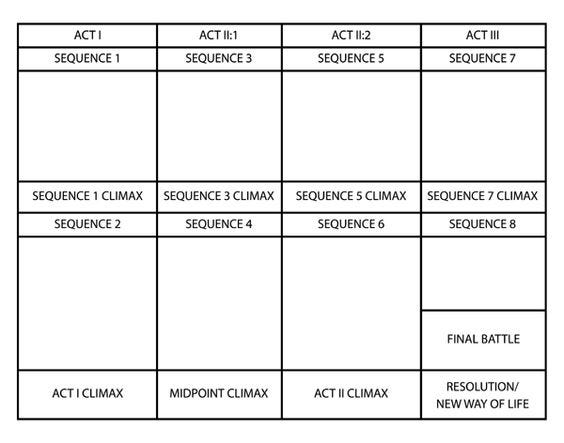
The 40-60 scenes that you brainstormed on Index Cards last week are all going to fit into this Story Structure grid - about 5-10 cards per Sequence. Which is the next step. But first let’s understand what this structure is.
Looking at that grid, you notice immediately that Act II really has two Acts, right?
Act II: Part 1, and Act II, Part 2.
In a two-hour movie, Act I is the first half hour, Act II is 60 minutes long, and Act III is about a half hour. So yes, in a two-hour movie this is actually a four act structure.
And even if it’s a shorter movie, which has more like three equal acts, it’s useful to look at that second act as two separate halves that are very different in tone.
In other words, it’s really a Four-Act Structure.
So why don’t we just call it the Four-Act Structure? What can I say? It’s been called the Three-Act Structure for over two thousand years. You can’t fight that kind of history! And really it’s more useful to hold that contradiction in your head - to acknowledge the dramatic principles that existed long before film came along, and understand WHY film added a different layer to that two-thousand-year-old Three-Act Structure.
Doing some basic math, here: each one of these four half-hour Acts consists of two Sequences of 15 minutes each.
This was the very rigid format that movies used for dozens of years because of a major technical limitation of film projection: The film reel.

One reel was all a projector could hold, and one reel could only hold about 15 minutes of film. So a 2-hour movie was separated into eight reels. A one and 1/2 hour movie was six reels.
And the thing about film projection is - when there’s only one projector in a theater (as was the case in most early theaters), after each reel, the projectionist had to manually change the reel. So there’s a break in continuity. And you know how audiences react if there’s some technical breakdown in a movie, right? You never want to break into that sense we all crave in a movie: to be caught up in an uninterrupted dream.

So early screenwriters (who were mostly playwrights, well-schooled in the Three-Act structure) really quickly figured out a way around this forced interruption. They incorporated the reel rhythm into their writing.
Every fifteen minutes they built to a cliffhanger — a climactic scene, that would ask a question or drop some explosive information, or throw in a twist so interesting that when that reel change came, the audience would be left in the dark… but not booing! Instead, they’d be dying to know what’s going to happen next.
That’s because of the Sequence cliffhanger - the climax of the Sequence.
It’s like an intermission in theater, only it happens every fifteen minutes.
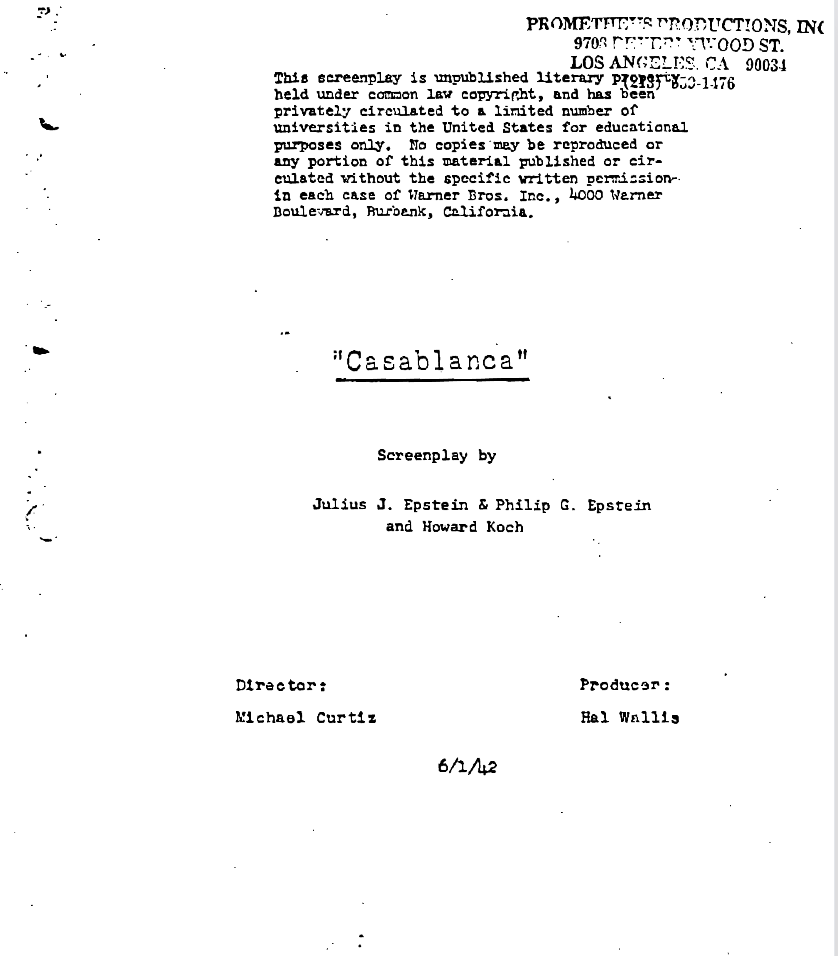
You can read older film scripts - try pre-1950!- and see those sequence designations typed into the script, every 15 pages or so: Sequence One, Sequence Two, Sequence Three, etc.
Obviously these days theaters have digital projection and no one is up in that projection booth scrambling to change reels. But modern films still follow that same storytelling rhythm.
Because what storytelling form came along mid-twentieth century that really locked that cliffhanger rhythm into place?
Right! Television!
That rhythm of building to a CLIMAX every fifteen minutes got locked into film storytelling with the advent of television, because you had to break for commercials.
And when the TV remote came along, you really needed those regular cliffhangers—because the audience didn’t even have to leave the couch to ditch the movie. When an ad came on, if they weren’t totally hooked, they could just change the channel!
So the Eight-Sequence Structure became an industry standard that is still being used - because it works.
Again, audiences expect it. So if they’re watching a film that is leaving some element out, or not giving the audience those regular climaxes, they get restless and start to feel like something’s wrong or the movie isn’t going anywhere.
You may have heard that movies are now written in Five-Act Structure. Some are, kind of, but it’s really the classic Four-Act Structure we’ve been talking about plus a TEASER or HOOK or PROLOGUE in the beginning. And yes, it’s useful in some genres to think of those opening scenes as a separate hook. We’ll talk more about it next post!
Here’s a footnote that explains Five-Act Structure further - 1
Now, we’ve been talking about the history of movies. But the thing you really, really need to understand about this Eight-Sequence rhythm is that it has hugely influenced the way books are written. I can’t tell you how many editors I’ve heard over the years say flat out that what they’re really looking for is a book that is like a movie playing inside their heads.
Well, a huge number of readers want that, too.
And you better believe that your reader, who like you has also seen thousands (Hah - make that tens of thousands) of movies and TV shows that use this rhythm, is going to be feeling it if you aren’t building to those sequence climaxes. (Let’s face it, we all need them…)
You need to be sure you’re giving them regular climaxes at the book equivalent of every 15 minutes (about every 50 pages in a 400 page book).
So that is the WHY.
Now, how do you learn to do it?
By watching movies and consciously looking for the pattern.
You already have this structure in your bones - just like your readers do. Now let’s bring it to the front and center of your awareness.
It is much easier to learn this structure with movies first, and then you’ll start to see it working in books and TV shows, which are obviously longer and usually more complex.
Now of course in a book we have more flexibility—a movie is necessarily a more rigid form than a novel. You might have an extra sequence or even two in an act, depending on the pace of your book. But again, roughly, a 15-minute sequence on film would correspond to 50 pages of a 400-page book.
This is why in my workbooks and workshops I take writers through lots of movies to point out these sequences and the must-have Story Elements that always happen in each sequence. Once you’ve been through a couple of movies in a row, it is incredibly easy to apply this structure to your own writing, and much easier to spot and fix your story problems.
So the first thing to do is to start watching movies for those eight sequences.
You can spot the climax of a sequence because it’s usually a SETPIECE: one of those big, memorable scenes that hopefully make film history, like the shower scene in Psycho, the orgasm scene in When Harry Met Sally, the Quid Pro Quo scene in Silence of the Lambs, Indiana Jones being chased by the boulder in Raiders of the Lost Ark. Any of the shark attacks in Jaws. Any of the musical numbers in The Wizard of Oz. You get the idea!
Try it! Take a movie you love, watch it with a timer, and note what happens around 15 minutes into it, and 30 minutes into it, and 45 minutes, etc. You’ll start to see those Setpiece Climaxes.
It is so worth your time to do this, because it will instantly elevate your writing. Because -
Now that you know you need a climax every 50 pages (or 15 minutes) you can go back into your book or script right now and quickly deal with those dull or sagging parts by working toward a climax at those regular intervals.
We’ll keep talking about this over the next few posts. But if you want to get right to it, below are some links to movie breakdowns.
I’ll just note one more thing. If you’re writing romance and looking at romantic comedy - those films can be closer to 90 minutes than 2 hours, and that changes the math. You’ll usually find a structure with three equal Acts and possibly only six Sequences. That goes for any shorter movie, so be sure to check the total running time before you view.
Again, this is all A LOT.
But there have also been some really excellent Substack articles on pitching and publishing this week. Too much to add in here, so I’ve done a separate post on my Writing Life Substack that gives you the ones I think are essential reading!
Here are some movie breakdowns for you to choose from:
The Holiday breakdown
Raiders of the Lost Ark breakdown
Die Hard breakdown
The Wizard of Oz breakdown
Or get one of the workbooks for ten full story breakdowns, act by act, sequence by sequence, story element by story element, and even more short ones.

Get the workbooks:
Stealing Hollywood ebook, $4.99, also available as print workbook
Writing Love ebook, $2.99
And I hate to have to bring this up - but there are some people out there who think they can get away with appropriating copyrighted material. Sharing with attribution is encouraged. Trying to pass my work off as your own is illegal.
All material ©Alexandra Sokoloff
Subscribe to Screenwriting Tricks for Authors for free weekly posts on story structure and book publishing. Paid subscribers get access to the full archives and the option of private feedback on your book or script issues.
Subscribe to the Screenwriting Tricks for Authors YouTube channel
for fifteen minute doses of craft to elevate your writing right now!
Likes, Comments and Shares are really helpful and much appreciated.
Share Screenwriting Tricks for Authors
Ready to Write a Book This Year? Browse the Table of Contents:
The so-called Five-Act Structure (in modern use) is another development from TV, popularized by streaming TV shows - which is really the classic Four-Act Structure we’ve been talking about plus a TEASER or HOOK or PROLOGUE in the beginning. Teasers used to be just a very short opening scene. Then premium cable came along, with more leeway for creativity than network TV, and those filmmakers started experimenting with longer teasers that sometimes felt like a separate act - Breaking Bad and Better Call Saul are great examples! And novelists, especially in the thriller and action genres, have jumped on to that innovation.
For you classicists, yes, Shakespeare wrote in five Acts - but those acts strictly follow the Three-Act structure of classic plays. If you look at Elizabethan plays, their Acts I and II constitute what we’ve been talking about as Act One, their Acts III and IV comprise our Act Two, and Act V is Act Three (shorter than the others, which the third act almost always is and should be).
Comments
Nothing yet. Say the first thing.
Sign in to join the conversation.