
Here are ten must-have story elements of Act I, no matter what genre you’re working in!

If you can write out these elements of your book or script, you will be in great shape to write A Book By the End of the Year. Which we are all going to do, right?
In my now very long experience working with writers, I’ve found that if I can get a writer to define these ten things about their book or script, they will need much less help with the rest of the book. Setting up these ten elements will almost always clarify a whole lot of what comes after Act I.
I’m not suggesting you don’t plan the rest of your book! But if you are a natural PANTSER - then getting these elements clear in your head means you can pants the rest of the book to your heart’s content but still have that road map keeping you from going too far astray.
And, if you are in the rewrite process, as I am right now - these elements are just as important to revisit. If anything’s not working in your book, you can be pretty sure that you’ve left one of them out, or underdeveloped it.
First, let’s see these elements in a in a narrative that gives you the basic flow of Act I.

We meet the HERO/INE in their ORDINARY WORLD.
They have:
A GHOST or WOUND or CORE TRAUMA, something that is haunting them from the past
SPECIAL SKILLS or SUPERPOWERS
And an ANTAGONIST, or several, who will stand in the way of the protagonist getting what they want, and possibly wants exactly the same thing that they want.
A Big Thing (INCITING INCIDENT) happens: the protagonist gets a CALL TO ADVENTURE: a phone call, an invitation, a look from a stranger, that invites them to change their life.
That Inciting Incident crystallizes a specific DESIRE, something that they want very badly.
That impulse may be blocked by a
Threshold Guardian
And/or the ANTAGONIST
And/or the character has INTERNAL CONFLICT; they are reluctant to take the journey.
But they overcome whatever opposition,
Gather a TEAM of ALLIES and maybe the advice of a MENTOR
Formulate a specific PLAN to get what they want
And Cross the Threshold Into a SPECIAL WORLD that is very different from their Ordinary World.
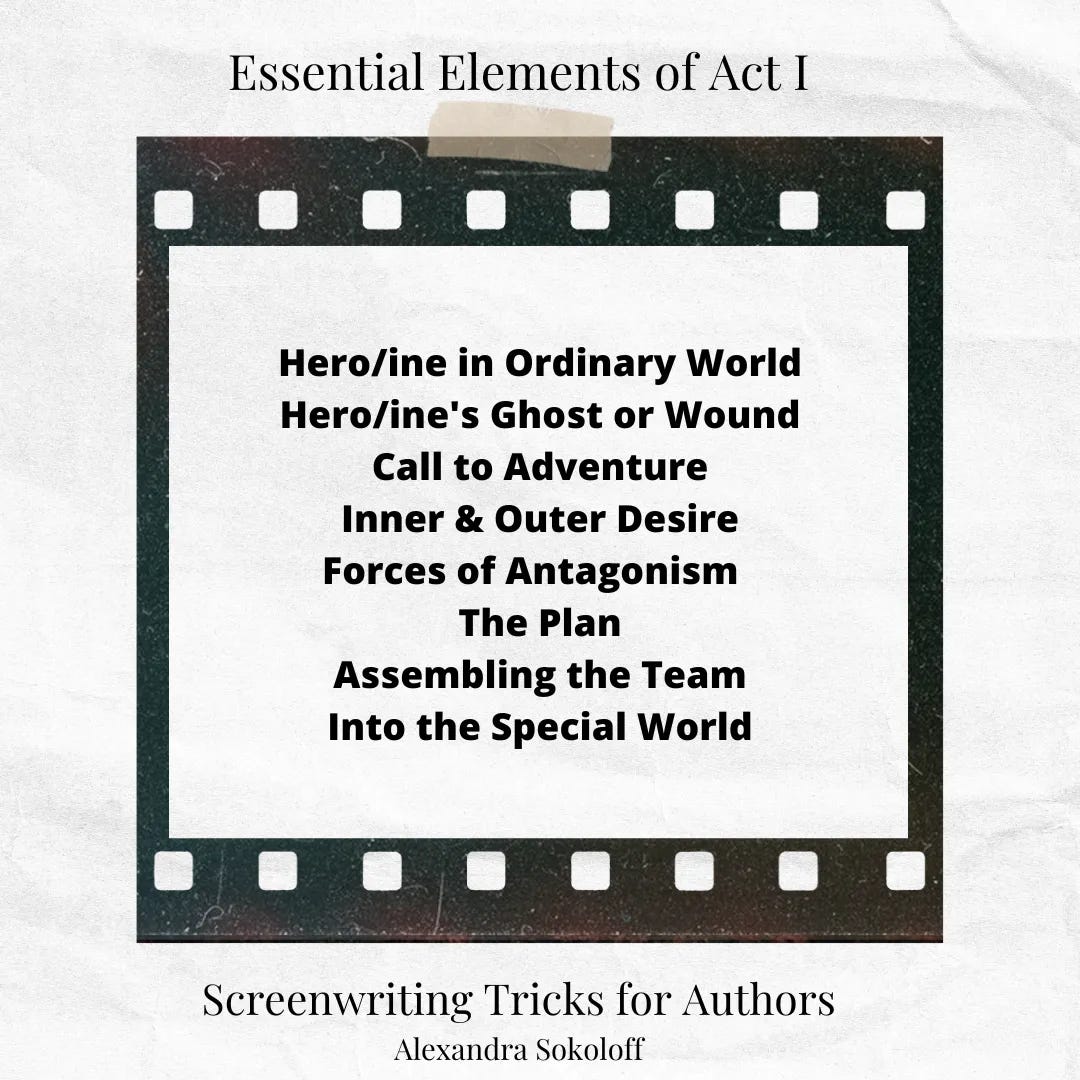
Here are some questions to help you define each of these Elements for your story!
(There are links throughout the following to in-depth posts and videos on these elements. You can also find in-depth discussions of Act I Elements in Chapters 7-12 and the story breakdowns of the workbooks: Stealing Hollywood and Writing Love.)
1. OPENING IMAGE/OPENING SCENE
What’s the MOOD, TONE, GENRE (s) your story sets up from the beginning? How does it do that?
What is the very first thing we see? Let the first part of the chapter play out in your head like a movie. How does it make you feel? Is there something maybe symbolic in the location, action, or composition? What might it tell you to expect from this story? Can you put what you are now seeing down on the page so that your reader will see it, too?
What kinds of EXPERIENCES does it hint at or promise? (through location, colors, pace, visuals, location, dialogue, symbols, etc.) Is there a big SETPIECE hook right away or are you starting slow?
Will the opening image or scene mirror the closing image or scene? (It’s not mandatory, but it’s a useful technique, often used.) How are the two, the opening and closing, different?
(Note: all of these are great questions to help you write your first chapter, but my advice is not to spend too much time on your first chapter on a first draft. First chapters often come together in your rewrites!)
2. INTRODUCTION TO THE HERO/INE
How do we know this is the main character? Why do we like them? Why do we relate to them? What is the moment that we start rooting for this person? Why do we care?
All of the following things about the protagonist need to be defined and dramatized:
What does the main character’s Ordinary World look and feel like? How might the Ordinary World reflect the inner life of the character?
* HERO/INE’S INNER AND OUTER DESIRE
What does the main character want? Or what do we sense that they want, even if they don't say it or seem to be aware of it? How is what they say they want going to turn out to be wrong?
* HERO/INE’S GHOST OR WOUND
What is haunting them from the past?
* HERO/INE’S CHARACTER ARC
Look at your beginning and then your end to see how much the hero/ine changes in the course of the story. That is their CHARACTER ARC.
4. INCITING INCIDENT/CALL TO ADVENTURE
What is the BIG THING THAT HAPPENS that forces the Hero/ine to take action?
How can you make this moment or sequence significant?
Ten Inciting Incidents to Help You Write Your Book:
* REFUSAL OF THE CALL (possibly - not always present)
Is the hero/ine reluctant to take on this task or adventure? How do we see that reluctance?
THE ANTAGONIST
(and/or the Mystery, which is what you have when you’re going to keep your antagonist hidden to reveal at the end).
How do we know this is the antagonist? Does this person or people want the same thing as the main character, or is this person preventing the main character from getting what they want?
A good story has multiple Forces of Antagonism. Who and what else is standing in the Hero/ine’s way?
4. THEME/ WHAT’S THE STORY ABOUT?
I always encourage writers to think of theme as not just a sentence, but a whole system of meanings.
Here’s how that works in Raiders of the Lost Ark.
There are usually multiple themes working in any story, and usually they will be stated aloud by one or several characters.
5. ASSEMBLING THE TEAM/ALLIES
How is each ally introduced? What are their individual desires or their group desire?
* INTRODUCE MENTOR (if you have one)
What are the qualities of this mentor? How is this person a good teacher (or a bad teacher!) for the hero? We may not meet the mentor until later in the story.
* INTRODUCE LOVE INTEREST (if you have one).
What makes us know from the beginning that this person is The One?
6. INTO THE SPECIAL WORLD/CROSSING THE THRESHOLD
What is the SPECIAL WORLD that the main character must enter in pursuit of their desire? How is it different from the ORDINARY WORLD? How can you make entering this world a significant moment?
This scene is so crucial it’s often - almost always! - at the Sequence One climax or the Act I Climax. Sometimes (as in the first Harry Potter) there are a whole series of doors or gateways that the protagonist must pass through.
* THRESHOLD GUARDIAN
Is there someone standing on the threshold preventing the Hero/ine from entering, or someone or something issuing a warning? This is a great suspense technique, often used, but not mandatory.
7. SEQUENCE ONE CLIMAX
In a 2-hour movie, this climax occurs about 15 minutes in. In a 400 page book, it’s about 50 pages in.
What revelation, location change, or big event happens that makes this scene significant?
8. HOPE, FEAR and STAKES
What do we, the reader or audience, HOPE for the main character? What do we FEAR for them? It’s vitally important that you spell these things out for your reader so that they fully engage in your story.
What are the STAKES of your story? What will happen if your main character doesn’t win?
What does the hero/ine say they will do to get what they want - or what do we understand they intend to do? The plan usually starts small, with a minimum effort, and gradually we see the plan changing as the hero/ine runs into obstacles. If it were easy, there wouldn’t be a story!
* CENTRAL STORY QUESTION/CENTRAL STORY ACTION
You can define the story question by identifying your Protagonist’s PLAN: and then stating the PLAN as a question:
Will Sheriff Brody and his team kill the shark?
Will Indiana Jones find the Lost Ark of the Covenant before Hitler’s minions find it?
Will Eleanor and Marianne rescue their family and find true happiness with the right husbands?
Try it with your own story. Now, can you have a character state the Plan aloud? When do we realize that this is the main question of the story?
10. ACT I CLIMAX
In a 400-page book, this takes place about 100 pages in. (In a script, it happens at about 30 pages in.
How can you make this moment significant? What is the change that lets you know that this Act is over and Act II is starting?
ADDITIONAL ELEMENTS/NOTES:
These elements may be introduced in Act II instead of in Act I—or may not be present:
GATHERING THE TOOLS or WEAPONS
And also possibly:
A MACGUFFIN (not present in all stories but if there is one it will usually be revealed in the first act).
A TICKING CLOCK (you may not have one or it may be revealed later in the story
And of course, always - look for and IDENTIFY SETPIECES.
But I always say - don’t worry too much about Setpieces in this first draft. Building Setpieces is very often rewrite work!
SETPIECES video
All content from the Screenwriting Tricks for Authors workbooks, © Alexandra Sokoloff
Why subscribe?
Screenwriting Tricks for Authors is a reader-supported publication. Please consider contributing to this work by becoming a free or paid subscriber!
Likes, Comments and Shares are really helpful and much appreciated.
Share Screenwriting Tricks for Authors
Subscribe to the Screenwriting Tricks for Authors YouTube channel
for fifteen minute doses of craft to elevate your writing right now!
Know someone who needs to read this post? Why not share it?
If you’d like to go through the brainstorming and plotting process with direct feedback from me on your story, you have a couple of ways to do that.
A paid subscription— includes the full Screenwriting Tricks for Authors archives. A yearly subscription includes access to the private forum, where you can post questions, problems, premises, story elements, or anything else for me to give you specific feedback on in a private setting.
The online class— which includes the private feedback, but also more intensively uses videos and written lessons to take you through the set up and writing of your novel or script at your own pace. You can sign up for just one section or all three parts.
You can find all of this material and more, plus ten full Act by Act, Sequence by Sequence, scene by scene story breakdowns in Stealing Hollywood and Writing Love:

Comments
Nothing yet. Say the first thing.
Sign in to join the conversation.