
For the last four weeks, I’ve been doing the hard work of sitting sweaty on my couch trying to observe exactly how my brain has morphed as I onboard a series of new meds. This is the third time I’ve done so in the space of a year, and trying to pick out where I end and the chemistry begins has been like trying to see through an emotional and cognitive kaleidoscope while surfing choppy waters. I can only hope the twisting movement is at last grinding to a halt as I approach the final stretch of habituating to these bossy and disruptive new molecules. My sea legs are over it.
The fun started at the end of last summer with HRT, which I knew I really needed when I started to experience emotional vertigo whenever the wind blew. I was rabbity, flushed, touchy as hell, dehydrated to the point of crispy, and rapidly accumulating soft tissue injuries. The tendonitis, calcium deposits and arthritis layered on my crumbling frame like deli meats on an Italian sub of agony. Menopause is pretty easy to diagnose, so the need was clear. It was hard to find a doctor in risk-averse France who would prescribe the treatment, but eventually I managed.
At first HRT made me weepy, moody and volatile—a less stoic version of the teenager I used to be, which is when I last experienced such an onslaught of hormones. But nobody told me that I would feel like I had no brain. It was so hard to concentrate during that first flush that I had to ask to extend a few chapter deadlines of a very research-intensive ghosting project that is thankfully no longer my cross to write.
About three weeks into topical gel and pills, the soft mess of yarn in my brain began to untangle. In every other unmentionable, lady-parts-related way, the experience has been felicitous. And with ongoing physical therapy, some of the injuries are even making progress towards healing. Strong recommend all around.
But that was just the opening gambit. I had assumed that the background anxiety that had been mounting in me for the past decade, and the insomnia I’ve struggled with most of my life, might also fade once I corrected the hormonal imbalance. I thought my brain, once it sharpened again, would also stop grinding on overdrive. That was probably unrealistic.
I’ve always been hypervigilant. I interpreted it through a psychological lens, though, as the result of bog-standard childhood trauma. Even then, anxiety was never my main complaint. My thing was depression, which I’ve been medicated for a few times in my earlier adulthood. Still, little by little, as I hit my mid-forties, I started to experience heart-pounding rushes of adrenaline whenever I had an oncoming stressor. Even with lady hormones once again flowing, the deadlines of my work that I once managed pretty well were causing me to crater with doubt, panic and a looming sense of defeat in advance. That’s not cute when you’re an old hack. Experience is at least supposed to give you confidence. Where did mine go?
You’ve been through a lot of change in the past ten years, I reasoned to myself. I am sure that all of you have too. If nothing else, we got the ass-kicks of Trump’s 2016 and 2024 wins. They fritzed out my system. I lived with constant red flashing sirens. Little on the world stage—the pandemic and its aftermath, the rising information war, the fires where we never had them before in France—has given me a reason to chill. And then of course there was all the personal drama. See Chapters One through Fourty-Four of this here publication for that backstory.
TL;DR: Upheaval has been my mot juste for quite some time. But now my insomnia was so bad that even the 5 mg of melatonin, and 1/3 of a Lunesta I had been taking for the past almost 20 years, every morning at 4am when I awoke unable to get back to sleep for love or money, was starting to lose its effectiveness. I began adding Xanax on top of it almost every night.
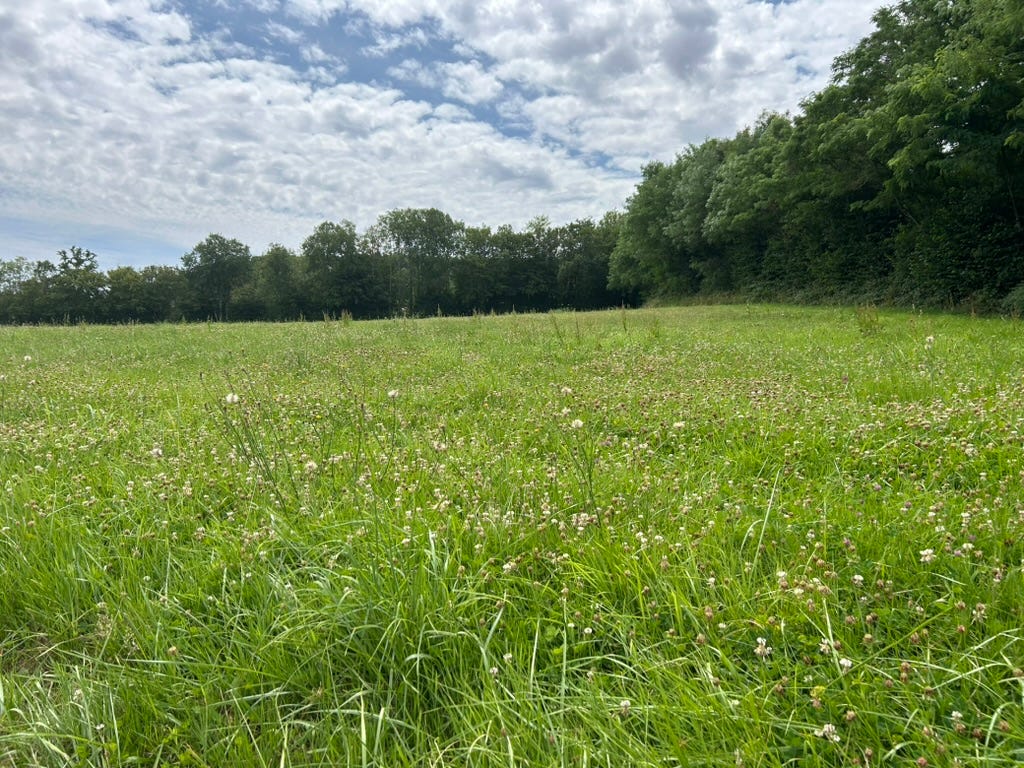
(Above, my brain off drugs.)
The aforementioned two pills are benzodiazepines. One side effect of continued use like mine is memory loss—above and beyond the normal slippage due to aging. I gave into list-making about the same time that I moved out here and the stakes of forgetfulness raised because grocery store trips require a 20-minute drive. But it’s been getting steadily worse. I have started forgetting things like what I ate yesterday, the names of my neighbors’ kids, and the whole identities of many, many people I have passed quality time with. If I see you and look past you, don’t take it personally.
All that is annoying as fuck when you write something memoirish almost twice a month. You need to remember stuff. It’s even worse when you segue from writing 1,500-3,000 word articles to writing books. Short articles are sprints. You spend a week on and off on research and interviews, a day or two writing fired up by the pressure of your deadline, and basta. You need a little time off afterwards because running very fast for a couple of days straight while concentrating for hours at a time is tiring.
Books are not just marathons, they’re marathons inside of hedge mazes, full of elaborate puzzles within puzzles that you construct, and then try to deconstruct to make sure everything holds together. Arguments don’t have to progress over a few pages, like in an article, but a few hundred, and they have to build on each other to a grand statement that should stand the test of time. It takes different parts of your brain to tackle books: the sorting part, the patterning part, the plotting part, the juggling many strands part, the overarching big picture part, the commercially minded part that writes loglines, the editor pleasing part as you go along. You have to work off of pre-agreed outlines and stick to them so there’s less improvisation, which is where the fun usually comes in. It takes months and months and months before you’re done, so you have to be both patient and fast at the same time.
Approaching writing a chapter of anything felt like standing on a very high cliff looking down. I needed multiple stops and starts before I could find a flow and let myself be carried by momentum. Reading through and editing as I went required me to keep too many elements in the front of my mind at once. I’d get stuck refining the first half and run out of steam before the end. The worry and anticipation that I wouldn’t have the energy to get it all done made it even worse. Even with subject matters I was comfortable with, I didn’t trust myself to handle the information like I had for the past 25 years because there was more of it and seemingly less of me. I started to doubt absolutely everything.
The rising nerves and diminishing efficacy of the tranquilizers I relied on to sleep couldn’t continue. Thankfully, I have a good shrink, one of the newer breed who prefers to manage trauma and dysfunction through the nervous system with non-Freudian techniques like EMDR, Brainspotting and Lifespan Integration. Working with him I had already been able to cut back my booze consumption by quite a lot, and in a serene manner. I didn’t have to go fully sober or do anything radical, I just decided I wanted to do it, stepped back, and found it was weirdly easy to get a handle on, where before I found it terrifying and difficult.
When I told him I needed to tackle the insomnia, we started to talk about ADHD. I suspected I might have some kind of attention deficit, now that the kind of work I was doing required more of it. He referred me to a psychiatrist colleague.
That was how I found myself on a Zoom with the French version of The Dude down to the meditation bracelet, leather cord man-necklace and mush-mouthed surfer drawl. He asked me a few vague questions about my youth. Was I depressed as a kid? Maybe, but I wasn’t treated for it until I was grown. Did I have trouble in school? Not really. I mean, junior high school teachers thought I wasn’t working up to my potential, but what smart kid who likes to doodle and procrastinate hasn’t heard that? I was never jumping off the walls or shouting. He shrugged. “If you find yourself suffering from depression, call me back,” he said as we ended the Zoom. Hang loose, I guess.
My shrink pressed me to get another opinion, so I got a referral from Michel, who has had his own history with psychiatry and the alphabet soup of neuroatypicity. This time the other end of the Zoom had the look of a John Hughes villain—floppy hair, thick eyebrows, upturned collar—but with a John Hughes hero’s bedside manner. He repeated the Dude’s questions and added a whole bunch more: about my memory, how I handle stress, whether I feel a lot of shame, and whether I am very sensitive to rejection. Check to the last two especially. He asked me if I could tolerate silence and I laughed out loud. “God no,” I said. “I have a background podcast running at all times.”
Ten minutes after we got off the phone, he sent me a remarkably detailed synopsis of our conversation and a prescription list as long as my arm. An SSRI for the anxiety and insomnia, an antihistamine-based sedative for weaning me off the benzos, and an amphetamine for the ADHD that I have been apparently masking for most of my life, even from myself.
The onboarding has been wild. The SSRI had me more nauseous and agitated than with past episodes, and then serene but highly unmotivated. “Just happy to be nominated” is how Charles described me when he showed up the other day. The sleep has been luxurious, though. Nothing under seven hours, at times reaching to ten. Now that we’ve all gamified sleep with our Apple Watches, I am on the leaderboard with my scores. #winning. Then I started the speed, which I was terrified of, but which has mostly been clarifying, and has not suppressed my appetite nor caused my sleep championship status to wobble. I am halfway to my full dosage, which I should reach by next week.
In the meantime, Claude and Google must have snitched because every algorithm has started coughing up a wonderland of “neurospicy” content. (Yes they call it that.) I learned that I didn’t have enough dopamine or serotonin to get through anything but short turnaround journalism. The fact that I started writing my master’s thesis a week before it was due now hits a little different. It turns out that my need for background noise, like my old habit of nail biting, is a form of “stimming,” or stimulation seeking, trying to create urgency and threat to get myself to manage boring-seeming tasks that other people can start more easily. Same with the constant scrolling I do. Et cetera.
Does everything unresolved in my life suddenly makes sense? It’s tempting to go there. I mean, maybe all the default shame wasn’t due to long ago failures to please my too-often absent father, it was just my wiring. Do I now retroactively absolve myself from all my complexes? Or am I simply doing the same thing I did when my father explained astrology to me? Back then, when I looked at a bunch of planets and angles and signs that showed me to myself in a different way than before, I thought I had found the answer to life’s great mysteries. Then, after many instances when life didn’t go according to what the planets seemed to predict, I realized that all I had found was another language in which to ask the same questions.
Luckily my navel is large enough to contain it all.
As everything levels out, I will leave the house enough to be able to tell you some stories generated from elsewhere than the thoroughly excavated innie of today’s. I assume some of you have gone through your own diagnosis epiphanies, though, and figured perhaps you could relate.
No posts
Comments
Nothing yet. Say the first thing.
Sign in to join the conversation.