
If you’ve followed this newsletter from the beginning, you have witnessed the gradual process of someone finding their place in a landscape that was once alien and intimidating. Staking your claim comes in fits and starts, and there are milestones along the way.
A big one is when you let go of your hypervigilant reflex to people please and stop worrying about whether your neighbors think you’re a pain in the ass. You stop stepping around other people you assume have a more genuine right to exist and become a problem for them to work around. I have never really leaned into this kind of entitlement before, but I am learning.
There has always been a hierarchy in Le Perche. At the very bottom are the weekending Parisians, who are mostly seen as invaders, rolling through in shiny company cars and expensive strollers, clogging up the fancy wine shops on Saturday, maybe even daring to show impatience at the farmer’s market. No one wants to be taken for one of them. This is why the village gays who acquired their country house around the same time I showed up full time are so willing to brave the August heat to work the grill at the annual fête de village. Backslapping with sheep farmers working side by side as the chipolatas and foul-smelling andouillette reach optimal char is a small price for them to pay.
Next come the transplants who live here full time, like Charlotte the painter, Jeannette, Cassandre, Jean-Yves and now me. We’re not just passing through. We go to all the town meetings and ask pointed questions of the powers that be. About half the members of the comité des fêtes, the all-important party planning committee, hail from this group. Some have real ambition, like Francine, a helmet-haired, semi-retired accountant who moved in around the corner from me three years ago. “I like to get involved in where I live,” she said through gritted teeth as she introduced her candidacy for assistant mayor. For lack of a challenger, she won.
At the very top of the pyramid are the maximiens de souche, the sons of Saint-Maxime’s soil like Johnny and Baptiste, whose roots run generations deep. We transplants regard them with the same deference we might have for the giant heads of Rapa Nui. They’re part of the landscape. They have genetic memory going back centuries. They don’t talk to you, and you don’t mess with them.
White-haired, about as tall as my shoulder, occasionally beet red from too much Ricard at the pétanque court by the trash bins, Johnny lives next door to Jean-Yves. I have been introduced to him fifteen times and we have never exchanged more than a barely audible bonjour. Johnny’s mother used to own Jean-Yves’s house, and he has very definite ideas about its landscaping. It doesn’t matter than Jean-Yves now earns his living designing gardens. Maybe that makes it even worse.
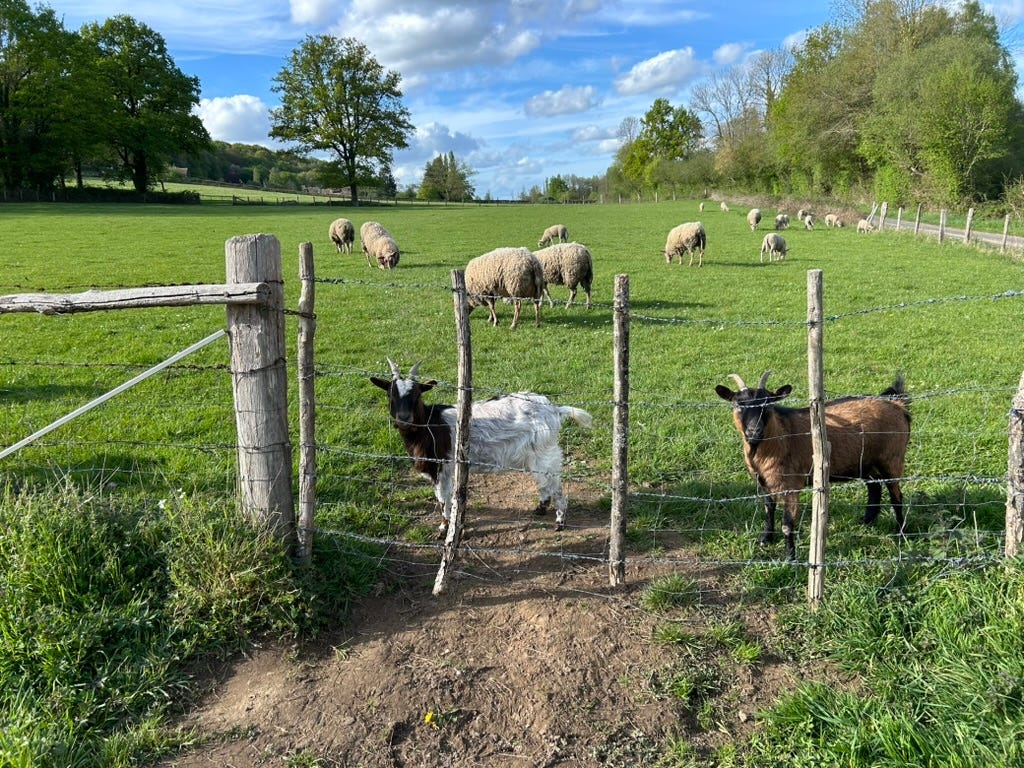
It started with a few offhand comments about hedges. Johnny was sure that Jean-Yves’ latest planting would attract snakes. (While a tiny garden snake once got under my front door jamb, to the bewilderment of Eleanor and Lucy, and there are two poisonous varieties native to the area, they are uncommon.) Jean-Yves said nothing at first, heeding the taboo. The unsolicited suggestions and sly comments mounted. Now it’s gone so far south, a month ago, Johnny hacked up Jean-Yves’s hedge without permission or warning. Benoît, the new mayor, had apparently let it be known that he wanted maximiens to take more responsibility for their yards. This was Johnny’s excuse at least.
When Jean-Yves told me about it, I pleaded with him not to cause a scene.
“He feels entitled to do whatever he wants,” I said, as if it that should be the end of it rather than the beginning. Jean-Yves wasn’t quite so easily cowed.
“’I explicitly ask you not to prune my hedge,’ I wrote to him, tout court, in a text message,” he explained. The point was to build a paper trail in case he ever has to lodge a formal complaint. If he was once worried it might turn out like it did for Cassandre, who let an offhand comment slip in front of her across the street neighbor, and found a blown-out tire on her doorstep the next day, he has moved past it.
I took inspiration.
Baptiste lives in one of the scruffy row houses in the small lot opposite my kitchen. The lot is named for one of his relatives, who was the mayor of Saint-Maxime for a seemingly endless mandate decades before I ever showed up. Baptiste is retired and told me once that he gives carriage rides for extra money, though I’ve never seen him on a horse, let alone pulling anything behind one. If he’s home and it’s not pouring rain, he’s usually sitting on his stoop, distant but in the sightline of my kitchen table, patently ignoring how far his two off-leash English Setters are roaming, or what they’re doing once they’re out of view.
If he asked me, I could tell him what they’re up to: shitting in my garden.
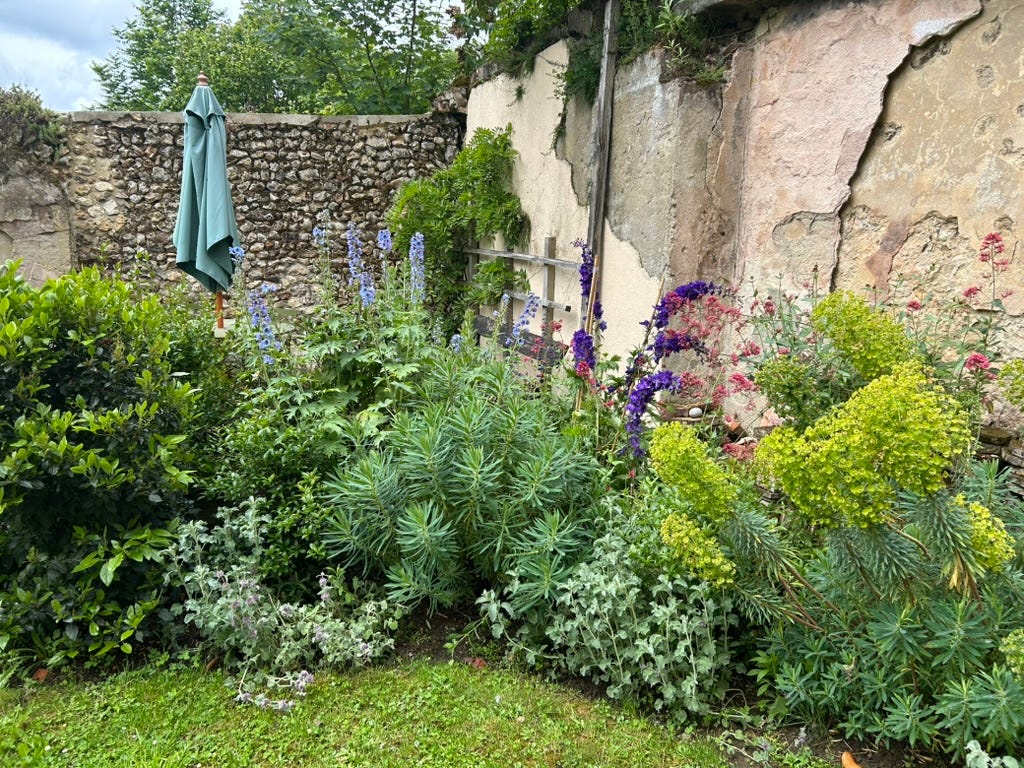
I’ve never had my own garden before. I’ve never lived in a freestanding single-family dwelling without the rest of a family until I arrived here. I’m slowly getting the hang of all the “my” that comes with the arrangement: my backyard, my view of the forest from my bedroom window, my delphiniums, whose ruffled stalks of electric blue I photograph every other day from mid-May until the end of summer when they finally go to seed.
Baptiste plays the jolly paysan. He likes to flirt with me when he mansplains like he did the other day, about the Virginia creeper ivy on the front of my house. “You’re going to have to fish it out of the rain gutters, you know, and then you’re going to ask me for help with it,” he said with an exaggerated wink.
No, I won’t. I keep my distance because I know he is a live wire. Underneath the high-pitched jocularity, he’s seething ever so slightly. I saw it at a village-wide meeting about trash collection, in the ease with which he raised his voice at the suits who wanted us to start using fobs every time we disposed of anything that wasn’t recyclable. He was furious at being tracked, sure there were soon going to be new taxes imposed and had zero interest bending the knee.
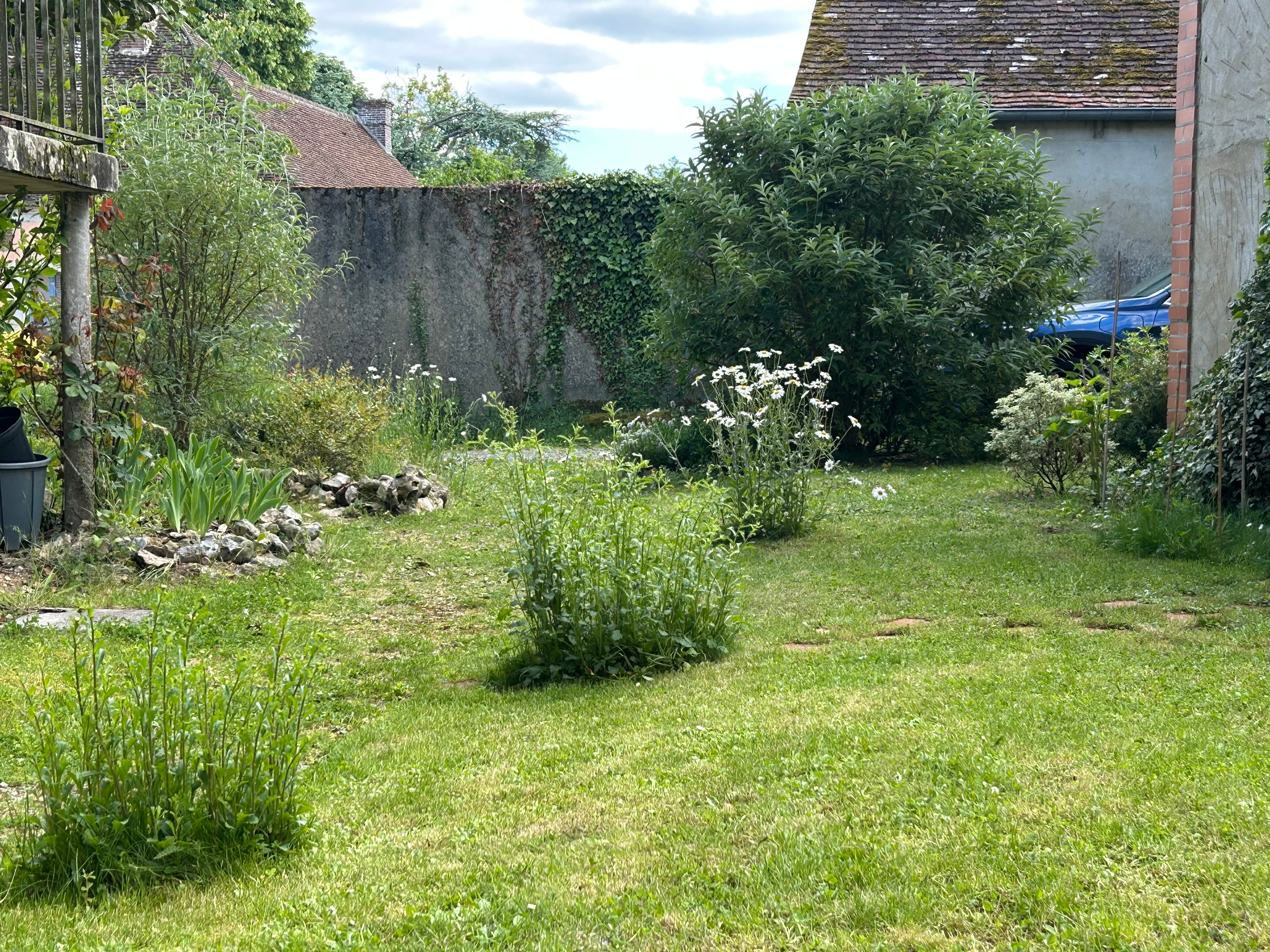
So I was very ginger with him a couple weeks ago when I pulled up to my front door to unload groceries and saw his dogs squatting in front of my house. Once, my first instinct when faced with a friendly English Setter was to hold out my hand and pet it. Now I yelled at them to get off the tiny slice of green that passes for my front lawn. Literally.
I got out of my car and walked over to Baptiste’s. He was having a whisky on his steps and gave me a look like he thought I might have finally come around to realizing his undeniable allure.
“Your dogs have always seemed really nice,” I told him, fixing my expression so I was grinning, but visibly a bit strained. “It’s just, they’re coming over and leaving piles.”
He rolled his eyes. “What am I supposed to do?” he asked. “I don’t have a yard for them.”
“They should be on a leash,” I said, stating the obvious. He rolled his eyes again, as if to say, sure, I’m going to put my dogs on leashes and ask permission here in this place that was once my family’s fiefdom.
“There are elderly people here who could trip and fall on a dog,” I said. Citing the welfare of the elderly is a civic ace in the hole. There is nothing anyone can say to counter that.
“Next time you see any cacas, let me know and I’ll come pick them up,” he hissed.
Normally I’d have stopped the conversation there, for fear of an emerging rift. But this was my lawn and its sacredness as an icon of expansionist homesteading was finally fully clear to me.
“There’s at least one fresh one there now,” I said, turning on my heel to return to my groceries. Two hours later, sitting in my kitchen, I heard a knock on the glass and saw Baptiste scooping poop. I opened the window and gave him the thumbs up as he shook the small plastic bag in my direction.
“There were three,” he said, admitting defeat.
“Anything with animals now, I go straight to the police,” Cassandre said the other night in her backyard over some chilled Sylvaner and tarama on toast. As she the words left her lips, a fat orange and white cat hopped over her fence into her backyard. It belonged to her new next-door neighbor, a woman who looked to be in her 30s. Like us, she is now living in Saint-Maxime full time, with a husband and a dog. Since she and her menagerie only just got here, it was up to us to throw our weight around.
“Honestly at one point I would have put out poison,” Cassandre continued. I hoped she was exaggerating for shock value but couldn’t be sure. “But you know, that’s a serious crime.”
The second cat popped over a few minutes later, and I made a lot of noise chasing them both off, my extravagant display of displeasure so that the neighbor would understand we saw her cats as interlopers. Even though I secretly wanted to hug them, we had a pecking order to guard.
No posts
Comments
Nothing yet. Say the first thing.
Sign in to join the conversation.