
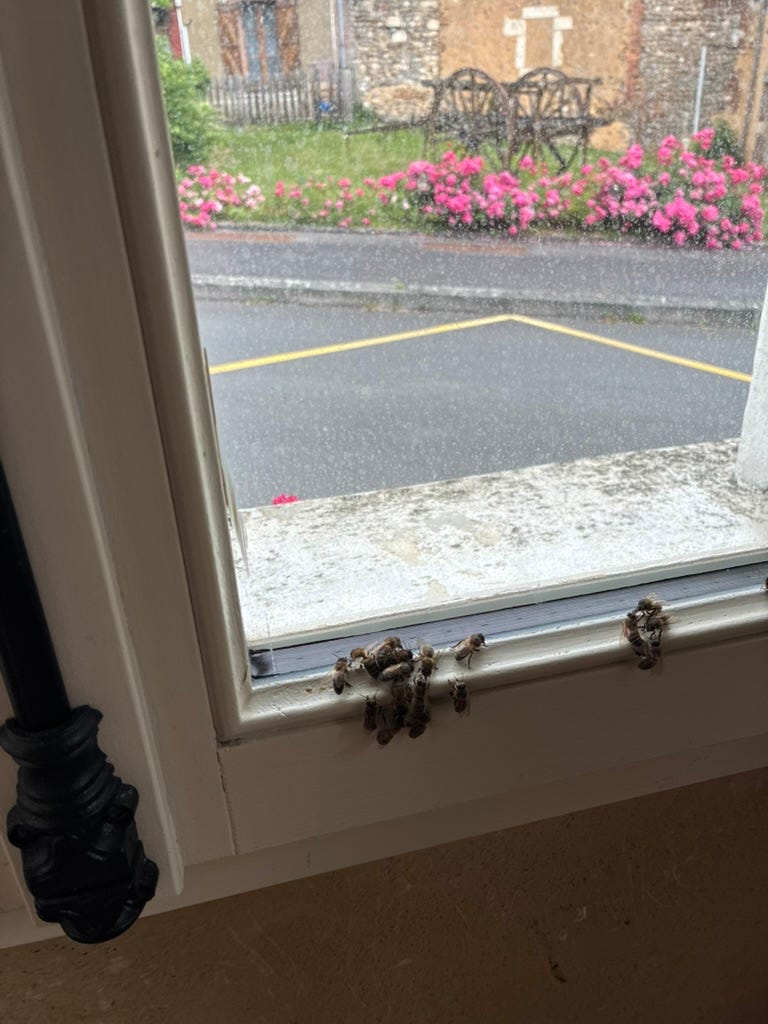
This Monday, as Jean-Yves was mowing my lawn, he got strafed by so many of the horseflies that had arrived with our latest heatwave, he called it quits after an hour. Those flies are nasty bitches who bite hard and leave an angry, zitty looking boil in their wake. The gays of Lower Normandy don’t need Jean-Yves disfigured and itchy. None of us do.
I was up in my office trying to get a story written that was due later that day, so he sent me a text to let me know he was on his way out.
“Go check your chimney,” he wrote. “I just saw there’s a group of bees up there trying to get inside.”
God damn it.
Regular readers of this newsletter may recall my two brushes with a bee colony last spring. Hundreds of scouts invaded my living room and office, having ostensibly identified the chimney conduit on the south side of my house as a nice place to build a hive. Their next step could have followed one of two paths: either they would signal to their compadres to come join them, the queen would arrive, and I’d be swarmed. Or they’d decide to keep looking and move on.
Repeated calls to M. Dupont, a local beekeeper, went ignored. My breathless entreaties never merited so much as a return text. To be fair, when I am flustered, my French falls off. He might have thought I was a teenage prank caller or an AI hallucination trying to sell him solar panels. (The renewables robocalls have become an even bigger blight than insects in France.)
So for days, I guided the bees towards open windows with dishtowels and pieces of paper and eventually, from what I could tell, they split. Neighbors had warned me that bees sometimes come back, but for the rest of that spring and summer none did, so for all I knew, I was out of the woods.
Welp. It turns out that bees have longer memories than menopausal women.
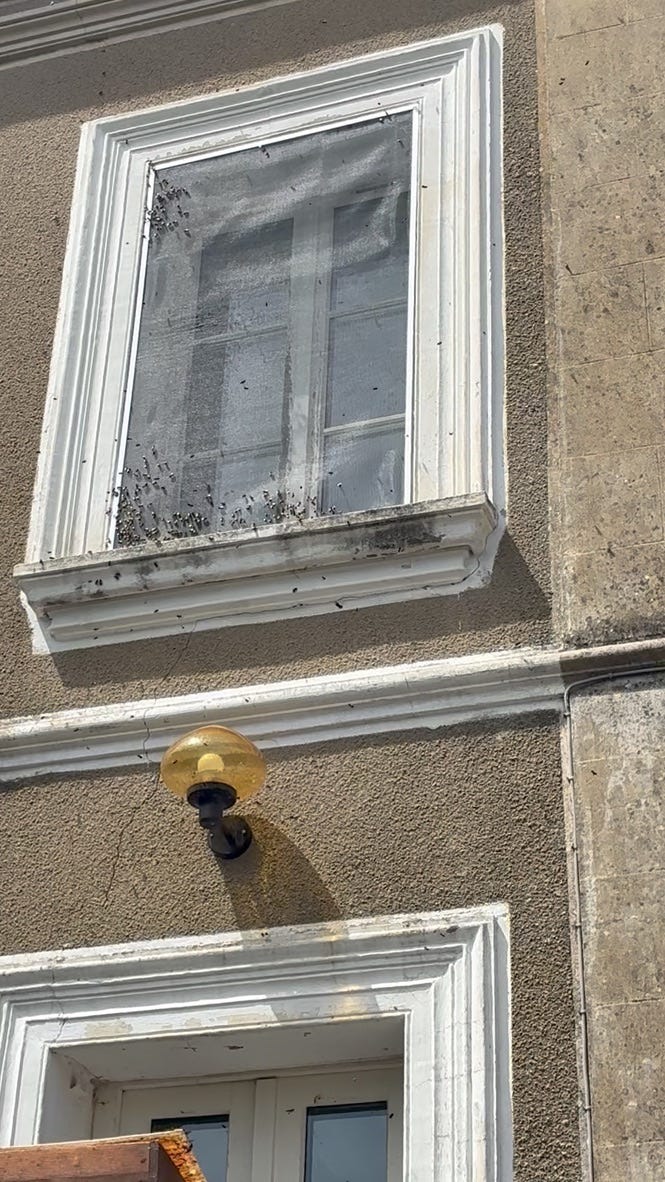
After receiving Jean-Yves’s message, I didn’t even have time to get up from my desk before five honeybees were circling the air around my desk, heading towards the one open window, next to me. That window has a screen. They couldn’t have gotten in from there, any more than they could get out, so where were they coming from? I got up and crossed to the other side of my office and that’s when I saw them wriggling up through the floorboards around the chimney conduit, one after the other, like an especially unwelcome conga line. I put books down to block the biggest openings in the floor, called Dupont, and this time, he picked up on the first ring.
He was cordial, but very to the point. “Do you hear anything in the chimney?” he asked me.
I went downstairs and put my ear next to the drywall that partially encloses the evacuation pipe connected to the wood burning stove in my living room. (I say partially, because there is a giant hole all around the pipe, waiting to be covered by a metal trap door that I have yet to order.) I did hear a faraway hum, the slightest vibration, and told him as much.
He said he’d be right over, and ten minutes after I hung up, there he was, Jean-y on the spot (sorry), softly knocking at my front door, all of 70-ish, potbellied and tan, in an olive wifebeater and jorts.
That alone was miraculous. Urgency isn’t usually a thing when it comes to services out here. The gas company has no other choice, but if you’ve got a water leak or a busted heater, you get nowhere just looking up a number and cold calling. It takes referrals from proven sources to get any joy. And even then, appointments take weeks.
When the tradesman finally arrives, you receive them with royal levels of courtesy. Coffee is offered, and flattering small talk is made during which you, the client, behave like a supplicant to prove that you are not the type to bark orders and throw money around; you are a member of the same team. Only after the large sugar cube is dissolved in the demitasse cup does anything get started.
Dupont dispatched with the pleasantries right away and followed me up to my office. Thankfully Eleanor and Lucy had beat it because there were now a good 50 or so bees in the room, throwing themselves against the screen in vain. Dupont looked under the books, found ten little strivers on the come up and said, “No, this won’t do.”
They could wriggle around the books’ flat surfaces, he explained. He told me to bring him some dishtowels, so I ran downstairs and came back up with a rainbow of microfiber cleaning rags. He whipped out the Opinel pocketknife that every French man of retirement age is required to carry on his person at all times and started wedging the rags into the gaps in the floor wherever he could. “Keep the windows closed now,” he said, gesturing to the outside, where suddenly there were thousands of bees churning in the sky.
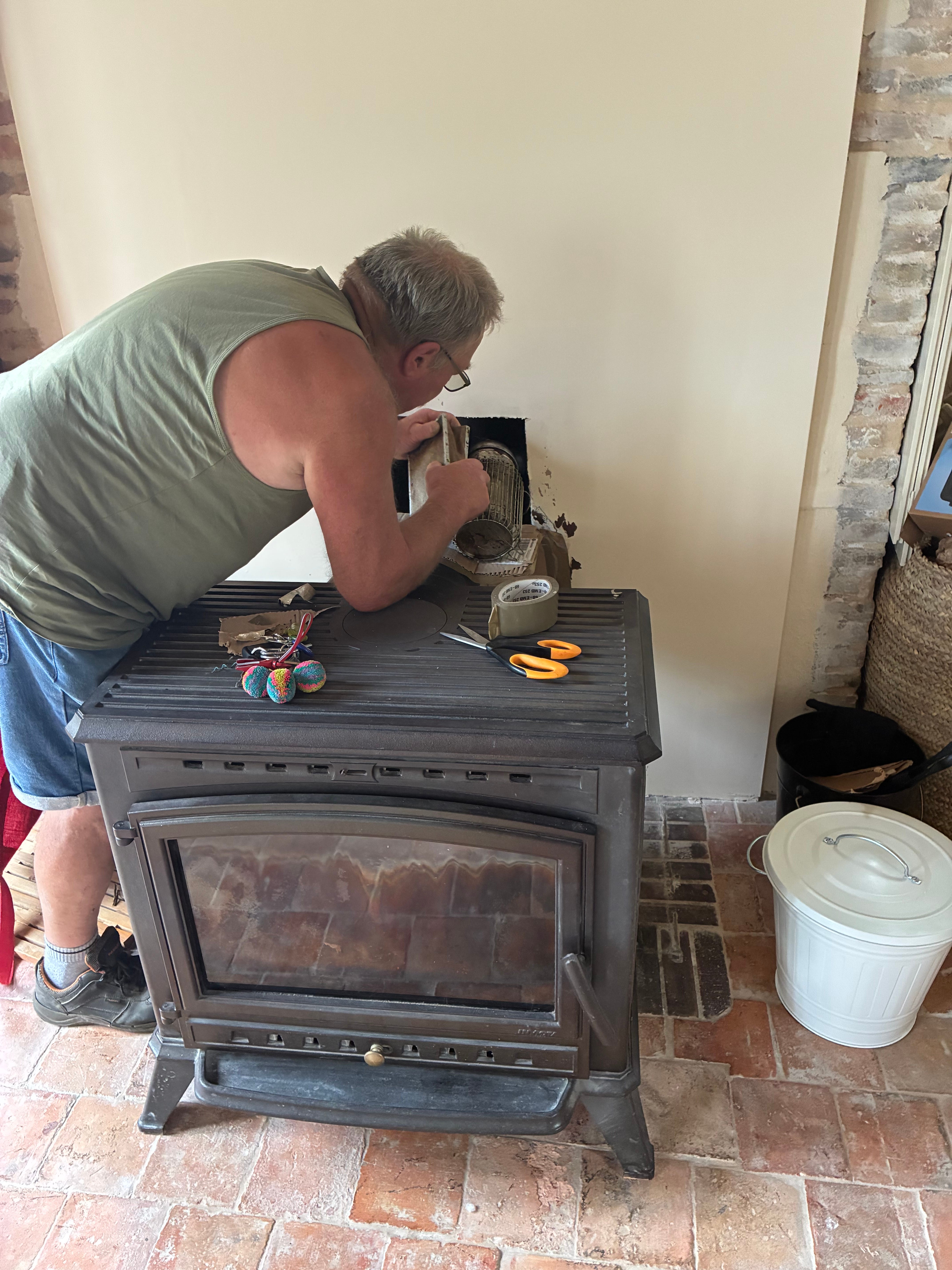
Dupont laid down the gameplan: we’d try to smoke them out and set up a small hive nearby with some food in it, hoping to lure them to greener pastures. He zipped out to his truck and returned with a sort of tin lantern with an attached bellows that he filled with dried straw, and topped with some fresh dandelions he tore out from the front of my house. He lit the thing on fire, affixed the lid, came back in and pointed it into the flue, patiently pumping sweet-smelling smoke up into the unseen heights of my house’s digestive tract. By now the living room was even more crowded with the bees than my office.
“If they’ve lodged in between the ceiling and the floorboards upstairs, and they’ve started to build a hive, we’ll have no choice but to use poison,” he said grimly. “I can’t smoke them out near the floor or I might burn your house down.”
I did not want mass death on my hands any more than I wanted a three alarm blaze in the room I had finally gotten painted. Like Dupont, whose entire career is tending to hives, I wanted the bees to get through this. But we had a small window of time. “If they build a hive and stay, later on in the summer, they will start to get much more aggressive,” he warned.
I thought back to last year, when Lucy chased one of the bees in the living room, got stung in the head, swelled up for a hot minute, and spent the rest of the day scratching herself under the dining room table. I knew from that experience that she wasn’t allergic. But what about Eleanor? And what might happen after multiple stings?
Thus began four hours of Dupont and me making trips up and down the stairs, between the office and living room, smoking, shooing, surveying and praying. Every few minutes, Dupont would go outside to see how the bees were behaving. He was looking for signs the queen might have fled. Or that the colony might finally be finding their hopefully future home. “Once a few find the food, it might take a while for them to spread the word to their friends, but the rest should follow.”
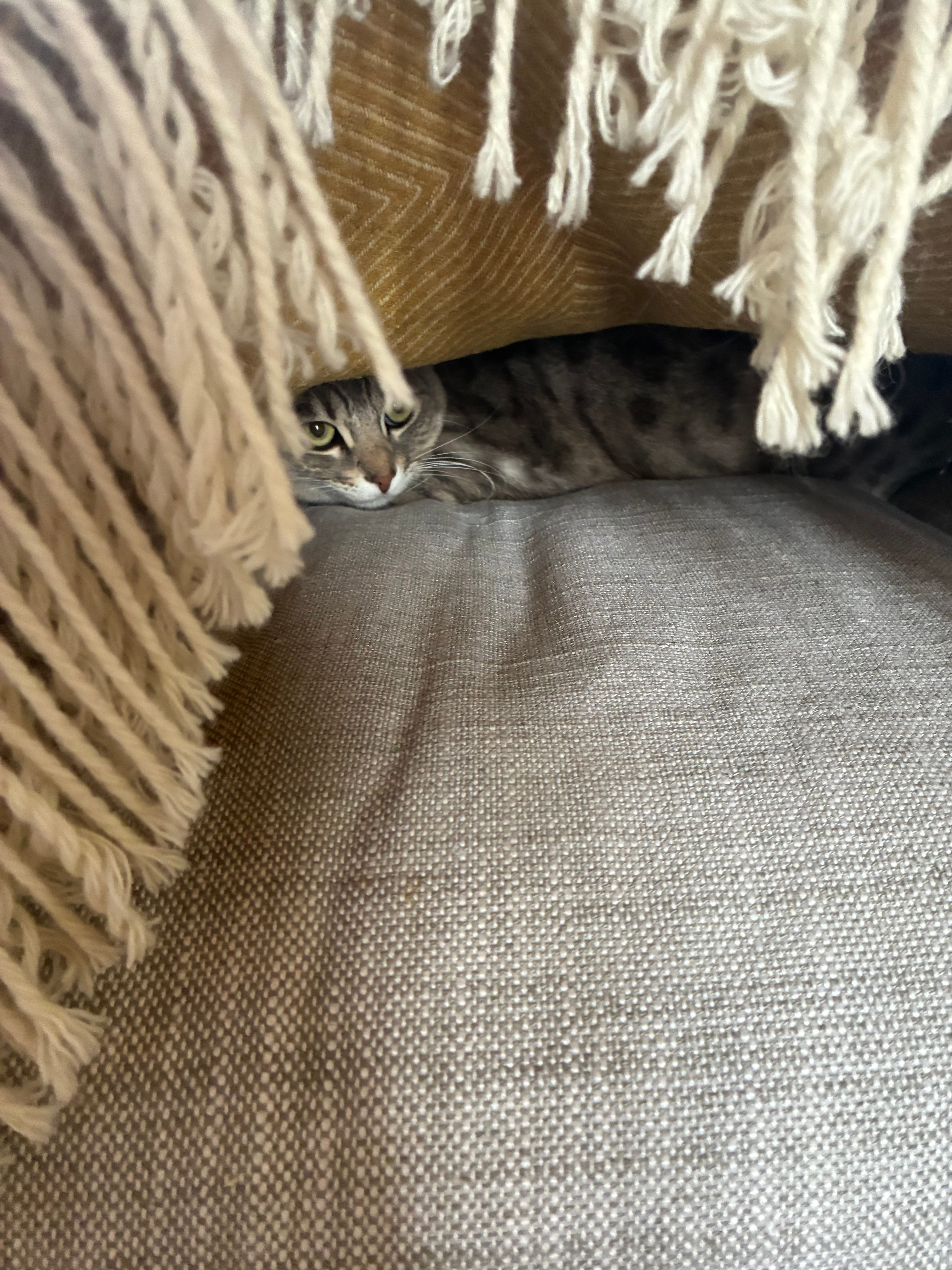
After the fifth or sixth trip between the two afflicted stories of my house, I had finally located the cats. Eleanor was under a blanket in the living room and Lucy had wedged herself under the couch. But when I went back up to the office and saw even more bees had gathered, I started to lose hope.
“Get your vacuum cleaner!” Dupont chirped.
“Are we giving up already?” I asked.
Not at all. Here’s a fun fact: honeybees can survive being sucked into the belly of an appliance. So I started gathering them up by the dozens, then holding the vacuum out the window and cracking open its trap door to let them fly out into the sky. This was working so well I was starting to actually enjoy myself until 20 minutes later when the battery ran out.
By then Dupont was grabbing them by the wings and flicking them out the window. I reached for another dishrag and started swatting but by now the subtlety was sapping from my gestures. I stopped coaxing and started flailing as they kept replenishing themselves and I gradually lost my ability to focus.
That was when the first one stung me in the nose. Then the second. I screamed and Dupont turned around. He brushed the stinger from the tip of my nose as it started to feel like someone was holding a cigarette lighter to it.
“Take a rest,” he said, so I plopped onto the daybed in my office slackjawed while Dupont went to get more dried straw and continued to work the chimney. I hated sitting there like a lump while he was so busy. The immediate pain from the stings started to ebb, and I recovered some pep, so I started to shoo the bees again. It was better than just sitting there.
That was when I stepped on one of the 50 or so dead ones on the ground and got stung again.
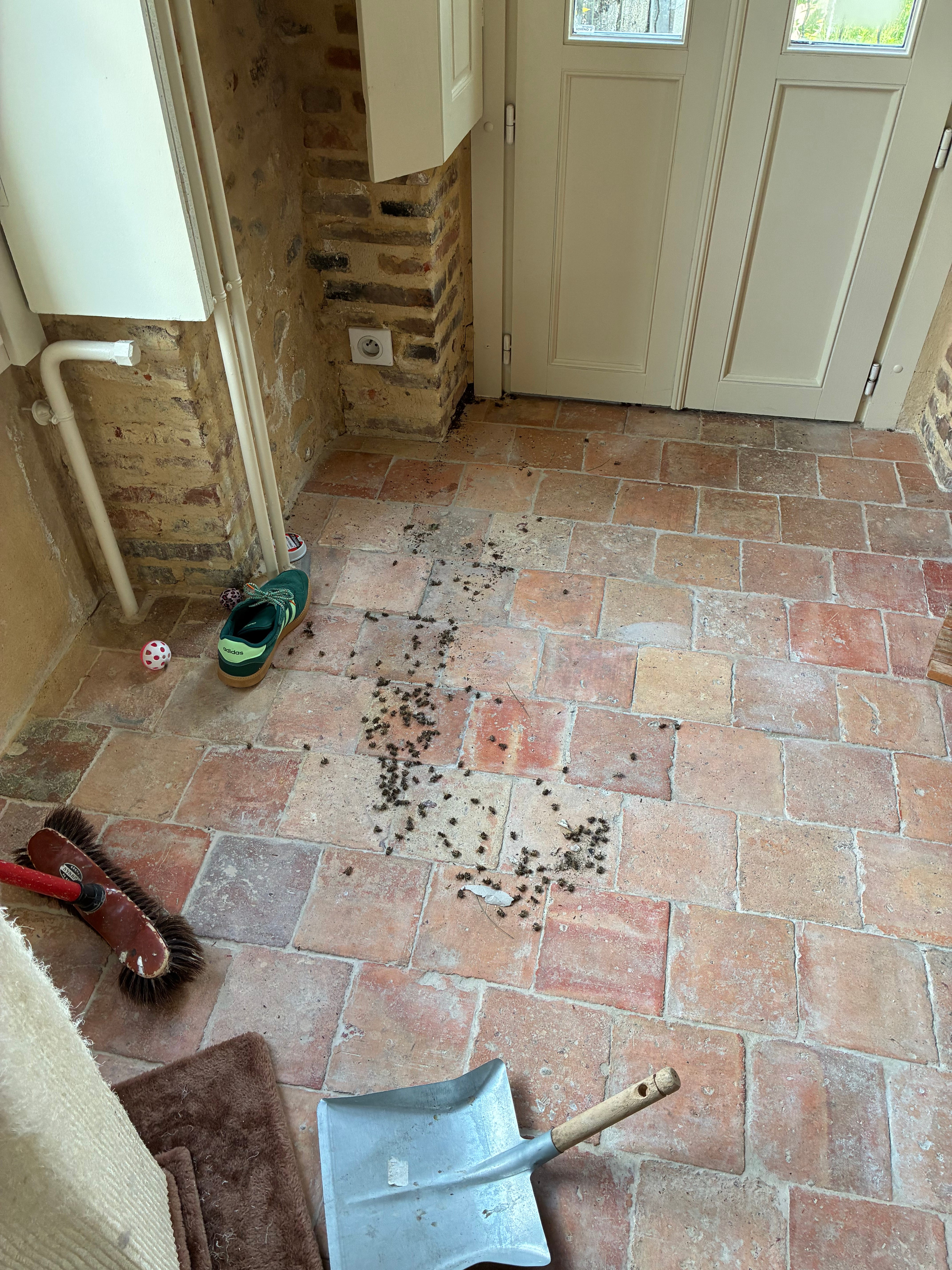
I screamed, found the stinger on the inside part of my right heel, and felt the rage inside me mount. As any mother of small children will attest, you start with the best of intentions, and gentle and loving thoughts, and then eventually you see that none of your benevolent interventions are working. Fatigue and resignation team up, something more primal takes over, and the hammer comes down.
Normally I take pride in being peace-loving. A negotiator with a smile looking for a win-win. I rarely go to the mat with my colleagues, both because I am conflict avoidant as hell, and because I really do believe that very little in the present is worth a big damaging upset that could jeopardize the future. But in that moment, I transformed from a kindly protector of the Lower Normandy ecosystem to a Viking defending my island. This was no longer an accident of nature. These were hordes.
Dupont had by now concluded that we had to start spraying, which was good news to the villain in me that had finally gotten out. He went back out to his truck and returned with a big red can of something as angry looking as I was. He apologized several times, possibly to me, but probably also to the great bee god he served, and gently tapped the nozzle. Out came a shy few toots of toxins into the crevices and corners where he had stuffed the rags before.
“We had no choice,” he said, trying to reassure me, even though by then I had made the transition to ancient Roman in the arena.
I told him I was going back downstairs to the living room to keep an eye on developments, and as I walked out of the office, I got one last sting, on my right pinky toe. Now he could burn it all down as far as I cared.
I limped outside to see a cloud of bees still hovering above the top of my chimney. Dupont showed up next to me and said they were most likely escapees from the spray.
“The queen is surely dead now,” he sighed regretfully, shielding his eyes from the sun. “She was stubborn, and she paid with her life.”
At least someone had it in him to be poetic.
An hour later, there were one or two bees hovering around the hive. Then five, then ten. It seemed that the worst had passed. The sting sites were welting up, but the sharpest pain had subsided, so it was safe to like them again. By the end of the day, I was back to cheering them on when they cleared the windowpanes, found the fresh air and joined the rest of their friends outside.
This summer, my fondest wish for you all is that whatever conditions you may find yourselves in, they allow you to maintain your bemused detachment.
No posts
Comments
Nothing yet. Say the first thing.
Sign in to join the conversation.