
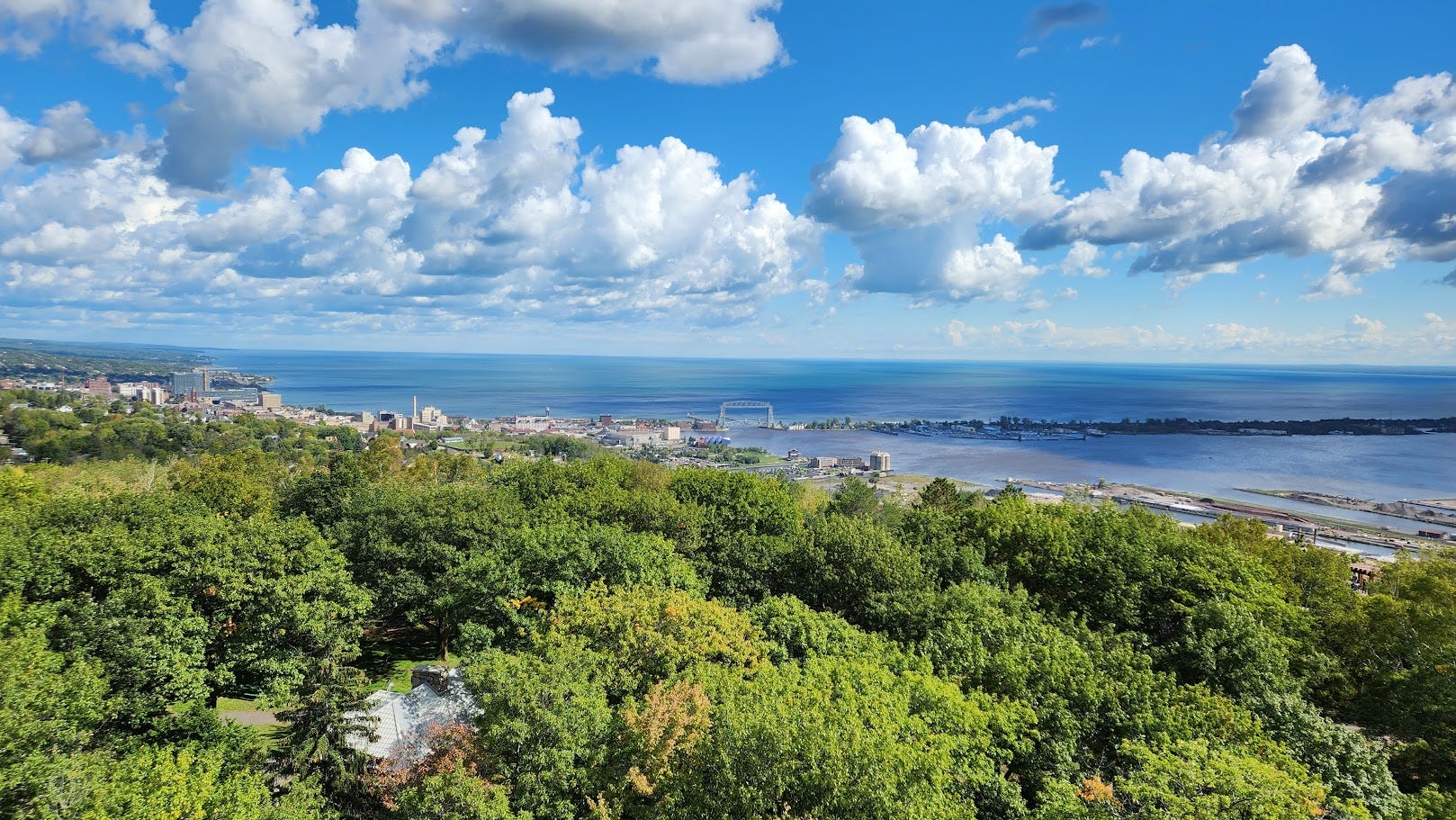
I often tell people that Lake Superior is the largest lake in the world, probably, then wait for them to ask me what I mean by “probably” so I can share my fun facts about the largest lakes in the world and how you have to massage the data to make that claim without reservations.
To start with, what do we mean by “largest”? If you list the lakes of the world by volume, Lake Superior sits at number four, and it’s not particularly close. We can knock out the Caspian Sea for being a weird hybrid freak, but that still leaves Lake Baikal in Russia and Lake Tanganyika, one of the African Great Lakes, and in neither case is Superior very close.
If we instead sort lakes by surface area then Lake Superior is behind only the Caspian Sea, and come on, seriously, that thing is geologically a small ocean, it’s 1.2% saline, there was a whole legal agreement between the nations that border it that specifically made clear that it’s not a lake, though this was because of some complicated maritime laws.1 And they don’t call it the Caspian Lake.
We also don’t count Lake Michigan-Huron, which is hydrologically one lake connected by the Straits of Mackinac. Since the water level of the two lakes rise and fall together, they’re actually a single body of water by some accountings, but come on, who cares about that? That’s nonsense. It’s got two names.
So Lake Superior is the largest lake in the world, at least in my book.
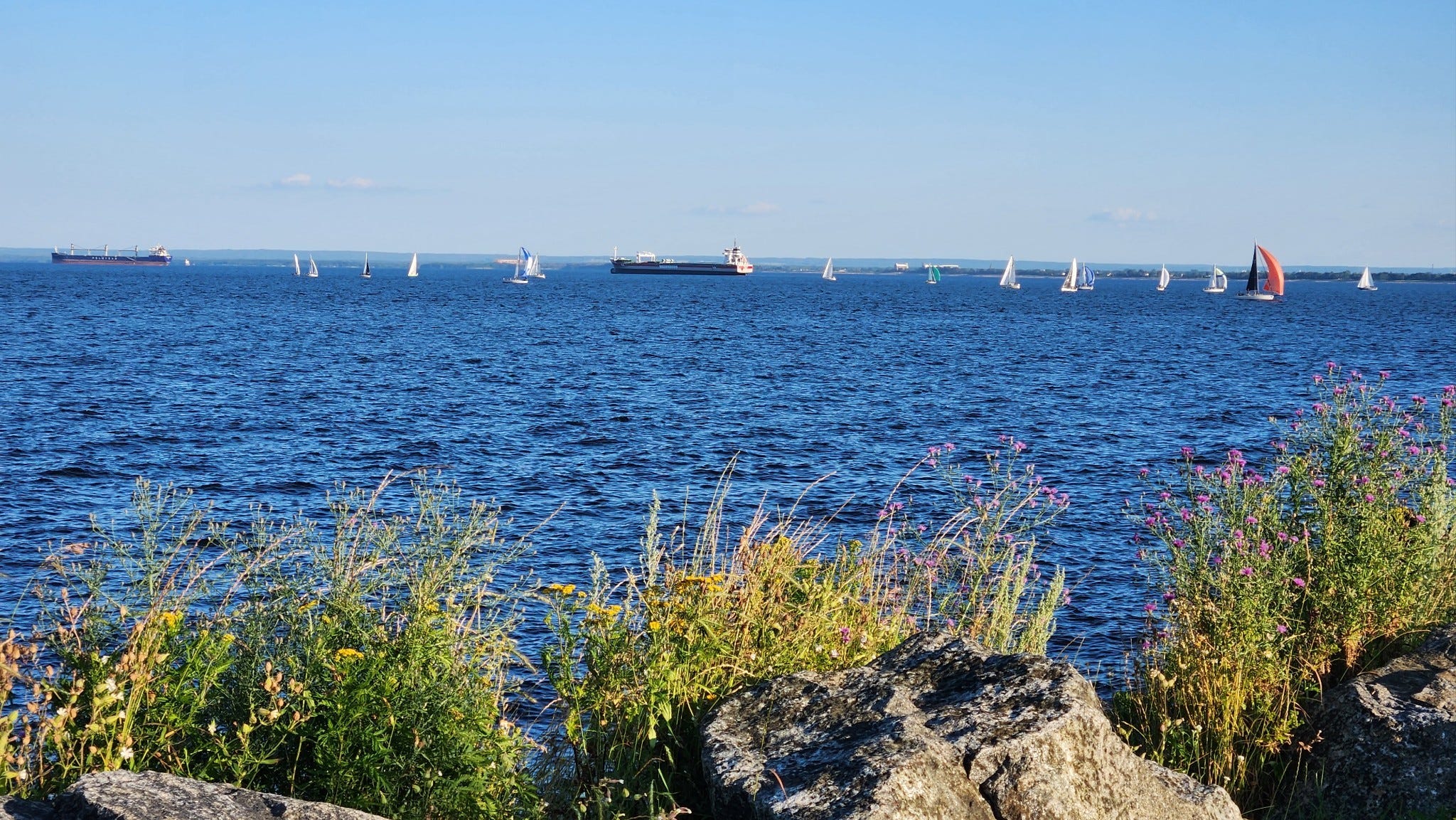
Lake Superior is the largest lake in the world, and Duluth is the largest U.S. city on that lake2, but there are a few other claims it can make: it’s the largest freshwater port in the world by tonnage.
You might be scratching your head and thinking, “wait, isn’t Chicago a freshwater port?”, but there are no shenanigans here, Chicago shifted away from being a major port, and instead handles a lot of air and rail, with very little shipping to speak of. Duluth, by contrast, does very little but shipping, and the things it ships are very big and bulky: iron ore, coal, and grain. In terms of tonnage, it’s the king, and part of this is because it sits on the western tip of Lake Superior, the terminus of water travel if you’re coming across the Great Lakes from the Atlantic (yes, you can move a boat from the Atlantic to the heart of America).
You might be scratching your head and thinking, “wait, aren’t there a bunch of very busy river ports on the Yangtze?”, and … alright, fine, this depends on your definition of freshwater port. Nanjing is 300km inland, past the estuary, where the water is no longer brackish, and must be considered a genuinely freshwater port by any reasonable definition of the term, with tonnage as much as ten times what Duluth handles, and Nanjing is only one of the port cities on the Yangtze.
So perhaps instead we have to say that Duluth is the largest freshwater port in the Americas by tonnage, a much less impressive claim.
It is, however, the world’s farthest inland port accessible by oceangoing vessels, 2,300 miles from the Atlantic Ocean.
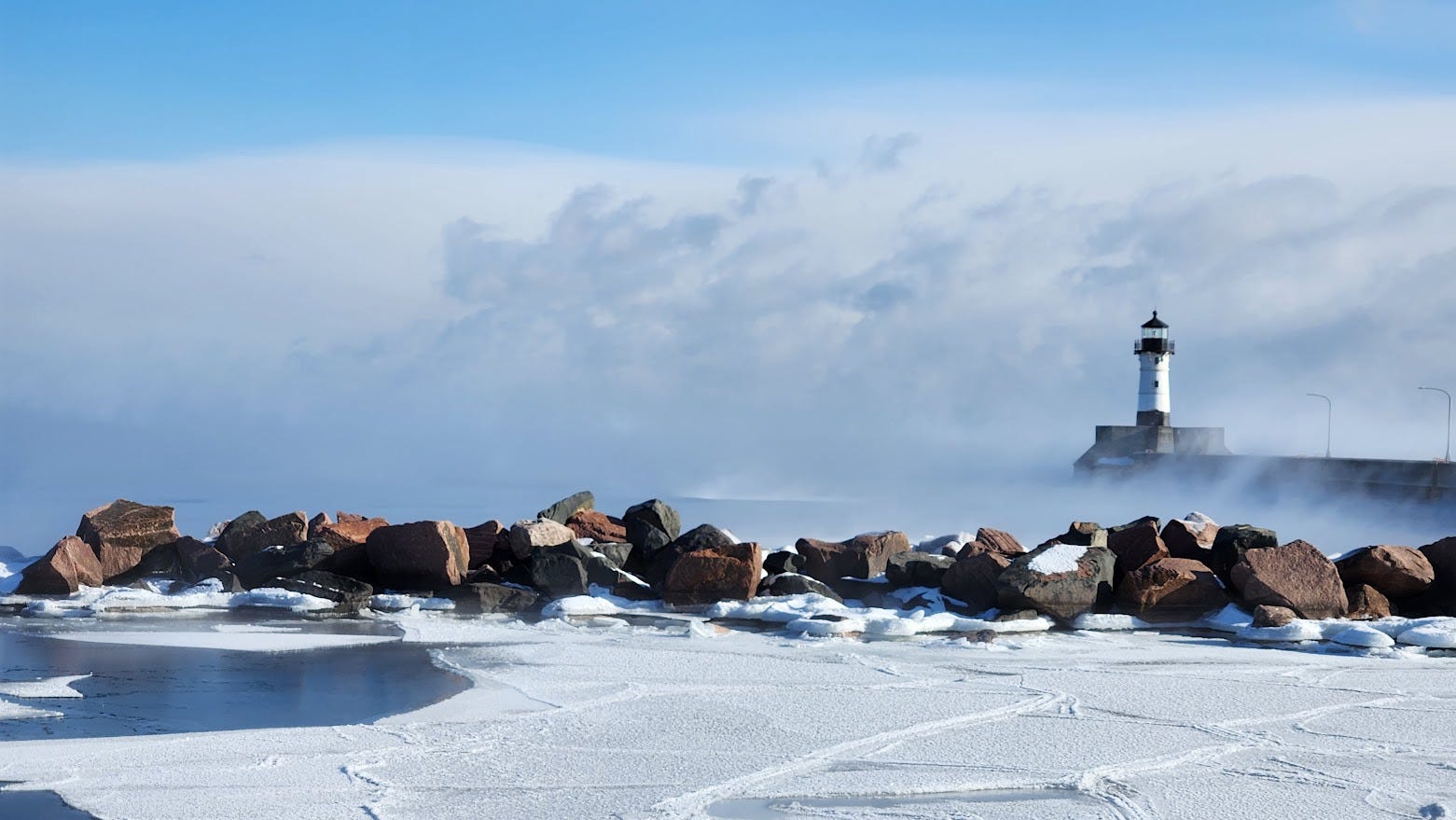
Duluth, Minnesota is the coldest city in the United States and also demographically the whitest. Surprisingly, these two things aren’t related!
Let’s take the cold first. Duluth sits at 46.78° N, further north than the average Canadian, but there are certainly other cities that beat it there. However, two factors make it much colder than you might expect: first, it’s far inland, without the modulating effects of the oceans, and second, it sits right on Lake Superior, which as you might have heard, is the largest lake in the world. The lake being so big means that it’s a giant heatsink, cooling the city in the summer, and in theory causing the winters to be warmer, which in practice is negligible.
For Duluth to be second coldest city, we need to decide what “coldest” means, and while we’re at it, define “city”.
“Coldest” might mean “lowest average annual temperature” or “coldest average winter temperature” or “lowest daily temperature” or probably some other things.
If we mean “lowest average annual temperature” then Duluth is at 39°F … which is behind both Fairbanks, AK, and Anchorage, AK, meaning that we could claim “coldest in the lower-48” or “coldest in the continental United States”, something I would find utterly humiliating. That’s before letting any of the small towns into the room, like International Falls.
So instead we’ll use “coldest” to mean “coldest winter”, or the more wordy “mean temperature from December to February”. And by that metric, Duluth’s winter mean is ~14°F, which is the lowest of any city in the United States … so long as we define “city” to mean “municipality with more than 86,000 people”. Duluth, population 86,697, comfortably passes that. Fairbanks, population 32,515, is colder but sadly doesn’t make the cut. Too bad my arbitrarily chosen cutoff excluded it!3 If not for that, Duluth would be second coldest city in the United States behind Fairbanks, which is much less impressive.
So what do we mean by “whitest”?
Well, Wikipedia has a list of municipalities by ethnicity based on the 2020 census. If you sort by percent “white alone”, Duluth comes third at 84%.
Now, I said “whitest”, not “third most white”, so let’s look at the two municipalities above it. First, the easier of the two, Dearborn, MI. By the census, very white, but if you look up anything about the city, you’ll see something like this:
Dearborn became the first Arab-majority city in the US, with 55% of its residents claiming to be of Middle Eastern or North African ancestry in a 2023 survey.
Are people of Middle Eastern or North African ancestry (MENA) white? Most don’t identify that way. So I’m going to exclude Dearborn on that count, which I think is correct to do. The census rules were set in 1997 and some things have changed since then.
What about Mount Pleasant, SC? It’s roughly the size of Duluth, MN, but if you go to the Wikipedia page:
Mount Pleasant is a large suburban town in Charleston County, South Carolina, United States.
Wait, let’s read that closer:
large suburban town
And if you look at Google Maps, it’s clear that “large suburban town” is a very accurate characterization of the place. It’s really just a suburb of Charleston, and virtually no one would call it a city. It was on the list because it’s a municipality, but it’s definitely not a city. As a place, it’s defined mostly by its relationship with the city of Charleston, and currently serves as a wealthy white enclave. Sometimes you go reading about the history of the South and walk away thinking about how horribly racist it is. This is one of those times. Plantations, the attack on Fort Sumter, the enslaved population, white flight in the 60’s … sigh.
Not like Duluth. Good old Duluth. Hey, why is it so white anyway?
Well, let’s start with immigration patterns. Duluth was originally home to the Ojibwe and the Dakota, but the Europeans came, and for a long time it suffered fits and spurts of immigrants until 1855, when it really started kicking into gear. At one point, Duluth was the only place in the United States with access to both the Pacific and Atlantic Oceans4. In 1869, it was the fastest growing city in the United States, expected to eclipse Chicago in size. A large number of the immigrants were Scandinavian, something you can still see in the demographics today. The environment was well-suited to them, cold and snowy, and they took to mining and logging, the main trades of the area.
The Great Migration was a period of American history where Black people moved northward from the South. It started around 1910, and by some accounts was the largest, most rapid internal migrations in the whole of human history, at least of those not caused by immediate threat of death or starvation. They were moving away from agrarian jobs and racial violence, to a brighter future in the north. And Duluth? Well, it wasn’t a part of that.
For one thing, it was pretty far from any established migration corridors, and this is one of the reasons that northern Minnesota, Wisconsin, and Michigan are all pretty white. It was cold, but that wasn’t the major thing, because there were plenty of other places that were cold. Duluth wasn’t a particularly industrial city, as it mostly moved freight without processing it, and the industry jobs were the ones that people were moving for.
And in 1920, three Black men were lynched on accusation of raping a white woman, an accusation that was later discredited, but not before postcards of the event had begun to circulate and the event had made headlines around the country. Duluth became known as a place that wasn’t safe for Black people to go, not that you’d want to anyway given that the economy was stagnant and certain industries were collapsing. I think there was something of a “man bites dog” quality to the story, a lynching that happened in the far north, the only lynching of Black people in Minnesota’s history5, and the last lynching the state has experienced. It’s a stain on the city’s history; I used to live next to a monument that was put up in 2003, and think about it often.
If the economy of the city hadn’t been stagnant, it’s likely that this wouldn’t have had all that much of an impact; the Great Migration lasted into 1970, and memories aren’t that long, with the event largely forgotten. But Duluth was a city on the decline, losing population. Immigrants don’t tend to go to cities that are shrinking, so the demographics stay mostly as they are, and they’ve stayed calcified until today, changing very little with the years. The industrial core of the city, to the extent it ever had one, has given way to a focus in tourism, which is largely what’s keeping the city alive. In some way, the city missed the Great Migration by also missing a series of economic booms.
So the whiteness and the coldness aren’t really related to one another, it’s more about economics and patterns of migration, with the city in some ways frozen in time.
In 1871, a relatively unknown congressman from Kentucky, J. Proctor Knott, took to the floor of the House and delivered a speech that came to be called “The Untold Delights of Duluth”. It was a speech given in opposition to a bill meant to grant federal lands to a railroad company, and it coats the city in ironic superlatives to mock and deflate it:
If gentlemen will examine it, they will find Duluth not only in the centre of the map, but represented in the centre of a series of concentric circles one hundred miles apart, and some of them as much as four thousand miles in diameter, embracing alike in their tremendous sweep the fragrant savannas of the sunlit South and the eternal solitudes of snow that mantle the ice-bound North. How these circles were produced is perhaps one of those primordial mysteries that the most skilful paleologist will never be able to explain. But the fact is, sir, Duluth is pre-eminently a central place, for I am told by gentlemen who have been so reckless of their own personal safety as to venture away into those awful regions where Duluth is supposed to be, that it is so exactly in the centre of the visible universe that the sky comes down at precisely the same distance all around it.
Knott was praised for this speech, briefly becoming a national celebrity, and the bill was killed, but he never gave another that got him close to the same glory. Duluth grew, and for a moment seemed like it would become important, then faded and nearly collapsed. For a time, the bustling city sold copies of the speech like trophies of their success, but now it’s a footnote, known to only a few.
I suppose it’s not that important to me that I live next to the largest lake in the world, or that I live in the coldest city in the United States, or that I watch ships enter the biggest freshwater port, but when I find these facts by carefully slicing the data, I do feel like Duluth finally matches the size it has in my heart.

The dispute over the Caspian Sea took its modern form in 1991 with the dissolution of the USSR. There are five Caspian nations — Russia, Iran, Azerbaijan, Kazakhstan, and Turkmenistan. If it’s a “sea”, then each of these states would have claim proportional to the length of their coastline. If it’s a “lake”, then each of these states would have one fifth. This is extremely important because there are oil fields on the seabed of the Caspian. As you might expect, whether a nation considered the Caspian a sea or a lake depended on the length of their coastline. They reached an agreement in 2018 on how to split it up between them, the Convention on the Legal Status of the Caspian Sea, which declared it neither sea nor lake, but a special third thing.
Thunder Bay, Ontario, is larger but also Canadian, which is why I said “U.S. city”.
I’m being cheeky, but there are some definitions of “city” which have the minimum cutoff at 50,000 people, which were not designed specifically to exclude Fairbanks. There are also lists of municipalities that exclude anything under 80,000 people, which only just barely includes Duluth.
Access to the Atlantic was through the Great Lakes and the Soo Locks, while on the Pacific side, Duluth was the terminus of the Northern Pacific Railway. I read this on Wikipedia, which I think is repeating the claim from a newspaper, which might have just been more carefully worded tourism copy for the city to attract investor dollars. There’s no way that the timelines actually match up for this to be true; the Promontory Summit linked Atlantic and Pacific by rail in 1869, and while the Soo Locks were finished in 1855, construction of the Northern Pacific Railway didn’t even start until 1870. It’s possible they meant some other railway, or I’m misunderstanding the claim. It’s also possible that this was something they wanted to happen, but with delays on the Northern Pacific Railway, the spike in Promontory Summit was driven well before it could happen.
Other people were lynched before this, but they were white or native. One of the more well-known ones was also in Duluth, a Finnish-American dockworker who was killed two years prior for attempting to avoid being drafted into World War I.
No posts
Comments
Nothing yet. Say the first thing.
Sign in to join the conversation.