
I’m staying at a place in Bodega Bay, California, which is beset by a foghorn. Where I’m staying, it’s roughly 60 dB, loud enough to be annoying. It seems to run for the entire day, blasting sound across the bay, roughly every ten seconds.
There are maybe a thousand people living in Bodega Bay, but it’s popular with tourists, and I imagine the number of people who have to listen to the foghorn is around two thousand.1
People vary in terms of their sound sensitivity, not just in how good their hearing is, but also in how well their brain is able to disregard unimportant sounds. Personally, I have very good hearing and a poor ability to not notice sounds, which is a pretty bad combination. The nuisance effect of the foghorn is, from my perspective, quite bad, even indoors with the windows shut … a state I don’t want to have to be in, because I’d rather be outside, enjoying the mild breezes and sunny weather. “Just wear noise-cancelling headphones” seems, to me, kind of bad.
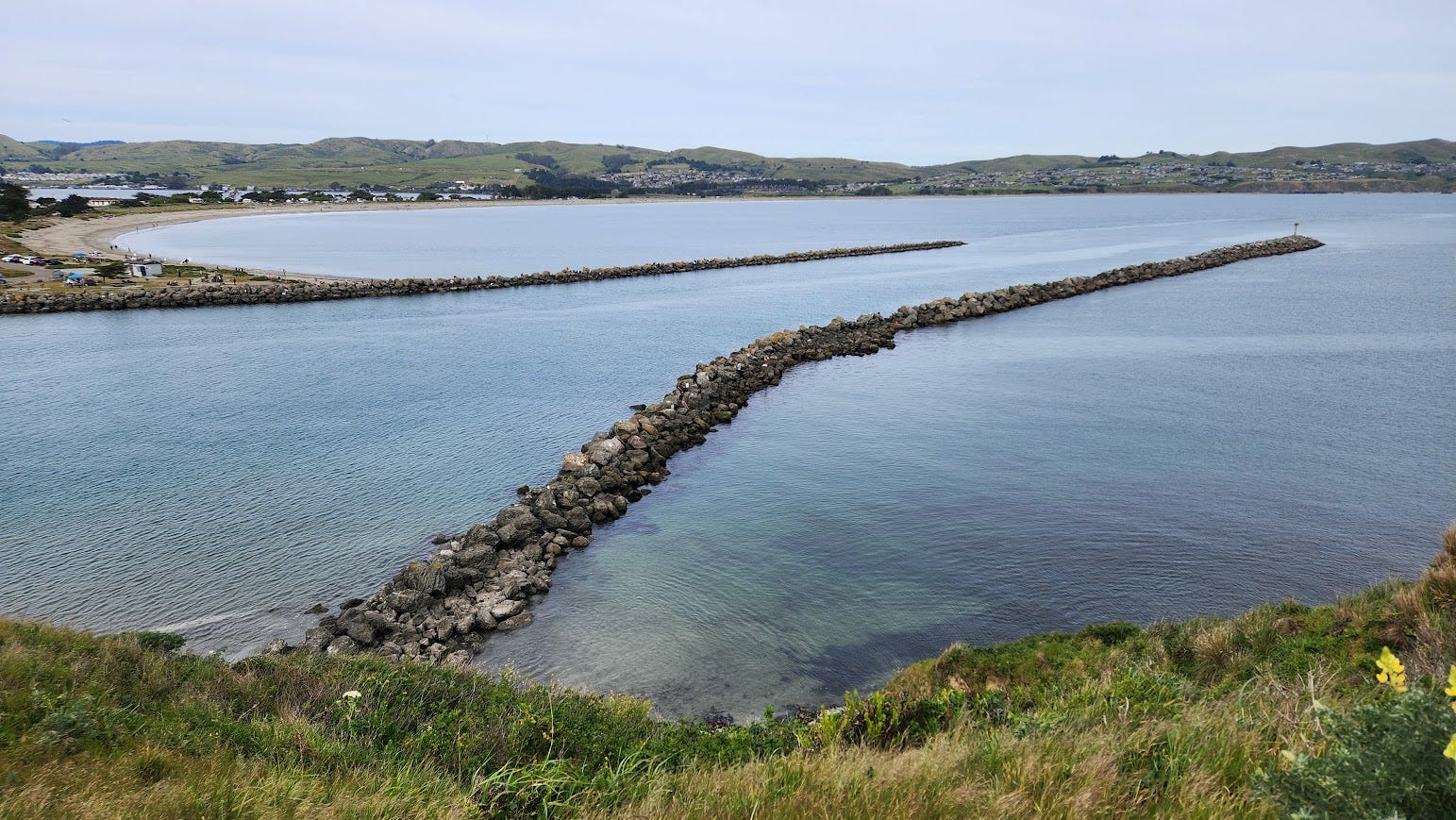
Origins of the Godawful Foghorn
Foghorns are navigational aids, useful mostly in the situation where you cannot navigate by sight. It’s a lighthouse, but with sound! They’re particularly useful in places where there’s regular advection fog, the kind you get when warm air meets cold air. Foghorns do run into the problem that fog makes it more difficult to know where a sound is coming from, but one of the ways they make up for this is by being very loud, audible from miles away. The foghorn at Bodega Bay runs pretty much 24/7, whether there’s fog or not, whether there are ships or not.
But we now live in a world where nearly every boat that goes out onto the ocean will have alternate, better navigation. GPS has been invented, and is used everywhere, particularly on boats. And in fact, the Coast Guard, which is responsible for these foghorns, has begun tearing some of them down, or replacing them with systems that only activate with a VHF code from mariners. In other places, they’ve added sound baffles so that the sound only projects out over the ocean, instead of back at land where people live.
So if GPS exists, what’s the foghorn for? Who would navigate by foghorn? Well, the main defense, from a public trade-off standpoint, is that the foghorn is there because of a fairly extreme tail risk. Someone might go out, run into trouble, have their electronics fail, and then require the foghorn as a last resort to navigate back to safety. Bodega Bay has pretty treacherous conditions, and it’s a “harbor of refuge” for ships to return to, as well as a launching point for rescue craft. While the salmon and crab industries are on the downswing for a variety of reasons, there are still recreational watercraft. Nevertheless, I should point out that the International Association of Lighthouse Authorities has declared that foghorns are “no longer necessary for the needs of navigation”.
How many people would die with the foghorn removed? How many ships would crash without a death involved? It’s impossible to say, and any calculation would have such wide error bars as to be useless. There’s a public trade-off being made against nuisance, and I have no idea what anyone else’s numbers look like, but because of how fuzzy the assumptions and calculations must necessarily be, I’m inclined toward deep skepticism. They would start by using the VSL (value of statistical life) and then reach for some studies about sleep disruption and nuisance, and it would result in some number that might even be worse than nothing. There’s a way in which “lives saved” seem relatively easy to count (disasters/wrecks are rare and visible) while nuisance costs seem extremely difficult.
But there’s another problem.
Some Psychopaths Love Foghorns
Back in 2015, Stonington, Connecticut had a public discussion on the removal of their foghorn. Residents had complained that it was making it difficult to sleep, and for reasons outlined above, the Coast Guard had been removing or replacing many foghorns anyway. Others in the Stonington community were outraged at the idea their foghorn would be removed. Here are some representative comments from Facebook:
The purpose it serves is important. Plus it's a wonderful sound. Possibly earplugs for the man who claims he can't sleep?????
NOOOOOOOOO! That sound IS Stonington!
I agree with the fog horn [sic] staying.... a good defense would be we can't sleep WITHOUT the sound!
Turn up the volume on the horn!!!
The Stonington Breakwater Horn was ultimately not removed, likely because the residents argued in favor of it.
Within the random insanity of the Facebook comments, I think we can construct a few solid foghorn arguments, which is hopefully what you’re here for:
The people who live next to the foghorn have selected to live next to the foghorn. We must also accept that some people like the foghorn. Removing the foghorn would legitimately be bad for them. It would be very easy to disparage these people and their preferences2, but probably they’re not lying about this.
The broader hedonic-pricing literature suggests that chronic noise depresses property values; a 1 dB increase in sound level results in a 0.4% loss in home value.3 If you are noise-insensitive or deaf, you can do arbitrage, and some people have done this, whether they knew it or not. In theory, removing a foghorn would increase property values anywhere it could be heard, but there are legitimate reasons to not want that (e.g., property taxes).
The foghorn is a tourist attraction. People arrive, hear the foghorn, say, “wow, a foghorn, it contributes so much to the soundscape”, then leave before it annoys them or causes sleep loss or whatever else.
There are also many specious arguments in the Facebook comments, most of which aren’t worth talking about; they will make safety arguments that make no sense with modern technology being what it is.
The habituation is what I find most interesting; the foghorns have been around for a long time, and thus have nostalgia and acclimation. There are positive and negative selection effects, as anyone who grew up near the foghorn and always hated it would be driven away to a place where there isn’t a loud sound every ten seconds. And it’s likely that anyone bothered by the foghorn, particularly at night, might have taken steps to mitigate it. You can put up sound baffles, soundproofing, or do some mitigating landscaping.
The people who live next to the foghorn are adapted to it in one way or another, and have developed coping strategies or grown to feel warmly toward the foghorn, so might prefer it to remain even if it were no longer necessary. And others have left for less noisy pastures.
Abyssal Inertia
We built a thing in Bodega Bay for a good reason: safety and navigation of ships when the fishing and crabbing industries were booming. The technology has vastly improved since the foghorn was installed in 19424. The costs are large but diffuse5. Selection effects have caused foghorn lovers to gather and foghorn haters to disperse. Now that the foghorn isn’t needed, it has all this built-up calcification around it, a contingent of people who are willing to defend it on aesthetic or nostalgic grounds.
I think I could give a few dozen examples of things like this which have stuck around past their due date and at least partially exist because of a desire for things to be how they were. Cursive handwriting in schools, daylight saving time, hourly church bells, the U.S. penny … I’ve seen arguments, and they boil down to inertia. The closest analogs to the foghorn are rail signals, which can now be replaced with automated lights and arms, with no reduction in safety. Railfans and locals resist these changes though.
Is there hope for the foghorns of the world to ever be removed? Well, most of them have been as the need for them has dropped and the technology has improved. The institutions responsible don’t have the same selection pressures as the locals, which makes it easier; the Coast Guard runs the foghorn and the U.S. Army Corps of Engineers maintains it. But there are examples from the wider world of diffuse costs; after twenty-five years, you no longer have to remove your shoes when going through TSA checkpoints, and the penny has finally been killed. So there is hope, yes.
… do you think there are people who are nostalgic for removing their shoes at the airport? I bet there are. Foghorn people.
This post was written while listening to a foghorn every ten seconds.
I made this guess, then asked Claude. Claude said that you could triangulate it using several different methods and proxies, some of which smell like pure guesswork. There’s a ton of math, all of it amounting to fiddling with numbers, looking at how much lodging there is, extrapolating from Sonoma County tourism records, etc. Claude’s guess is ~2,400, for whatever that’s worth, so I’m just going to use my original guess.
For example, by calling them psychopaths. Who would do that?
Here’s the cite, but there are all kinds of wibbly-wobbly things, since this depends on a crazy number of factors like country, noise source, threshold, etc. For any given foghorn you’d need to map how sound travels in the surrounding area if you wanted to gauge impact this way. I’m going with this number, but other studies have higher and lower figures.
Alright, so this is actually maybe not the correct date. The north and south jetties were built in 1942 by the U.S. Army Corps of Engineers, and the foghorn is installed on top of the south jetty, but it’s possible that it was in a different location before that. To find out, I would need to walk to the Bodega Bay Heritage Gallery, and the roads are not at all walkable, which is another post for another time. I could also email some archivists, but if this year is incorrect, they’ll just have to seek me out, or put the information on the public internet.
I stand by this claim, but as stated earlier, calculating those costs is virtually impossible, especially because so much of the cost is psychic damage from this foghorn going off, rather than the easier-to-calculate loss of sleep.
Comments
Nothing yet. Say the first thing.
Sign in to join the conversation.