
By Jascha Bareis, Andreu Belsunces Gonçalves and Johannes Klingebiel in collaboration with Steffen Leidel and Deutsche Welle Akademie.
Technology reporting is often shaped as much by persuasion as by facts. Journalists must navigate claims that exaggerate impact, compress uncertainty, or promise inevitable change. This chapter equips you with practical tools to spot hype, verify speculative claims, and provide context.
By the end of this chapter, you will be able to:
identify rhetorical traps in tech coverage
go beyond hype in your reporting
ask better questions in the process

Above: This column is a republication of Lesson 5 of the Hype Literacy Handbook for Journalists. Reprinted with permission.
Despite technology’s aura of cold rationality, hype is explicitly emotional. The stories told must resonate with people to be believed and acted upon. To accomplish this, hype relies on a number of rhetorical tricks and tools.
Buzzwords are shorthands for complex technological fields, simplifying them with a catchy name. They may develop from terms with specific meanings in specialist jargon and become fashionable among non-specialists, losing their precise meaning in the process.
Buzzwords serve a promotional function: They compress uncertainty into a confident label that implies progress and inevitability. Their vagueness allows many actors (companies, investors, policymakers) to project their own hopes or interests onto the same word. This elasticity makes them powerful tools for persuasion and hype.
Questions to ask:
What does the speaker mean by this term in concrete, operational terms? If in doubt, ask the speaker to clarify.
Does the term mean the same thing in policy papers, academic research, and press releases? If not, what might explain those differences?
The timeframe for adopting or reacting to a technological novelty is explicitly presented as short, with time quickly running out. This framing positions hesitation as risk and compliance as smart or visionary.
In some cases, such as AI or space exploration, technological development is framed as a nationalistic race, though the concrete goal remains often elusive.
Questions to ask:
Who defines this “window of opportunity,” and who benefits if others rush?
What happens if we wait — what evidence suggests urgency is justified?
How does the story change if the same development is treated as part of a long-term process rather than a fleeting chance?
Tech reporting often amplifies claims that a new product, algorithm, or platform will transform entire industries or human life itself. They create the sense that we are standing on the brink of an inevitable transformation.
Such language compresses complexity into spectacle. It glosses over incremental progress, uncertainty, and continuity with earlier developments. Grand narratives of progress also tend to centre inventors and investors, while erasing the social, labour, and environmental contexts that make technological change possible.
Questions to ask:
What exactly makes this technology “revolutionary”? Compared to what baseline?
Who benefits, who bears the costs, and who is left out of the “game” being changed?
Have similar predictions been made before? What actually happened then?
Investment announcements, funding rounds, and market projections are presented as proof of a technology’s value or inevitability. High valuations and venture capital interest become self-reinforcing signals: Media coverage attracts investors, investment attracts more coverage, and both generate public excitement that can drive further investment.
Venture capital is a high-risk investment category. Meaning, even though high funding rounds are reported as achievements, they are mostly an obligation: The money must eventually generate returns.
Furthermore, what gets funded is not always what works best, but what fits current investment narratives.
Questions to ask:
How does the reported valuation compare to actual revenue, users, or demonstrated impact? What would need to happen for the valuation to be justified?
Are financial projections based on proven business models, or do they assume behaviour change, regulatory approval, or technological breakthroughs that haven’t yet occurred?
How many previous “game-changing” companies in this space failed to deliver on similar promises?
Founders, investors, and developers or researchers are often the first voices quoted in technology reporting. While they can offer insight into innovation and intent, they do not represent everyone affected by a technology. Their perspectives are typically promotional, future-oriented, and shaped by financial or reputational incentives.
Seek out the people who experience technologies in practice, not just those who design or fund them. This might include workers, end users, or communities shaped by the technology’s deployment. For instance, when reporting on a ridesharing startup, talk not only to the founders or investors but also to the drivers, local taxi unions, and passengers from different socioeconomic backgrounds.
Questions to ask:
Does my source list overrepresent people who stand to gain from the technology’s success?
Who is absent from this story? Whose work, labour, or lives make this technology possible but invisible?
Who is most dependent on it — and who is most vulnerable to its failures?
First-person reporting can illuminate how a technology feels to use. Still, it often reflects the experience of those technologies’ intended or ideal users. Typically, people with access, knowledge and compatibility with the product. To balance this, seek out those whose perspectives reveal the limits or exclusions of design.
Questions to ask:
Does my personal experience reflect the average user?
Who cannot access or afford this technology but might still be impacted?
Who maintains or supports the infrastructure that enables my own experience?
Journalists should look beyond the headline company or charismatic founder and examine the economic ecosystem that makes a technology viable. This includes identifying who profits at different stages, who absorbs the risks, and who provides the often-overlooked labour that sustains the system. In the case of AI, this might mean examining data labelling work, energy consumption, hardware supply chains, surveillance infrastructures, or government contracts.
Questions to ask:
Who funds this technology, and what returns are they expecting?
What companies, contractors, or workers are essential to making it function, but rarely mentioned?
How does revenue actually flow through this system — subscriptions, licensing, data extraction, public procurement?
Who bears the costs (economic, environmental, social) if the technology fails or scales unevenly?
In coverage, proponents are often framed as “experts” while dissenting voices are labelled as “critics,” as if they speak only from opposition rather than expertise. This framing subtly skews credibility toward those promoting novelty.
Remember that critical analysts, ethicists, labour organisers, and social scientists often have deep domain knowledge that reveals broader contexts and trade-offs. They are “experts” in the same way as proponents are, if not more so. Instead, try to broaden the vocabulary to accurately reflect actual expertise (e.g., researcher, analyst, scholar, practitioner).
Questions to ask:
Am I presenting expertise as something only technical, or also social and ethical?
How can I balance the narrative so that scrutiny and enthusiasm receive equal weight?

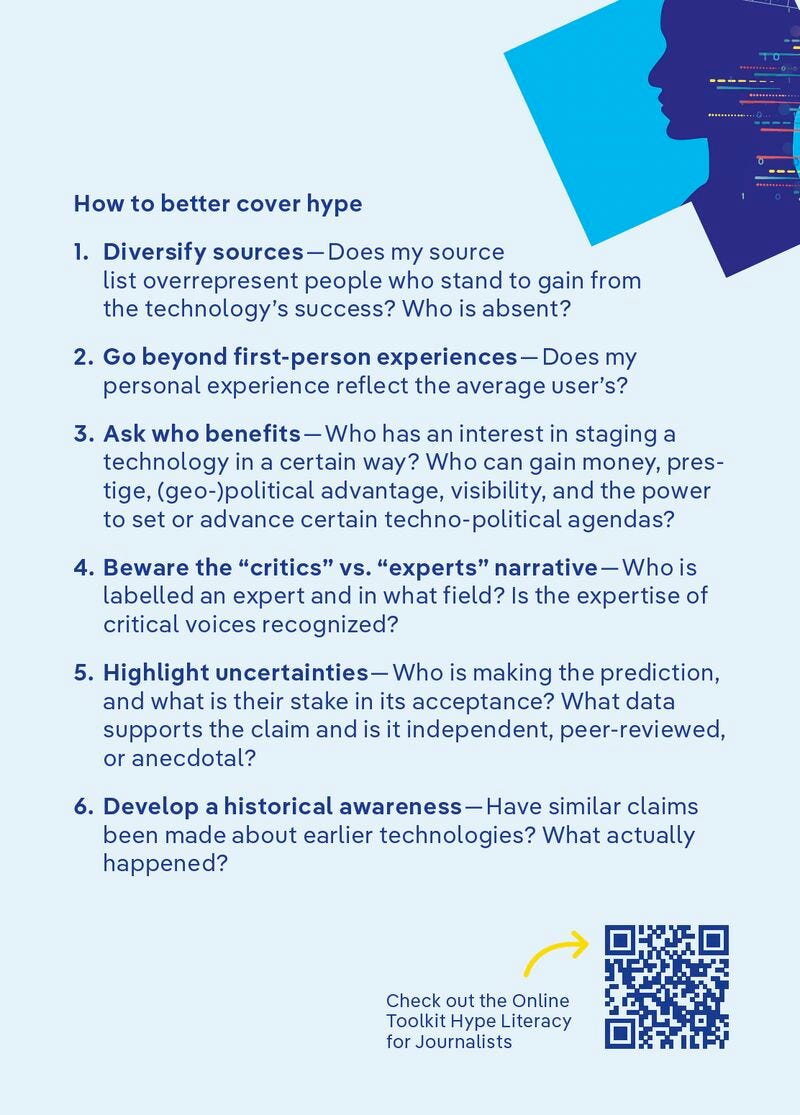
Above: Full course accessible here. Reprinted with permission.
A central feature of technological hype is its tendency to smooth over uncertainties and present speculative futures as certainties. The rhetoric of inevitability (as introduced in the previous chapers) — that a technology will change everything, will replace workers, or will solve global problems — replaces complex, ongoing processes with a single linear story of progress.
Predictions in tech discourse often masquerade as evidence. Forecasts are presented in the language of probability or pseudo-science (“there’s a 70% chance of AGI by 2030,” “quantum computing will be mainstream within five years”), giving the impression that the future can be modelled and measured. In reality, these claims rest on assumptions, economic interests, and selective optimism.
In the same sense, journalists themselves should be careful with speculations in their reporting. Good reporting should instead try to excavate uncertainties and show competing perspectives. Acknowledging what we don’t know strengthens journalistic credibility and helps readers think critically about technological futures.
Questions to ask:
Who is making the prediction, and what is their stake in its acceptance?
What data or research supports the claim — and is it independent, peer-reviewed, or anecdotal?
What social, political, or economic conditions would need to change for this forecast to come true?
Hype is selective. It clusters around certain technologies, companies, and narratives while leaving others in the shadows — not because they are less important, but because they are less spectacular, less aligned with current investment trends, or less conducive to grand storytelling and venture capital interests (see Chapter 2).
Underhyped technologies are often those that have already proven themselves in practice but lack the narrative momentum of shinier alternatives (e.g. the disconnect in attention to solar energy vs. atomic energy). They may be open-source tools, low-tech solutions, or incremental improvements to existing systems. They might address needs in the Global South, serve marginalised communities, or prioritise maintenance and repair over replacement and growth. So are technologies developed outside dominant tech hubs, by researchers without venture backing, or in fields that lack charismatic spokespeople. The result is a distorted map of innovation that overrepresents what is loudest, not necessarily what is most useful or transformative.
By covering these technologies, journalists can offer alternative stories about what progress could also look like. This doesn’t mean abandoning coverage of emerging technologies, but rather balancing it with attention to what works, what lasts, and what serves people rather than investors.
Questions to ask:
Are there low-tech, open-source, or community-led alternatives to the high-profile solution being hyped?
What innovations are happening outside Silicon Valley, outside English-language discourse, or outside venture-backed ecosystems?
Who is building technology to meet present needs rather than speculative futures — and why isn’t that considered newsworthy?
Technological hype rarely appears out of nowhere. New tools are often framed as an explicit break with history, a revolution or disruption. But this is, of course, far from the truth. Technologies always have a history, and what might be presented as a sudden breakthrough is often instead just the sum of a thousand small steps over the last decades.
Past technologies — from railways and electricity to personal computers, the internet, social media, and big data — were once surrounded by confident forecasts that did not fully materialise or unfolded in unexpected ways. Revisiting earlier coverage, including your own outlet’s archives, can reveal how similar claims were framed, which actors benefited, and which risks were overlooked. History does not repeat exactly, but it often rhymes.
Questions to ask:
Have similar claims been made about earlier technologies? What actually happened?
How was this technology (or a comparable one) reported on five, ten, or twenty years ago?
Whose voices were amplified or ignored in past coverage, and how did that shape public understanding?
The Hype-Literacy Course is licensed under Creative Commons. The course may only be used when credit is given to “DW Akademie with support from the German Federal Ministry of Economic Cooperation and Development”(BY) and used for noncommercial purposes only (NC). The online course may not be modified without permission by DW Akademie (ND).
Previously from The Grade
'Complicating the narratives' in education journalism
AI HYPE VS. CHROMEBOOK REMORSE: WHO WILL WIN?
How edtech lost its inevitability
No posts
Comments
Nothing yet. Say the first thing.
Sign in to join the conversation.