
America’s public education system is facing a demographic crisis – all the headlines say so.
From the New York Times to the Education Commission of the States come reports of falling birth rates leading to declining enrollment. And then there’s the grim news of how the COVID-19 pandemic catalyzed an already existing trend toward charter schools, homeschooling, microschools, and other alternatives to the traditional neighborhood school.
So why is the superintendent of one of Florida’s largest public school districts optimistic?
Fred Heid of Polk County Public Schools faces the same challenges confronting school systems across America. His response: Flip the script. “Families are looking for something unique, something different,” Heid explained in a recent interview. “Why not create that opportunity within our own system?”
This spring, Heid persuaded his school board to act on that spirit. Rather than lament the rise of microschools — small, highly personalized learning environments that have become one of the fastest-growing forms of education — his district, which serves Lakeland and its Central Florida surroundings, invited one in.
Beginning this fall, WonderHere, a play-based microschool founded by two former public school teachers, will operate as a public program inside one of Polk County’s elementary schools. Families who might otherwise have left the district for a private microschool can now choose a similar experience without leaving public education. Before the program even opened, nearly every seat had been filled.
This development was covered by LkldNow, a hyper-local online pub that calls itself “Lakeland’s homegrown resource for local, independent news.” There was a mention in Forbes online and by advocacy sites like the Foundation for Economic Education, but that was about it.
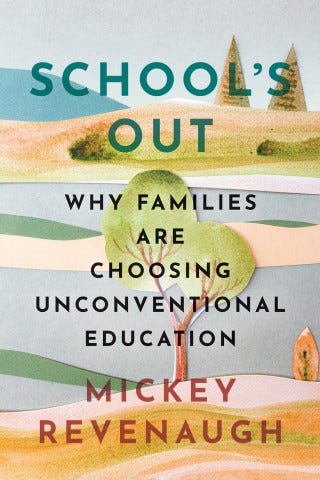
I’ve spent the past three years researching the explosion of homeschooling, microschools, virtual schools and other forms of what I call “unconventional education” for my book, School's Out (available everywhere August 4 and here now). Along the way, I met countless parents who were looking for something different: more flexibility, more personalization, more opportunities for their children to learn in ways that matched who they are.
What surprised me most, however, wasn’t even what I learned from those families. It was what I discovered among a vanguard of public school leaders.
The most innovative among them aren’t asking how to stop educational choice. They’re asking how to make public education the most attractive choice available.
That is a profound shift in thinking, but you wouldn’t know it was happening from the mainstream education press. The notable silence there has been broken primarily by coverage of microschools as novelty items not to be taken too seriously (hence the Wall Street Journal headline chirping about "Teeny, Tiny Schools") or as an invasive species "Raising Serious Concerns About Accountability, Accessibility and More," as the Center for American Progress summarized its 2025 study.
There’s good reason for that. Debates over school choice have become highly polarized. Education reform advocates on the right are deeply suspicious of what they call “government schools.” Every child who leaves a district school for a homeschool, private school, microschool or charter school is typically viewed by reformers on the left as evidence that public education is under siege — especially if public dollars follow that kid into their new learning environment.
But what if these new forms of education are telling public schools something valuable?
Parents today are sending a remarkably consistent message. They want schools that recognize children as individuals. They want greater flexibility. They want specialized programs, smaller learning communities, and opportunities that don’t fit neatly inside a one-size-fits-all model.
Those aren’t unreasonable demands. They’re invitations to innovate, and smart districts are already responding.
Outside Indianapolis, Indiana’s Eastern Hancock School District is launching public microschools to better serve rural communities. Arizona’s Phoenix Union High School District allows students to build individualized programs by combining learning opportunities across schools, businesses and community organizations. Utah’s Canyons School District welcomes homeschooling families into district classes and extracurricular activities instead of treating them as competitors.
None of these districts is abandoning their public education mission. They’re just expanding the ways they fulfill it. And their timing could hardly be better.
As new federal scholarship tax credits and state-level education savings programs create additional opportunities for families to customize their children’s education, districts face a choice of their own: They can define themselves by the students who leave — or by the families they choose to still serve.
That may mean creating district microschools. It may mean offering à la carte courses to homeschoolers. It may mean opening career pathways, outdoor learning programs, early childhood centers or partnerships with community organizations. The specifics will differ from place to place.
The larger principle is the same.
Public schools don’t have to resist every new idea that emerges outside their walls. They can adopt the best ones to adapt to changing needs, as they’ve already shown they can do over the past century. Kindergarten, Advanced Placement courses, career and technical education, magnet schools, dual enrollment and online learning all began as weird innovations before becoming part of the educational mainstream. Today’s unconventional models may represent the next chapter in that tradition.
Like it or not, competition has a way of sharpening institutions by forcing them to focus relentlessly on the people they exist to serve.
Public schools already possess enormous strengths, namely dedicated educators, deep community roots, public accountability and a commitment to educating every child. Those advantages haven’t disappeared.
But families increasingly expect something else as well: meaningful choices within public education itself.
The districts that flourish in the coming decade won’t simply defend the public schools they’ve always been. They’ll build the public systems families are looking for now. And we can only hope the rest of American will hear about it.
Mickey Revenaugh is the author of School’s Out: Why Families Are Choosing Unconventional Education, forthcoming August 4 from Johns Hopkins University Press. She co-founded Connections Academy, a leading public virtual school network; helped launch the E-rate program to connect American schools and libraries to the Internet; and served as editor of Instructor and other magazines for educators at Scholastic.
Comments
Nothing yet. Say the first thing.
Sign in to join the conversation.