
Maybe you’ve noticed that Anthony Fauci is back in the news? Something about a leaked diary and a Senate hearing or something?
If so, you’ve probably decided to ignore the story as much as possible. The leaked information seems vaguely unethical. The hearing seems blatantly political.
There’s lots of “ick” around the whole thing. Plus which, it’s summer. COVID was a long time ago. Let’s all go back to thinking about the young lifeguard saving the kid in California, or the fires in France and Spain, right?
For a day or so, it seemed like mainstream news outlets agreed that this was a non-story. However, that’s all changed in the last 24 hours.
It turns out there are lots of strong feelings about the former bureaucrat’s role in shaping the pandemic response and his subsequent glorification in the media — and, I’d argue, a big opportunity for educators and education journalists who are willing to step off the sidelines.
Here are some reasons why Fauci still matters — to educators and education journalists in particular — and some story ideas for anyone who’s looking for them:
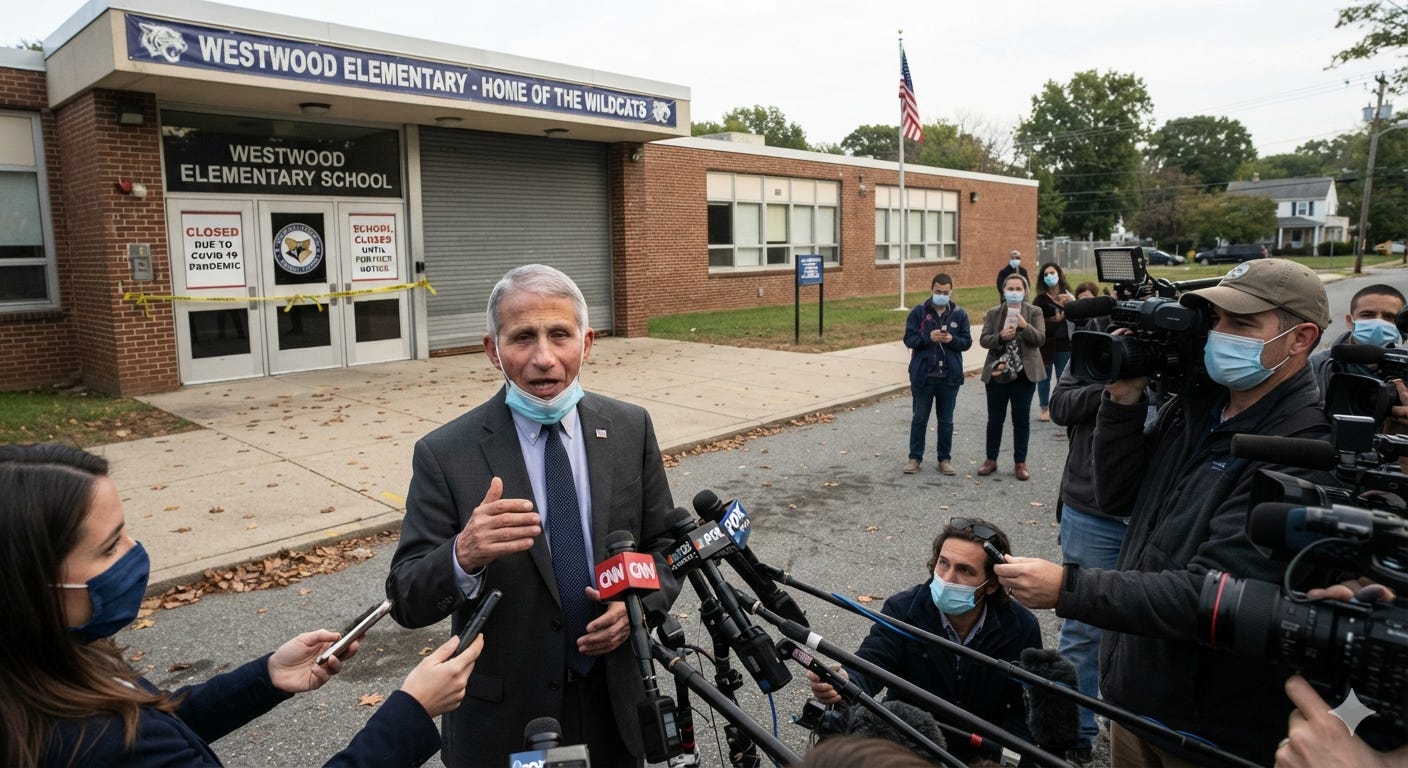
Above: An AI-generated image representing Fauci’s role during the pandemic.
FAUCI’S UNIQUE INFLUENCE
Schools were among the most-affected parts of American society during the pandemic. And there’s no place where Fauci’s influence was more apparent than it was on the closing of schools and the ensuing protocols that delayed the return to normal. While he may have claimed after the fact that he wasn’t literally in charge of those decisions — technically true — he provided invaluable air cover for all the politicians, agencies, and organizations that preferred a “safety first” approach.
GIVING THE PANDEMIC RESPONSE ITS DUE
Lots of folks like to talk these days about how the education recession in the US started way before the pandemic, and it’s true. But that doesn’t mean that the Fauci-led pandemic response — the shutdowns, masks, distancing, etc. — didn’t play an important role in breaking decades of cultural norms around school attendance and learning, not to speak of the proliferation of devices in schools and tech reliance that resulted from remote learning. Whatever was starting to go awry in the 2010s was bolstered by what happened starting in 2020.
HOLDING FAUCI ACCOUNTABLE
While other government officials and education leaders like Redfield and Weingarten have made some serious acknowledgement of the fact that the school lockdowns and other requirements were excessive or ineffective, I don’t remember Fauci taking that kind of personal responsibility.
He did tell ABC News that people should close the bars but keep the schools open as far back as November 2020. And in 2024, he admitted that the prolonged shutdowns weren’t a good idea. But he didn’t admit that the bad idea was largely promoted by him.
MAKING AMENDS FOR 2020-2022
While individual journalists and educators did some heroic work, the journalism business and the education sector didn’t exactly cover themselves in glory during the pandemic. They went along with the prolonged and ineffective shut-down of in-person learning — not to speak of the weak remote learning alternatives that most schools provided. They failed to ask hard questions about the protocols being proposed, or to stand up against them.
CORRECTING THE RECORD
Even now, years after the events have passed, there are many people who still don’t have a basic grasp of what happened to schools during the pandemic. How long were school shut down, nationwide? How much live instruction did kids actually get during remote schooling? Did in-person schooling (or masking, or distancing) actually affect COVID transmission? Fresh journalism could help correct the record.
REBUILDING TRUST
One way for educators and journalists to rebuild trust that they have lost in the last few years is to lean into opportunities to show readers and the public that they’re on the public’s side, not on the government’s or anyone else’s — that they care about the people they serve, regardless of politics or ideology. The Fauci diaries are just that kind of opportunity.
FIGURING OUT HOW TO DO BETTER NEXT TIME
Whether you’re an educator or an education journalist, you know that there’s going to be another pandemic, and you desperately want to respond better than in 2020. One obvious issue that comes up in the context of Fauci is the need for the education beat to keep a strong focus on the social and academic lives of children, rather than playing at being health care reporters. But there are probably many other useful lessons.
GETTING IN ON ALL THE PAGEVIEWS
At its most basic, Fauci has emerged as a story that attracts a lot of attention. That’s why we’ve started to see a surge in coverage even from outlets that initially seemed disinclined. Fauci is at least as much an education story as anything else. There’s no reason that education teams and outlets shouldn’t get in on all the pageviews.
LOW-HANGING STORY IDEAS
An enterprising education journalist could create a useful timeline ofFauci’s school-related pronouncements, or ask school leaders if the diaries give them any cause to reflect on their pandemic responses. They could talk to educators and academics about how much influence if any the Fauci-led pandemic response had on the decline in learning, or whether they wish they’d done anything differently. They could find the school or district that was closed or kept to strict protocols the longest, and see how that school has recovered, compared to a similar school with a different response.
I know that there were many others just as involved in the COVID response, including former CDC head Rochelle Walensky and of course Biden and Trump. I’m not trying to give credence to political fuckery or amplify criticisms of schools or medicine in ways that aren’t good for kids. And I get that it’s deeply uncomfortable realizing that one’s heroes have flaws and make major mistakes.
But today’s education landscape has been shaped by Fauci and his allies, and it’s absolutely necessary for journalists to take honest stock of what happened in response to COVID and to address new information as it emerges. And it would be a particular shame if education journalists and school-focused news outlets couldn’t find a way to address such an important, relevant, and still-recent story.
Previously from The Grade
COVID collapse (Frances Lee interview)
Learning from COVID, five years later
Complacency and inertia (Alec MacGillis interview)
How to avoid writing needlessly alarmist school reopening stories
'We could have been a lot louder,' says NPR's Anya Kamenetz
How media coverage turned vulnerable kids into an invisible threat
No posts
Comments
Nothing yet. Say the first thing.
Sign in to join the conversation.