
Since the ‘excursus’ from the reading of Nietzsche’s ‘Birth of Tragedy’ consisting in a supplementary analysis of Wagner’s Meistersinger looks like it is now stretching from three into four supplementary sessions, and the underlying argument becoming very complex indeed, I am posting these ‘guidance notes’ as an Ariadne’s Thread for anyone who feels they are getting lost in the labyrinth of my exposition of ideas from various different disciplines. The substance of these notes extends beyond what I was able to cover in the audio posted today and they can also be used as guidance for the final recording of this excursus, to be posted some days from now.
§
I wanted to round off the excursus on Die Meistersinger quickly because it has, pleasingly, attracted some philosophical attention -
The user Sadair’s connection of it to my Kingfisher idea -
and it now stands in danger of becoming something that has no connection any longer to the main line of commentary on The Birth of Tragedy.
§
I want to do one last session on it, then, and stress the fact that I brought it up in relation to a specific problem, namely
The use of the Meistersinger quotation seems anomalous because the Meistersinger is a music-drama whose specific theme is
The need, if true art is to come into being, for a certain immediate HEROIC INSPIRATION to work in tandem with a certain PATIENT, UNHEROIC FOLLOWING OF RULES.
The first chapter of the Birth of Tragedy, by contrast, seems to lay out a model of artistic creation that passes directly from inspiration to finished work of art without the mediation of the sort of codified body of artistic techniques.
This seems to be true both of Nietzsche’s account of the Apollonian and of his account of the Dionysian artist. Both Traum and Rausch are forms of inspiration and Nietzsche appears to portray both of them as providing the creation fully developed without need of processing through technique.
§
In the last two sessions I very cautiously threw out the suggestion that this overly “immediatist” understanding of artistic creation remains a flaw in Nietzsche’s thinking right on until the late and even last work.
(Certainly, we find Nietzsche reiterating this idea of an immediate, comprehensive inspiration delivering the artwork directly, in completed form, to the artist in his description of his own writing of Zarathustra, fifteen years later in Ecce Homo).
§
Now, this is a vast critical claim to make – and one that I can hardly believe in myself.
It is hard to imagine that we do not find, in much that Nietzsche wrote between 1872 and 1888, a more nuanced and dialectical view of artistic creation.
We shall doubtless discover these passages as we proceed.
In drawing up the notes for today’s talk, though, it occurred to me that this shaky thesis can be made less shaky by being intensified.
§
Die Meistersinger is a work which operates on many levels.
It is a sort of treatise on the nature of art in the sense I have just summed up.
But it also has, for example, a theological dimension – something it has in common, in fact, with many of Wagner’s apparently more secular works
(The Ring)
All the figures are linked by names and situations to figures from the Bible
Eva.
David.
Hans Sachs to John the Baptist.
The last two figures are linked to Christ Himself, respectively as his avatar and as “the Preparer of His Way”.
§
Now, in Act Three, which I want to look at today, these theological/soteriological themes and the theme of meditation on the nature of art are drawn together.
There converge in this Act
(a) The specific philosophy of art that Die Meistersinger propounds whereby, in order for the work of art to be completed, the artist must descend from the heights of heroic, effortless inspiration into the depths of laborious and humble adherence to inherited rules
(b) The Judaeo-Christian thematic of the Saviour as “man of sorrows”, of the Redeemer descending into the lowest depths of human fragility and wretchedness in order to complete his mission of Redemption.
§
I am not, generally speaking, of one mind with those – Rene Girard is perhaps the principal example – who have suggested that the key to understanding Nietzsche is recognizing his failure to understand the mystery of the Christ.
I have to acknowledge, however, a certain force to this thesis: Nietzsche’s philosophy does either ignore, or consciously refuse, the logic of kenosis.
It would be interesting to explore, by the example of the Meistersinger, how these two logics of
salvific and artistic self-humiliation
are connected and how Nietzsche does indeed refuse both.
§
The first half hour or so of the Third Act may seem, at first sight, as though it could be crammed into Nietzsche’s paradigm after all.
That is to say,
We might read what we see here as Hans Sach himself spanning, in his own personality alone the whole problem of
the Apollonian and the Dionysian artist and of their fusion in Attic tragedy
that Nietzsche lays out in the opening paragraph of B of T.
§
This first half hour is the Overture and the famous Wahn monologue.
The Overture tells us that we are dealing with something very deep here.
Wagner often reaches his greatest heights in Third Act Overtures
Parsifal
§
Then we have the monologue.
We might read this sequence, as I say, as corresponding to the last line of the first paragraph of Nietzsche’s B of T
bis sie endlich, durch einen metaphysischen Wunderakt des hellenischen „Willens“, mit einander gepaart erscheinen und in dieser Paarung zuletzt das ebenso dionysische als apollinische Kunstwerk der attischen Tragödie erzeugen.
i.e. as a movement in which Rausch is reconciled with Traum.
But in fact, the two models don’t fit over one another.
§
The focus on Wahn does, indeed, appear to be a propitious starting point.
We hear Sachs deploring a world dominated by Wahn, which is indeed almost a synonym of Rausch, the state in which the Dionysian artist receives his inspiration.
This promises well for the rest of the monologue, which looks like it might shape up to be a reconciliation of Rausch and Traum, of Dionysian and Apollonian inspiration.
§
But in fact, as the monologue develops, it explodes this paradigm.
Its principal trait is a passing out of night into day
The beautiful passage in which the music swells and rises from night-music into day-music behind the words
Der Flieder war’s: Johannisnacht!
Nun aber kam Johannistag!
and thereby the realm of both Rausch and of Traum is transcended.
§
This passage in fact reminds me of nothing so much as of something which, in our age of extreme counter-enlightenment, has become a forgotten curiosity:
the ending of the 1975 play Fanshen by the Marxist British playwright David Hare
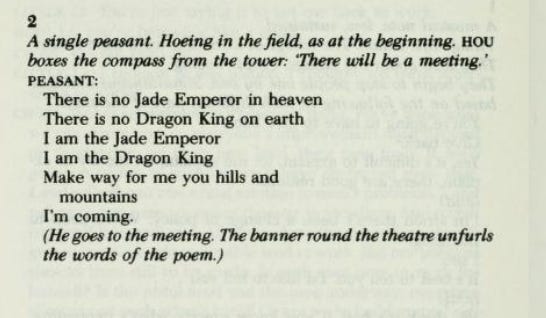
§
With both Rausch and Traum left behind, the area of activity that Hans Sachs announces his entry into here is an area of human activity that really dispenses with such figures as the hero and the inspired genius.
This “day-labour” that Sachs enters on here has nothing vertical and inspirational about it but is a horizontal activity carried out in respect for and cooperation with others.
It is the work of enlightenment in the sense in which this has been understood by the intellectual Marxist tradition.
This being the case, it falls outside of Nietzsche’s philosophical paradigm.
Yet this – the erstwhile “hero” Sachs taking up the unheroic posture of the patient tiller of the collectively cultured soil – is precisely the topic of the Third Act.
§
The Wahn monologue passes directly over into the scene that Nietzsche cites from: the long dialogue between Sachs and Walther von Stolzing.
The scene has barely begun, in fact, before Sachs sings the lines that Nietzsche quotes
Mein Freund! Das grad’ ist Dichters Werk,
dass er sein Träumen deut’ und merk’.
Glaubt mir, des Menschen wahrster Wahn
wird ihm im Traume aufgetan:
all’ Dichtkunst und Poeterei
ist nichts als Wahrtraumdeuterei
Now, it has to be admitted that, if we take just this passage in isolation, this second scene of the Third Act of Die Meistersinger fits perfectly into the context of references in which the Birth of Tragedy takes its place.
I have already mentioned that B of T was composed almost simultaneously with Wagner’s book on Beethoven, published in 1870 and drawing on certain ideas about dreams taken from one of the essays (On Spirit-Seeing) in Schopenhauer’s Parerga and Paralipomena.
In that essay Schopenhauer had sketched out an idea about “morning dreams” as dreams that best served to communicate deep “noumenal” truth to the “phenomenal” world.
It is clear that, even though these ideas of Schopenhauer’s entered Wagner’s theoretical writing in 1870, they had been an influence on the writing of the Meistersinger libretto throughout the late 1850s and early 1860s.
Walther von Stolzing is “gifted” his Meisterlied by a Morgentraum of exactly the sort that Schopenhauer describes.
This fits perfectly with Wagner’s Schopenhauerian philosophy of art, which saw the artist as carrying back images of the noumenal Wille into the phenomenal world of Vorstellung.
But it is problematical, as I’ve said, for the more elaborate variation on this philosophy that Nietzsche produces in 1872 in the B of T.
Walther von Stolzing is really more musician than “bildender Kuenstler”, so on Nietzsche’s scheme he ought to have been gifted his vision by a Rausch rather than a Traum.
§
But this, as I’ve said, is for me not the really essential problem here – because it is certainly not the central problem of the Third Act.
This central problem is rather quite plainly that of inspiration itself – the problem of what lies between the initial gifting, whether by Rausch or by Traum, and the finished work of art.
“What lies between” here, as I said, is a humble “peasant” work of unheroic rule-following the burden, we might even say the humiliation, of which Hans Sachs here takes on.
§
The most beautiful thing in Die Meistersinger, perhaps, is the poignant contrast between Sachs’s words of Satanic pride in the Second Act
Mein Kind, für den ist alles verloren,
und Meister wird der in keinem Land;
denn wer als Meister geboren,
der hat unter Meistern den schlimmsten Stand.
which celebrate something that Sachs certainly at least once was:
The proud “born master” who needs to follow no rules and can create by pure inspiration
And the deeply humble words with which he explains what a “master” actually is and what rules are for in this Third Act
Mein Freund, in holder Jugendzeit,
wenn uns von mächt’gen Trieben
zum sel’gen ersten Lieben
die Brust sich schwellet hoch und weit,
ein schönes Lied zu singen,
mocht’ vielen da gelingen;
der Lenz, der sang für sie.
Kam Sommer, Herbst und Winterszeit,
viel Not und Sorg’ im Leben,
manch’ ehlich Glück daneben,
Kindtauf’, Geschäfte, Zwist und Streit:
denen’s dann noch will gelingen,
ein schönes Lied zu singen,
seht; Meister nennt man die!
The “master” is really not the strong and masterful being that the name suggests.
He is a “master” because he has lost control, because inspiration and life itself have abandoned him.
§
These themes are stated even more strongly and poignantly in Sachs’s answer to Walther’s question about the rules
Walther
Steh’n sie nun in so hohem Ruf,
wer war es, der die Regeln schuf?
Sachs
Das waren hoch bedürft’ge Meister,
von Lebensmüh’ bedrängte Geister:
in ihrer Nöten Wildnis
sie schufen sich ein Bildnis,
dass ihnen bliebe
der Jugendliebe
ein Angedenken, klar und fest,
d’ran sich der Lenz erkennen lässt.
§
“In ihren Nöten Wildnis…”
A portrait of the artist as man of sorrows, man of abjection.
Perhaps the greatest and most touching modern example of this is an artist who is not much esteemed in our post-modern age: Kerouac.
§
All that this scene brings out about the abject nature of the artist renders, as I’ve said, Die Meistersinger a theological, specifically a Christological work as well.
Walther may seem, superficially, to be the one who bears the Christ role in the drama.
In the opening scene Eva notes his resemblance to David, earliest avatar of the Christ.
But it is really Sachs in the end who takes on the role of Christ as the man who lowers himself into unheroic, decrepit “neediness” as a “man who follows the rules”.
In the last analysis, the whole story of Die Meistersinger is there in the opening chorus, in which the qualities of John the Baptist and those of Christ flow into one another
Da zu dir der Heiland kam,
willig seine Taufe nahm,
weihte sich dem Opfertod,
gab er uns des Heils Gebot:
das wir durch sein’ Tauf’ uns weihn,
seines Opfers wert zu sein.
Edler Täufer!
Christs Vorläufer!
Nimm uns gnädig an,
dort am Fluss Jordan!
§
Another important expression of the kenosis – the taking on the form of a slave – thematic in the Act Three scenario is the sexual one.
In the next scene but one Eva arrives…
In this crucial third-act scene the form of expression adopted by this soteriological problematic is, in large part, the masochistic cuckold scenario, as in Sacher-Masoch’s interesting treatment of the iteration par excellence of the Judaeo-Christian dialectic of messianism, the story of Sabtai Zwi.
Hans Sachs, in this scene, very decidedly and resolutely places himself in the position of the “cuckold”, recalling – in his pursuit of his Handwerk while the love of his life sinks into sexual ecstasy with another – the classical “cuckold” Hephaestus.
§
To reiterate my first remarks, then:
In this sense, I have to concur with those many critics of Nietzsche, whom I otherwise strongly disapprove of –
Rene Girard, for example –
who have suggested that Nietzsche lacked a true understanding of the meaning of Christ.
Nietzsche gives a sign that he will lack this understanding in his later work by clearly lacking, here at the beginning,
an appreciation of that avatar of Christ who is the needily rule-following artist.
Comments
Nothing yet. Say the first thing.
Sign in to join the conversation.