
0:00
-1:07
Can someone make my simple wish come true?2
Male biker seeks female for touring fun.3
Do you live in North London? Is it you?
Gay vegetarian whose friends are few,4
I’m into music, Shakespeare and the sun.
Can someone make my simple wish come true?
Executive in search of something new—
Perhaps bisexual woman, arty, young.5
Do you live in North London? Is it you?
Successful, straight and solvent? I am too—
Attractive Jewish lady with a son.
Come someone make my simple wish come true?
I’m Libran, inexperienced and blue—
Need slim non-smoker,6 under twenty-one.
Do you live in North London? Is it you?7
Please write (with photo)8 to Box 152.9
Who knows where it may lead once we’ve begun?
Can someone make my simple wish come true?
Do you live in North London? Is it you?10
This villanelle is from Cope’s 1986 debut Making Cocoa for Kingsley Amis. Villanelles were invented by the French, who speak a language where approximately every fifth word rhymes, and are hard to pull off in English. The form has changed over time, but in its current state, it contains five stanzas of three lines (rhymed ABA) followed by one stanza of four lines (rhymed ABAA). More importantly, the first and third lines of the poem are repeated at the end of every other stanza before acting as the final two lines of the entire thing. If all that has your head swimming, check out the poem itself.
With respect to Dylan Thomas, Elizabeth Bishop, and, uh, myself, Wendy Cope is the undisputed champion of the villanelle. Perhaps because of the sheer number she’s written, she feels completely at home in the form. In “Lonely Hearts” every line has perfect iambic pentameter and, with the exception of “young” in line eight, perfect rhyme. All that and the language is conversational and charged with meaning. She’s the master.
Long ago I was going to write an essay titled “What’s the Point of Repetition in Poetry?” I may still do so, but so far I’ve been thwarted because the answer to that question seems to be different for every poem: nothing generalizes. It’s obviously a question we have to grapple with here because villanelles are dominated by repetition.
The first thing I notice is that lines one and three contain only questions. Why? Because—wonderfully—the entire poem is a sort of epistolary novel taking place in the personal ads! I’m old enough to have read such ads (though not old enough to have used them) and can imagine this writing miraculously coming into shape as I scan the tiny-fonted entries, a sort of found poem that just happens to create a villanelle.
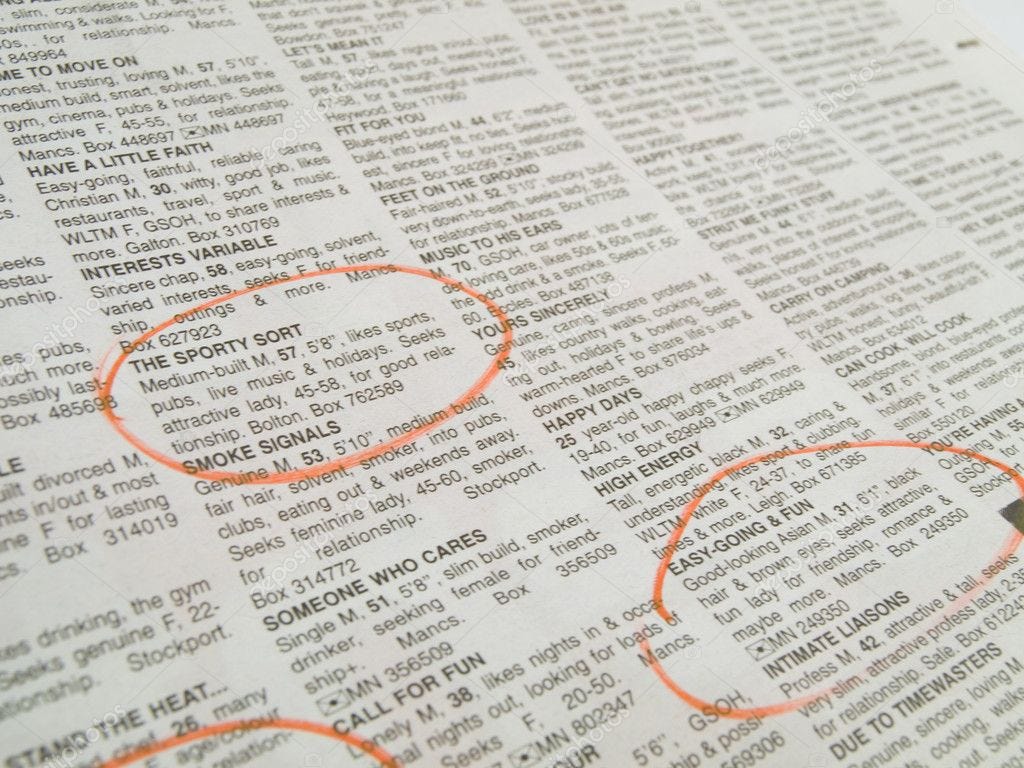
It’s the perfect marriage of content and form: the repetition reproduces the effect of multiple voices writing to each other in the same canned language. It also reproduces the experience of looking for love: as anyone who has survived the dating game can tell you, finding “the one” involves trying your luck again and again and again and again. Compared to the misery of a million blind dates, one could be forgiven for thinking Sisyphus had it easy with his boulder and hill.
The most endearing aspect of this poem is the cast of characters. This is not a London dominated by a homogeneous population of Mr. Beans (or Mr. Bleaneys). Cope’s lineup is both modern and varied. The fact that she can accomplish this effect in such a short poem (made all the shorter by the repeated lines!) is a testament to her genius. Her sense of humor also shines through in this very first example, if only because people who dress like this are a very special sort.
But there’s also a sadness in how varied these people are! Sure, the city feels vibrant and alive, full of different people with different values living together in harmony, but how do you find your match in such a world? I don’t think there’s some hidden screed about the dangers of multiculturalism here, but I don’t envy the gay vegetarians of the world: the dating pool is small enough already. I do think it’s funny how this particular poster vacillates between the specific (gay, vegetarian, Shakespeare) and general (music, the sun) when describing himself.
Of course, not everyone is looking for love; some are just having a midlife crisis. Once again, Cope packs an entire short story into a few lines. “Executive” is a wonderfully stodgy contrast to the bohemian adjectives he’s seeking. I can imagine the end of the relationship before it even begins: after weeks of trying to keep up with the girl—going to shows that don’t start until midnight, meeting her twenty-something friends, actually having to act on that bisexuality request—the man finally realizes he can’t regain his youth by finding it in a partner.
Talk about a time-capsule. Of course you had include smoker / non-smoker.
By the end of the poem, the repetition, use of cliches, and lack of any metrical derivation create a cloying, childish, sing-songy feeling which masks the very real pain of these lonely hearts. But what can they do? Get creative at fifty cents a word? Ol’ Bill Shakespeare himself couldn’t reveal a rich inner life in such a small space. It really makes me feel for them. I don’t know why, but I’m rooting for the attractive Jewish lady and the Libran the most. Maybe because one is very old and one is very young?
A bit of humor, made funnier by the parentheses. We all want to find a soul mate…but preferably a hot one.
A minor aside: I love when poems rhyme weird things—numbers, dollar signs, other symbols—with words. The visual is jarring but the sound isn’t.
Wendy Cope’s life story is interesting in how uninteresting it is. For fourteen years she taught primary school, unlucky in letters and love. Professional success came in 1992 with the publication of her second book Serious Concerns, and romantic success came in 1994 when she shacked up with the poet Lachlan Mackinnon, whom she married in 2013. She’s famous for her sense of humor, but scratch the surface and you’ll almost always find sadness underneath. Her most famous poem, “The Orange,” is another great example of this.
No posts
Comments
Nothing yet. Say the first thing.
Sign in to join the conversation.