
If you’ve never seen the first five minutes of The Social Network, you’re missing out.
I don’t think you can fully understand this scene without understanding the different types of irony.
There’s verbal irony: that’s the one everybody knows.1 There’s also dramatic irony, in which the audience possesses knowledge the characters lack.2 And then there’s tragic irony. It’s very similar to dramatic irony, but here the lack of information itself is the cause of the tragic event. To turn Hitchcock’s example into tragic irony, imagine the bomb only goes off if a character says, “I’m certain there’s no bomb in here.”3 There’s also cosmic irony and romantic irony and a dozen nuanced variations on all of the above, but tragic irony is what we’re interested in today.
The best example—and we’ll get to The Social Network soon, I swear—is the story of Oedipus. You know how it goes. King Laius and Queen Jocasta, struggling with infertility, consult the Oracle at Delphi, who proclaims King Laius will one day be murdered by his son. (Whomp, whomp, whomp, waaaaaaaaa.) Soon enough Queen Jocasta gives birth, and, in a vain attempt to save himself, King Laius orders his son to be abandoned on a mountainside (an apparently common practice in ancient Greece). But the servant, less of a sociopath than the king, can’t go through with it, so he passes the baby to a shepherd who passes the baby to a shepherd who passes the baby to the King and Queen of Corinth. They raise it as their own, and, after reaching maturity, Oedipus visits the Oracle himself. She tells him he will murder his father and have sex with his mother, and soon enough he does, since he’s misinformed about who they actually are. Years later a plague of infertility strikes Thebes and the Oracle—who by this point is giving off real “Ain’t-I-a-stinker?” vibes—says it will only end when the man who murdered King Laius is brought to justice. Oedipus takes on the challenge and unknowingly vows vengeance upon himself. Yikes.
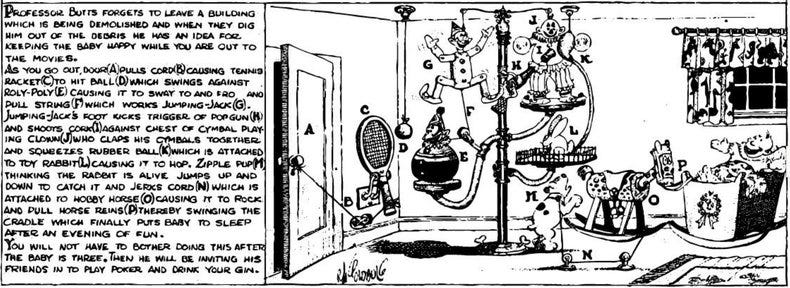
What I love about this is how King Laius, in trying to avoid his fate, sets in motion the events that ensure his fate. There’s something perversely satisfying about the structure. It’s like a Rube Goldberg machine of infanticide, murder, and incest.
So finally—finally—we can get back to those first five minutes of The Social Network.
You know, I once told a group of students I loved this movie and they burst out laughing. None of them had seen it, I’m a nerdy enough guy, and they thought I saw myself as Mark Zuckerberg on some sort of hero’s journey.4 But the thing is—and please don’t take this out of context—I do relate to the Mark Zuckerberg of this movie.
You see, we both have an inferiority complex.
That psychological detail underpins every scene, every action, every line of dialogue: Mark has no self-esteem, so he needs external validation, so he is desperate—just achingly, sweatily, desperately desperate—to become one of the beautiful people.5 That explains his obsession with getting into a final club, and it explains everything else. Just look at the opening lines:
Text within this block will maintain its original spacing when published
MARK: Do you know there are more people with genius IQs living in China than there are people of any kind living in the United States?
ERICA: That can’t possibly be true.
MARK: It is.
ERICA: What would account for that?
MARK: Well first, an awful lot of people live in China, but…here’s my question: how do you distinguish yourself in a population of people who all got 1600 on their SATs?
The insecurity, the need to “distinguish yourself,” the humble-bragging: it’s all there.
The movie doesn’t explain where this personality defect comes from, which is for the best: I don’t need some cheesy scene of ten-year-old Mark getting ignored by a distant father. It’s just who he is. In fact, the movie doesn’t even explain why Mark wants to achieve his goals. There’s a generic “fame and fortune” angle, but it’s obviously an afterthought:
Text within this block will maintain its original spacing when published
ERICA: Is it true that [the final clubs] send a bus around to pick up girls who want to party with the next FED chairman?
MARK: So you can see why it’s so important to get in.
Jesus, Mark. The correct response—to your girlfriend—is, “Gross, right?” And yet, Zuckerberg doesn’t want be the next FED chairman or to party with hot girls. He wants external validation. Go back to 2:58 and listen to how Jesse Eisenberg delivers this next exchange: you can tell he really means it when he says he wants to get into the clubs “Because they’re exclusive”—which is about as close to circular reasoning as you can get—before unconvincingly tacking on the reasons a sane person might give.
Text within this block will maintain its original spacing when published
MARK: I’m just saying I need to do something substantial in order to get the attention of the clubs.
ERICA: Why?
MARK: Because they’re exclusive. And fun. And they lead to a better life.
And the thing that really hurts—the bitter icing on this pathetic cake—is that Mark could be one of the beautiful people if he didn’t want to be one of the beautiful people. They look at him and see a needy little go-getter who never learned you aren’t supposed to be so obvious about things. It breaks my heart. Zuckerberg is an asshole, and it breaks my heart all the same.
It’s a fantastic example of tragic irony. Just like King Laius could have avoided his fate if only he hadn’t tried to avoid his fate, Mark could get what he wants if only he didn’t want it. Remember, with tragic irony, the lack of information itself is the cause of the tragic event. If Mark understood that trying too hard was the worst way to try, he’d be a shoe-in for a final club. Then again, if he understood why he was trying so hard—if he could peer into his own soul and comprehend the lack of self-esteem behind his actions—maybe he wouldn’t be so obsessed with external validation in the first place. But he lacks that level of introspection. You know what else the Oracle once said? “Know thyself.”
In fact, another way to read this movie is as—oh, hell, why not—a hero’s journey in which Mark replaces the symbols of old money with the symbols of new money. If the cools kids won’t let him into their club, he’ll start his own.6
The process begins immediately after the (unbearably sad) credits. And it works! While everyone else is out partying (we see those girls getting bused in to party with the next FED chairman), he’s crafting his misogynistic “Facemash” program. The two scenes are brilliantly intercut, and we get to witness his hateful little website slowly infect and overwhelm the partygoers. Do the cool kids row crew? Mark and his friends hack servers while taking shots. Does old money wear Brooks Brothers? Mark wears a hoodie and fuck-you flip-flops.7 Do WASPs venerate the East Coast and Hah-vahd? Mark’s moving to California and oh yeah here’s Dakota Johnson’s butt in Stanford underwear. Even the title of the movie plays the game. A “social network” used to mean getting hired by a law firm because my father plays tennis with your father at the country club. It means something else now. As the Winklevoss’s friend Divya says in a courtroom scene,
Mark was the biggest thing on a campus that included nineteen Noble laureates, fifteen Pulitzer Prize winners, two future Olympians, and a movie star.8
Some stories are tragic because the characters don’t get what they want. This is not that story. Zuckerberg’s success feels hollow because even when he beats the beautiful people at their own game, he’s still playing the game, still looking outside of himself for a sense of self-worth. The Social Network resembles Citizen Kane not only because it’s about a man and his media empire, but because it’s about a man who gives up something good and real in the pursuit of power. That mistake is symbolized by Rosebud in Citizen Kane, and you might think it’s symbolized by Erica in The Social Network: the movie ends, after all, with Zuckerberg alone in a law office, requesting her “friendship” on the platform he created, refreshing his browser every ten seconds to see if she’s responded.9 But Erica is only there to bookend the film as a framing device. Mark’s real “Rosebud” is his best friend Eduardo, who’s briefly mentioned in the opening conversation:
Text within this block will maintain its original spacing when published
ERICA: Okay, well, which is the easiest to get into?
MARK: Why would you ask me that?
ERICA: I was just asking.
MARK: None of them. That’s the point. My friend Eduardo made three hundred thousand dollars betting oil futures one summer, and Eduardo won’t come close to getting in. The ability to make money doesn’t impress anybody around here.
It feels bizarre not to have mentioned Eduardo before now—his friendship with Mark is the heart of the movie—but this essay is on the first five minutes, inferiority complexes, and tragic irony, so, I don’t know, watch the whole thing to see what happens between between Mark and Eduardo. You’ll never guess who gets into a final club, and you’ll certainly never guess who later gets kicked out of Facebook. You’ll just never, ever guess.
I’ve watched The Social Network a scant three times over the last sixteen years. It’s hard to see my own insecurities laid bare on the screen like that. The melancholy it creates is too intense, too close to the real thing. A person would be a fool to voluntarily crack that door very often: what if it blows wide open?
Good movie, though.
My favorite explanation of dramatic irony comes from Alfred Hitchcock, who calls it “suspense”:
There is a distinct difference between “suspense” and “surprise,” and yet many pictures continually confuse the two. I’ll explain what I mean.
We are now having a very innocent little chat. Let’s suppose that there is a bomb underneath this table between us. Nothing happens, and then all of a sudden, “Boom!” There is an explosion. The public is surprised, but prior to this surprise, it has seen an absolutely ordinary scene, of no special consequence. Now, let us take a suspense situation. The bomb is underneath the table and the public knows it, probably because they have seen the anarchist place it there. The public is aware the bomb is going to explode at one o’clock and there is a clock in the decor. The public can see that it is a quarter to one. In these conditions, the same innocuous conversation becomes fascinating because the public is participating in the scene. The audience is longing to warn the characters on the screen: “You shouldn’t be talking about such trivial matters. There is a bomb beneath you and it is about to explode!”
In the first case we have given the public fifteen seconds of surprise at the moment of the explosion. In the second we have provided them with fifteen minutes of suspense. The conclusion is that whenever possible the public must be informed. Except when the surprise is a twist, that is, when the unexpected ending is, in itself, the highlight of the story.
Or perhaps, “Hey Siri, is there a bomb in here?”
A sentiment echoed by the Buzzfeed article I hate-read every couple of years, “It May Be a Red Flag if a Guy Is a Superfan of Any of These 20 Movies and TV Shows”:
The Social Network paints Mark Zuckerberg as the uncomfortably nerdy nerd who strikes it big and makes friends and enemies along the way. We know a little bit more about Zuck now, and if you’re still fanboying, it’s a no here.
I really, really hope the person who wrote that summary didn’t see the movie, because that’s way less depressing than imagining the level of illiteracy required for such a bad interpretation.
I’m using the term “the beautiful people,” but there’s also “the jet set,” “the in crowd,” “WASPs,” or just plain “old money.” They’re represented in this movie by the Winklevoss twins, who were born rich, row crew, and belong to Harvard’s most exclusive final club.
The real Mark Zuckerberg said the only thing this movie got right was his wardrobe: “Like, every single shirt and fleece they had in that movie is actually a shirt or fleece that I own.”
While “Baby You’re a Rich Man” by the Beatles fades in. Forget the title. What about the first lyrics? “How does it feel to be one of the beautiful people? / Now that you know who you are?”
No posts
Comments
Nothing yet. Say the first thing.
Sign in to join the conversation.