
If2 my darling were once to decide
Not to stop at my eyes,
But to jump, like Alice,3 with floating skirt into my head,4
She would find no tables and chairs,
No mahogany claw-footed sideboards,5
No undisturbed embers;
The tantalus6 would not be filled, nor the fender-seat7 cosy,
Nor the shelves stuffed with small-printed books for the Sabbath,8
Nor the butlers bibulous,9 the housemaids lazy:
She would find10 herself looped with the creep of varying light,11
Monkey-brown,12 fish-grey, a string of infected circles
Loitering like bullies, about to coagulate;
Delusions that shrink to the size of a woman’s glove,13
Then sicken inclusively outwards.14 She would also remark
The unwholesome floor, as it might be the skin of a grave,
From which ascends an adhesive15 sense of betrayal,
A Grecian statue kicked in the privates,16 money,17
A swill-tub of finer feelings. But most of all
She’d be stopping her ears against the incessant recital
Intoned by reality,18 larded19 with technical terms,
Each one double-yolked20 with meaning and meaning’s rebuttal:21
For the skirl22 of that bulletin unpicks the world like a knot,23
And to hear how the past is past24 and the future neuter25
Might knock my darling off her unpriceable pivot.26
For a while I didn’t like this poem: the level of self-loathing seemed indulgent, even comical. But one day, snooping around for an explanation of the last line (what the heck is an “unpriceable pivot”?), I read an essay which noted this speaker (from here on: “Larkin”) suffers from depression.
I had never considered the poem in clinical terms, and suddenly I had all the sympathy in the world for the guy. He’s not indulging in these feelings, like a pig wallowing in mud, because he likes them. Depression takes over your brain. It forces itself upon you. It lies to you, and the thing that could correct the lie is the thing it takes over.
This is now one of my favorite poems. It puts me in mind of Scott Alexander’s instant classic “Singing the Blues.” The level of self-loathing is indulgent, yes—but that’s depression for you.
The comma from the title is missing. This break in parallelism would normally drive me nuts. What’s going on?
I’d like to explain it using an anecdote from history. Two-thousand-some years ago Philip II sent a message to the Spartans: “If I invade Laconia you will be destroyed, never to rise again.” The Spartans could have responded with a lengthy diatribe full of crude insults and military braggadocio. Instead they sent one word: “If.”
The titular comma operates the same way, turning the conjunction into a challenge: “If you looked inside my head you’d be horrified by what you found. If you looked.”
Titles can, paradoxically, feel like the punctuation mark that ends a poem. When we first read them, we have no idea what’s coming, so the words are signifiers fairly divorced from signified. It’s only once you’ve finished the poem that you can reread the words fully knowing what they imply. So there it is, waiting for us to look back up: a single, sardonic comma rebuking the darling for what she will never dare do.
A critic once called this allusion to Alice’s Adventures in Wonderland unlike Larkin. Really?! The man who thinks distant travel is Ireland? Who hates modernity? Who pretends to have never heard of Jorge Luis Borges? It’s unlike him to reference a famous, Victorian, English novel?
I sort of get it. Alice is a poignant, fanciful, loving reflection on childhood. Still, the allusion strikes me as apt. And choosing a children’s book highlights the nastiness to come in a way that “If my darling were to once to decide / Not to stop at my eyes, / But to descend, like Dante, with Virgil into my head” doesn’t.
A quick note on the form. There are eight stanzas of three lines each. We switch from the nice things the darling wouldn’t find to the nasty things she would find in the fourth stanza, so nasty outweighs nice five to three. The meter is roughly iambic, and the line lengths vary (though they converge toward pentameter near the end). The rhyme scheme—and I do think there’s a rhyme scheme—is AXA. Those rhymes are almost hidden, not only because the middle line doesn’t have one, but because every AA pairing is a sickly, unsatisfying slant rhyme. I mean, “decide / head”? If the pattern didn’t hold in the other stanzas, I’d say it wasn’t even there. Do I think that disgusting sonic quality fits the subject matter? Yes. Yes I do.
As I noted in my annotations on “Church Going,” Larkin is a great lister of things. This is the objective correlative at its finest. Larkin never once directly states his mood: it’s all stuff. Lewis Carol does the same thing to great effect during Alice’s fall down the rabbit hole—
she looked at the sides of the well, and noticed that they were filled with cupboards and book-shelves; here and there she saw maps and pictures hung upon pegs. She took down a jar from one of the shelves as she passed; it was labelled ‘ORANGE MARMALADE’, but to her great disappointment it was empty.
—and the initial things Larkin lists could all be found in the pleasanter parts of Wonderland: tables, chairs, a mahogany (gorgeous!), claw-footed (fancy!) sideboard, warm glowing embers.
The word tantalize comes from poor King Tantalus, who is condemned in Hades to stand in a pool of water beneath the boughs of a fruit tree, the water and fruit forever receding when he bends down to drink or reaches up to eat. That story also gives us tantalus: “a locked cellarette with contents visible but not obtainable without a key.” I imagine it most often contains expensive bottles of alcohol. As with the sideboard, Larkin is describing pleasant furniture related to eating and drinking.
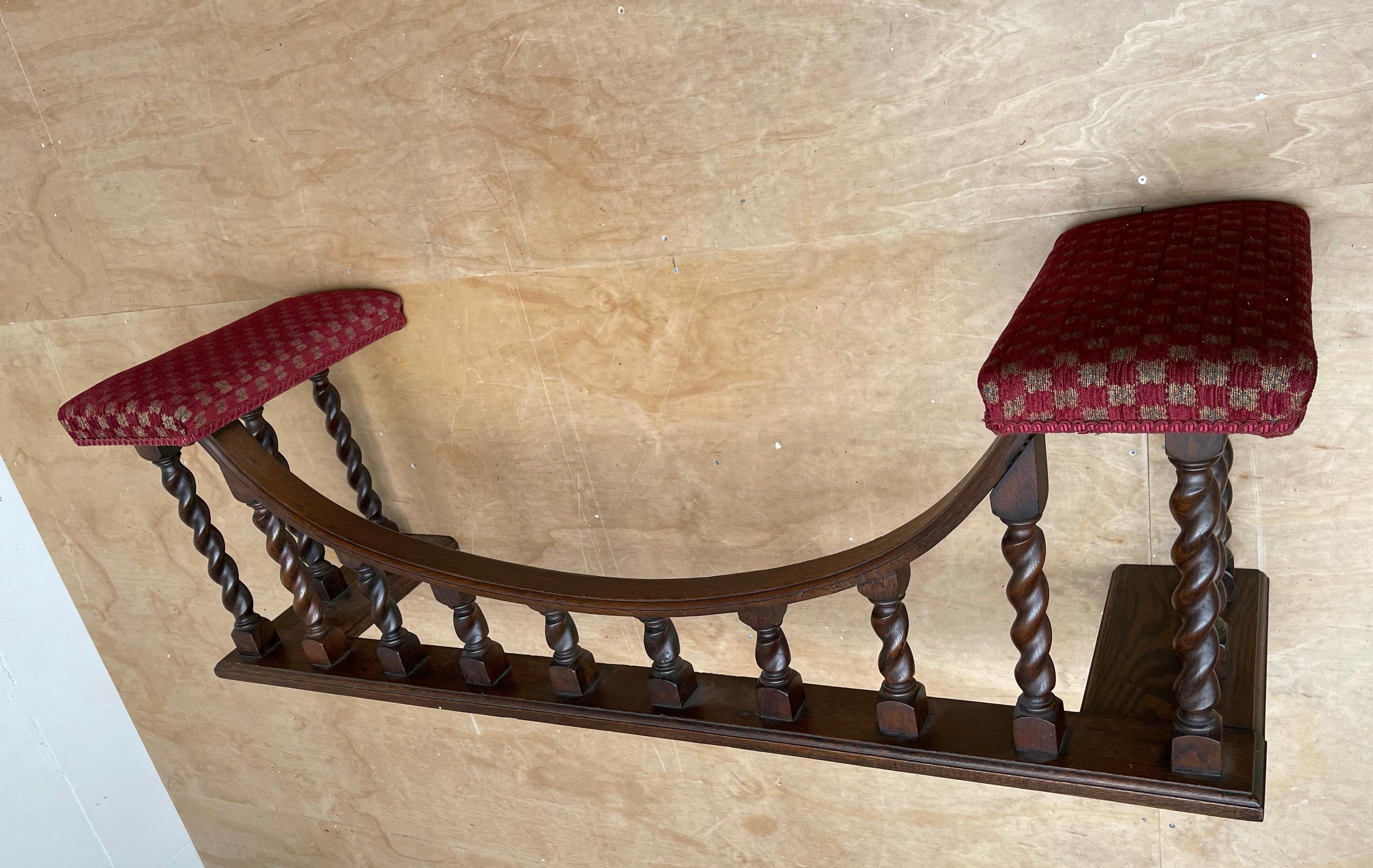
We’re focusing more on furniture than poetry in this section, but a fender-seat is a railing / seat that surrounds a fire and allows people to to warm themselves.
I don’t imagine these are religious books: the scene is simply too pleasant for talk of Heaven and Hell. Rather, these are engrossing Victorian novels (I have never seen smaller print than in leather-bound Victorian novels) one can read on their day of rest.
I was once in the bathroom of a luxurious mansion. It had two light switches. One operated wall-mounted globes beside the mirror. The light they produced was golden, diffused, and soft: I was never as handsome as in that lighting. The other operated an overhead fluorescent rectangle. The light it produced was…well, let’s just say I never looked more sickly, tired, and jaundiced. Any good horror director—and we’re in a horror movie from here on out—could tell you “the creep of varying light” is essential for making an audience uncomfortable.
I know a woman’s glove is a symbol of feminine mystique because I know what sort of glove he’s talking about:

This line is meaningful to me in a manner too personal to be arguable. Let me explain using Robert Egger’s 2015 film The Witch.
Watching that movie, one realizes true horror isn’t some supernatural being, it’s life as seventeenth-century New England Puritan. Like, ninety percent of the film documents the routine misery of surviving premodern life. If you haven’t seen the film, I cannot describe the existential dread one feels when the family is starving to death and the inept father fails, once again, to shoot a rabbit.
And so, when Black Philip offers to buy young Thomasin’s soul, what does he say? “Wouldst thou like the taste of butter? A pretty dress? Wouldst thou like to live deliciously?” This scene is profound because it shows just how pathetic earthly goods are: this girl is going to sell her soul for butter and a dress! But what would a modern person ask for? A bright-red Ferrari and a mansion in Beverly Hills and a coterie of supermodels? That’s the lesson the offer makes clear: to Satan (or God), these things are just as fleeting and trivial.
What does this have to do with the poem? Larkin understands the provincial nature of his own desires: granted any wish in the world, he’d ask for a good lay. Even his delusions—the fantasies in which one is absolutely free—are small, cramped, unimaginative things. We see this again and again in poems like “Wild Oats,” “Annus Mirabilis,” and “Breadfruit.”
And worse, those fantasies “sicken inclusively outwards” to fill his whole mind. His desires aren’t just petty, they’re petty and all-encompassing. They shrink and they expand. In fourteen words Larkin reveals an entire psychology of obsession, small-mindedness, and regret.
One last thought: it is only here, 103 words in, that the first sentence ends. Larkin cheats a bit with colons and semicolons—those punctuation marks that let you start a new independent clause—but the poem is, shockingly, three sentences long.
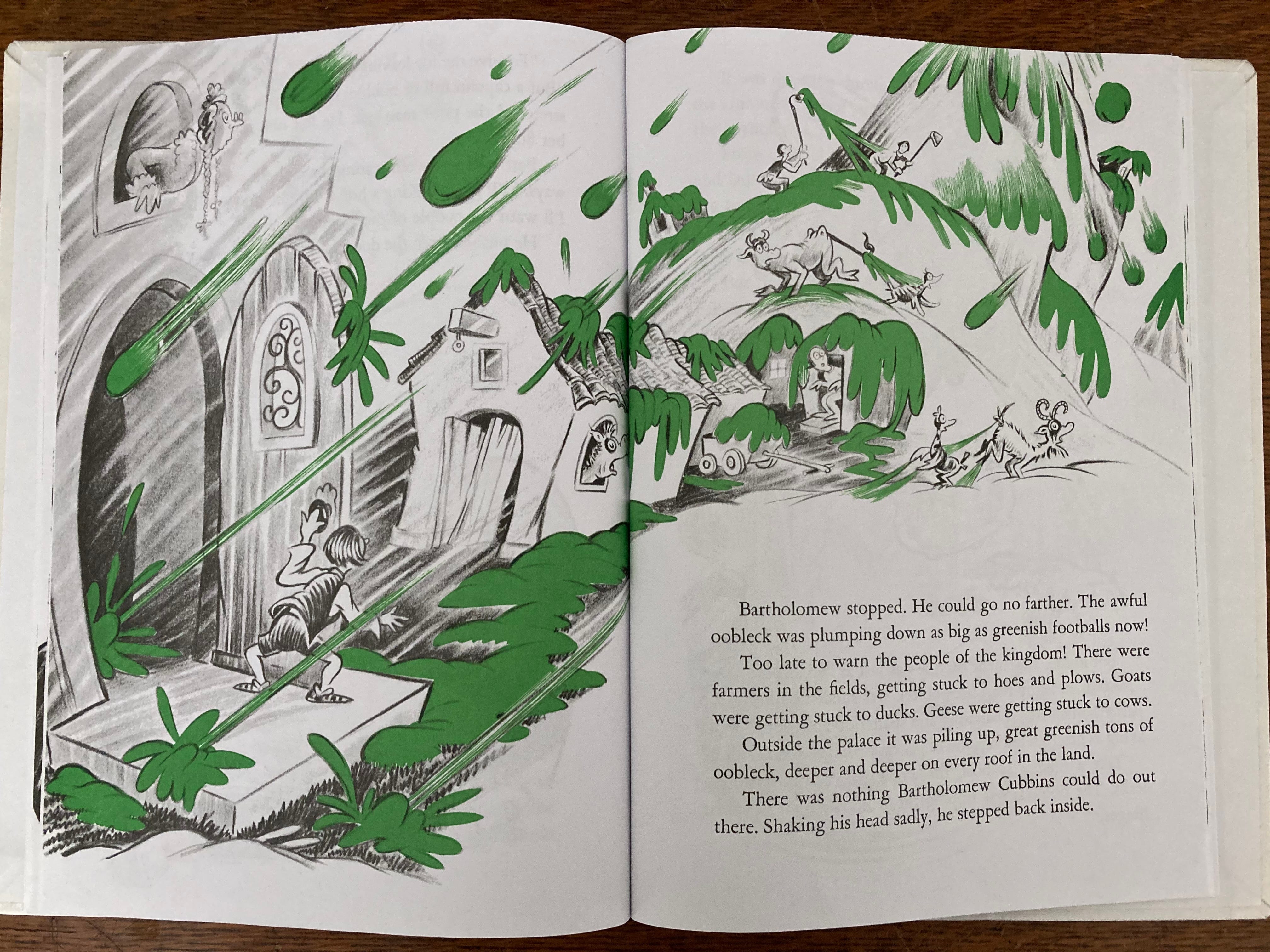
I’ve heard it argued that disgust is the strongest human emotion. So much of this poem is viscerally disgusting. For betrayal to be so physical it binds to your skin, covers your fingers, and gunks up your hair! It reminds me of nothing so much as Dr. Suess’s “oobleck”:
I don’t picture a foot harmlessly bouncing off a marble statue. Rather, I picture a marble statue momentarily come to life, so that when the foot lands in its crotch, the statue bends over double, clutching its groin, only to then turn back into stone, stuck in that ignoble position forever. There are lofty things in Larkin’s mind; they’ve just all been perverted into something shameful.
More than “Money,” this word makes me think (again) of “Breadfruit,” where Larkin notes that young men, after getting tricked into marriage, are now saddled with “A mortgaged semi- with a silver birch; / Nippers; the widowed mum; having to scheme / With money; illness; age.” I think of the phrase having to scheme with money all the time, because it’s something I do all the time: paying for utilities, frowning at subscription increases, bringing coupons to the grocery store. What I love most about the word here is the complete lack of modifiers. To Larkin, money is so obviously negative it doesn’t require a nasty adjective.
The word “reality” makes me think of my favorite Lovecraft passage:
The most merciful thing in the world, I think, is the inability of the human mind to correlate all its contents. We live on a placid island of ignorance in the midst of black seas of infinity, and it was not meant that we should voyage far. The sciences, each straining in its own direction, have hitherto harmed us little; but some day the piecing together of dissociated knowledge will open up such terrifying vistas of reality, and of our frightful position therein, that we shall either go mad from the revelation or flee from the deadly light into the peace and safety of a new dark age.
I have spent a decade-plus believing this referred to farm equipment which keeps two pack animals side-by-side—

—only to recently discover a “double yoke” is different than a “double yolk”:
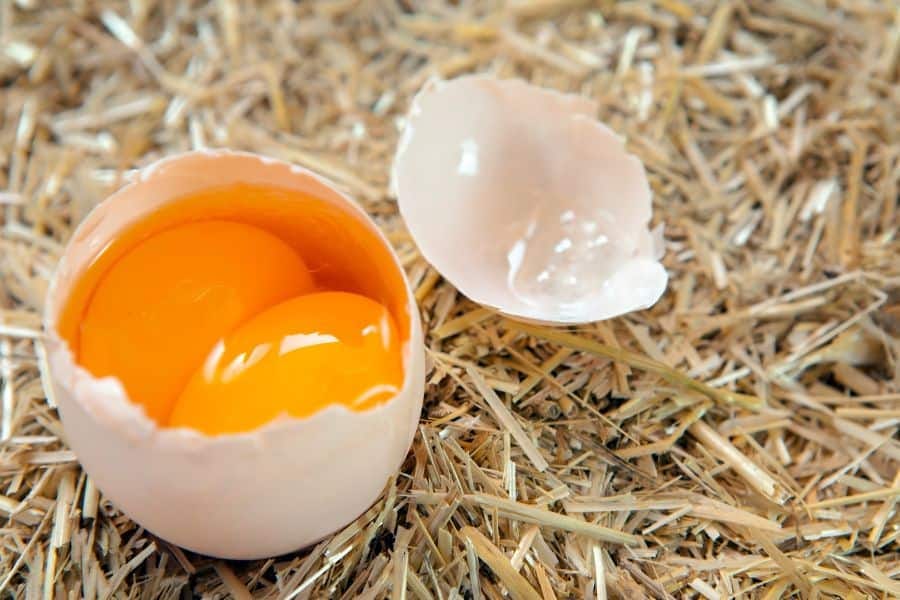
I suppose the meaning remains the same (Stanley Fish, eat your heart out): “meaning and meaning’s rebuttal” are inseparable.
When I was severely depressed in college, a number of heinous liturgies were always running through my head. “I don’t deserve this” was one of them. It was supposed to be a nice thought: I didn’t deserve to feel so bad!
You might think depression would follow a nice thought with an awful thought. It doesn’t work that way. It was more like the nice thought and the awful thought were superimposed on each other. The nice thought was a bit of translucent blue plastic film, the awful thought was a bit of translucent red plastic film, and they were overlaid, so that I never experienced blue, only some sickly purple-brown. (You might even say my thoughts were like “a string of infected circles / Loitering like bullies, about to coagulate.”)
Consequently, when I tried to stick up for myself by thinking “I don’t deserve this,” there was a simultaneous rejoinder—not one nanosecond late—which said: “No, you don’t deserve this; you’re one of the luckiest people on earth. How fucking pathetic and selfish of you to feel sad when you’re so privileged. You don’t deserve to feel this way at all, you spoiled piece of shit.”
“Each one double-yolked with meaning and meaning’s rebuttal,” I guess. When I was at my worst, everything I could think to say was instantly contradicted by a howling chorus of clever, sadistic, irrefutable bullies pointing out the untruth of anything useful or forgiving which might have crossed my mind.
I have read many books and poems and essays about depression. Most of them leave me flat. “Each one double-yolked with meaning and meaning’s rebuttal,” isn’t histrionic or even very vivid to the non-depressed person, but it is the single greatest description of depression I have ever encountered. It is so good it makes me feel not alone. No one who hasn’t felt it could ever come up with that.
This line eludes me. Untangling a knot seems like a good thing. On the other hand, “to unravel” is to (emotionally) fall apart. But Larkin doesn’t use either phrase: his knot is unpicked. I don’t know. All I can think of is Alexander the Great cutting through the Gordian Knot with one fell swoop of his sword.
The poems stuns, again and again, because of the off-kilter vocabulary. I have no idea what sort of life one must live to come up with “neuter” here. It means “neither active nor passive” or “taking no side : neutral,” but come on, no one reads this word without thinking of a spayed dog. The future (which has the “ew” sound of “neuter” right in it) is castrated. It is barren and without progeny. It is a a dead end.
This is the line I had to look up. Unpriceable = priceless = of unlimited value. The Mona Lisa is priceless. But what about “pivot”?
In “Born Yesterday,” Larkin wishes for newborn Sally Amis to be “ordinary” and have “Nothing uncustomary / To pull you off your balance, / That, unworkable itself, / Stops all the rest from working.”
Have you ever seen someone’s life dominated by their own good looks? There is a sense they dare not squander this gift the rest of us don’t have, and so they spend exorbitant amounts of time keeping up their appearance, until finally they forget “that maybe there’s more to life than being really, really, really, ridiculously good-looking.”
Anything extraordinary can dominate a person’s life. (Ask Larkin: he was an extraordinary poet.) If any one trait is too extreme, it becomes “unworkable itself,” like kiln-fired clay that cannot take a new shape, and “Stops all the rest from working.” I imagine a ballerina in a music box. If any one gear is too large to turn, all the other gears, and the ballerina herself, can’t turn either.
And so the final word of “If, My Darling” is not “peak” or “pedestal” or “perch,” but “pivot”: a word that implies the ability to change course if something isn’t working. (One day I will write an essay on all the times stasis shows up in Larkin’s poetry. Till then, feel free to read “The Life with a Hole in It.”)
That is what the darling will lose if she looks inside Larkin’s head: the priceless ability to change and adapt. Maybe it’s best she never does.
No posts
Comments
Nothing yet. Say the first thing.
Sign in to join the conversation.