
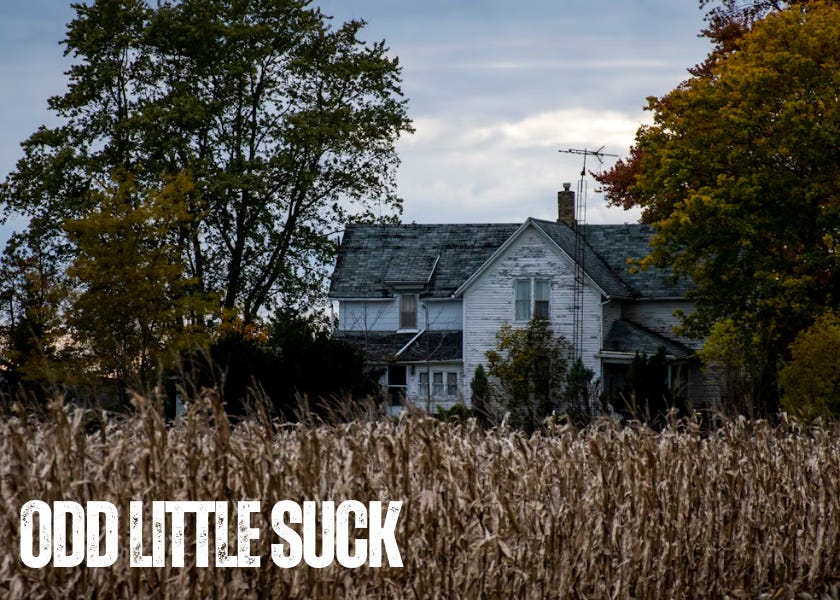
It all started when Ma caught me out in the pasture talking to the cows. She cried to Pa that night. She wept for hours, screaming about how my relationship with my bovine friends was unnatural, and Pa seemed to agree. News of my friendships spread through our little town like a flame through Pa’s brush pile. Folks would see me as they passed by our farm, out there in the pastures, getting along with my bovine friends, and the first thing they would do is go blab to a friend about it. I guess you could say I became famous after that.
Every time we went out in public, I would hear folks whisper as they passed, or see them staring from afar, pointing fingers. I didn’t understand why they did that at first, but then Ma told me it was because I was an odd little suck. She didn’t like that much; me being an odd suck. I learned Ma preferred our neighbors to see us as normal, upstanding, hardworking folk, with not much of any problem to speak of. If there was a problem, we’d work the shit out of it with our sweat and blood until that problem no longer existed, Pa would say. But I guess me being odd messed that up for Ma because her friends stopped coming over on Tuesdays to play bridge, and no one stopped to talk to Pa about the weather anymore when we went to market.
Last week, I received a text from Pa, inviting me home for the holidays and I just about fell out of my chair during a History of West African Arts lecture. Last time I saw him, two years ago, when I sat him down to break the news of my scholarship, he called me a faggot. Then, with my boots tied and bag in hand, Ma called me a disappointment as I headed out the door for the bus station.
After reading Pa’s text, I decided not to go. I couldn’t face them again. They wouldn’t approve of my new life, and frankly, I didn’t approve much of theirs, not to mention their general outlook on things. I wouldn’t go. I couldn’t go. And yet, there I was a week later, boots tied and bag in hand once more, waiting outside student housing for a taxi.
#
As soon as the wheels of the taxi hit the dirt road starting into my hometown, something knocked loose inside me. I had been in Des Moines for so long, on the smooth, paved streets lined with their colorful coffee shops and fancy eateries, I had forgotten how harsh these roads could be after a hard wet season. With each jostle and jolt from the bouncy back seat, a fresh memory would arise, like the surge of a cruel tide, surfacing a new monster at the face of every swell.
The first farm we drove past was the Jensen’s. I noticed there were no goats grazing in the field at the corer of Locke and Burrow like there had been in years past. In fact, there were no animals anywhere on their property as far as I could see. Strange for a farm. They must have sold them off. I heard there had been a recent meat shortage, so maybe they needed the extra scratch to get by.
Mark Jensen and I used to play together in grade school. I wouldn’t say we were the best of friends, but we got along pretty well. Last time I was over there for supper, I think it was sixth grade; I sent Mark’s parents into a tizzy after we said grace.
Mrs. Jensen served me a couple of big ropes of muscle from the roast. I declined and said I had decided not to eat meat anymore. This was something I had decided just that morning, after Henrietta and Earl out in the pasture told me they didn’t much like being eaten, and that went without mentioning the slaughtering bit. Earl could be a bit of a curmudgeon, so I took most of what he said with a grain of salt, but Henrietta displayed nothing but the utmost levelheadedness in all our previous engagements. When she told me something, I took it to heart.
When I revealed to the Jensens, sitting in front of their heaps of dead, sweating cow, that my friends had expressed their preference not to be eaten, it was not met with a Henrietta degree of levelheadedness. Mr. Jensen began shouting at me about the importance of a high-protein diet and said only pussies were vegetarians. Later that night, after Pa brought me home and rubied up my backside for causing a fuss, I did some digging of my own and found that, according to the first website I clicked on called Cattleman’s Beef Board, Mr. Jensen was right. I learned that evening that I should listen to my elders. I ate meat from that day forth, as long as I lived on the farm, because Pa said if I didn’t I’d be no son of his. Sad part is, I never did get invited back over to the Jensen’s to show them how much meat I could eat.
#
We passed a few more farms, all of which looked dilapidated and nonoperational. I couldn’t remember the names of the families that ran them, and to be honest, if it weren’t for their cars in the driveway, I’d say no one had lived on these lands for quite some time. Then we came upon the McMurray’s farm. My system flushed with turbulence, and I felt like I might throw up my tofu breakfast, partially because I was almost home and didn’t want to look Ma and Pa in the eye, but mostly because of the state of the McMurray barn. The big, white barn, standing high upon that hill, had always been a bright, shining beacon for my family that signaled home was just around the bend. It was the most immaculately painted building in all of town. Mr. McMurray had no children on the count of Mrs. McMurray being barren, Ma would say. And I guess all that extra time and money they had on the count of her barrenness allowed Mr. McMurray to afford to slap a fresh coat of white paint on that barn every single spring. Except today the barn was filthy, dull, and in ill-repair. One of the doors was hanging from a single hinge, and in red paint, smeared haphazardly across the white siding was the word ‘NO,’ written over, and over, and over, wrapping around the barn as far as I could see.
About twenty feet down the hill from the barn, I saw Mr. McMurray sprawled out on the ground, taking a nap, covered from head to toe in that red paint. Poor old Mr. McMurray. He must have finally had it with Mrs. McMurray’s Barrenness and gone completely mad. Pa had said he wouldn’t have stood for it, and I believe him. If Mr. McMurray would have bothered to ask, I could have recommended him to the best psychotherapist this side of Wisconsin, but people around here tend to be proud.
My Therapist, Dr. Hallowitz, was not only the best psychotherapy practitioner in town, he was the only one. Unfortunately, he wasn’t as successful as some of the big city therapists I’ve seen since leaving the farm. He practiced out of his basement, and most of the machines he used, like the electroshock therapy chair, he had to make himself. Poor guy. Ma always said a corn fed brain is a healthy brain, and one thing an Iowan is never short on is corn, so business was slow. Luckily, I had some sort of demon in me that kept him pretty busy, because Ma had me over there three days a week strapped to that chair until the cows stopped talking to me.
#
It’s funny how things change.
I was in tenth grade when I passed through therapy with flying colors. I used to question everything, and it made life pretty confusing. After my time in the chair, all the confusion just meted away. The cows used to tell me how great I was, and that I must be the kindest, best human of the lot. It made me feel pretty good to think that, but it turned out, those cows never did really talk to me. Dr. Hallowitz helped me see that. He told me the pain from the treatments would be worth it, and he was right. Things became so much easier.
Ma and Pa were tickled that I didn’t talk to the cows anymore, and I steered clear of my old friends in fear of any possible relapse of my psychosis. Unfortunately, Ma and Pa’s elation was soon replaced with more disdain when I began painting pictures. I painted mostly farm related things, but with my own unique style. My teachers said I had a lot of talent and that I should pursue art as a career. Pa didn’t love this path for me, because he always thought I would grow up to tend to the farm as he did after his father. Pa said painting pictures was for homosexuals, but in my experiences since leaving for art school, I haven’t found that to be factual.
After living in the dorms for a while at Drake, I learned that there was actually a decent sized population of folks in the city that were vegetarians. I couldn’t tell if they were pussies like Mr. McMurray had said, but I decided I’d forgive them even if they were. I found a lot of great restaurants and recipe books that made my transition to a meatless diet quite enjoyable. I often wondered why I chose not to eat meat and guessed it was probably a benign relapse of my psychosis. I kept that to myself, though. Folks might not understand, and I wasn’t fond of the idea of sitting in Dr. Hallowitz’s chair again.
The best part of my entire experience at Drake was meeting Mary Katherine. She was a year older than me, which made her just old enough to buy alcohol legally. She got me good and drunk the first night I met her, which was the first time I had ever drank. Boy, had I been missing out. Later in the night, we made dinner together. I taught her how to make my favorite dish called ratatouille. It was the best vegetarian dish I knew how to make—thanks to that talking rat in that movie—and it seemed like she enjoyed it, although she did ask if I forgot to put the meat in. Best yet, that same night, she took my pants off, and we had sex. That was a first for me too. I had no idea life could be so exciting.
After over a year at Drake, I had finally made a friend. Someone I could stay up late with, and tell my secrets to, and have sex with everyday. This was going to be wonderful.
Except it wasn’t.
The next day, we went to a little cafe to have breakfast. Mary Katherine was from Nebraska and talked about how much better their corn was than the corn in Iowa. I had to protest, because, as dad always said, Nebraska’s corn tasted like dog shit next to an ear of Iowa’s finest. Mary Katherine must never have heard this because she went bananas. After our friendly debate turned into her shouting at me, I added that Iowa’s beef had to be better too because the cows fed on our superior corn, and that sent the poor girl over the edge. I saw Mary Katherine on campus a few more times after that, but she would walk in the opposite direction once she saw me. She even flipped me off once.
#
When my taxi rounded the bend, my heart revved as I tried to make sense of what I saw. Where the flowing green fields of our farm once danced, a thirsty, brittle sea of brown lay in its place. My old friends, the cows, were gone. The goats, gone. The chickens, gone. All of it, just a skeletal wasteland of a once thriving homestead.
“Is this the place?” the driver asked, confused at our dieing destination.
“Uh, y-yes. I guess it is. You can just let me out here.”
The driver pulled to the dusty shoulder, and I stepped out of the car, unsure if I should investigate the carcass of my childhood grazing grounds or run back to Des Moines, where so much possibility of art and sex awaited me.
As I inched up the stretch of dirt driveway, I felt as if walking back into this house would be the end of me. As if this house, this farm, all my life, was feeding off me, gradually collecting its pound of soul, and when I left, I had starved it. It wasted away into this thing that encompassed me now. What would happen when I entered those doors ahead? Would it devour me whole? Would it finally have what it wanted? What it needed to return to its vibrant state after consuming what was left of me?
How were they living like this? It wasn’t like Pa to let the grounds fall so far. He was a man of the land, proud of the work he did and the fruit it bore him. And Ma, she would never let the neighbors see her home in such shape. Social suicide, she would call it. But maybe that’s just it: Maybe when I left home, their sweet little disappointing faggot, I ripped a hole in their hearts too big to mend, and this was an outward representation of the pain I caused them. Did I hurt them that badly? Did they care that much? Maybe that’s why Pa texted me. Maybe they need their son back home so they can heal.
I approached the front door and knocked three times.
I waited a minute, then turned the knob and eased the door open.
As soon as I entered, the most glorious smell wafted into my face, carried upon the warm humidity of cooked meat. I hadn’t had meat in over a year, but it smelled incredible. The inside of the house was immaculate, just as the day I left. The living room to the right was dark, but to the left, an amber glow came from the dining room, and a sweet song poured through the halls.
When I entered the dining room, the music got louder. The table was spread with a magnificent feast, fixed with every cut of meat imaginable, some I wasn’t even familiar with. Ma and Pa must have really missed me. I wondered if they were doing all this to get me to stay. So that I could take over the farm from Pa and bring it back to life, and so Ma could look good in front of the neighbors again. I could hear running water and fiddling with the dishes in the kitchen.
When I entered the kitchen there was Ma and Pa, facing the sink, washing dishes together, their large bottoms swaying in unison to the woeful, honey dripping sounds of Leanne Rimes’s ‘Blue.’
Ma’s hair was matted and had chunks of something red in it. The back of Pa’s head was split down the middle, revealing a red, black, and white gouge. Their bodies were and bursting at the seams. The skin on the back of their arms was like overdone sausage, their furry, black and white innards spilling from their rigid skin casing through large tears in every direction.
“Ma?…Pa?”
They stopped what they were doing and looked at each other. When their heads turned, I could see silhouettes of their long snouts. Ma tuned off the water, and Pa reached over and turned off the radio beside him, laying silence upon the home. The silence deafened me as my shock singed mind was given the space to piece together what I was seeing. Ma and Pa nodded at each other and spun to face me, standing upright on their back hooves.
They were both wearing their aprons, the one Ma always cooked with in the kitchen, the one with the flower print. And Pa’s apron that he wore when he grilled out on the back patio, the one that said ‘Is It Beer:30 Yet?’ The aprons were soaked in blood, most of it dried to the point of flaking. In the areas that the skin was not pulled across their bodies as tight as wet rawhide exposed to the afternoon sun, it hung loose and shriveled like month-old, fallen citrus.
Both of their faces were sagging and ripped into pieces, placed mosaically, accented by Ma’s signature blue eyeshadow and the scruff of Pa’s mustache, to create a gruesome sort of flesh Picasso, propped up by their large, gooey snouts. The bits of their faces kept sliding down, and they would reach up every few seconds with their hooves to try to reposition the meat flaps to where they thought they should be.
“Hi, Bobby,” said Pa.
“Hi, hon,” said Ma. “We made you a lovely dinner. It’s your favorite. Meat.”
I looked back at the dining table behind me and realized the beautiful smorgasbord that adorned the table comprised human body parts, skinned, filleted, basted, roasted.
“Henrietta? Earl? What have you done?”
“No, no, Bobby,” said Pa. “Henrietta and Earl were sent to market long ago. I’m sorry, I know you were close. But they passed down the legend of you, young Bobby, the kind one. All of us cows that came after have heard the tales.”
“And, Ma, and PA…you cooked them?”
“Oh, yes. Just for you Bobby,” said Ma.
“But…why?”
“Us cows have been planning this uprising for a very long time, playing dumb, mooing about, walking around on all fours like any other common animal. We had to wait for the humans to build the infrastructure for us, and to grow our numbers until we had the populous to overwhelm. So many of us have been sacrificed so that we could get to this point, fueling the humans with meat from our own bones so that one day, our race could rise. We freed all the animals, bobby, all across these lands. They’re prisoners no more.”
“I’m the one who texted you, Bobby,” said Pa. “I brought you here, because we just had to meet you. And we prepared your parents just the way you humans like it, medium rare.”
“I—but—I don’t eat meat anymore. I’m vegetarian.”
The cows that wore Ma and Pa’s meat suits looked at each other and both of them burst into tears. Blood-laced rivers ran down their faces, sending slabs of soaked flesh slapping to the floor.
“I can’t believe this,” said Ma. “The legends are true. You really are the kind one.”
Both Ma and Pa walked over to me and wrapped their legs around me. My heart filled with warmth, like the inside of Ma’s oven. My body tingled, and I couldn’t help but smile. It was a feeling I had never experienced before. Was this what love felt like?
Pa walked into the living room and grabbed the throw from the couch. He came back into the dining room. Ma and I each grabbed a corner, and we hoisted it over the dinner table, laying it to rest over the meat of my parents.
“What shall we eat then, Bobby?” asked Pa.
I walked into the kitchen, opened the refrigerator and began pulling vegetables out and placing them on the counter. “Have you heard of Ratatouille?”
Ma and Pa gathered around and watched in admiration as I chopped the vegetables into neat little circles. I told them all about my artwork and the experiences I had since I went away to Drake. They listened intently, hanging on every word, light in their eyes, amazed by me. Just me.
As we walked out onto the back patio to eat our supper, the cool night air enveloped us, and Ma stopped in her tracks at her sudden realization. “Oh, dear. Would you like us to take these dreadful things off?” she said, motioning to the skin suits of my parents hanging from their bodies. “This may not have been the best way to go about things. We just thought—if we made you feel more comfortable, more at home—”
I set the steaming plates down on the picnic table and walked toward them, taking one of each of their hooves in my hand. “It’s perfect. Absolutely perfect. I love you, Ma. I love you, Pa.”
Comments
Nothing yet. Say the first thing.
Sign in to join the conversation.