
More on this newsletter here.
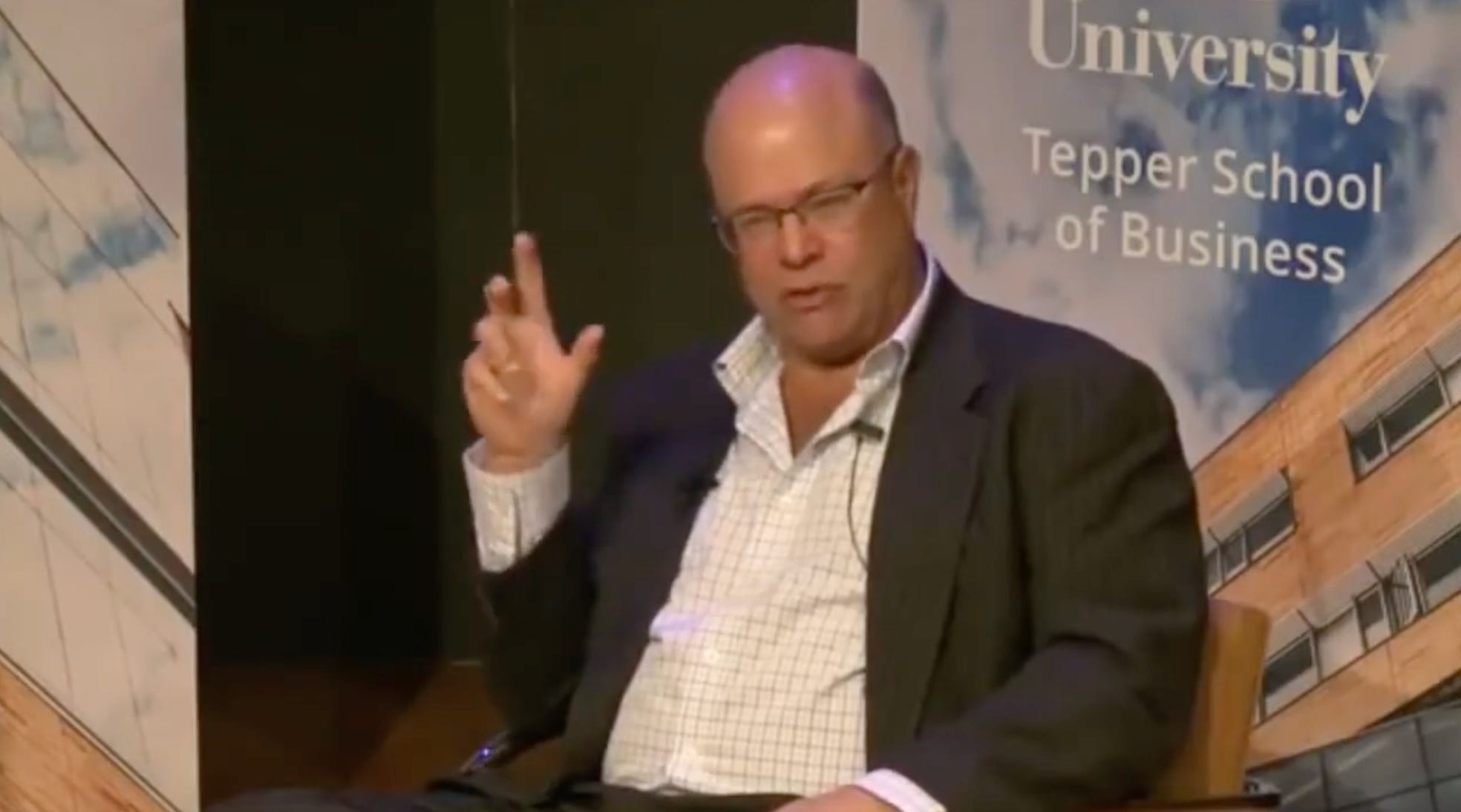
Today’s letter is the transcript of a student Q&A with David Tepper at Carnegie Mellon from 2018.
David Tepper is the Founder of Appaloosa Management and the Owner of the Carolina Panthers.
Host 1: David, by any definition, you’ve had a very successful career. What were some of the things you did earlier on, what habits did you set, what priorities did you set in your early college years or your early career years, that you think have been contributing to that success?
David Tepper: I didn’t get that drunk, I guess? I don’t know. Early college years. Listen, I think, I was talking about how I don’t have anything written for this commencement speech, so I’m in a lot of trouble already. But I think, through life, it’s how you bounce back from disappointment and failures. How you recover and how you move on. For instance, when I came here, Bob said I took a job at Republic Steel when I came out of here. Well, Republic Steel was on its way to bankruptcy. And I could have gone down to LTV down in Dallas, but I chose to go up to Boston for a mutual fund. So there are always those challenges of things going on.
When I was at Republic Steel, I was there for maybe three months, and they gave a 7% across-the-board pay cut. And everybody in my graduate school decided to call me up and say, “Hey, great choice, Tepper!” But it actually was a pretty good choice because they did more financings in the next year or two years than they did in the whole hundred-year history of the company. So, being up in the Treasury Department, that company was on its way to bankruptcy; eventually, you went bankrupt with LTV. There were a lot of things to learn, a lot of opportunities there.
If I go through my career, there were a lot of disappointments, a lot of things that didn’t go right. But those aren’t the things that make you. It’s how you bounce back, how you move on from there, and what you learn from those things. It’s kind of “the river flows.” The river flows. That should be out of somebody’s culture: the river flows. You have to make choices on where your life goes. But you never stop flowing. You never stop riding the river. You never stop dancing.
I just think you kind of keep pushing forward. You’re going to have disappointments. You’re going to have problems in your life. You’re going to have different things that go wrong. But that’s not what’s going to define you. What’s going to define you is how you recover from those things and how you move on.
That should be the commencement speech, right? That’s a good one.
Host 1: That was inspiring. Thank you. So, we’d now like to open it up to the audience. As you guys can see, there are mics set up on the left and the right. If you have any questions, you can start lining up now, and we’ll start with questions soon.
Host 2: Again, we would like for our students to say their name, school, and program.
David Tepper: If there are no questions, I can go out into the sun.
Host 2: If the audience needs a second to think, we have additional questions.
David Tepper: You have additional questions?
Host 2: Yes. So, we talk a lot about this school, but I think this is a great opportunity to learn more insights about your career and your approach to business. So, as business students here, what are some lessons that we need to learn, in addition to what you just said, that are not covered in the textbooks? There are a lot of opportunities to learn here at Carnegie Mellon and access to a lot of resources.
David Tepper: Yeah, listen. I was actually out there for Spring Fling? Spring—
Hosts: Carnival.
David Tepper: No, what was outside with the hamburgers and hot dogs?
Audience Member: Tepper Spirit!
David Tepper: Tepper Spirit? Tepper Spirit, yeah. I didn’t get a hot dog because I was afraid of slopping mustard on myself. But anyway, I was telling somebody out there that one of the things I think you have to do when you’re in business is always try to be ethical and honest.
I was telling them a story about when I was at Goldman Sachs. They set up this bankruptcy fund, and the person who set it up was the head of M&A. This was back after Drexel Burnham went under. So, the guy who was head of M&A was in charge of this fund that was buying assets. He wanted to buy this one company’s bonds, and he gave an order for it. I refused his order because the company was on the restricted list—a no-buy list—because they had information inside the firm—the day before, and he took it off the next day.
So I told him, “I’m not buying it. I’m not gonna buy it.” It was a big thing. We went to legal, and then legal said to me, “It’s okay, it’s not a problem, you can buy things from them.” And I refused to buy anything else for this guy. Now, since he was the head of M&A, it really didn’t help me the next time I was up for partner. But, I don’t know if you know this: it didn’t really hurt me in my career.
So I think that there’s kind of a thing to always running your life right, and always doing the right thing, and always run it ethical. And don’t be afraid if somebody says to do something that you really think is not right. Don’t do it. I don’t think—they may teach you that, but when you’re on the line, I’m just going to say it again: Don’t do it. At some point in your lives, you’re going to have kids, and especially if you have kids, you look at your kids and you say, “Would I rather see my kids or not see my kids?” If it comes down to those sorts of things, if you think things aren’t really right, don’t do things that aren’t right. Stay true to yourself always. I don’t know if they teach you that or not, but you kind of know that already, right? Being a good Pittsburgh person.
Host 2: Yes, of course.
David Tepper: Oh, there’s somebody in the audience!
Audience Member: Hi, I’m a first-year MBA. Thank you so much for coming. My question is around how the program prepared you and made you successful and achieve this phase of your career. Is there any advice you can give current students about how we can perhaps someday be as successful as you are?
David Tepper: You know, I like to say—on my desk, there are three little pigs, and I toss the pigs to see how they land, and then I make decisions on that basis. I’m going to send you those pigs. No. Listen, I really do think that this place at the time gave me the tools that I needed to be well-prepared and in front of other people. So I really do always think that I owe this school a debt of gratitude. I might have paid it back, but I owe them a debt of gratitude. I do think you get a great education here, and I think that did prepare me pretty well. What was your second part of your question again?
Audience Member: Any advice you can offer current students on how we can be as successful as you?
David Tepper: The hardest part of the question, right? Listen, I just think, like with some of the other advice I just offered, just keep your feet moving. Don’t get stuck. Try to do what you like, if you can do it possibly. I mean, I happen to like investing. If you like marketing, do that. Try to do what you like. You can’t always start out that way, but even if you don’t start out that way, you’re still going to get experience, you’re still going to get things that you can learn from.
I’m the type of person, if somebody hit me on the road in an accident, I’m still interested in what the process is when the police come and all that. It’s stupid as hell, but it’s still interesting to me. I think you always have an opportunity to learn from different situations, even the ones that are disappointing. So I would say just always try to learn and move on and try to grow from that.
Host 1: Do we have more audience questions?
Audience Member: Hi, I’m a first-year MBA student. I’m a generally very optimistic person. However, we live in a time where it seems that there’s pessimism all around us, especially with tariffs, and the political scenario.
David Tepper: You don’t like Trump, do you?
Audience Member: Well, I tend to remain optimistic in general. What are your views on this? How do you see the next five years shaking out? We’re entering the job market again. So how would you encourage us to think about these situations and the scenario?
David Tepper: You’re a first year now?
Audience Member: I am.
David Tepper: The economy is really good right now, despite different things. Since you alluded to tariffs, I’ll talk about some of the policies that have come down. I’m not going to get into whether I like the person or not, although I did call him a “demented narcissistic scumbag.” If you look up “demented narcissistic scumbag,” you’ll see my name calling Trump that. Just Google those three words. But that’s beside the point; we’re not going to comment on that now.
From a policy standpoint, some of the deregulation stuff was probably really good for the economy. We probably went too far in the Obama years, and even Bush put on too many regulations. Now, we might have gone too far deregulating things already, but I think some of those things had to happen; I think it was holding back the economy.
The tax policies that they did, although I don’t think they were all good, I think there were some things that needed to be done. I think some of the corporate reform was probably good because we were becoming a high-tax country. I don’t know if they needed to do the individual stuff, cut some stuff for higher-income people, one way or another, so I’m not going to say that’s good or bad. But those two things, I think, were really helping to move the economy and really getting the economy going. And you really have low unemployment now.
Obviously, the tariffs and attacking individual companies like Amazon—I mean, attacking individual companies like Amazon, it’s just nuts. It’s just nuts because Bezos owns The Washington Post. But that’s what we got. And the tariffs—I think tariffs in general are just not a good thing for the economy. I think putting tariffs on steel and making that a fight in something that’s so old-economy and something that employs so few people in the country was probably not the best place to start.
On the other hand, there is a certain amount—if you talk to tech companies, they believe, and there has been proof, that China has taken intellectual property—borrowed it, stolen it, whatever you like to say. So I think something needs to be done on that front.
Putting the first $50mn in tariffs—I don’t know if I totally agree with it. It’s a shot across the bow, and it was okay. The $100mn was crazy because he didn’t tell anybody else in his cabinet. So it’s just nuts. It’s just nuts. So I don’t know where that goes. I’m not a big fan of it. I think they could have done other things for intellectual property.
As far as your prospects, the economy seems pretty good as long as they don’t take these tariff wars too far. They probably will get a NAFTA agreement. You don’t want to take things too far with China because eventually—I can tell you the steps that it will go to. And China’s retaliation—we’ve spent a lot of time trying to figure this out. And you get to the fourth step; it’s a war—it’s a real war. If you look at the history of tariffs, they’ve resulted in, a lot of times, real wars. So I get a little nervous when you start down that path.
But I don’t think—well, I hope—I worry about the erraticness—is that a word? Erraticness?—of the president sometimes, but you hope that you don’t go down that—if you go down that path, you’re kind of... there’s a word, it begins with an “F” and ends with a “K”... you’re kind of that. But if there’s none of that, I think you’ll get a good job. I think the economy will probably stay okay. I’m a little worried about higher interest rates right now, but I think that it will probably hold up for when you get out, which is important. It is a pretty good economy right now around the world, especially in the United States. I think that answer it, right? Wow, it feels like—you ever see this—there’s this show, this—Joy. Anybody see the movie Joy? Where at first she gets no calls, and then she gets a lot of calls coming in? It’s like this—I got a lot of people lining up now. I feel like Joy from that movie.
Audience Member: Hi, I’m a first-year MBA. One of the benefits we have being part of the Tepper Network is all of the people that we’ve met or will meet along our career that serve as mentors and advisors. Can you talk about a mentor that you had early in your career and the impact that they had on you?
David Tepper: Well, I’m trying to think if I had any mentors early. I guess when I was out of undergrad at Pitt, I had a little bit of a mentor at my first job at Equibank, which I don’t know which bank it’s part of now. I just always remember one thing he said about projections. You want to know what he said about projections? He said, “Projections are like assholes—everybody has one.” So that stuck with me. It’s the truth. I’ve always remembered that. That’s a true story.
I want to tell you about mentors, though. Mentors are a little bit tricky. I had a mentor, actually, at Goldman Sachs, a little bit of a mentor. His name was Bob Rubin, who became co-chair of the firm and eventually became Secretary of the Treasury of the United States. Bob was kind of a mentor, but the third time when I didn’t become a partner, it was kind of Bob Rubin’s fault. And I’ll tell you why, so you’ve got to be careful about this mentor game, right?
He was kind of a mentor, and he liked being on the floor, and he liked talking to me. At some point, Bob had the role of head of fixed income before he became vice chairman and chairman. Before that, he was the head of fixed income. And so I would talk to Bob. I was the head trader, and I would go talk to Bob. Eventually, a guy by the name of Jon Corzine, who became the Governor of the state of New Jersey, became the head of fixed income.
Now, when Jon Corzine became head of fixed income, he came from the government side—Bob Rubin came from risk arbitrage. So I was in junk bonds. So Bob Rubin knew about junk bonds because they have an equity component, so I would still talk to him still; I’d still go to his office. And I wouldn’t go to Corzine’s office. Now, Bob Rubin should have said, “Go to Corzine’s office,” because when that third time came up to be partner, Corzine killed me—that’s what I heard in that partnership thing.
So even if you have a mentor who becomes Secretary of the Treasury, you still have to think for yourself—you have to know the playing field. That was my fault, in a way, for not knowing the playing field. But Bob was a questionable mentor, right? At that point. Now, it was lucky for me—maybe he was a very good mentor because if I was at Goldman Sachs, I would have been not nearly as successful. But maybe Bob was a very good mentor. But at the time, when I didn’t get that partnership the third time, and I did everything—I mean, I had put a lot of things together, and he was basically—that was the reason I didn’t get it. He didn’t like me for that reason; he thought I wasn’t one of his people. So, I don’t know if that helps, or if it doesn’t help. A lot of stories there, right?
Audience Member: Hi, I’m a second-year undergrad in the Tepper School of Business. Speaking about interest rates, I had a question: in light of the Fed raising rates and with equity prices at an all-time high, where do you foresee the bond and stock markets for the remainder of 2018?
David Tepper: Listen, it’s tough right now because historically, yields are fairly low. It’s kind of complicated because—actually, tonight, I’m actually trying to figure out what the BOJ is doing, because the BOJ, either this meeting or the next, may change their interest rate policy, which will affect our Treasuries too, and will affect the stock market.
As far as the stock market’s concerned, I think they’re okay; I don’t think it’s great. I think we might have reached the highs for the year, and it really has to do with interest rates. I’m not sure—we’re right on the cusp of breaking out on interest rates at this level, around 3%. I think they closed at 2.98% for the ten-year—actually know, because I just looked. But if they do, if they do—a lot of people don’t think they’re going to break higher. Most people are saying they’ll only go to 3.25%. I think if they only go to 3.25% through the rest of the year, the stock market will be up. But too many people are saying that. When so many people say that, I become wary that’s not going to hold. And if they don’t hold, then stocks may have a problem.
Host 1: Let’s start rotating between the queues now. So we’ll go from the right and then we’ll switch back and forth.
Audience Member: Hi, I’m a first-year MBA at the Tepper School. We learn in business school that there’s a lot of focus on prioritization; prioritizing our professional choices and our classes and student groups. Can you talk a little bit about how your priorities have changed over the course of your professional career?
David Tepper: Sure. Well, I can go back to when I first got out of college—I’m pointing at you [Host 2] because you went to Pitt, too. But when I first got out of college, your priorities are intertwined with different parts of your life, really. So when I first got out of college, I probably was very happy to go out three or four nights a week and go out with buddies, then try to come into work the next day and not be too stoned—too drunk to work. Eventually that got too old, and I got kind of tired of doing that, so then I settled down and decided I better get married, or find someone to get married to, because I didn’t want to do that anymore.
And I think that you’re priorities go, and then you have kids, and for me, it was trying to figure out that balance, because I wanted to do the other things in life. I wanted to coach Little League, which I did. I coached baseball, softball, and soccer. So that was important to me, at that point in time. And that was a priority for me, where I put a lot of my energies: the balance between work and my kids. You want to be as successful as you can in all aspects of your life, not just in your business part, but your personal part, if you can do it.
Eventually, as my kids got older, I probably switched some of that energy that I was putting on them into more charitable sorts of things. I always was charitable, but just more involvement in charity and that sort of stuff. The other thing that I think you have to do, that I probably neglected sometimes—I was going to make a joke about myself—is you also have to think about your personal health, which I do. I don’t neglect that necessarily, but doing enough physical activity, going to the gym enough times—that’s what I was going to make the joke about myself.
Those sorts of things too. So that, I think, is more of a priority now: that whole balance of weight, and also for me trying to see my kids. As your kids aren’t in your house anymore, you try to figure out how you can see them. Then, at the point where your kids have their kids, it becomes a different priority. So I think you have different phases of your life. It’s almost like you have different lives, right? You had a life when you were with your parents, you have a life now, and you’re going to have a few more lives before you’re done. And I think you try to—every one of those lives—I think when you’re younger—
Listen, especially for guys. Guys are idiots. Every woman would agree that every guy under 25 is an absolute idiot. And I was an absolute idiot too. Some guys are still... I’m not going to mention you buddy, now—a buddy of mine is here. Anyways, but I do think there are different priorities at different points in our life. I think if you can figure out that balance—which you guys also struggle with when you’re in school, because the demands are overwhelming—but I think that striving for balance should be something, no matter what part of your life you’re in, I think that’s something you should try to prioritize; try to figure out. That was pretty good, right?
Audience Member: Hi, I’m a second-year undergrad in the Tepper School of Business. My question has to do with your interest in finance and your career in finance. Was it something you always knew you wanted to venture into, or was it more serendipitous? If so, what did that journey look like, and what advice can you give to students who may not be sure what they want to specialize in within business?
David Tepper: That’s a great word. I would not be able—serendipitous? Is that how you say that word? Serendipity? There’s a movie called Serendipity that I like, that I think was with Matthew Broderick or something—no, yeah, no, with John Cusack; I get him confused with Broderick sometimes. Anyway, no, it wasn’t just a coincidence or such. I think I really, one way or another, got exposed to investment. My dad let me invest in a stock called Career Academies. I was really interested in how stocks move—like I really liked collecting baseball cards and statistics and stuff.
Then somehow I got to stocks; it’s all kinds of numbers, and I loved these numbers, the way they played around. So I invested in this Career Academy; the company went bankrupt in three months, and I lost all my money. That’s probably why I’m good at bankruptcies at some points. But I always had an interest in it, and I had different schemes when I was in college. I had this great trading scheme idea that kind of worked for a while, and then didn’t work.
So I always liked markets, and I was fascinated with them, and it was just natural to go into that sort of stuff. It just fascinated me, so I kind of liked it. So it wasn’t by luck. I didn’t go there initially; I went to Republic Steel, but I soon moved to the mutual fund side. Before that though, I was at Equibank. I started as a credit analyst and I moved into the trust department, investing. So I always was trying to get back into investing somehow. For me, it was something I always tried to do.
Host 1: David, to follow up on your answer there, if you were a student in college—
David Tepper: How do you get a chance? I thought we were going over there? Alright, go ahead; I’m sorry.
Host 1: Just following up on your answer there, if you were a student right now that’s interested in finance, whether it’s an undergrad or MBA student, what are the three things you’d be focusing on?
David Tepper: That’s kind of interesting. Listen, I think you still have to take the certain courses that you need here to understand the underlying parts of it. I think that’s one thing. I think some people are going to say you have to be careful because everything’s going to be models and machines. Machines could compete against machines. Bet you there’s a lot of machine finance. But the machines are doing shitty this year. Really bad; not good. I’m kicking their ass.
The reason I know this: when I worked at Goldman Sachs, they had a trading model on the desk, and it was just wrong. That’s one of the great things about being here; I just knew the option part of it was wrong, the way they had to call prices in there. That was a good thing to be here, because I recognized, I had that knowledge from training here.
But now, when people talk about machines taking over, the machine is only as good as the people programming the machines. And when you have some times that are changing, like there might be changing higher interest rates, you’re out of this long Quantitative Easing environment we’ve been in, this financial crisis environment, and people are continuously programming the same damn thing. And yeah, they’ll be less emotional than people, but when the times change, they don’t change unless somebody who programs them changes the programs.
And when times are changing fast, that doesn’t work. And when you have a guy like Trump, you better know how to deal with people, and know how different emotions work. So it makes for a different environment. But I think what you have to understand, even if you do go into—and I don’t necessarily think those quantitative or “black box” deals can’t be really good, but you have to know the fundamental stuff that you learn here: how options work, how finance works, how accounting works. Whether you’re going to program those machines or you’re going to compete against those machines, you have to know that stuff. I think—I know—I don’t have to think—I know this place does a very good job of kicking your ass and making you learn that stuff. For that reason, I think, you get the stuff here that you need for that.
Audience Member: Hi, Mr. Tepper. I’m actually not a business student; I’m a senior undergraduate studying computer science. I hope that’s okay.
David Tepper: Okay, good. That’s what we’re trying to do—get everybody mixed together.
Audience Member: Everybody else who asked a question seemed to be an MBA.
David Tepper: No, glad to have you here.
Audience Member: Anyway, my question is: a couple of years ago, a lot of companies seemed to claim themselves as “Uber for X, Y, and Z.” These years, a lot of companies, I’ve realized, claim to build something—they claim to build blockchain for X, Y, and Z. I heard that Goldman Sachs just started to hire for cryptocurrency traders. Some say it’s literally our future; others say it’s just a hype bubble. So I wanted to ask you, what are your thoughts on cryptocurrency and blockchain technology?
David Tepper: Listen, I’m no expert in blockchain technology. I’m not bad at markets, but I’m no expert in blockchain technology. I understand it, but I’m not great at it. As far as cryptocurrencies are concerned—listen, I view them more like gold, with the trading of them, it’s more like a gold-type value. I don’t see the value above what it costs to mine them, at least the way I view them.
And I think the value—I mean, there’s another value of them—the value that should work with them, to a certain extent, is who can do the fastest—who can make the fastest transaction times? Which currency can do that? Is Ethereum better than Bitcoin, or whatever the new thing is that I don’t know about is better than something else. That should matter, but it doesn’t matter as much, and there’s different speculation. And sometimes what drives that is the potential capital controls in one part of the world or another, whether it’s China or someplace else, can drive the value of Bitcoin, or not, around the world. And you see these different markets with different values in Bitcoin.
So I’m not—I think that it’s harder to—it’s hard to analyze the price movements of Bitcoins to me; why it’s going up or why it’s not going up. I mean, it’s obviously demand and supply reasons; and there are some reasons for some of the things I just talked about. So there is some analysis as to why that stuff may go up or down, but I’m not a big believer in the fundamental value of the individual currencies above that mining value. But that doesn’t mean they can’t trade.
As far as being on a trading desk at Goldman or something like that, if you can be on a trading desk and you can be a good trader, because you’re looking at the information that moves that market, and you can figure out how—in this case, it may be some of the other things we were talking about, it could be what I think are the other things that might move it: whether something goes bankrupt, or somebody’s going to steal your money, or whatever it is. There are some reasons why the thing does move around.
So if you can be somebody who can sense those things or get that information, it’s kind of the basics of trading. If you can get into a good place like—Goldman Sachs is a great place to work for five or six or seven or eight years—in my opinion. I once said I’d rather work at McDonald’s than Goldman Sachs after that, but that’s another story; I can tell that story why. But I think if you can get in there, get in that desk, if that’s your opportunity, it’s not a bad place to be. But I don’t really love Bitcoins or Bitcoin trading or that sort of thing. And I don’t really love gold either, by the way. I mean, I would have a little bit, maybe, in my portfolio. I actually own a little bit of Bitcoins, because my son made a lot of money at some point trading Bitcoins. I think I made $200. I actually bought Bitcoins at the absolute lower Bitcoins. Well, not there. I think I bought Bitcoins at $200 or something. That had to be—$200 handle? That had to be near the lower of the recent prices, right? I sold a little bit and took a little bit of money out, but I only put in like $50 or $20 or something like that. I can’t remember. Anyway, that’s kind of what I view them as.
Audience Member: Thank you. Thank you for being here, Mr. Tepper; we really appreciate it. I’m a second-year MBA. I had a question from the entrepreneurial-minded among us: What were the early days like when you branched out on your own, and do you have any wisdom to share? Obviously things have turned out well, but from the early days, were there challenges or lessons learned that you could share with us?
David Tepper: Yeah, I mean—listen, I’m just trying to think of the lessons learned or whatever. I think some of the things I talked about are that you’re going to make mistakes, and you just keep driving through them. If you have a good idea, you know what you’re doing, and you have a basic knowledge of what you’re doing, I just think it’s something to persevere. That would probably be the biggest thing when you’re an entrepreneur or starting a new business.
We actually started out fairly fast, but I don’t think everybody starts that way—depending on what your business is. But we had different growing pains, like we hired the wrong administrative assistant. I made her cry, I think, because I was just asking her to do something with Word thing and she didn’t know how to do Word, or something like that. It’s employee questions and that sort of thing. I think I probably would have been a little bit more careful in how we hired some people off the get-go. Eventually, you get a lot better at it, but that’s probably not an uncommon thing.
I will tell you this: to me, just a general—one of the greatest undervalued assets in different places are those sort of people—administrative assistants and those people that can really help smooth things in the business. People think they’re a little bit less needed now because of the way the world is, but I think they still do a very important function. But I just think hiring people in general is something that you can’t be careful enough about when you start out.
Host 1: So, we only have time remaining for one more question, unfortunately. So, we’ll take the last question now.
Audience Member: I’m a first-year MBA. As we look and see large segments of change, both geopolitically, technologically, economically—what skills do you think will be important five to ten years out that maybe aren’t important now or haven’t been as important in the past, as we all look to face our careers in business?
David Tepper: Can you just repeat it one more time?
Audience Member: What do you see as skills that will be important in the future that maybe haven’t been as important in the past?
David Tepper: First, I want to just comment on your beautiful haircut. Just want to say that to get it out of the way.
Audience Member: Back at you.
David Tepper: It’s hard to know what things will be in ten years out; it really is difficult. What will be changed, what won’t change? Things drastically change, and it’s really hard to know some of those things. But I think if you’re looking for an answer of what you’re going to do in the future, I think you get a basically great grounding education, and you’ll be able to navigate whatever change there is, because you don’t know what is going to change.
In fact, when we built this quad, we built this building, one of the things I insisted on—I guess I insisted on a few things—is that this building is flexible, because just what you’re asking. I don’t know where we’ll be in five years or where we’ll be in ten years. So that building had to be flexible for different changes in how things get taught or what needs to be taught.
The only thing I do know is things will change. And there will be changes. You’ll have changes to your business, you’ll have changes in things that you will do. So I just think you get this great foundation that you can get here, and I think it will help you no matter where things go. But as far as where they’ll go in five or ten years, you can see some of the same trends that I see now. The question is what happens socially for some of those changes.
You could think there’s gonna be changes that—that there’s not going to be a need for truck drivers. Well, there may be a revolution in this country before there isn’t a need for truck drivers. You understand what I’m saying? So it’s hard to know what actions happen, what different things may happen. What I do generally is try to figure out what can happen in different situations. But if you’re just prepared with good things, continually try to learn things from wherever you go, I think you’ll be ready for whatever changes come.
Host 1: Awesome. So with that, I’d like to conclude this afternoon’s event. I want to start off by saying thank you to everyone that joined us today. The time did flow by, and students do have their evening classes, unfortunately, so we do have to conclude now. David, thank you so much for joining us. It’s been truly a highlight.
David Tepper: So was it better than being in the sun? Was it better than being outside in the sun or not? That’s the question, right?
Host 1: Yes. I think I speak on behalf of all the students here when I say that we hope that you come back to this campus often. On behalf of the Tepper community, I’d like to present to you a special present that was made just for you. This is a Tepper Quad photo collage made for you. We hope this reminds you of the vision that everyone here, as well as the Tepper students, share for this great school. Thank you.
David Tepper: Thank you very much. Are these the current students now?
Host 2: That’s the first-year, full-time class.
David Tepper: First-year MBAs?
Host 2: Yes.
David Tepper: Where are you?
Host 2: In the back?
David Tepper: I can’t see anything. Thank you very much. Thank you, guys.
Summary and Full Bio at the top; Related and Other Resources below
Comments
Nothing yet. Say the first thing.
Sign in to join the conversation.