
Intro
More on this newsletter here.
Today’s letter is BlueDrive Global’s Closing Investor Letter. You can read the original here.
Short Bio
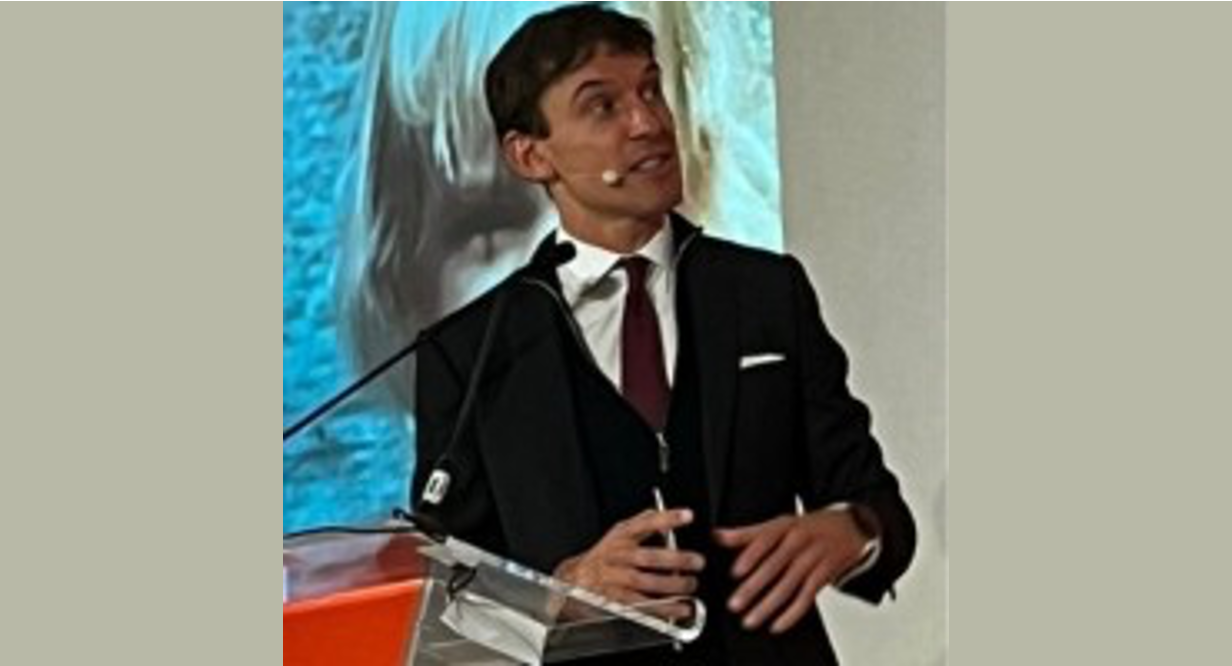
Oscar Hattink is the Founder of BlueDrive Global.
Summary and full bio for paid supporters here. Upgrade to get full access.
Letter
To: BlueDrive Global Investors Fund Limited Investors and BlueDrive Global Investors Fund Limited Partnership Investors
From: Oscar Hattink
Date: Thursday, July 9, 2026
Closing Investor Letter
Period Ending June 30, 2026
“The market can remain irrational longer than you can remain solvent.”
— attributed to John Maynard Keynes
Dear Partner,
Over 70% of our personal net worth has been invested alongside you in the BlueDrive Global Funds since inception. Alignment of Interests is, and has always been, the foundation of everything we do.
After careful deliberation, we have decided to return all external capital to our investors and bring down the curtain on the BlueDrive Global Funds. The portfolio has been liquidated, and assets will be returned according to the plans already communicated to you. We will continue to manage our own capital with the same discipline and the same strategy: long selected structural-growth monopolies/oligopolies, combined with an active portfolio of tail hedges. Should we return with a vehicle to manage outside capital again, you will be the first to know.
It has been a rewarding journey, and the recent setbacks have in no way erased the triumphs that came before. This letter is our attempt to give an honest account of both, and of the lessons we take with us. Most of them, we discovered, are very old lessons. The literature of every age warns of the same things: that haste diminishes what diligence builds, that no one should boast of tomorrow, and that the prudent see trouble coming and take shelter, while the simple walk on and pay the price. But knowledge does not equal wisdom. We simply had to live the lessons to learn them.
I. The Beginning:
We started BlueDrive Global Investors in 2017 with ~$10 million in internal capital, two people, two computers, and one belief: that high-quality, structural-growth companies in consolidated industries should outperform bad companies in no-growth, commoditized industries. It was not a complicated idea. It did not need to be. The plans of the diligent are rarely complicated; they lead, little by little, toward abundance, and they are executed day after day, when no one is watching.
Fast forward to 2021, and our assets under management had grown to ~$500 million, our team to ten people, and our belief was delivering tangible alpha for our investors. We were tap-dancing to work.
II. The Flood We Did Not Foresee:
There is an ancient warning against boasting about tomorrow, because no one knows what that day may bring. We should have heeded it more carefully.
In 2021, the post-COVID liquidity flood swept through markets and turned our world upside down. In the meme-stock bubble, some of our low-quality short positions exploded higher, while our high-quality longs underperformed. The portfolio ended the year down 19%, while the MSCI World rose 20%. Some of our investors immediately voted with their wallets. Understandably so.
The flood of 2021 was not water but liquidity, and it lifted precisely the vessels we had bet against. We do not say this to excuse the result. The result was ours to own. But it taught us the first hard lesson of this letter: diligent planning protects you from most weather, but not all of it.
As fiduciaries, we felt a moral obligation to continue for the investors who remained. A friend is loyal in fair weather; a true partner reveals themselves in adversity. To those of you who stayed after 2021: you were that partner when it mattered most, and we will not forget you.
In 2022 we did what we were built to do and outperformed meaningfully (-2% against the MSCI World’s -19%). Since then, however, our value-based investment strategy has struggled. As the world grew ever more excited about AI, we parted with our long-term holdings in Amazon, Google, and Safran. Throughout 2024 and 2025 we accumulated a substantial cash balance (at times 60% of our NAV) and initiated an active tail-hedging strategy (based on out-of-the-money index put options and credit spreads), as we positioned the portfolio for what we believed was a heightened risk of an economic contraction. The result of this was underperformance over the past three years.
III. Why We Believe We Are Doing the Right Thing:
The foundation of BlueDrive Global’s success has been a disciplined commitment to buying high-quality, structural-growth companies at reasonable prices with positive variant perceptions (“What don’t people know yet?”), while shorting the opposite. In a rational market, this strategy works wonders. But in an irrational market, where a loss-making rocket company that bleeds $5 billion per year successfully IPOs at 92x revenues and a $2 trillion market cap, leveraged free-cash-flow yield counts for little, while momentum and FOMO are the main drivers of stock prices. We see no clear sign that a swift recovery is at hand.
We could have changed our strategy. We could have chased what was working. Plenty of managers have, and their numbers look far better than ours. But you did not entrust your capital to us so that we would become someone else with it. Whoever walks in integrity walks securely, and the secure path here (and the only one that lets us look you in the eye) is to admit that we have no edge in a market we frankly do not understand, and to hand your capital back, rather than expose it to risks we cannot underwrite. There is no merit in charging fees for conviction we do not hold. However, understanding why we are closing requires digging into a deeper problem that faces all money managers in late-cycle markets. We call it the Noah Problem.
IV. The Money Manager’s Noah Problem:
The prudent see danger coming and take shelter; the simple keep going and pay the price. Investors who prepare for floods before the rain look foolish. Until they don’t.
Many thousands of years ago, a man was instructed to build an ark. The dimensions were exact: three hundred cubits long, fifty wide, thirty high, sealed within and without with pitch (tar). He was to bring his family, and pairs of every living creature crawling on the earth, through forty days and forty nights of non-stop rain. Noah did not know whether the animals would come. He did not know whether the floodwaters would come. He had no forward contracts, no remaining performance obligations (“RPOs”). The skies above him were clear, and the ground beneath his feet dry. His neighbors laughed, but he built the ark anyway. The animals came. The rain came. The ark floated.
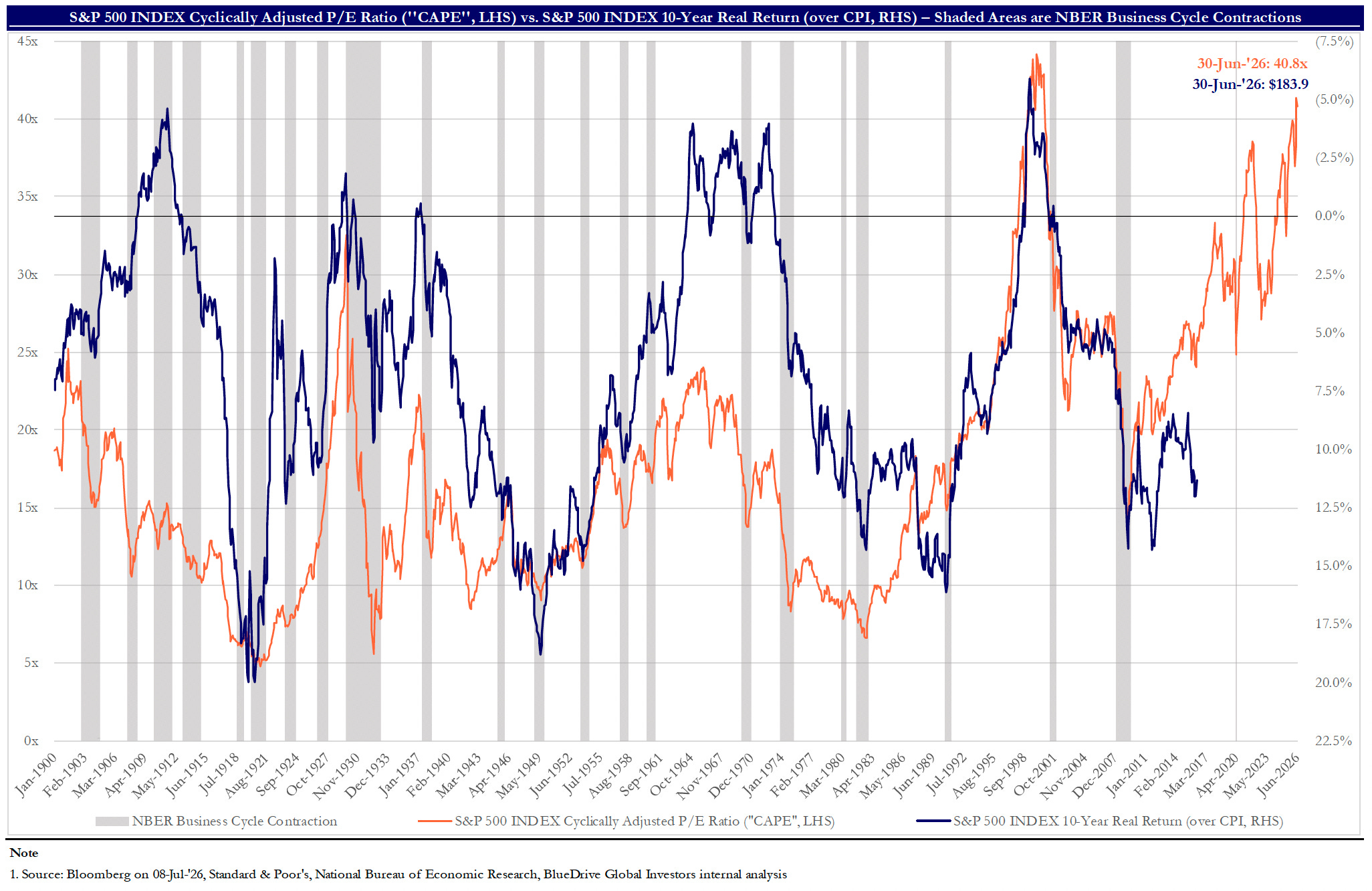
The Noah Problem is the dilemma of acting on a forecast the sky refuses to confirm. It is the central problem of investing in late-cycle markets, and it has rarely been more acute than it is today. Consider the position of the long-only equity investor in the second quarter of 2026. The cyclically adjusted price-to-earnings (“CAPE”) ratio of the S&P 500 sits in the highest decile in history, modestly below only the dotcom peak. An investor who bought at this level of market valuation during the last 126 years would have gone on to make a -5% real return per annum on his investment for the subsequent 10 years.
In addition, the Buffett indicator (market capitalization as a share of GDP) has held above historical extremes for the better part of two years. It is no surprise that Berkshire Hathaway is sitting on over $400 billion in cash, waiting for better opportunities to present themselves. Market breadth has narrowed to a handful of stocks whose collective valuation now rests on the assumption that AI will generate cash flows on a timeline and scale that the underlying economics have yet to demonstrate.
Leading indicators of recessions (yield-curve normalization following deep inversion, softening labor-market dynamics, deteriorating credit conditions in the lower tiers) are all flashing red. None of these signals, individually or collectively, tell you when the rain will fall. They only tell you that the conditions for rain are approaching. Conviction about when the rain will fall has cost many investors dearly.
If you build the ark (if you trim equity exposure, raise cash, shift into quality and defensives, hedge) and the skies stay clear for another year, two years, three years, you will underperform a benchmark that has done nothing but rise. Your neighbors will laugh. Your clients will ask, politely at first and then less so, why their AI-focused manager has been making them rich while you have been preparing for a flood that never came. Career risk in asset management is asymmetric in precisely the wrong way. You are rarely fired for being wrong when everyone else is wrong. You are often fired for being right too early. We felt this pressure deeply and we chose not to surrender.
If you do not build the ark, and the rain comes, you lose capital that took years to compound. The arithmetic of drawdowns is brutally asymmetric: a -50% loss requires a +100% gain to recover. The investor who avoids the deepest part of the cycle does not need to be a genius in the next; just solvent.
The Noah Problem, therefore, is not really about forecasting. It is about asymmetry, conviction, and time. Three observations follow.
First, the cost of being early is not the cost of being wrong. The investor who de-risks at elevated valuations and waits eighteen months for the storm has not made a forecasting error; he paid an insurance premium. The error is to confuse the premium with a loss. Insurance is rarely cheap when you need it most, and almost never available on the day the house is on fire.
Second, the ark should only be built in clear weather. By the time the case for defensive positioning is obvious to everyone, the price of defensive assets and tail hedges has moved away. The rally in Treasuries that accompanies a recession does not wait for the recession to be declared; the rotation into quality compounders does not wait for earnings to roll over; the repricing of tail hedges does not wait for markets to panic. Markets do not confirm the present; they discount the future.
Third, conviction in the face of mockery is the operative skill of the money manager. Noah’s neighbors were rational, in the sense that all their priors (their baseline assumptions, e.g. long stretches of dry weather, the absence of visible storm clouds) pointed to the absurdity of his project. They were wrong not because their reasoning was poor, but because their priors were wrong. The investor who positions defensively today is making a bet not against the prevailing narrative that AI will be transformational, but against the prevailing priors that (i) valuations do not matter, (ii) elevated profit margins will only go higher, (iii) a business cycle contraction will not end the party this time, and (iv) AI capital expenditures will enjoy good financial returns.
Building an ark today does not require a precise call on the timing of the next recession, the next earnings disappointment, or the next correction. It requires only a willingness to act on the balance of evidence rather than the balance of consensus. The forecast does not need to be confirmed by the sky today. It must be confirmed by the analysis.
There is one further lesson in the story worth noting. Noah did not refuse to build because he could not be certain. He did not delay until the first raindrops fell, by which point the timber would have rotted and the animals would have drowned. He built, and waited, and was mocked, and eventually vindicated, although the vindication was not the point. The point was the building itself.
That, in the end, is the answer to the Noah Problem. You build because the analysis tells you that you must build, not because the sky tells you to build. You accept that you may look foolish for a long time. You accept that the cost of being early is the price of being safe. And you remember that when the rain comes (and in markets, the rain always comes eventually) the ark is no longer something you can begin to construct. By then, it is something you either built, or you didn’t.
V. AI’s Noah Problem:
Today, AI dominates the market narrative. Technological advances in robotics and biotech may well prove extraordinary, and AI’s outsized influence on markets is already evident: estimates based on data from the US Bureau of Economic Analysis suggest that AI investments accounted for as much as three-quarters of US real GDP growth in early 2026. Without AI investments, the US economy would already be near contraction. “Invest in AI and forget about price,” our brokers advise. In recent years, that has indeed been the winning strategy.
But wealth gathered in haste has a way of dwindling fast, while wealth gathered patiently tends to compound over time. We think the AI capital investment thesis rests on shaky ground. In fact, the companies at the core of the current equity market paradigm face their own Noah Problem.
In 2025, the three US cloud “hyperscalers” (Amazon, Google, and Microsoft) earned combined cloud revenues of ~$300 billion. Consensus expects these to quadruple, reaching ~$1.2 trillion per year by 2030, with AI investments powering the growth. Two observations follow.
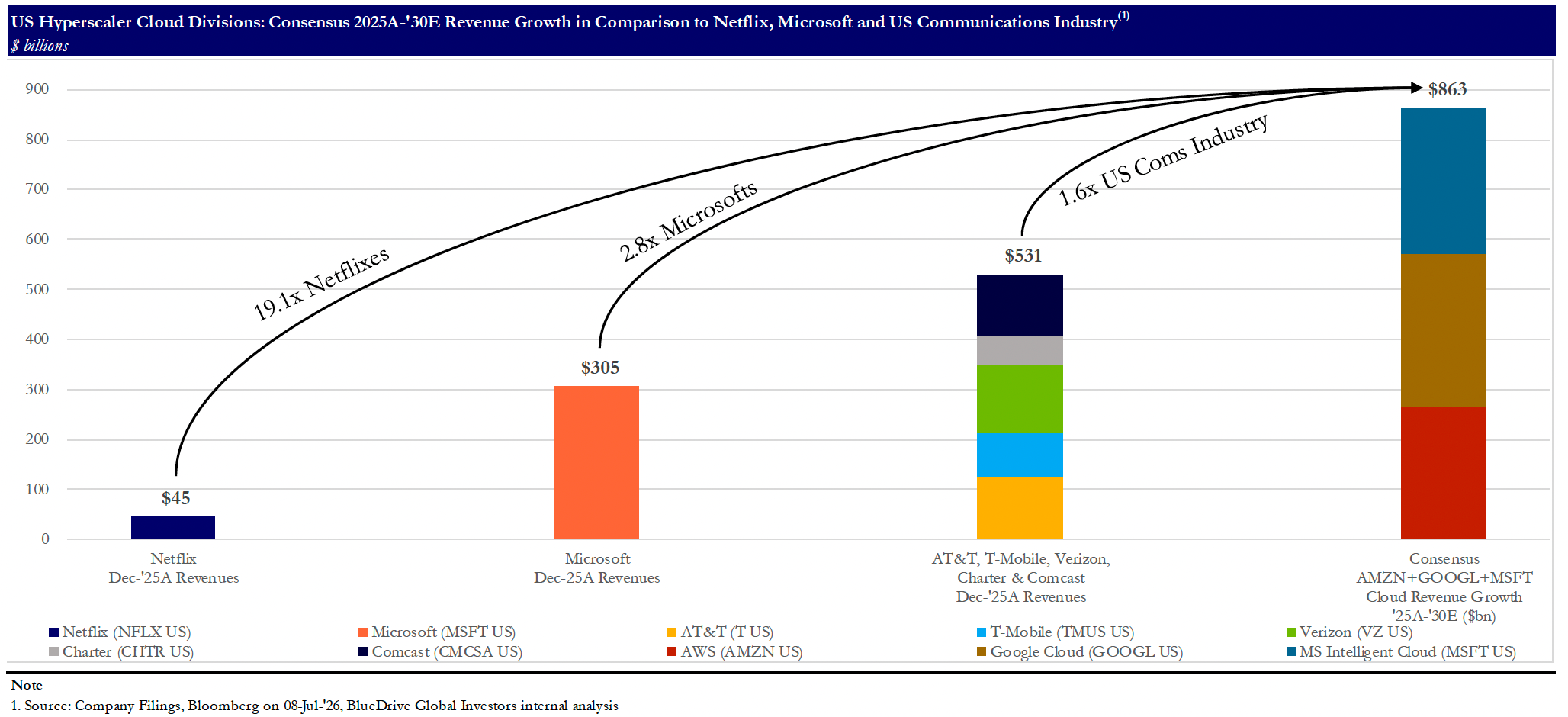
One, achieving the revenue projections for AI investments ($863 billion incremental annual revenues by 2030) may prove challenging. To put the scale in per-capita terms: if this revenue were ultimately borne by US and EU consumers (whether directly or through the products and services they buy), every person in those regions, including children, would need to spend an additional ~$100 per month on AI by 2030. Viewed against other large businesses, the scale of the required ~$863 billion incremental annual revenues by 2030 becomes even clearer. It is equivalent to 19.1x Netflix’s current revenues, 2.8x Microsoft’s, and 1.6x that of the entire US communications industry (AT&T, T-Mobile, Verizon, Charter, and Comcast). Those businesses took decades to reach their current run rates; consensus expects the hyperscalers to cover that ground, and more, in roughly four years.
Two, AI capital expenditures may destroy shareholder value. Consensus estimates combined 2026E–‘30E capital expenditures for the hyperscalers at ~$3.5 trillion. The return arithmetic is stark: ~$863 billion of incremental revenue, at a 40% incremental margin (historical baseline), and a 20% tax rate, implies a post-tax return on incremental invested capital of ~8%. As noted above, the revenue assumptions required to reach even that return appear stretched. Moreover, with the 30-year US Treasury yield above 5%, and the resulting cost of equity at ~10%, these investments may deliver a return below their cost of capital, and therefore destroy shareholder value.
The hyperscalers are building their arks. The question is not whether the animals will come; it is whether they will arrive in sufficient numbers before the rain.
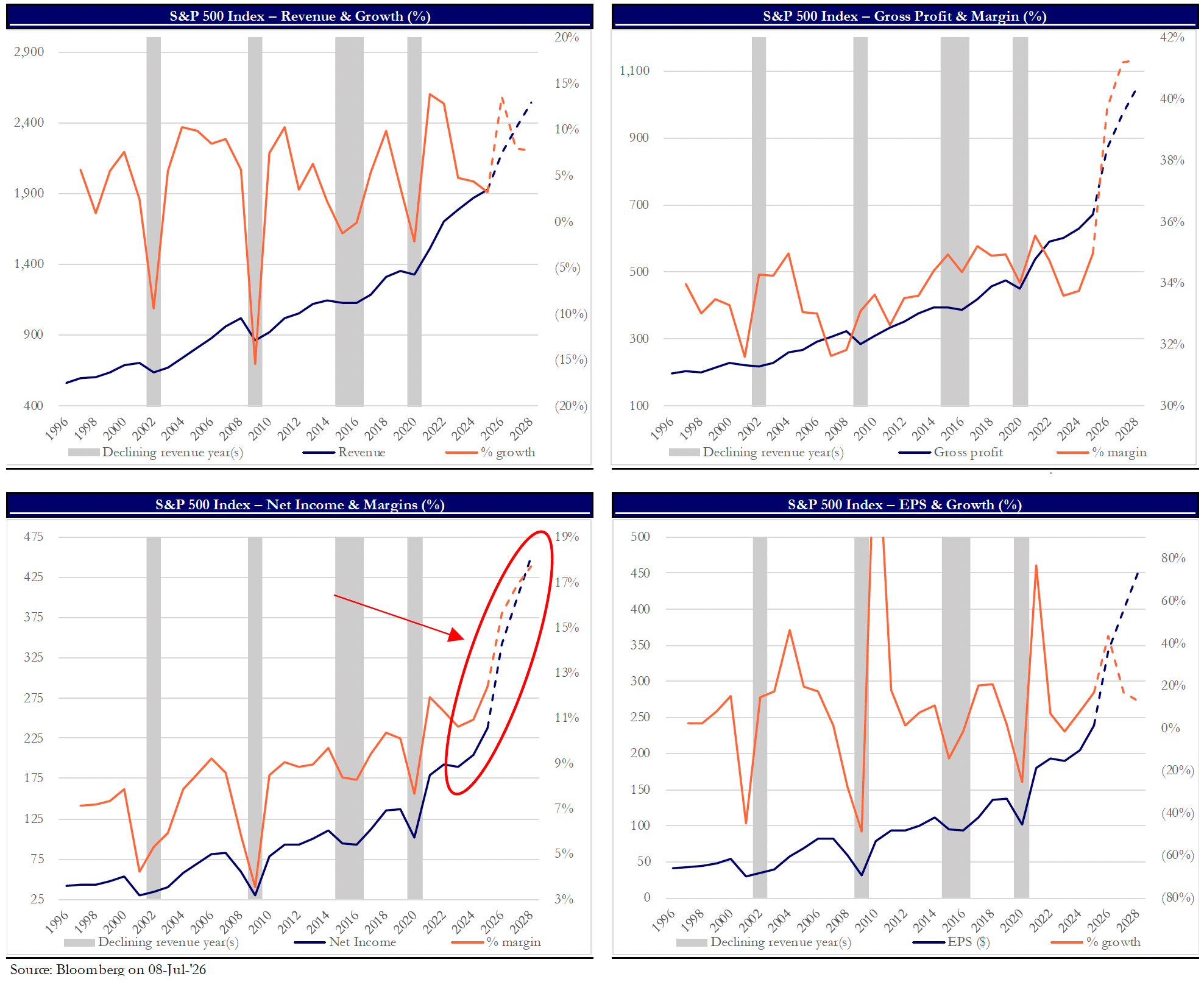
Looking at other companies in our coverage, we observe excess optimism for many businesses through rosy consensus earnings projections and elevated valuation multiples. The same phenomenon is evident at a market level when looking at consensus earnings projections for the S&P 500 index. We see projected net income margins for the S&P 500 at levels the index has simply never achieved before. As ice hockey players, we see hockey sticks in many places, the kind we used to see in vendor-due-diligence materials during our years in large-cap private equity. The response we keep hearing is that “with AI, this time it’s different,” and “things will go to the moon.” We must humbly admit that we simply don’t know. Certainly, we are uncomfortable betting on it with our own capital, let alone yours.
VI. This, Too, Shall Pass:
We hold firm to the conviction that “this, too, shall pass.” We have lived through manic periods before, and we remain confident that, however out of favor it may be today, disciplined value investing remains the soundest investment strategy over the long run. This is far from the first time value investing has been left behind. Many of the great value investors posted dismal returns from 1970 to 1975, from 1980 to 1981, and from 1999 to 2001. They always came roaring back.
It is said that the honest man falls seven times and rises again. What the saying does not promise is a schedule. The turn will come, but the difficulty lies in predicting when, and here we simply have no edge. What we do know is that there is no merit in exposing our investors to unwanted risks in a market we frankly cannot underwrite. One does not rise by pretending not to have fallen, nor by borrowing conviction one does not possess. One rises by getting up honestly, in one’s own time, on one’s own feet. That is what we intend to do with our own capital, and what we hope, one day, to do again with yours.
VII. Thank You:
We managed money for nine years. We compounded capital for some of that time, and wisdom, we hope, for all of it. The oldest books of counsel insist that wisdom is the better merchandise: worth more than silver, its gain finer than gold. If that is right (and we believe it is), then those who traveled with us leave significantly richer than their account statements suggest.
Contributions and efforts from many partners, related parties, and service providers drive a hedge fund’s success. The fund’s limited partners are at the top of that list. Many partners stand with us in fair weather; committed investors reveal their true character during difficult times. I feel particular gratitude towards those families and investors (European, US East Coast, and Middle Eastern) who stayed loyal to us until the end. You know who you are. Our duty to serve you is not over. We will be back.
The very best part of our journey has been the privilege of working alongside an exceptional group of colleagues and investors. I feel tremendously honored to have worked closely with professionals of the highest caliber and integrity: Angel He, James Minshull, James Cleary, Robert Hung, Emil Eriksson, Joey Friedman, Klas Norr, Wafa Tawfeeq, Chris Davies, Pierre-Arnaud Ladoux, Tessa Jones, Nicola Hudson-Dowling, and Janine Duncan-Anderson. Thank you for all that you gave to BlueDrive Global, and for spending some of your best years with us.
For every minute of it, the good times and the bad, the victories and the defeats, we, on behalf of all BlueDrive Global team members past and present, thank you from the bottom of our hearts.
Build your arks in clear weather. We will see you after the rain.
Yours sincerely,
Oscar Hattink
Managing Partner
Summary and Full Bio at the top; Related and Other Resources below
Comments
Nothing yet. Say the first thing.
Sign in to join the conversation.