
This post describes the continuation of a speculative historical scenario in which there was a World Cup in 1942, and is the fourth in a series of posts that begins with an outline of the process we used to generate it. Here, we present the results of the simulated quarter-finals and semi-finals, in which the hosts receive a drubbing from the Hungarians, the Germans face stiff competition from the Croats, and the Italian dream of retaining the trophy hangs in the balance.
Saturday 9th May 1942 - Estadio Chamartin, Madrid (Attendance: 27,209)
Spain 1, Hungary 5
The expectation among the fans packed into the Estadio Chamartin was palpable. Thousands lined the streets as the Spanish team arrived, escorted by Spanish troops from the Blue Division carrying banners emblazoned with Franco’s ‘Victor’ symbol. El Generalísimo himself sat in the stands to watch the match against Hungary, receiving the salutes of both teams before the game. The Hungarians, sporting their scarlet jerseys, started brightly with a number of incisive passing moves. The Spaniards, on the other hand, looked overawed by the occasion - perhaps fearful under the gaze of the great Franco. After ten minutes, Hungary broke the deadlock with a goal from Mátyás Tóth. This marked the beginning of a devastating onslaught from the Hungarians, who bombarded the Spanish goal for the rest of the half, adding another goal just before half-time through György Sárosi. The red tide continued in the second half, and a sense of unease began to pervade the stadium, as the Spanish fans began to perceive the undeniable truth of Hungary’s superiority. Sárosi scored again in the 53rd minute and Gyula Bodola added a fourth goal for Hungary five minutes later. By the time Bodola scored his second goal of the game and his fifth of the tournament, the Spanish team seemed to have accepted their fate. A late Spanish consolation goal by Edmundo Suarez did nothing to change the inevitability of the outcome nor the sour mood of the home fans.
Saturday 9th May 1942 - Atocha, San Sebastian (Attendance: 17,517)
Italy 4, Sweden 0
Sweden’s early promise, following their impressive win against Portugal in the first round, ran aground in their second match against the world champions, Italy. The Italians played a perfect game of counter-attacking. Italy’s defensive structure - built around the Juventus trio of Alfredo Foni, Pietro Rava and Teobaldo Depetrini - soaked up Swedish pressure before sending the ball quickly forward to the Italian striker, Silvio Piola. Time and again, Italy punished Sweden’s cavalier attacks in this manner, with Piola Silvio scoring two goals in the first half, before setting up his teammate, Valentino Mazzola, for two more in the second half. Mazzola showed dazzling skills throughout the match, underlining why many Italian clubs are so keen to secure his signature for next season.
Saturday 9th May 1942 - Estadio de Mestalla, Valencia (Attendance: 16,908)
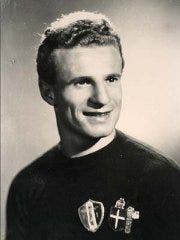
Germany 4, Chile 2
The heavy rain accompanying the unseasonable thunderstorms in Valencia were not the only deluge this Saturday afternoon, as Chile were swept aside by an imperious German display. Fritz Walter, rapidly establishing himself as the young and dynamic engine at the heart of the Reich’s footballing machine, was like a whirling dervish in midfield. Chile could not contain his skill and energy, seemingly powerless to stop his first goal. In the twelfth minute, Walter ran from the edge of his own eighteen yard box, past four Chilean defenders, before firing a shot low and hard past the opposition goalkeeper. Chile equalised through Alfonso Domínguez, but this served only to galvanise the German team who added two more before half-time, going into the break 3-1 ahead.
Coming out in the second half, the German team were stirred once more by the fillip of a second goal from Chile. Enter the young hero, Walter. As lightning forked against the backdrop of a blackened Valencian sky, he once again picked up the ball deep in his own half. Over the sodden ground he drove, teammates and adversaries alike left trailing his progress. He knocked the ball out wide to the German inside right, Karl Decker, who returned a cross high in the air. All watched on, the ball hanging in the air, until Walter, who had continued his run, met it with his head, smashing it onto the underside of the crossbar and into the back of the net. The fourth goal broke Chilean resolve, and Germany ran out the worthy winners.
Saturday 9th May 1942 - Estadio de Sarrià, Barcelona (Attendance: 12,498)
Denmark 1, Croatia 2 (aet)
Three goals in extra time provided a lively end to a game that was characterised by a distinct lack of adventure throughout the initial 90 minutes. Both Denmark and Croatia failed to commit players forward during the match, at times seemingly playing ten defenders against ten defenders. When either team did attack, their coaches would shout and gesticulate wildly, ordering any players that had ventured forward back into their own half, like centurions marshalling a shield wall.
A number of the crowd had left the stadium before the game eventually went to extra time. It was only at this point that Croatia seemed to remember that the objective of a game of football is to score goals, and unshackled their frontline, which included Franjo Wölfl, Zvonimir Cimermančić and Milan Antolković. As the trio advanced with more freedom, they began to create chances. Eventually, Cimermančić scored forcing the Danes to throw caution to the wind. No sooner had the Danes roused themselves then Antolković threaded a through-ball for Wölfl to run onto. He smartly rounded the Danish goalkeeper and extended the Croats lead. The Danes then totally reversed their earlier tactics, encamping all of their players in the opposition half and assailing the Croatian end. A late goal from Johannes Pløger proved too little too late for Denmark.
Tuesday 12th May 1942 - Camp de Les Corts, Barcelona (Attendance: 29,204)
Hungary 2, Italy 1
Italy were left stunned following a Bravura performance from unfancied Hungary in Barcelona. The reigning champions looked complacent during the opening exchanges of the match, allowing the Hungarians to settle into their pattern of play. The intricacy and speed of Hungary’s passing made it difficult for Italy to gain possession of the ball. The likes of Alfredo Foni and Pietro Rava quickly resorted to repeatedly fouling their fleet of foot opponents. Even this could not disrupt Hungary’s rhythm: Tóth to Sárosi, Sárosi to Zsengellér, Zsengellér to Bodola. The Hungarians ran through this cycle many times, leading the Italian defence on a merry dance.
Italy were able to survive unscathed for nearly sixty minutes, thanks in large part to the acrobatics of goalkeeper, Luigi Griffanti. It took another moment of brilliance from Bodola to finally score. When the ball came to him inside the box, he took his time, looked up and slotted it between Griffanti’s splayed legs. No one looked more surprised than the shame-faced Griffanti.
Vittorio Pozzo, the Italian manager, shouted instructions to his players, apparently inducing a tactical change in the team. A more attacking formation saw the Italians begin to get a foothold in the game. They were a little lucky to equalise through an unfortunate own goal, following a mix up in the Hungarian defence. Most of the watching Catalans, and this correspondent, thought that Italy would go on to win the game at this point, but György Sárosi upset the apple cart with an audacious chip over Griffanti, embarrassing the giant Italian for a second time. When the referee blew his whistle to signal the end of the match, the Italians fell to their knees in stark contrast to the celebrating Hungarians.
Tuesday 12th May 1942 - Estadio de Mestalla, Valencia (Attendance: 17,861)
Germany 1, Croatia 1 (aet)
Replay: Thursday 14th May 1942 - Estadio de Mestalla, Valencia (Attendance: 15,422)
Germany 2, Croatia 1
The first game proved to be a bruising encounter, with little love lost between the German and Croatian players. Germany opened the scoring through the Austrian Karl Decker, who sadly had to limp off in the second half with an injured knee, leaving Germany with only ten men to finish the match. He would not recover in time to feature in the replay two days later. Croatia levelled halfway through the second half from a corner, Franjo Wölfl tapping in from close range as the ball fell fortuitously to his feet. Extra time saw two tired and battered teams fail to land a decisive blow, meaning a replay would be required.
In the replay two days later, both sides picked up where they had left off, instantly reverting to combative tactics. The tackles were flying and the Spanish referee, Pedro Escartín, had to give both captains a stern talking to, asking both men to instil some discipline on the field of play. This seemed to restore a sense of order and a better game ensued. Soon afterwards, Zvonimir Cimermančić lit up the match with an astounding piece of skill. The ball came to him in the air as he stood 10 yards out facing away from the goal. It looked as though he would have to control the ball in order to turn and shoot. Instead, he stunned the German defenders by performing a half somersault, raising his right foot above his own head and striking the ball in the opposite direction to that which he was facing - towards the goal. Helmut Jahn, the German goalkeeper, remained rooted to the spot, unable to anticipate Cimermančić’s brilliant gymnastics, and the ball simply trickled over the goal-line. The largely Spanish crowd jumped to their feet and applauded enthusiastically in appreciation of the trick.
The only man who remained unimpressed was Sepp Herberger. The German manager threw his hat to the ground and kicked it with more vigour than he had seen from his team up to this point. The manager’s displeasure clearly filtered through to the German players, who redoubled their efforts, with Fritz Walter rising to the occasion. Another of his surging runs was instrumental in creating the first German goal. Walter burst through the Croatian defence and played a precise through pass to Ludwig Durek, who slotted home to draw the Germans level.
As the game approached the 90 minute mark, and thoughts began to turn to extra time, the defining moment of the tie occurred. Dudek, standing clearly outside the eighteen yard box, was felled by Miroslav Brozovic. Escartín blew his whistle and, after hesitating, pointed to the penalty spot. The Croatian players surrounded the referee, unable to contain their incredulity. The neutral Spanish spectators, sensing a gross misjustice booed and whistled in unison. The referee was not for turning, however, and he stubbornly insisted on the penalty being taken. Dudek obligingly converted the spot kick to Herberger’s delight, and Señor Escartín blew up, signaling the end of the game. Croatian complaints continued on the pitch long after the final whistle, and Croatians and neutrals alike left the stadium with a sour taste in their mouths.
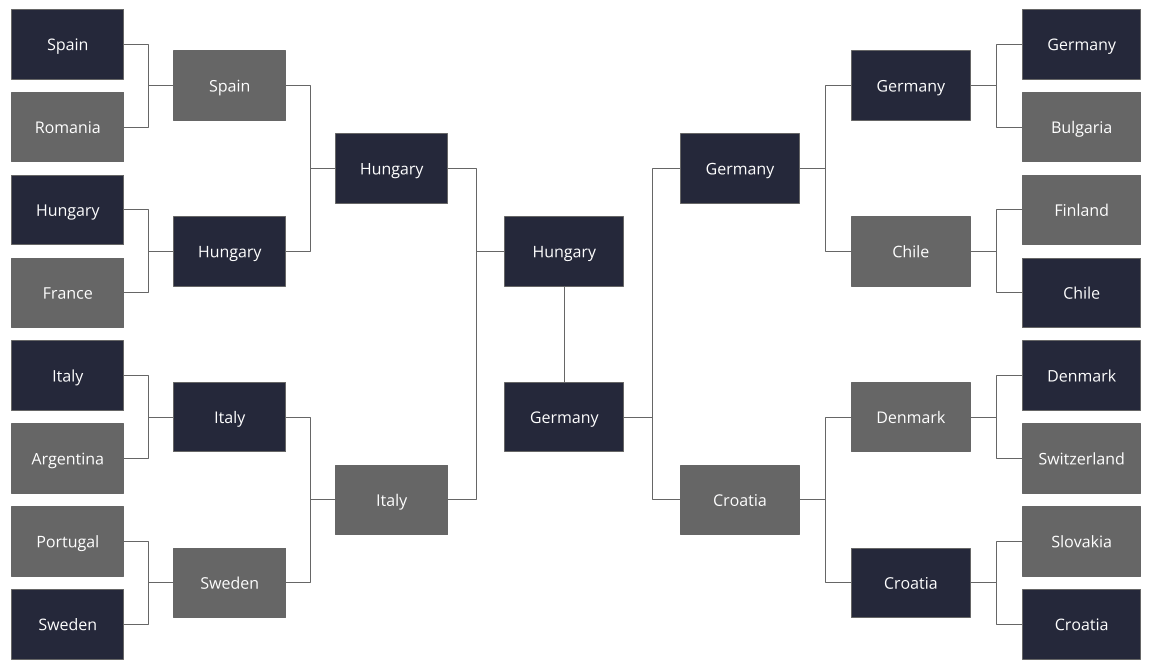
The tournament state before the 1942 World Cup Final
No posts
Comments
Nothing yet. Say the first thing.
Sign in to join the conversation.