
Please be advised, this post contains detailed references to fictional suicide.
If this horror-themed post isn’t for you, check out these alternatives.
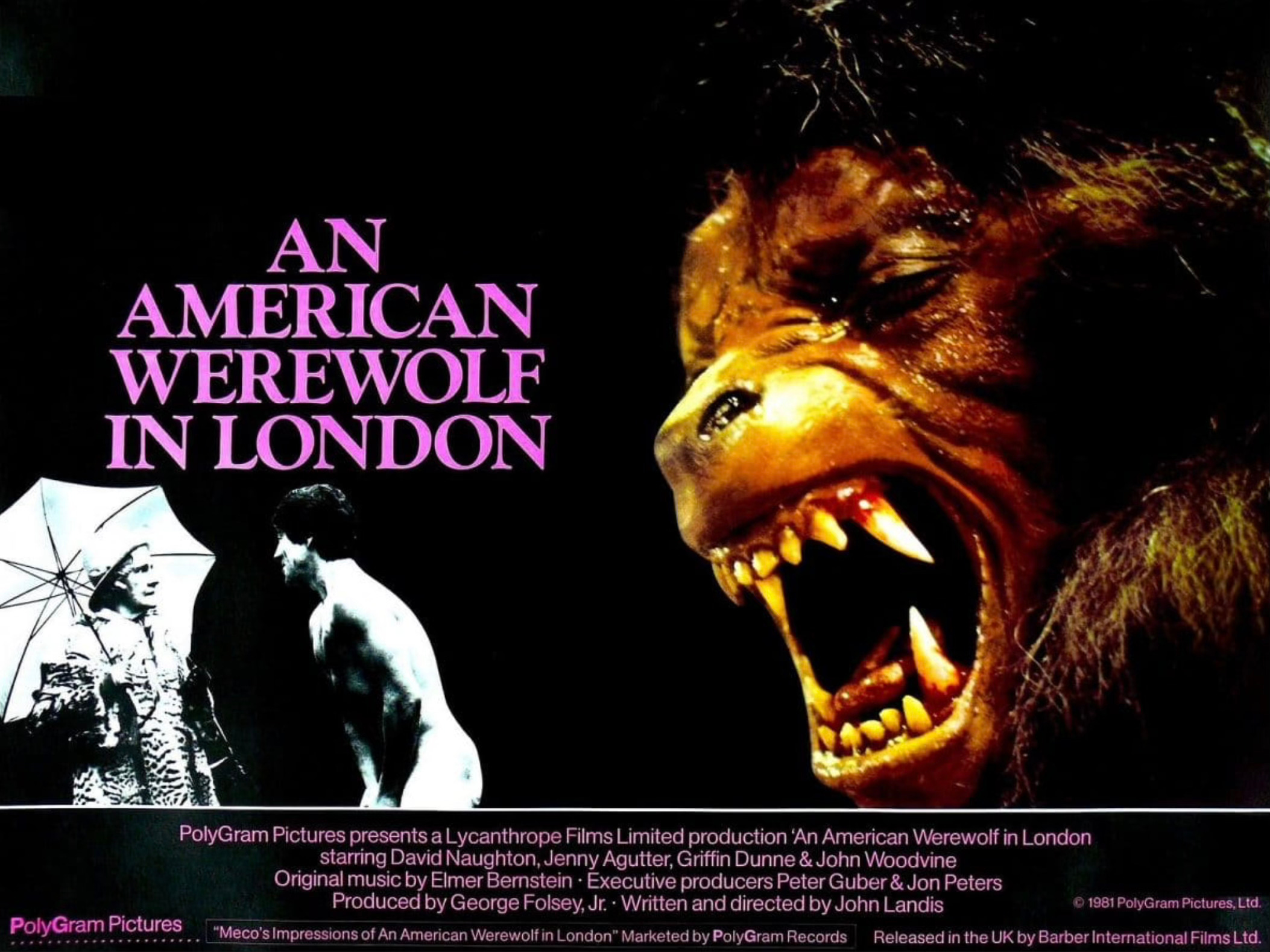
As horror-comedies go, An American Werewolf in London is a peculiar beast.
It’s not a loony gross-out routine like Evil Dead II (1987) or Braindead (1992). It’s steeped in werewolf movie-lore, but it’s not a parody like Young Frankenstein (1974), Scary Movie (2000) or What We Do in the Shadows (2014). It’s full of funhouse monsters, but it’s more than just a jokey creature-feature like Gremlins (1984), Lake Placid (1999) or Eight Legged Freaks (2002).
The scares in American Werewolf feel distinct and personal, reverberating deeper than mere surface thrills. Its playful humour shows just how comedy can be applied to horror to make viewers and readers bear the otherwise unbearable.
The movie’s unconventional approach to horror-comedy culminates in its very best scene, a saucy number that everyone remembers, but which gets talked about a good deal less than FX legend Rick Baker’s still-showstopping transformation scene.
Having established his career with three balls-out comedies, The Kentucky Fried Movie (1977), Animal House (1978) and The Blues Brothers (1980), writer-director John Landis switches to a more sensible gear, telling a seemingly straightforward cautionary about American backpackers, David and Jack (David Naughton and Griffin Dunne).
Attacked by a monster on the Yorkshire moors, David survives while Jack is killed. Though Jack returns from the grave with a face like an Amazon parcel that lost a fight with a Dobermann, and warns David that he has inherited the werewolf’s curse.
Beneath the next full moon, David will be unable to prevent himself from rampaging through London unless he takes certain, drastic measures.
The movie casts a jaunty Yank’s eye over nascent Thatcherite Britain, finding both quaintness and decadence as David convalesces in the arms of elfin nurse Alex (Jenny Agutter). The romantic humour is stilted, disarmingly sweet, and punctuated by flashes of pant-pissing terror.
The movie plays like a rom-com directed by Jason Voorhees.
Moments of horror land with shocking abruptness, spasms of noise and violence, creating pure animal terror: the ambush on the moors, the bedridden ghoul, the werewolf’s climatic rampage through Piccadilly Circus.
Editor Malcom Campbell would later specialise in zany comedies like Coming to America (1988) and Wayne’s World (1992) and perhaps understood how best to disrupt the comforting rhythms of laughter. His jolting cuts feel like you’re being bushwhacked by a maddened lycanthrope.
But these jump-scares land with a terrible resonance. David’s dream of shrieking, demonic Wehrmacht arriving to slaughter his entire family in the middle of The Muppet Show is the childhood nightmare of every Jewish boomer.
FOOTNOTE: The Third Reich had a thing about werewolves, as explained in Jon Spira’s illuminating 2019 video essay on this movie, I Think He’s a Jew: The Werewolf’s Secret.
Urbane fears of the violent and irrational are couched in the more ancient horrors of Britain itself. “There’s something wrong with this place,” warns a furtive Yorkshireman.
Cosy pubs are sites of conspiracy and folk ritual, candles burning to ward off monsters. It turns out Britain is not the place of picture postcards and the middle-class fantasia of the Paddington movies. Through how many generations has this werewolf’s bloodline been flowing? How long has it been covered up?
What the Sam Hill have these crazy Brits been up to all these years?!
The humorous and the hideous are embodied in the mouldering spectre of Jack, easily the most vivid character in the movie. He’s certainly the funniest, with a wonderfully sly comic performance by Griffin Dunne.
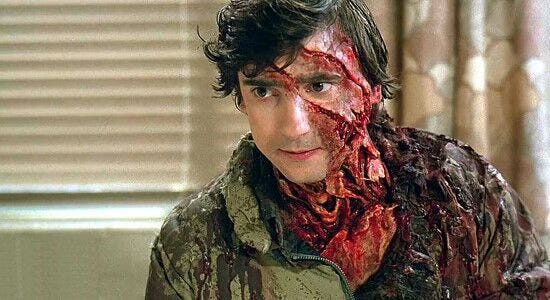
Jack is no Shakespearean phantom pronouncing from the battlements. In a grim running gag, he appears progressively more decayed with each visitation, still kvetching about the girl he liked hooking up with some asshole she met at Jack’s funeral. (“Life mocks me even in death.”)
He remains chatty despite the shredded face. His manner is as open as his gouged larynx. That personable grin gets wider every time we see him.
In Jack, humour and horror are indivisible.
He’s David’s best bud, a true mensch; but he’s also the movie’s antagonist.
It’s Jack who is trying to convince David to leave the world of love and sex – the very stuff of life – guiding his friend deeper into the icy depths of Hell like some mouldering Virgil.
Jack also does the worldbuilding that makes American Werewolf feel so unique, creating the off-screen “hyperdiegesis”, a limbo-world in which the werewolf’s score of victims are unable to move on until the last remaining werewolf has been destroyed.
FOOTNOTE: Hyperdiegesis is a term coined by Matt Hills in his book Fan Culture (2002). “The creation of a vast and detailed narrative space, only a fraction of which is ever directly seen or encountered within the text.”
Humour is typically used in horror stories as a distancing device, often providing momentary relief during stretches of tension. This allows the storyteller to manage the ebb and flow of suspense, bringing rhythm and levity to what might otherwise be an unbearable monotone of horror.
But humour can also encourage believability.
“[Edwardian ghost story writer M.R.] James made the important discovery that a wry sense of humour is far more reliable for establishing credibility in a fantastic narrative than Gothic props or occult theorising. We believe, or at least want to believe, a narrator with a sense of humour, even when his tale is unbelievable.”
Jack Sullivan, The Penguin Encyclopaedia of Horror and the Supernatural (1986)
It’s Jack’s sardonic humour that helps us buy into the potentially cheesy world of the supernatural that he’s asking us to visualise.
We’re too busy laughing at Jack’s complaints about life in limbo (“Have you ever talked to a corpse? It’s boring!”) to notice the true horror of what he’s actually proposing. The amiable comedy of American Werewolf is perhaps the reason why the movie’s true nature is so commonly overlooked.
Like all truly great horror movies, An American Werewolf in London is a tragedy.
Yes, it’s a love story, but one in which love doesn’t conquer all. Declarations of feeling are met with feral snarls. Bullets are the only cure for David’s occult malady. As in Night of the Living Dead (1968), The Shining (1980) and Hereditary (2018), the narrative doesn’t ascend towards healing or resolution; the story of American Werewolf is a death spiral.
Worse still, David has done nothing to invite his fate. Okay, so he wandered onto the moors. That’s hardly a mortal sin. He’s not a fatally flawed Othello or Lear. He’s innocent of hubris, as much a victim of fate and bad timing as Oedipus.
By the end of the movie, David himself is the slaughtered lamb, his doe eyes and blood-red puffer jacket marking him for sacrifice from the very beginning. David must die to take away the lycanthropic sins of the world.
Landis builds his story along the lines of classical tragedy, deliberately borrowing from the granddaddy of all werewolf movies, Universal’s The Wolf Man, released forty years before in 1941.
FOOTNOTE: What we know of ‘traditional’ werewolf lore was almost entirely invented by Hollywood. The infectious bite, the full moon, the transformation, the silver bullet: it all stems not from folklore, but from The Wolf Man’s script written by German Jewish émigré Curt Siodmak.
In doing so, the story gets around the fundamental weakness of many werewolf movies, pointed out by critic Peter Nichols in his book Fantastic Cinema (1984). “The hollowness of the werewolf story, perhaps, is its fatalistic view that a good chap, through no fault of his own, can become a beast. There is not much dramatic pith in this arbitrary cosmic injustice.”
The central conflict in American Werewolf is between Jack and David, the living pitted against the dead, as David gradually succumbs to the survivor’s guilt that will finally drag him to his doom.
Here it is in the starkest dramatic terms: David must end his own life (objective), but he’s done nothing wrong, is in love and wants to live (obstacles). If he fails to achieve his objective, yet more people will die (stakes).
If this movie wasn’t a comedy, it would be unwatchable.
This core conflict resolves itself in the movie’s very best scene, which takes place around 10 minutes before David finally bites the bullet.
Having just learned of several murders that took place last night, David suspects he may be responsible and flees into the city. He enters a red phone booth in Piccadilly Circus. The camera circles him, trapping him inside this cage as he calls home and presses his argumentative kid sister into telling his family that he loves them.
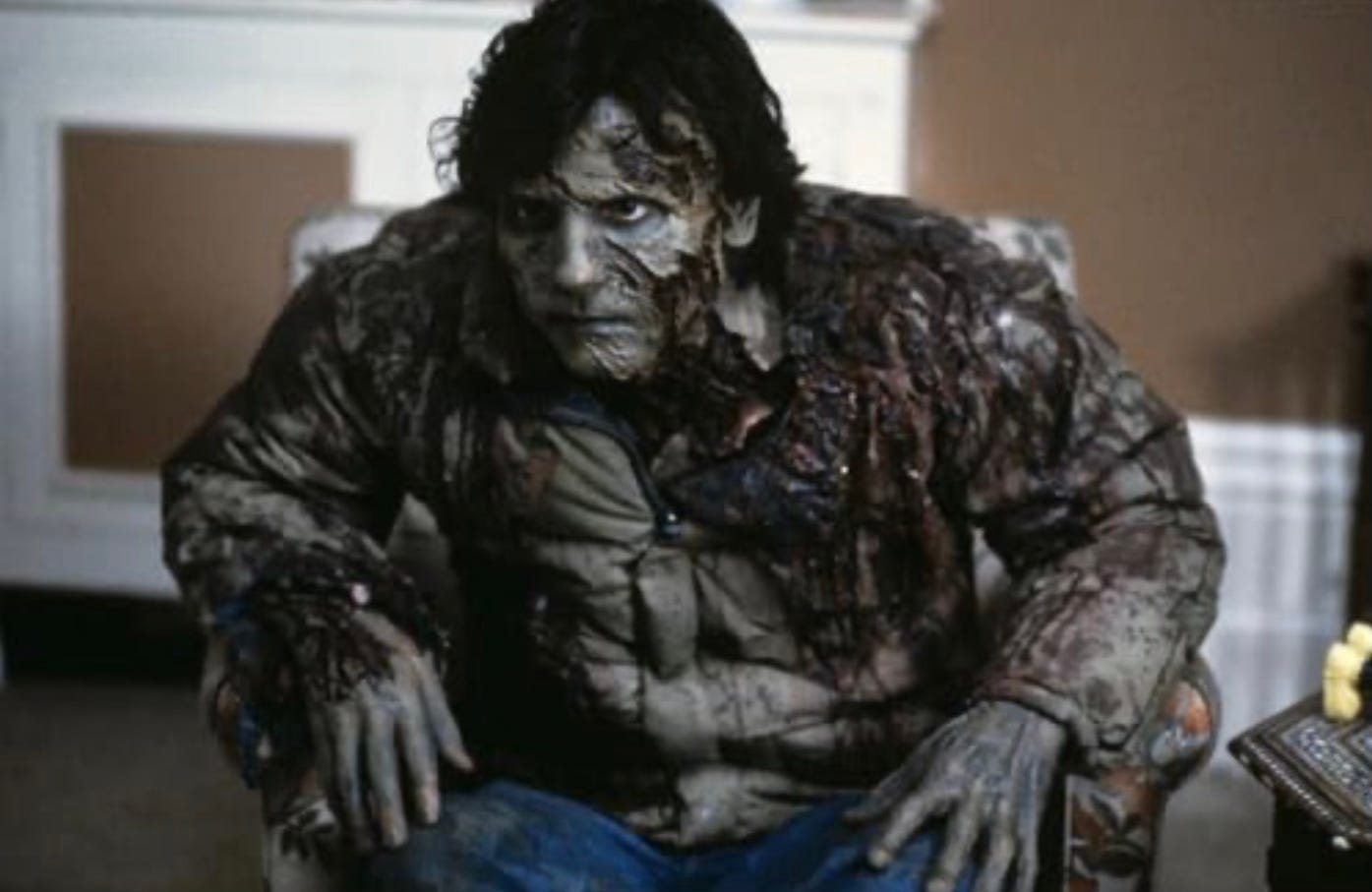
He hangs up and presses the blade of a penknife to his wrist, but he can’t do it. The only light at the end of this tunnel is his dead friend Jack – by now a withered green mummy in a shredded hiking jacket – standing in broad daylight, pointing into a nearby porno theatre.
This scene has been edited for boobies, but still NSFW.
The original script called for a movie theatre full of children. This setting was even storyboarded.
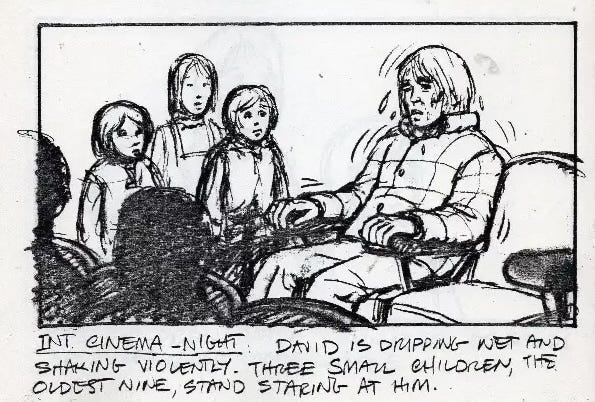
The nearest movie theatre to Piccadilly Circus was the Eros Cartoon Theatre, which in 1976 (apparently sometime after Landis visited the location) switched from showing kids’ cartoons to imported softcore grot like Love in a Women’s Prison (1972) and Sins Within the Family (1975).
FOOTNOTE: I used to work as a projectionist round the corner in London’s Odeon Haymarket, and a lot of the older projectionists who had worked in the West End for donkey’s years remembered the old Eros before it closed in 1985 (with Bo Derek’s Bolero, 1984). The veteran projectionist who trained me up actually wandered onto the set of American Werewolf while they were filming the Piccadilly pile-up. He got to see John Landis arguing with the guy whose job it was to bounce a severed head off the bonnet of a car.
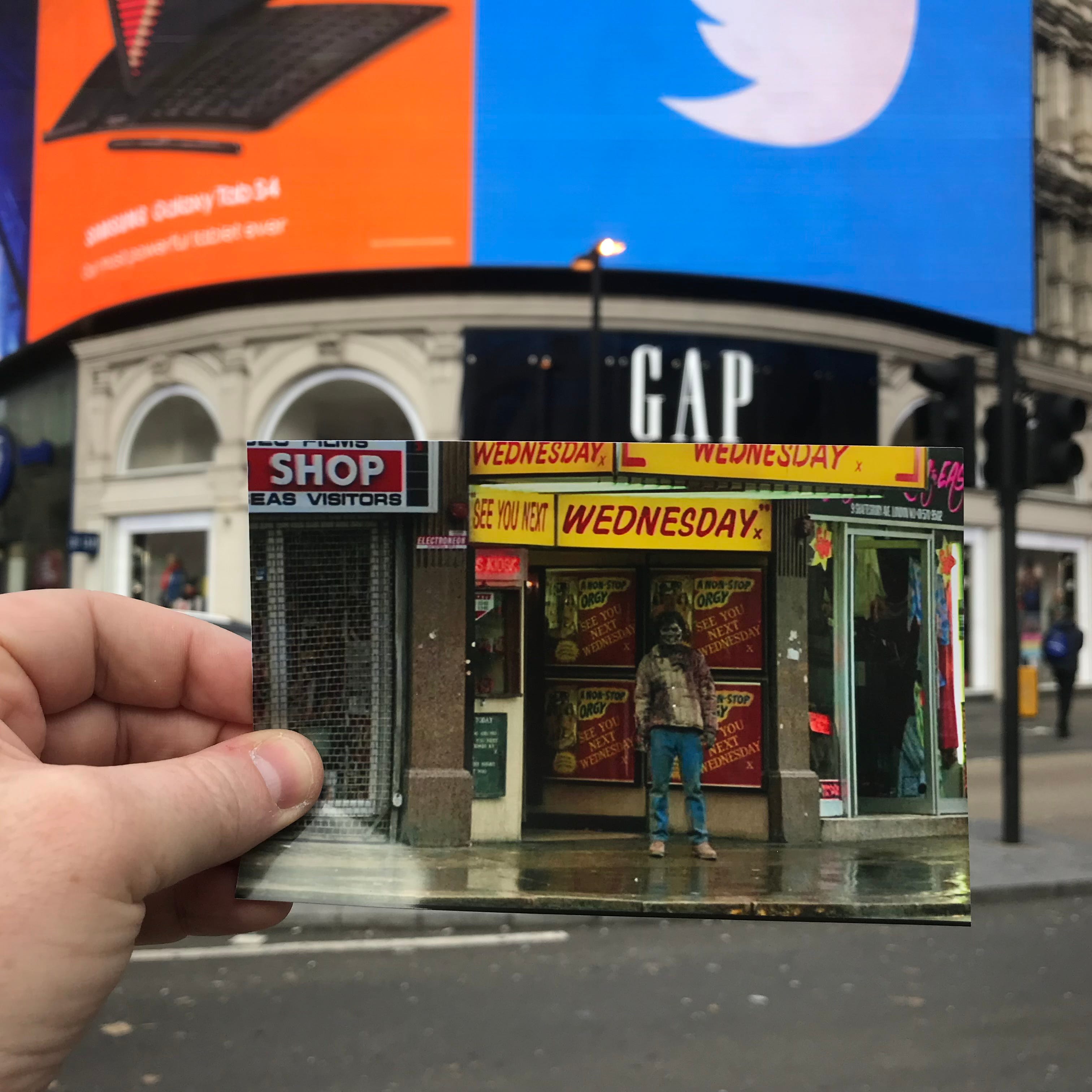
As deliciously transgressive as it might have been to have the werewolf slaughter an auditorium full of children, the porno-palace setting is more thematic. The macabre scene that follows plays against a backdrop of bare bazongas, faked orgasms and bow-chicka-bow-wow.
It’s a parody of intimacy, mocking the loving human life with Nurse Alex that David must leave behind.
Once inside (the auditorium was a Twickenham Studios set) where David finds Jack once again, beckoning from the back row. The ravaged spectre is sympathetic, but wearied by David’s continued reluctance to do away with himself.
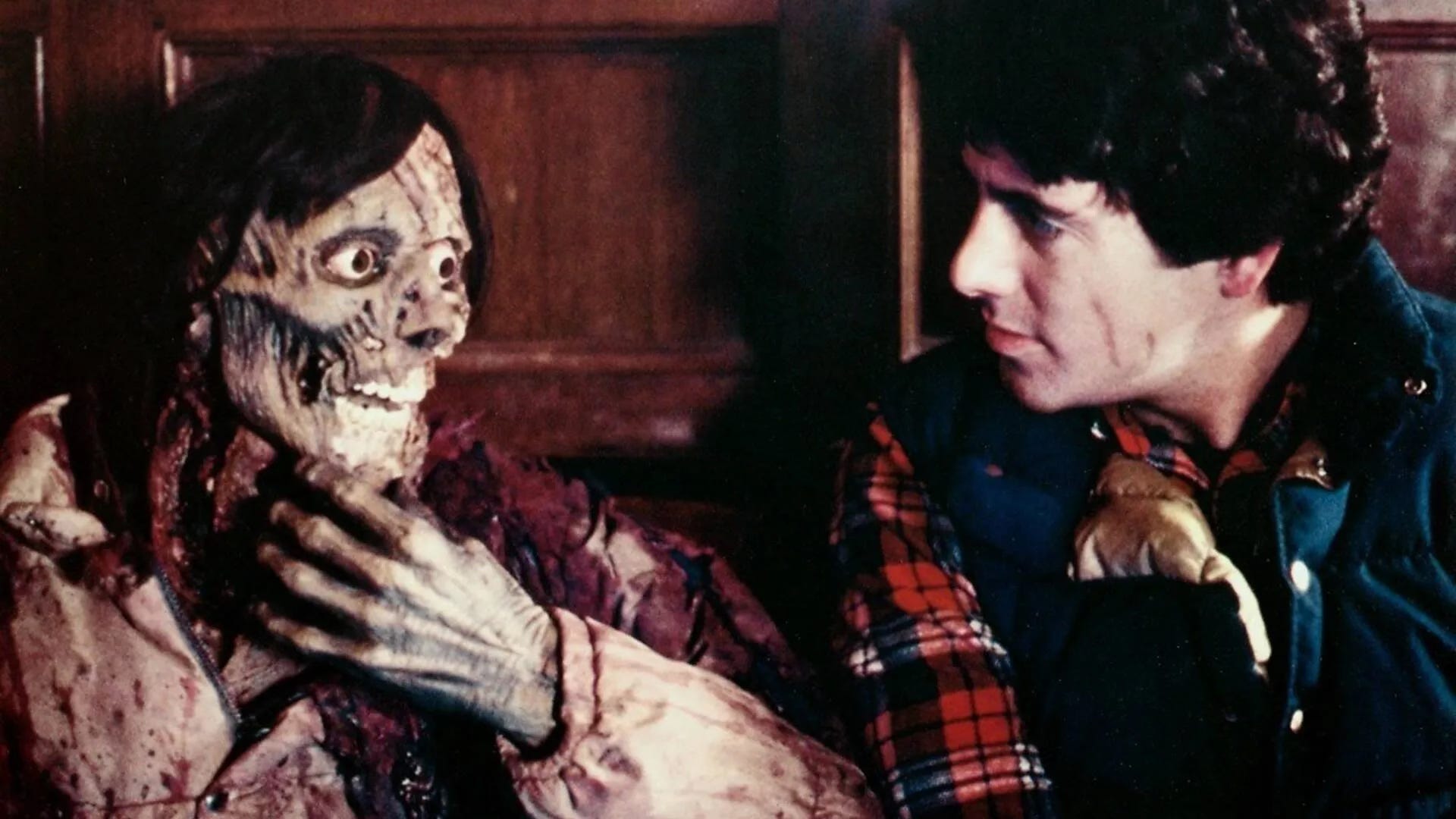
Griffin Dunne didn’t want to miss out on a third of his first major role, and so was allowed to puppeteer Jack’s carcass. Once again, he puts in a wonderful performance, full of weirdly human touches like having Jack pause to scratch what’s left of his nose.
The exchange that follows between Jack and David is awkward, perfectly human, grounding the phantasmagoria to come.
David can’t help himself and tells Jack he looks awful. “Thank you,” says Jack through gritted teeth. David apologises, confessing he’s genuinely glad to see his undead pal.
David’s grasping for comfort here but will find none in this haunted grindhouse.
Jack hesitates. You can sense his compassion, his reluctance: “I want you to meet some people.”
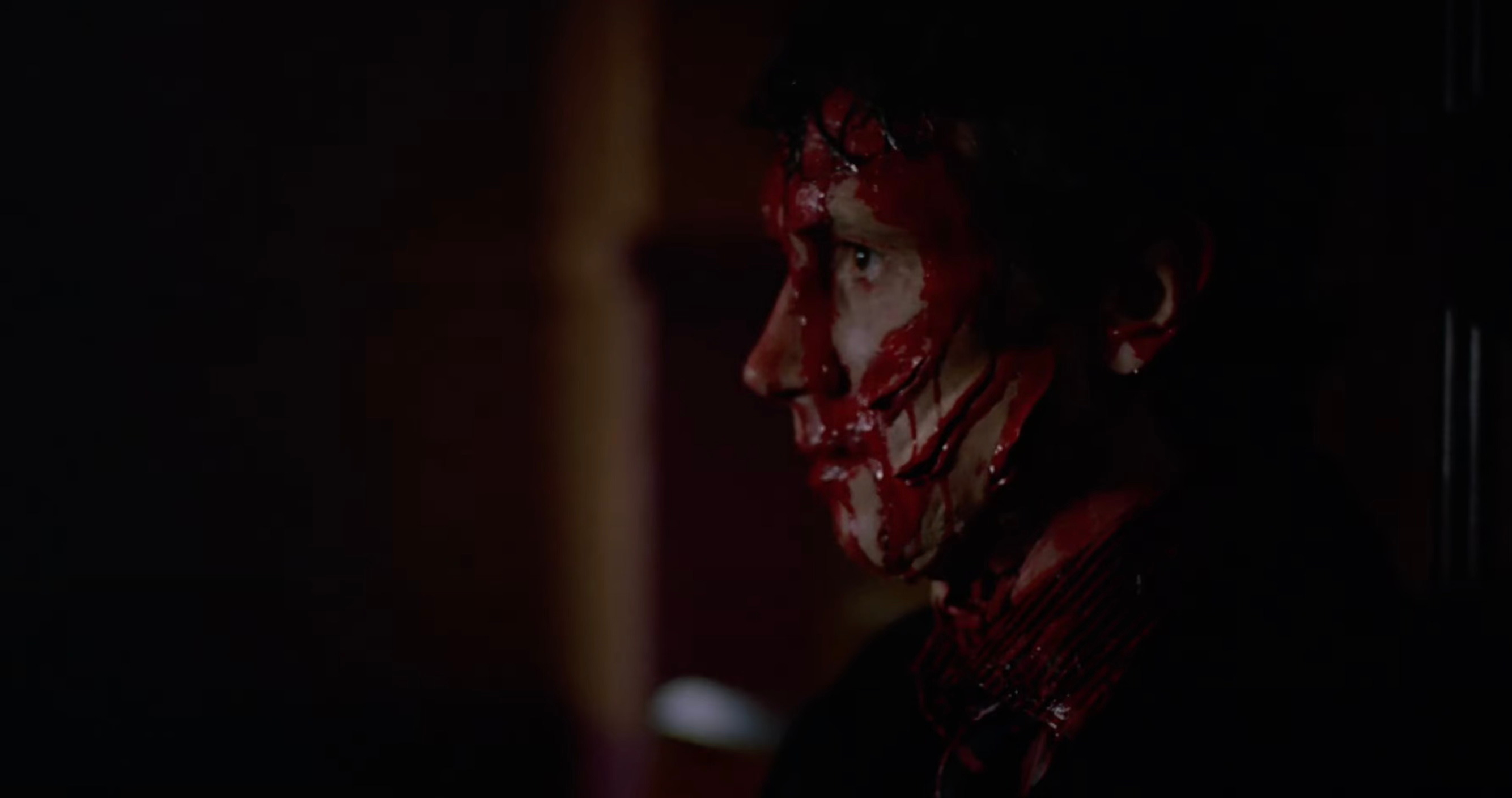
Jack reveals another dead man sitting next to him, a mutilated civil servant who wasn’t there a moment ago.
Jack leans in like he’s trying to save David’s blushes. “Gerald’s the man you murdered on the subway. We thought it best for you not to see him as he’s a fresh kill and still pretty messy.”
The “we” in that line feels conspiratorial, as does Gerald’s insistence that this grisly meet-up wasn’t Jack’s idea. We get a sense of the undead characters having consulted off-screen.
“Yes, I do look most unpleasant.” Gerald (Michael Carter) is understandably irked.
Notice how these spectres all have personalities. They’re characters, not just special effects. Their reactions to their circumstances make them feel (un)alive.
“You’ve left my wife a widow and my children fatherless.”
This weighty line really sells the cost of David’s carnivorous lunar activities, wounds that cannot be healed by the resolution of this story.
“And, I understand, I am to walk the earth in limbo, one of the living dead!”
Carter delivers these lines with splendid indignity, like he’s complaining at the front desk and has never heard of anything so preposterous.
His response is as hilarious as it is eerie.
This is the first time David is confronted with hard evidence of the atrocities he has committed, crimes of which he has no memory and no idea what to say in response.
The horror is suddenly inescapable, no longer the primal terror of being devoured by an apex predator or the fear of losing control over one’s body.
Gerald raises a bloody finger and growls with quivering intensity.
“You must die, David Kessler.”
Pure existential dread – rudely interrupted by another orgasmic on-screen moan, making this moment of incomprehensible horror palatable with a laugh.
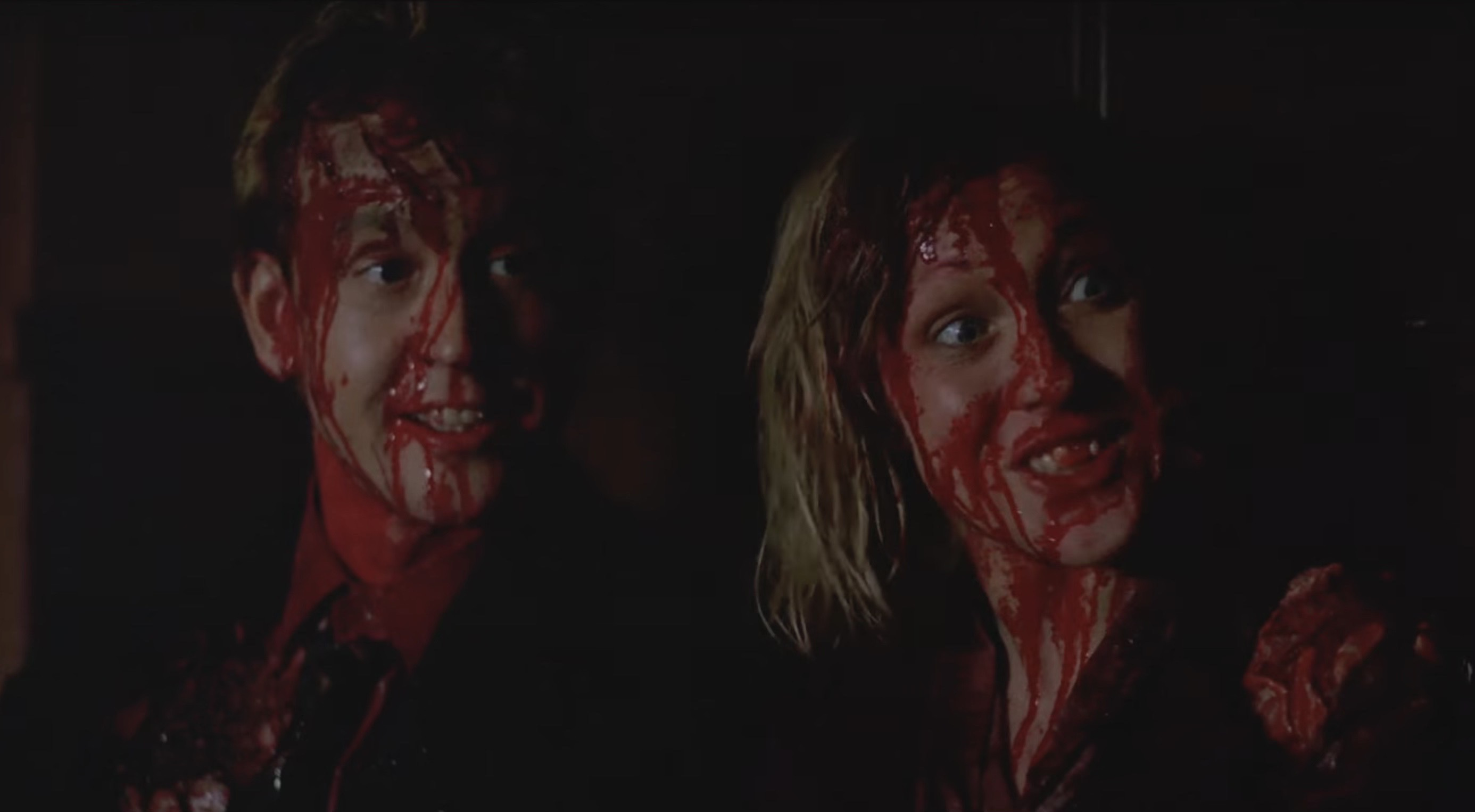
Jack goes on making introductions like he’s hosting a formal gathering and we meet yet more ghosts at the feast. Here’s Harry Berman (Geoffrey Burridge) and his fiancé Judith Browns (Brenda Cavendish), middle-class airheads still grinning through their gory locks.
The trio of murdered homeless men – Alf (Sydney Bromley), Ted (Frank Singuineau) and Joseph (Will Leighton) – are too working-class to get surnames. These poor gentlemen of the road seem to bear the burden of undeath as just another humiliation life has heaped upon them. They’re impatient and mean.
By now we have several mutilated corpses chatting in the middle of a porno-theatre like there’s nothing at all strange about this.
The dream-like tableau doesn’t land all at once. The weirdness builds, introduction by introduction, guiding you in. David doesn’t react to the sudden appearance of these ragged spectres. He takes it all in his stride and so do we.
Finally, David asks. “How shall I do it?”
What follows could only be delivered as comedy.
Everyone agrees sleeping pills are unreliable and Jack doesn’t trust David with knots, not wanting to cause his friend undue suffering.
“So what? Let ‘im choke!” snaps Ted.
“Do you mind?” barks Jack. “The man’s a friend of mine!”
“Well, he ain’t no friend to me!”
Gerald tries to keep the peace.
Those personalities are bouncing off each other, anchoring the grim surrealism.
“I know where you can get a gun,” says Joseph.
The spectres keep offering ruthless advice.
“Don’t I need a silver bullet or something?” says David.
Jack rolls his lidless eyeballs. “Oh, be serious, would you?”
David’s incredulity at the world of the undead is mirrored by the undead’s incredulity at the superstitions of the living.
David grips his hair and looks away. “Madness.”
The bloody couple offer yet more cheerful advice.
“Thank you,” says David. “You’re all so thoughtful.”
This sounds like a concluding line, but the suggestions keep coming, without mercy, becoming ever more excited and vengeful. The overkill is horrible yet hilarious.
But now the full moon is unveiling above Piccadilly and David – now eerily alone in the theatre – is getting a familiar tingle.
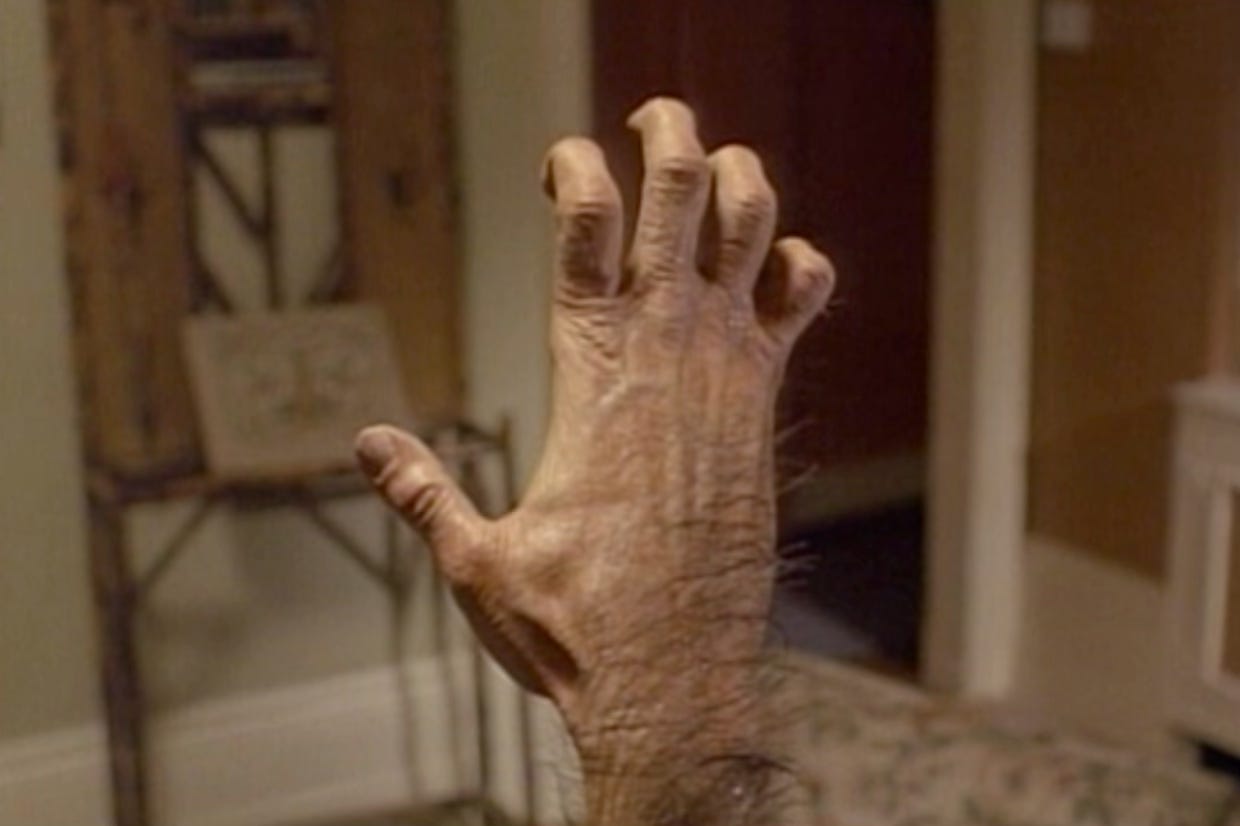
In this scene resides the dark heart of An American Werewolf in London. It’s the moment in which the movie’s separate strands of horror and comedy fully intertwine, and laughter itself becomes bleak and monstrous.
It’s the kind of gallows humour peculiar to British comedy like Monty Python, The League of Gentleman and The Office. British sci-fi is often just as jaded, resigned to cosmic indifference in The Hitchhiker’s Guide to the Galaxy and Red Dwarf, decades of oddball satire in anthology comic 2000 AD and the operatic grotesquery of Games Workshop’s Warhammer.
An American Werewolf in London is a movie that acknowledges the dramatic weakness of the werewolf genre, bolstering its limitations with unique worldbuilding and an alternative narrative structure, all the while overdelivering on the genre’s demands.
You like agonising transformation scenes and wolf-monsters? Well, here’s dream-demons, sarcastic ghosts and a Hell-world of undeath as well!
Landis doesn’t shy from letting the scares reflect his personal fears and outsider perspective. He employs humour not to poke fun at horror’s shortcomings or to have characters crack daft jokes from the sidelines.
The comedy in American Werewolf masks the fact that it’s one of the darkest popular horror movies ever made.
But the humour also humanises the horrors, has us laughing in the face of death.
George Bernard Shaw had a saying, “If you want to tell people the truth, you’d better make them laugh or they’ll kill you.”
As in comedy, so in horror.
Stay weird.
Comments
Nothing yet. Say the first thing.
Sign in to join the conversation.