
Welcome back to Ordinary Delusions, a newsletter searching for answers in the fever swamp of late capitalism. I’m currently deep in a sprint on my second book, which I’m very excited about. It’s about climate, and how our rapidly heating atmosphere connects to all our other present malaises. Despite the, y’know, somewhat apocalyptic subject matter, I’m having a lot of fun writing it. However, my brain only has space for so many words, so this is the last essay I’ll be publishing for a while. I’ll still be landing in your inbox in the coming weeks, but it’ll be with a punchier format. Thanks for being here.
The nepo baby discourse was cultural dynamite when it blew up a couple of years ago. It tapped into something everyone knows to be true, but it took on a life of its own because we have grown up in an economy that’s turned nepotism from an annoying fact of life into an unavoidable force that’s felt in every corner of our cultural spaces.
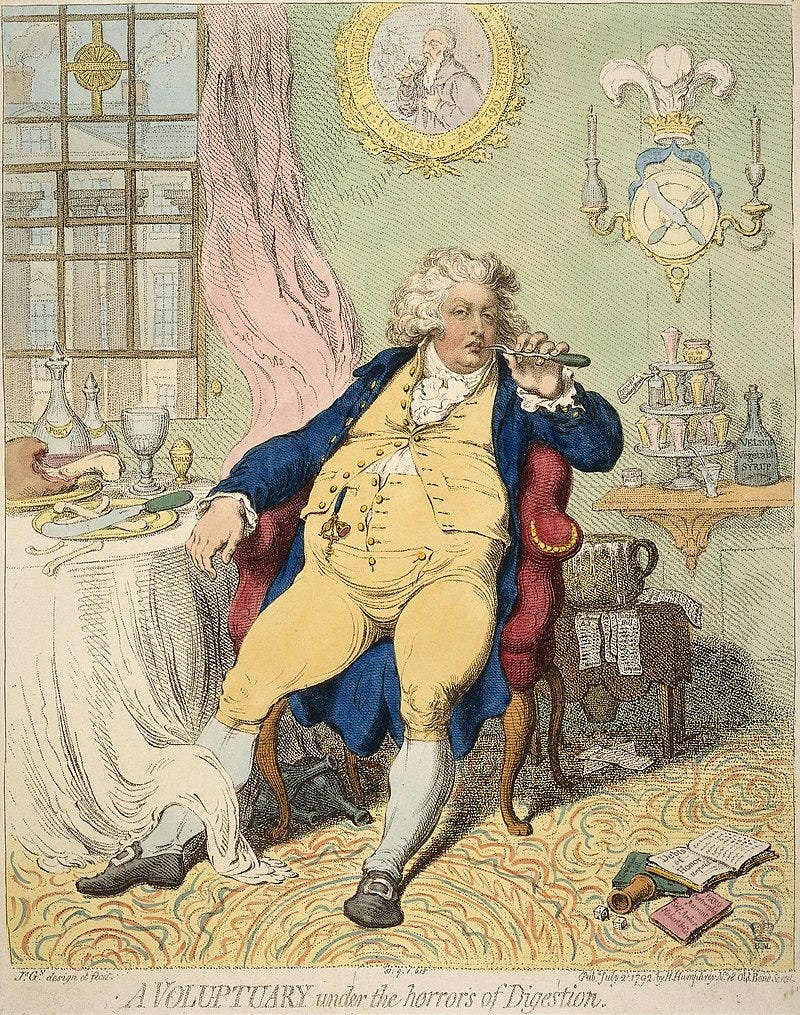
It’s always been kinda like this. Brighton, my hometown in the UK, became famous in the 1800s because the son of King George III built a palace there that’s modeled on the Taj Mahal. The Prince Regent was obese, possibly addicted to opium, and spent most of his life spending taxpayers’ money. "A more contemptible, cowardly, selfish, unfeeling dog does not exist” wrote one of his aides.
British society is so aristocratic that you can spot old money a mile away if you know what you’re looking for, but it’s murkier in the US. Take The Strokes: the singer’s dad founded Elite Model Management and the guitarist’s dad wrote songs for Celine Dion and Whitney Houston. The band met at private school, but the lore leaves out that part.
The nepo baby discourse touches a nerve because nepotism has become such an inescapable feature of life in the 21st century. But people aren’t mad that nepo babies exist, they’re mad that there’s no chances for the ordinary babies anymore.
The big cultural capitals are unaffordable for regular people. Just going to university is a luxury. Career ladders are disappearing as tech rewires entire industries. Getting onto the property market is a fantasy if you don’t have a few hundred grand lying around. And if you’re in the US, you can add the giant scam that is health insurance to the list of financial “headwinds” you have to grind through just to keep the lights on (the American Psychiatric association reports that money is the number one cause of anxiety for Americans).
These problems are much easier — if they exist at all — for the kids of the 1%. They have connections that open doors in cultural spaces, and the money to sit around doing cool stuff without having to worry about paying the bills. And beneath them is what Xochitl Gonzalez calls “the comfort class” — people who got a head start in life because their parents got on the property ladder at the right time, even if they worked very ordinary jobs and were paid very ordinary salaries (you can put me in this camp).
But if you weren’t born on the right side of the intergenerational wealth chasm, just working in a quote-unquote cool industry is becoming a luxury in itself. Many of these spaces never paid well to begin with, but they’re now having to adapt to new (and in many ways worse) economic models thanks to Silicon Valley. Think Hollywood and the shift to streaming, magazine writers pivoting to newsletters and musicians trying to eke out a living when their work has been made essentially free by Spotify. And on top of that, inflation is making everything more expensive.
The nepo baby phenomenon is what happens when social mobility tightens, or just disappears altogether — it’s not about this or that actor being an entitled douche who doesn’t know how lucky they have it (although they might be!). It’s about the framework of our economies and how they open so many doors for the rich and well-connected, and slam them shut for almost everyone else. It all comes down to the boring, unsexy ways politics shapes our lives — it’s the laws and tax codes that concentrate wealth at the top of society, the property markets that push home ownership further and further out of reach, the neoliberal policies that keep people trapped in poverty.
Clearly, it’s deeply unfair, but it doesn’t bode so well for the future of our culture more generally. Culture is supposed to be a way for us to come to terms with the slippery, indescribable parts of the human condition. What does it mean when it’s only a tiny sliver of the population that’s able to do that?
It’s telling that one part of our culture that is thriving is podcasting, a medium where being a regular Joe can be a massive plus. Sure, the manosphere is clearly making a very big (and bad) impact on our political climate, but you wouldn’t accuse them of being nepo babies. Joe Rogan did construction work and delivered newspapers while he was starting his comedy career, and Theo Von was legally separated from his parents at 14.
Just throwing this out there, but maybe the nepo baby economy is part of the reason those guys are drawing such huge audiences? When ordinary people know that “proper” culture is only for the privileged, then they’re going to look somewhere else when they want to make sense of the world.
No posts
Comments
Nothing yet. Say the first thing.
Sign in to join the conversation.