
Maybe it’s just me, but it seems like it’s harder all the time to have a real and substantive conversation with someone, especially someone you just met. If it’s just me, it’s probably because I’m “old and irrelevant” as one of my dear children once described me when I was much younger than I am now. But I kind of think it’s not just me, because it seems like a symptom of the bad direction we’re moving in, in the culture.
I’ve written on the atomization effect we’re experiencing, in which we’re increasingly siloed into loneliness and lack of commonality with those around us, making us easy pluckings for totalitarian ideology that seems to re-bond us socially but does so deceptively: only on the terms of the tyrannical Machine.
I recently read a piece that was mostly about how this happens in religious/church circles, and I recognized this effect in a way I hadn’t before. Lots of ink gets spilled on the rejection of authority by those who go to church and say they respect the authority of God. But boy do they not respect the authority of the church, so everyone is a moral authority unto themselves, even if they kinda sorta subscribe to the proposition that the Bible is God’s expression of authority, in matters of morality. They get around this expression by not believing the Bible, mostly, or by reconstructing it on more—to them—congenial lines by emphasizing some parts and de-emphasizing other parts out of existence. They skip the line that says “scripture cannot be broken.” Among many others. Or they just cut to the chase and toss out all revelation, keeping only the god they made in their own image or a metaphysical Nothing where the necessary Divine used to be.
For a lot of reasons I can share (and have, in my books and substacks) the atomization occurs because we feel the differences are so profound they cannot be overcome. If you express some viewpoint with real depth, you may get slapped down as a hater, immediately written off in the other’s mind as a monster. You feel that they feel the world would be better off if you just got off it. Maybe some social hygiene is in order, like the holocaust. Your views aren’t something that can be civilly discussed, so overwhelming is the moral umbrage.
The person who responds to you this way is experiencing at least these things. One, rejection of the liberal principle of pluralism. They are profoundly illiberal and you must keep that in mind for your own safety. Two, rejection even of your humanity, the idea that as different as we are in outlook, some basic mutual respect can exist between any two people anywhere and under any circumstances, even in war. Three, rejection of threat to their cocooned self, insulated in ideology.
This third rejection means they are well on the way already to ideological capture. That’s why you’re a threat. It’s their desperate clinging to rules of the state. Or really, state plus allied ideological power centers, the Machine I always go on about because the next totalitarianism won’t have a strong-man leader like Stalin. It’ll be run by a tiered committee of managerial elite. Your worst nightmare: fascism by bureaucracy. You’re experiencing its outer rings already, enveloping you like innocent-seeming mud that turns out to be quicksand. Quicksand of the cartoon or jungle-jim matinee variety: you go all the way down, until only your bwana pith helmet floats on top.
When you discern this plenary rejection from someone, go easy on them. They’re in a bad way, they just don’t know it. They’re already cut off from humanity because they’re atomized and alone, and are desperately trying to rejoin. They’re trying to glom onto an accessible social tribe by adopting its shibboleths and hatreds. They’re puppets unaware of their puppeteers. They feel they can’t bond with anyone socially without re-grouping under the fascist banner. I use their swear-word “fascism” not for clever turn-around, but because that’s really what their own view is. All individuality subsumed into the state, just like Mussolini said when he coined the word expressly in rejection of liberalism.
You may dare to talk to someone about something substantive, even with the risk that you’ll find them to be in this predicament. (This woke predicament, to be precise, but I think they mostly now disavow the word they invented.) If you do want to get into a substantive discussion, you might begin by talking about books. How about this conversation starter: “What are you reading?” I love this question. Sometimes the answer dribbles off into nothing—“too busy” or whatever and then you both have to drone on about the sort of stuff you’d like to read but don’t. Sometimes, though, it sparks an opportunity to have a real discussion because it begins at arms-length, so to speak. At least initially, you’re talking about what someone else thinks, not putting yourself out there or expecting your interlocutor to do so. And if you find they’re tetchy about the made-up ideology they’ve absorbed, you can always keep the discussion at the level of books.
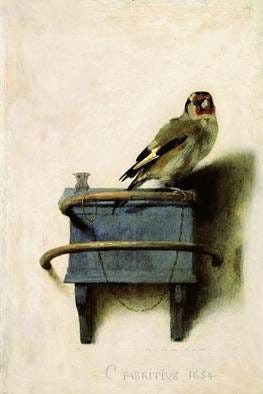
Even better, you can keep it at the level of art. Books as art, imagine that. Not just vehicles for ideology, but actual artistic words, like poetry. Sometimes the prose is enough to penetrate the hide-bound ideological cylinder people climb into. For example, here is Donna Tartt in her novel The Goldfinch, her first-person narrator talking about the experience of being able to look from time to time at the priceless painting he stole:
[E]ven when I couldn’t see it I liked knowing it was there for the depth and solidity it gave things, the reinforcement to infrastructure, an invisible bedrock rightness that reassured me just as it was reassuring to know that far away, whales swam untroubled in Baltic waters and monks in arcane time zones chanted ceaselessly for the salvation of the world. (p. 304).
For the sane person this is a great jump-off to a discussion of the necessary structure of the world as against its restless devolution to the formless void, and what that should mean in our ways of living with each other. For the woke ideologue it’s the warm “oceanic feeling” of social solidarity, humanity only achievable by adopting a socialism of the heart. Entirely opposite views of reality, as far as east is from west, but joined at least in the beauty of the text. Or the painting the text is based on. Woke people are skeptics of truth and moral realism (that’s what it means to be woke) but they’re not going to be skeptics of beauty.
On the subject of beauty, let’s consider trees. Yes, trees. In early spring I was taken with the beauty of the American beech, providing a light umbrella understory to the oak/hickory stand still dark and just coming out of winter. I’m not obsessed with the American beech, in fact if I were to start from scratch selecting a tree to extol the virtues of, I’d probably pick another. But I start where I am (of course) and where I was recently when I thought about beauty in the mundane was in the woods where I often walk.

On trees (and their beauty, singly and in symphony) I always like to quote Donald Culross Peattie, who saw the majesty in the scrubbiest scrub tree. I had his volume on western trees, but I’m presently located—[checking googlemaps]—in the east. His volume on eastern trees was out of price range but for some reason I thought to check again recently and now I have it! I can now follow his lyrical writing on trees I have daily contact with and of course start with the American beech, p. 179. I see you quivering with excitement.
[W]hen the tree stands naked in winter it seems to shine through the forest, almost white in contrast with the dun colors all about it, . . . In very early spring an unearthly pale pure green clothes the tree in a misty nimbus of light. As the foliage matures, it becomes a translucent blue-green through which the light, but not the heat, of the summer day comes clearly. . . . As the sun of Indian summer bathes the great tree, it stands in a profound autumnal calm, enveloped in a golden light that hallows all about it.
Peattie then records this excerpt from the Bard, pertaining to the Beech:
O Rosalind! These trees shall be my books,
And in their bark my thoughts I’ll character;
That every eye which in this forest looks
Shall see thy virtue witness’d everywhere.
As You Like It, 3:2.
Beauty is all around us. Maybe it can transcend our enmities, even when ambient love has evaporated and truth and morality become merely words attached to theory.
Comments
Nothing yet. Say the first thing.
Sign in to join the conversation.