
It’s been almost two weeks since l’ve posted here, which feels like a lifetime. Apologies to all my lovely subscribers — I promise I have plenty of excuses.
The first, and most exciting, is that I’m closing in on the deadline for my book manuscript.
I’ve written a book before and am fully aware of what that entails, but it still can be a bit overwhelming. I have about three weeks until I ship everything off to Lost Art Press, so I’ve really been feeling the crunch.
The good news is I’ve used my time away from here to make serious progress on it. As of right now, I have the text for the entire book (including photo captions!) complete. Most of the photos and illustrations are also ready to go, and all told I’m feeling pretty good. I still have to complete and photograph the practice projects in the book, but since I’ve written them out it should go rather quickly
When I pitched this book last fall, I had a fleshed-out outline and table of contents. I had a pretty good handle on what I wanted the project to be, but of course things changed during the process of actually writing the thing.
The book is roughly divided up into four sections. The first goes over all the introductory stuff— the terms, definitions, and theory behind double-bevel marquetry. There are a whole mess of illustrations in here that alter scale to make concepts more digestible.
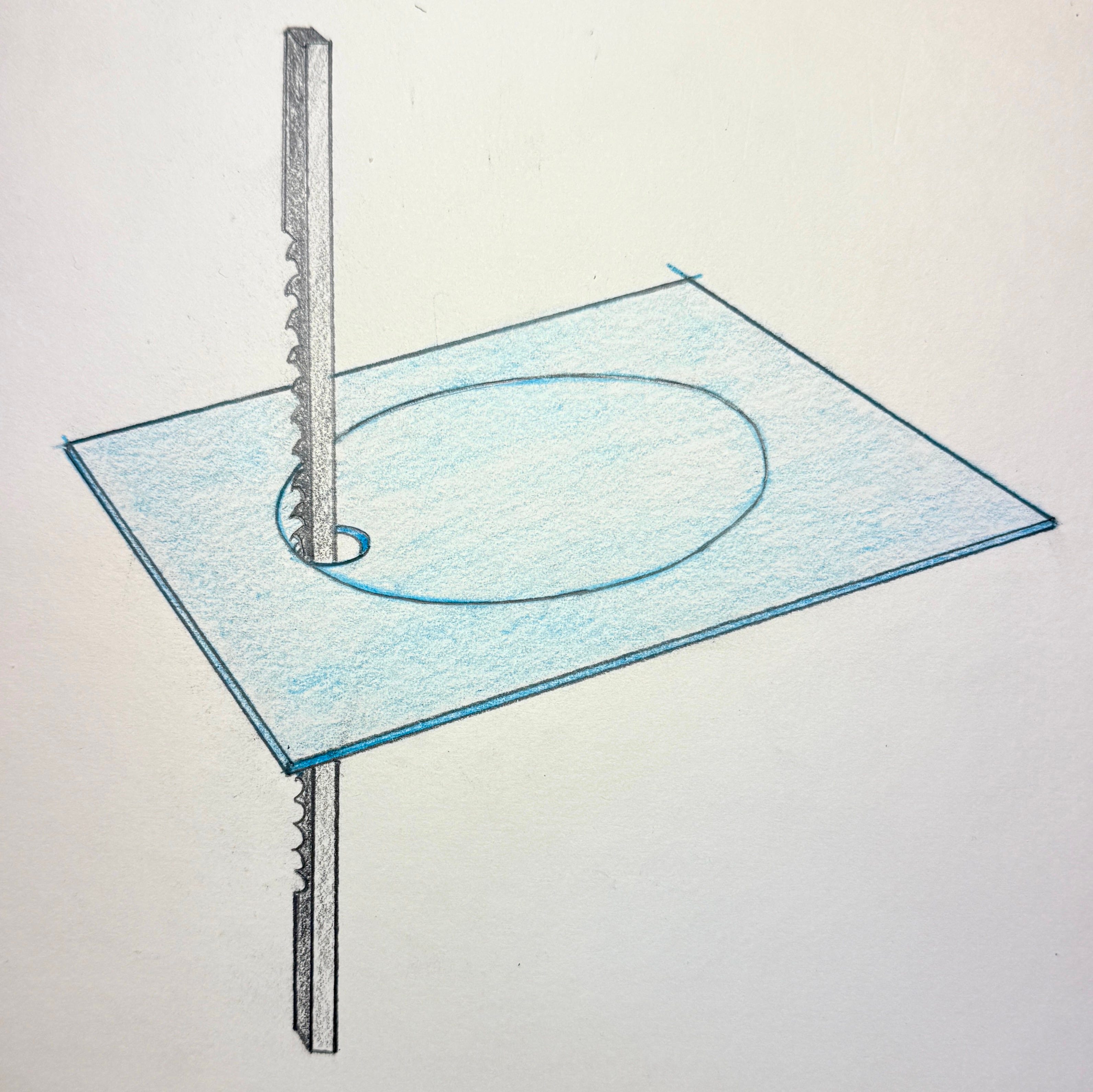
Next, I go over all the tools and materials that you’ll need, offering plenty of alternatives and always assuming the reader has limited funds and shop space.
The following section is entirely focused on the practical aspects of marquetry. I go over how to drill holes, how to saw, the layering process, how to troubleshoot, and more. In my opinion, this is the real meat filled with tons of process photos.
The book ends with three introductory projects that are meant to expand upon concepts and skills introduced earlier. Something to get the creative juices flowing.
Instead of retyping why l arranged and presented things the way I did, here’s a little excerpt from the conclusion":
Throughout this book, my entire goal has been to leave you with a solid foundation to go out and flourish.
[…]
[It] was not to lock you into a particular way of doing things. I do not purport to have the best ideas or methods about marquetry (or anything for that matter). And I have no interest in trying to convince people otherwise. The fact is once you understand the fundamentals of double-bevel marquetry, there are so many ways you can go with it. My sincere hope is that instead of locking folks into doing things my way, my writing instead inspires readers to think and develop their own approach.
I actually first pitched this book to Fox Chapel Publishing (the publisher of my previous book) because they have first right of refusal. They ended up passing because they thought there wasn’t a large enough market for a book specifically on marquetry.
After that, I pretty much viewed my options as either 1) don’t do the project at all, or; 2) pitch it to Lost Art Press.
I’ve already gone over that whole story. Lost Art is so appealing is not only because of their cache and standing in the woodworking world, but also because of how they treat authors.
One thing that’s really cool about them is they allow authors to have a hefty amount of input in how the book looks and how it’s printed. This is not the case at most places. I had no idea what my box-making book was titled or what it was going to look like until it was basically at the printers. If I had any say, the design would have been quite different.
I’m the kind of person who really tries to avoid overthinking these kinds of things. I find that a lot of times people really just want the bells and whistles associated with hard work and just kind of hand wave at the hard work part. This is why I don’t sell personal branded merchandise and whatnot. Time spent doing that is time spent away from the real work.
Well, now that the real work of the book is (nearly) done, I’m giving myself permission to think about these things. Even if I prioritize the meat of the content, I still believe that aesthetics are incredibly important. So it’s not entirely self-indulgent.
When Megan Fitzpatrick started listing off all the options when we met last fall, I got a bit overwhelmed. At the time I was still concerned with securing a contract, so I didn’t really want to think about paper and the like.
I’m still incredibly ignorant about this whole process and the options avaitable to me. I’ll learn those in due time, but I have decided on a few general guidelines.
I like the size of Megan’s Dutch Tool Chests. It’s large enough to fit sequential process photos on a single page, and the general form makes it suitable for use right at the bench.
I want it to fit the general Lost Art Press “style.” To me, that’s cloth bound books with a die stamp. I want my book to be mine, sure. But I also want it to be apparent that it’s a Lost Art book. I’m proud that I got this contract and people are going to know it, damnit.
Since the book is tentatively titled “Marquetry for Everyone,” I want the outside to appear inviting and approachable. A light pastel color for the cloth seems in order. I keep returning to lilac...
No dust jacket. I feel like 90 percent of people are nodded their head in agreement.
Who knows how many of these things will change by the time the book is printed. I also still need to figure out what I want the die stamp on the cover to be. My knee-jerk suggestion is the silhouette of a fret saw, but maybe that’s not right.
If anyone has any ideas on the die stamp or general suggestions for the book design that would make it easier to consume, let me know in the comments below.
About 15 years ago when I was just finishing up graduate school, I started writing for a Philadelphia Flyers hockey blog. I promise I’m going somewhere.
At the time, all the private equity [redacted]s were throwing their money into the blogosphere, and the site I wrote for was pretty impressive. We were able to secure press credentials (I covered a few Flyers games in the press box) and had a big following online. A few of the writers went on to bigger gigs in hockey journalism, and in general it was a great time spent around really impressive people.
I ended up growing “meh” on hockey and in love with woodworking, so my activity at the site eventually faded.
While I was there, all the writers spent most of the day (and night) talking to each other in a group chat. I made a few lifelong friends there— one of them is actually dating a longtime coworker of mine after meeting at my last book release party. I’m basically cupid.
One of them ended up going to work for the Carolina Hurricanes as a data analyst. He kept getting promoted and in May 2024 he became the general manager. His name is Eric Tulsky, by the way.
Anyway, in June, Eric and his team won the Stanley Cup. He is my sketch below of him hoisting it, which is absolutely hilarious to me.
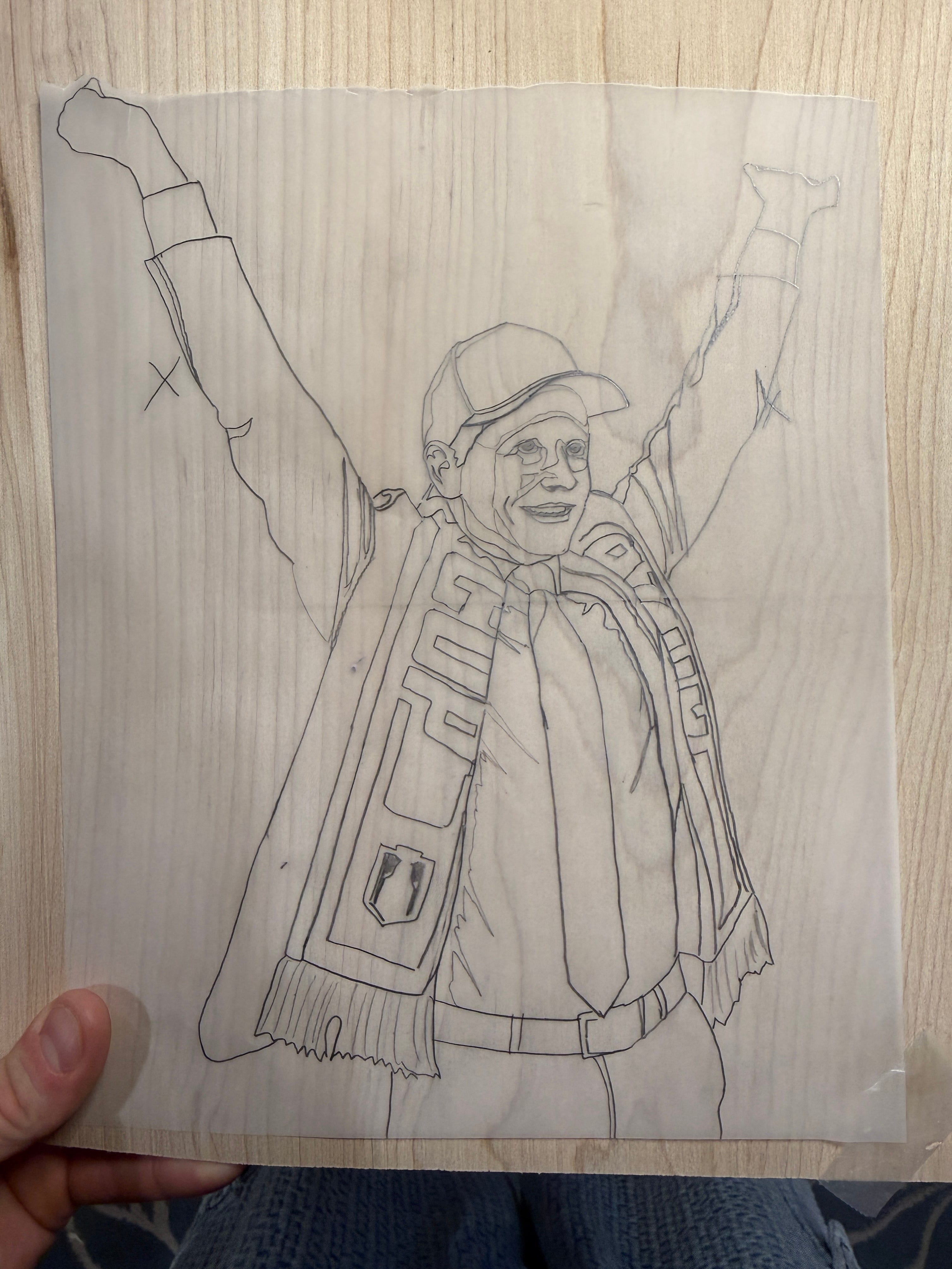
In my world, winning a Stanley Cup is A Pretty Big Deal. And to that end, I’m now working on a marquetry portrait for him.
There’s a lot of work left to go for this. Once the panel is complete, I’ll frame it in a dovetailed shadowbox. The shadowbox is going to have enough depth to house a hidden drawer so Eric can stash his Stanley Cup Championship ring (again, hilarious to me that he has one of those).
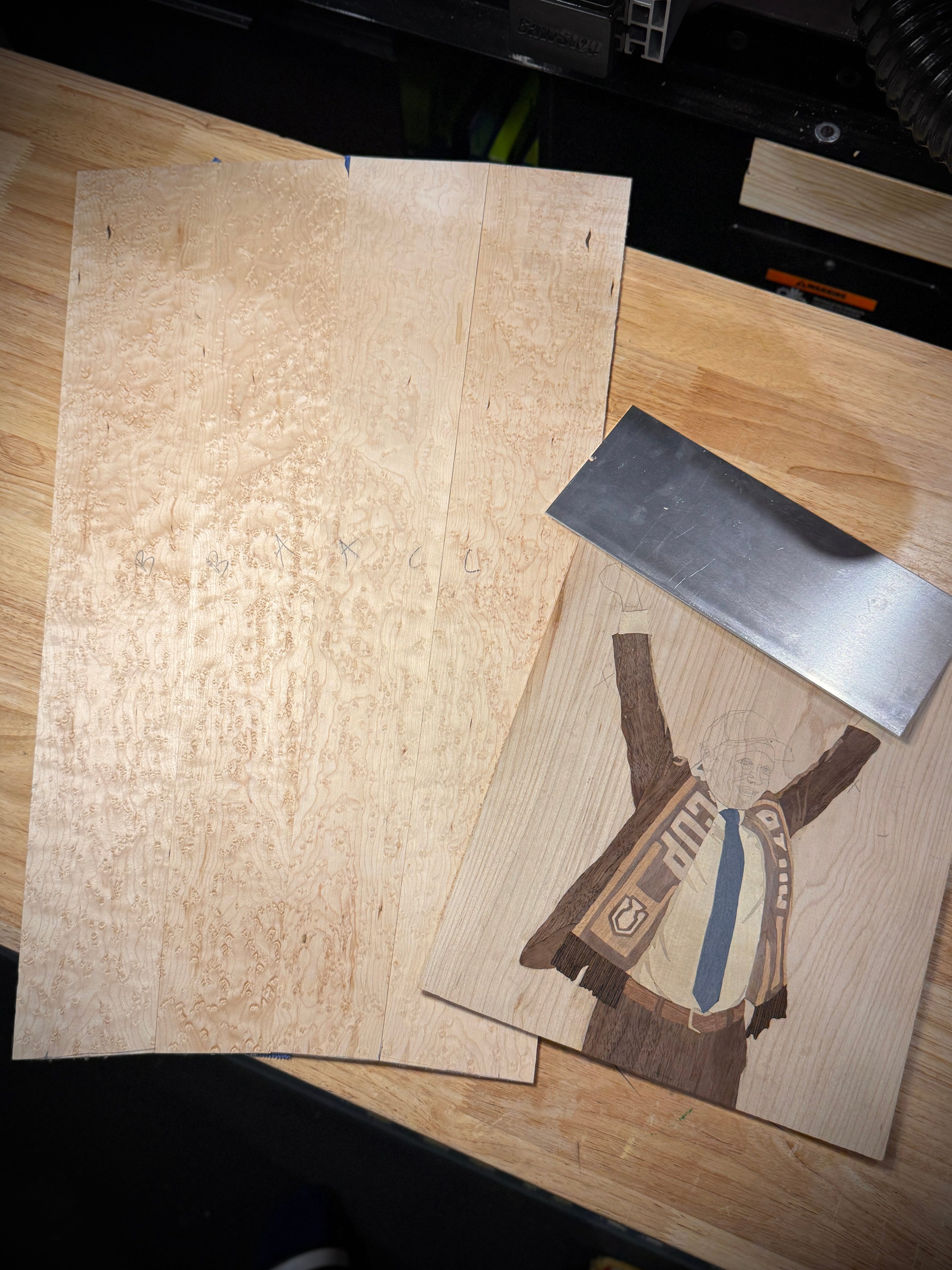
I’m absolutely honored to be making this for him. Making a portrait of anyone for this occasion would be special, but since it’s an old friend that I knew from before he made it big, it’s even more so.
Every member of a Stanley Cup winning team gets a day with the cup to do what they like - I’ll be delivering this portrait to Eric on his day. It’s OK to be a little jealous.
In addition to everything above, I’ve also been teaching and getting ready to hit the road.
First up, I’ll be at Handworks in Amana, lowa at the beginning of September. I don’t have any plans or work to do there, so you’ll probably see me poking around here and there.
Next, from September 25-27 I’ll be in Austin, TX at the Texas Woodworking Festival. This is my first year attending, and I’m pretty excited about that. Ilbe giving three talks while I’m there - one on social media type stuff, one on marquetry, and one on dovetails. It should be a great time even though Vic Tesolin will be there too.
And finally, this October 9-10 I’ll be returning to Woodworking in America in Des Moines, lowa to give some talks on marquetry and veneer. I’ll be focusing on simple, practical applications for marquetry in furniture pieces. I spoke at the event last year and it was a wonderful time with some of the best in woodworking and also Shea Alexander. If you use code KLEINE100 when purchasing tickets, you’ll shave a cool $100 off the total price.
Looking forward to seeing everyone!
No posts
Comments
Nothing yet. Say the first thing.
Sign in to join the conversation.