
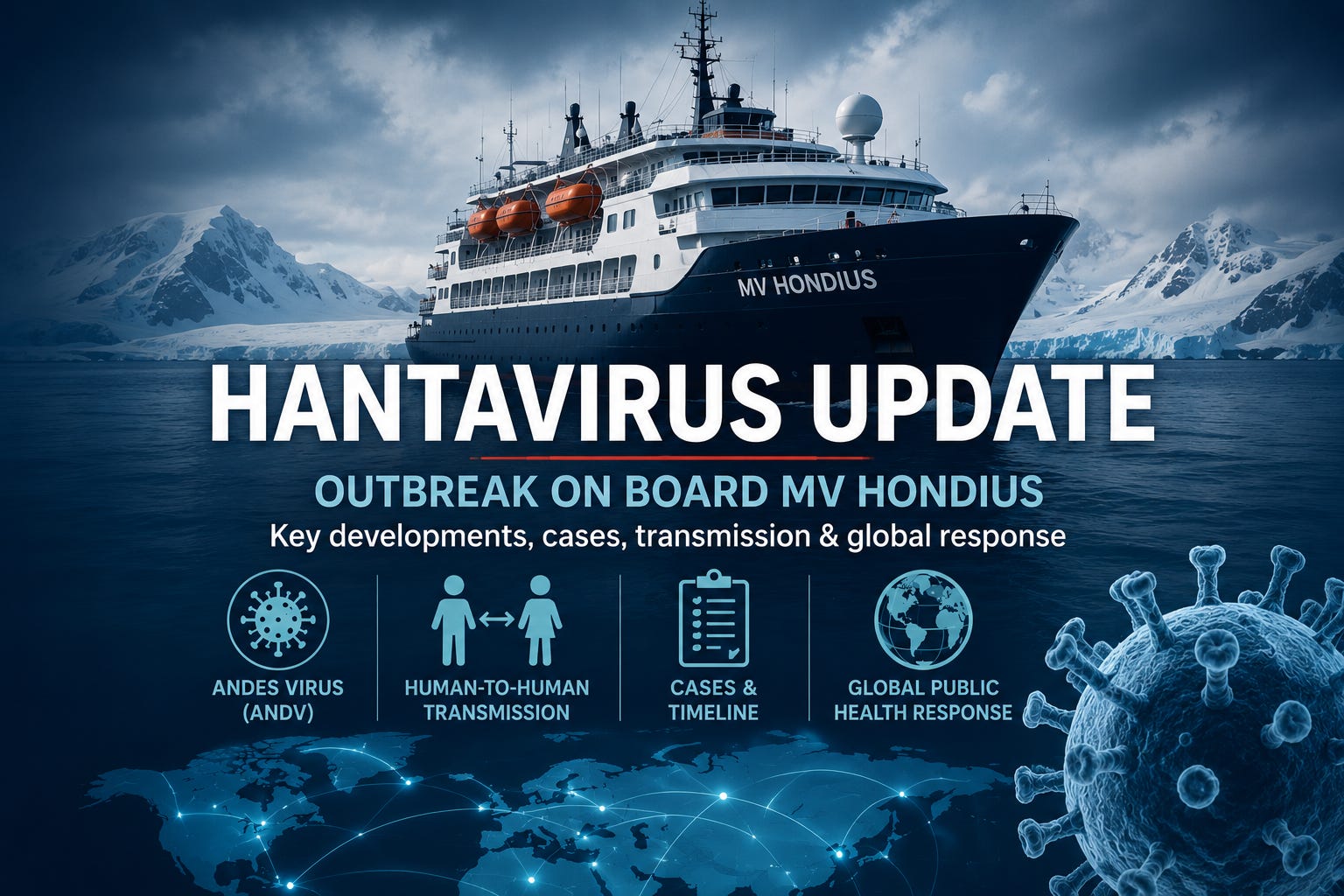
In my previous post I covered the background to the hantavirus outbreak on the cruise ship MV Hondius. At that point, it was largely a matter of interest among the infectious disease community, with only a faint interest from the press. Things have changed substantially in the past few days, with widespread media interest and a significant amount of anxiety among parts of the public - perhaps unsurprising given the recent pandemic.
Hantavirus on a Cruise Ship: Understanding the Atlantic Outbreak
·
May 5

This week has brought some unexpected news to the infectious disease community. The WHO issued a Disease Outbreak News notification on 4 May 2026 about a hantavirus cluster aboard the MV Hondius. Not many people have heard of this disease, but the setting is unusual. The implications, depending on what investigations reveal, may be significant.
The situation has evolved rapidly and we have much more information now to give us a better handle of where we stand and the risks going forward.
Tldr; this will not be the next pandemic.
As of 8 May 2026, authorities have identified at least nine confirmed or suspected hantavirus cases linked directly to the outbreak, including three deaths: a Dutch couple and a German passenger. Confirmed infections include a critically ill British expedition guide evacuated to the Netherlands and a Swiss passenger diagnosed after leaving the ship at St Helena. Additional suspected cases include the ship’s Dutch doctor, a German passenger, and two symptomatic crew/passengers still under monitoring. As of this morning, an additional British passenger on the remote Atlantic island of Trista da Cunha is now also considered a suspected case.
There has been much interest in two potential cases in people who were not passengers aboard the ship, but had been in contact with them on their flights home. A Dutch KLM flight attendant who interacted with the infected Dutch woman in Johannesburg was hospitalised with mild symptoms but has now reportedly tested negative for hantavirus, according to WHO. Meanwhile, French authorities are monitoring a French national identified through contact tracing after sharing a flight with an infected passenger; officials say this person is currently considered a “contact case” only, with test results still awaited and no confirmed infection announced so far.
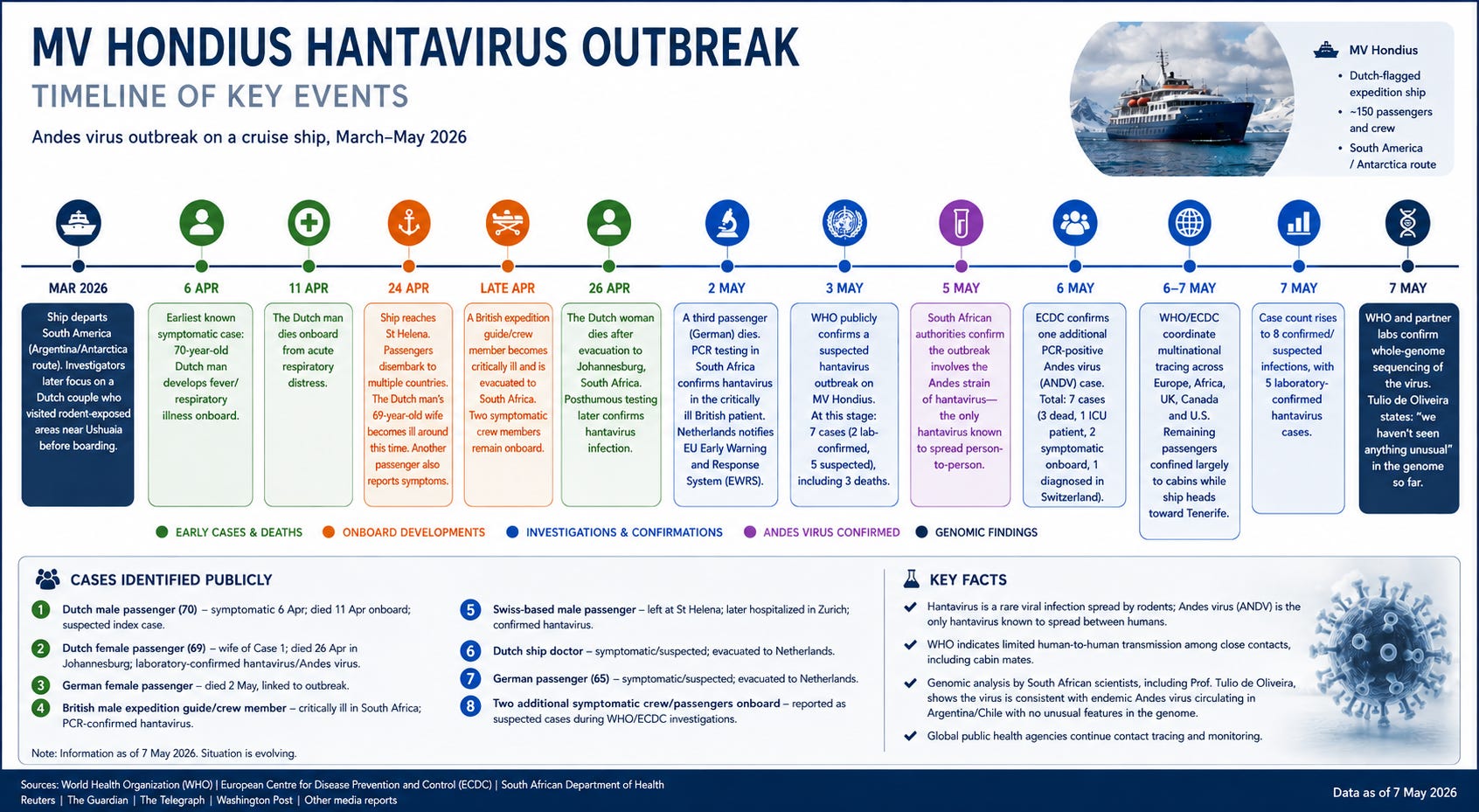
There have been two important developments in the genomic assessment of the hantavirus involved in the outbreak. South African scientists have confirmed that the virus has been identified as the Andes virus. This makes sense in the context of the outbreak, as this is the only hantavirus previously documented to have caused human-to-human (H2H) transmission; it seems very likely given the distribution of cases that H2H transmission occurred on board the ship.
This is useful to know, as it highlights that the current features of the outbreak are consistent with existing knowledge of outbreaks with this virus. This means nothing unexpected has happened so far. The only unusual feature is that the outbreak has occurred on a cruise ship. However, we know that outbreaks of infectious diseases on cruise ships generally are a frequent occurrence.
The next development is that the same scientists have commented more broadly on the genetic sequencing of the virus, to report that it seems closely related to other identified Andes viruses from South America and does not appear to have any usual or distinguishing features present which would indicate it might have acquired additional or unusual features in it’s transmission or disease.
Put together, this means that nothing so far has happened which would be unexpected for this virus, and we have no indication as yet that we would anticipate anything unusual to occur.
Previous outbreaks of Andes virus strongly suggest that transmission is inefficient, requires close contact, and has never demonstrated the sustained community spread needed for a pandemic.
The first well-documented person-to-person Andes hantavirus outbreak occurred in southern Argentina in 1996. Investigators identified 20 linked cases, including healthcare workers and family members, with epidemiologic and later molecular evidence supporting human transmission. Genetic sequencing showed identical viral genomes among linked patients, strongly indicating direct spread rather than repeated rodent exposure.
Subsequent studies confirmed similar patterns. A 2005 CDC review documented several Argentine household and hospital clusters in which transmission occurred primarily among spouses, caregivers, or people with prolonged close exposure during the symptomatic phase of illness. In another detailed Argentine cluster from 2014, whole-genome sequencing confirmed transmission between three closely linked patients. Researchers noted that infection generally occurred during the prodromal phase, when patients were already visibly ill, and incubation periods ranged from roughly 9–40 days.
The largest modern event occurred in Epuyén, Argentina (2018–2019), where one zoonotic spillover infection triggered a cluster of 34 cases and 11 deaths after several symptomatic individuals attended crowded social gatherings. A NEJM review described this as a “super-spreader outbreak,” but even there, transmission chains remained relatively short and geographically contained.
This means there are several reasons why we do not expect Andes hantavirus to cause a COVID-scale pandemic:
Transmission appears to require close, prolonged exposure, often among household contacts, intimate partners, caregivers, or people sharing enclosed spaces. Casual encounters rarely lead to infection.
Patients are believed to become infectious mainly after symptoms begin, unlike SARS-CoV-2 which spreads efficiently before symptom onset. This makes contact tracing and isolation much more effective.
Andes virus has a relatively low reproductive number (R₀) in most observed outbreaks, often estimated below or near 1 outside exceptional superspreading circumstances.
The virus is biologically less adapted to human transmission than respiratory viruses such as influenza or coronaviruses; its primary ecological reservoir remains rodents in South America.
As mentioned above, scientists involved in the sequencing of this Andes virus have said there is currently “nothing unusual” in the outbreak genome compared with previously circulating Andes strains.
For these reasons, the current cruise ship outbreak is considered as a serious but containable international cluster rather than the start of a globally transmissible pandemic.
Just because this outbreak isn’t unexpected doesn’t mean we shouldn’t be concerned. In fact, it shows we have not been concerned enough about hantavirus, or other viral haemorrhagic fevers previously. Whilst similar outbreaks have occurred before, they haven’t garnered interest because they haven’t impacted affluent, western populations. That needs to change. We need more research investment in this diseases because they are already impacting people in low-and-middle-income settings, and because in an increasingly globalised world, they are more likely to end up on our doorstep.
Finally, an important reason we can be confident this won’t become a pandemic is due to the rapid and diligent response and co-ordination of international and local public health agencies. Without them, things could quickly get out of control. We need them in the modern world more than ever before, and we need to make sure these agencies receive the funding and resources they need to keep us safe now, and in the future.
Thanks for reading The Munro Report! This post is public so feel free to share it.
As of the morning of May 8th there are now 9 suspected or confirmed cases, all of whom were passengers on board the ship. There are no secondary cases of contacts from ships passengers to date, with contact tracing ongoing. The virus has been confirmed as the Andes hantavirus, which is known to cause H2H transmission which is highly likely to have occurred in this case. There are no unusual features in it’s genome which would cause us to expect this outbreak to behave differently to previous outbreaks.
Given all we know about the Andes virus and the extensive efforts being put into contact tracing and containment, the likelihood of the current outbreak turning into a pandemic is close to zero.
Diseases like hantavirus are important, and research into them is underfunded. In an increasingly globalised society, more funding is needed for research and public health agencies to keep us safe from serious and transmissible pathogens.
No posts
Comments
Nothing yet. Say the first thing.
Sign in to join the conversation.