
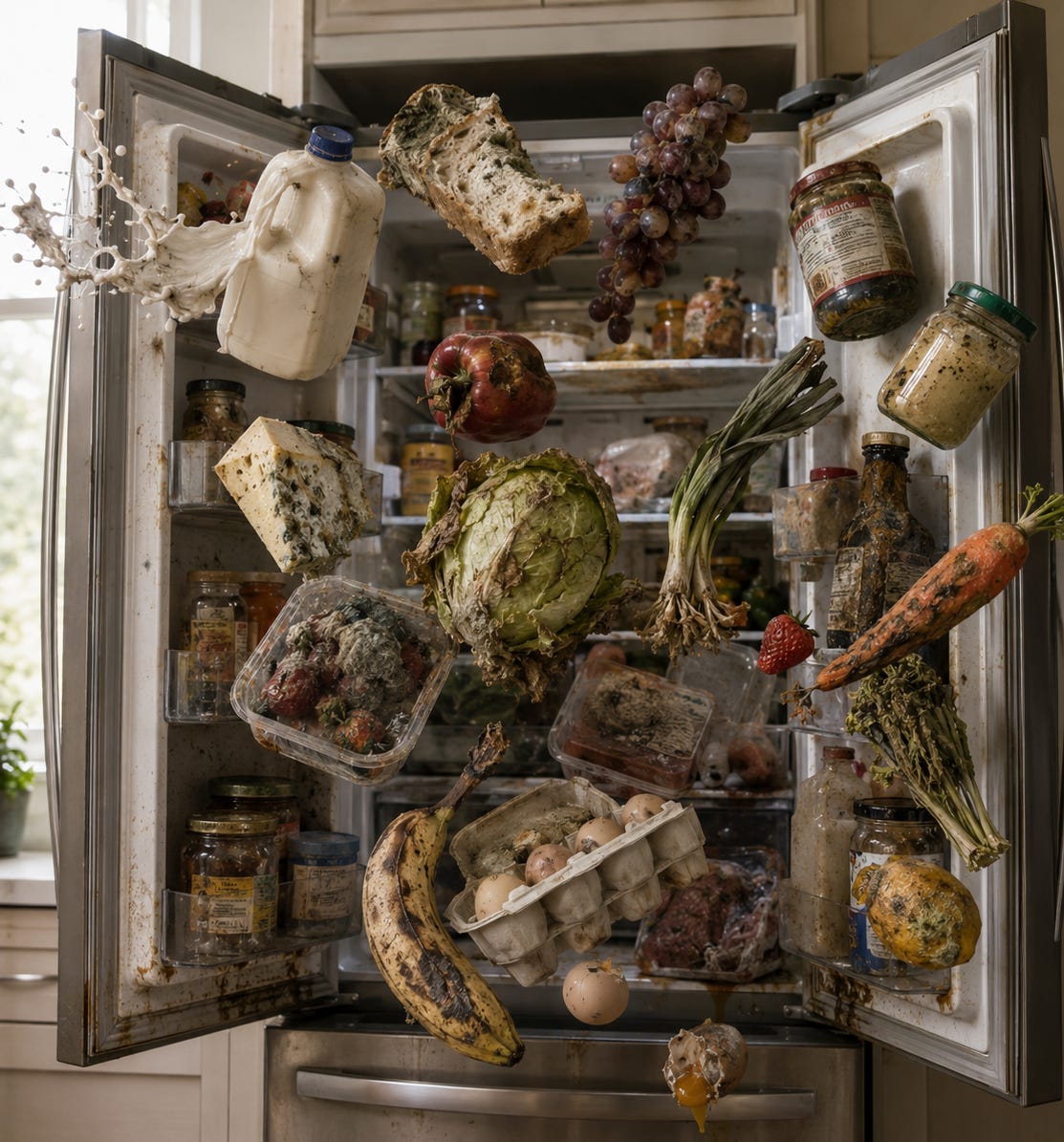
There are places in our refrigerator where only the truly brave will venture.
Deep, dark places where strange gardens grow.
We had every intention of using the rest of that pesto sauce, before it got up on its own and hid on a different refrigerator shelf.
We generally reach a point where we say about our leftovers “Eat it, or throw it out.”
If those are the choices, maybe throw it out should win every time.
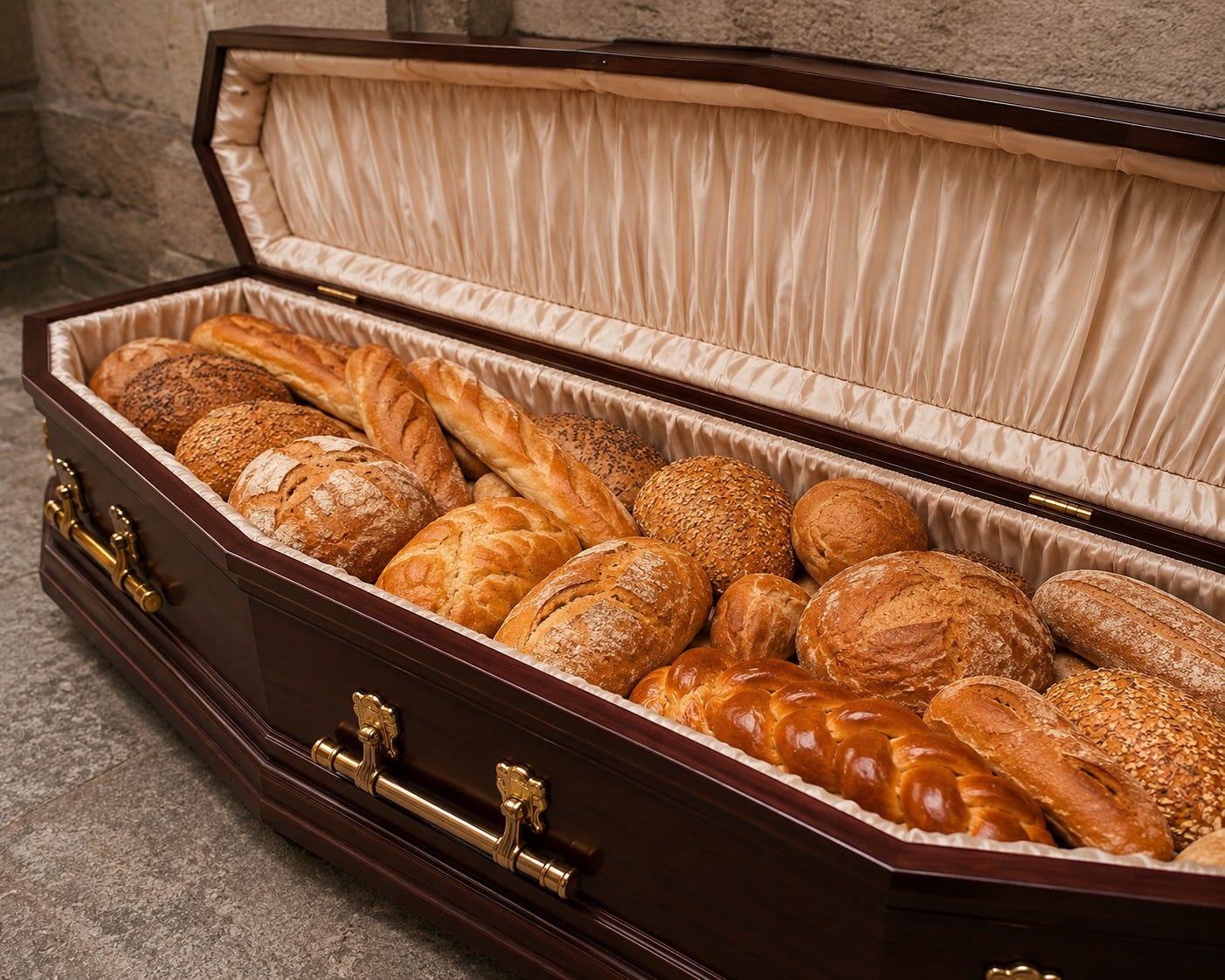
And do not even mention our bread basket (see below), filled with baked bread well on the way toward becoming penicillin.
The place where bread goes to die - - we now call it our “bread casket.”
As bad as things can get in our kitchen, what is worse are the social assassins who revel in pointing out every decomposing item.
They are like the aunts who come to visit in the Geico Insurance commercials, gleefully announcing “Expired! Expired! Expired!” as they pull out past their sell-by-date groceries.
Chief among our tormentors is our grown son Jordan, an experienced social assassin with a scathing touch.
We cower in fear about what he might find in our refrigerator as we scramble to clean up disintegrating offenders.
Actually, recent articles have pointed out that much of what is deemed “expired” may be perfectly edible.
So take that Jordan!
There are no federal regulations that require standardized food date labels other than for baby formula. Come to think of it, these days there are no federal regulations for corruption or ineptitude either.
There are more than 50 types of labels on food in the U.S. so what the heck do these terms actually mean: “use by,” “sell by,” “packaged on,” “best before,” and “dump in the bread casket.”
Apparently, the labels apply to freshness (quality) more than safety (“expired”).
Since individual food companies use their own methodology to determine dates on their products, and different states have different laws regarding what labels can go on products, the result is inconsistency.
As reported in the New York Times, “Two nearly identical products, packaged on the same day, can have substantially different sell-by dates.“
“Less a scam, more a mess.”
Well, that certainly describes our refrigerator and bread casket.
As soup kitchens and food pantries can attest, a lot of food that is still edible gets thrown out when it could be used by hungry people.
Which puts me in mind of a children’s book that we used to read with our sons. “Eggbert, the Slightly Cracked Egg,” by Tom Ross.
This is a true story about an egg (Eggbert) who is cast out of his refrigerator because of a crack in his shell and who then travels the world using his ability to paint to try to blend in.
This, of course, could never happen with us, since Eggbert would have lived a long and happy life in the deep recesses of our vegetable drawer.
That would ruin the story, so instead Eggbert eventually realizes that he cannot hide who he is, the world is full of wonderful cracks (see Grand Canyon, Liberty Bell, etc.), and it is okay to be “a little cracked.”
The point of the story may be that children are gullible and think eggs can fly around the world painting.
Or perhaps, that none of us is perfect, being a little cracked is okay, and eggs are only human.
On that subject, I recently learned that Major League Baseball umpires, those imperfect people we curse and yell at for flubbing calls, have this season actually made the correct balls and strikes call 93.5% of the time.
So close to perfect as to put Eggbert to shame!
Who else is right 93.5% of the time!
That’s right. Nobody.
If a baseball hitter could hit 93.5% he would be a legend.
If someone could fix 93.5% of the Lincoln Memorial Reflecting Pool, he or she would be the new Secretary of the Interior.
If this newsletter made sense 93.5% of the time … well, never mind.
Old Guy Complaining About Technology Alert:
How do we know MLB umpires are so close to perfect? That is because with smart phones, social media, AI and other technology completely running our lives, we also now have robot umpires in MLB who can track every pitch.
As I have whined about in prior newsletters, this year MLB instituted its automated ball-strike system (ABS, aka robot umpires) which can tell with complete accuracy whether or not a ball is thrown within the strike zone, and pitchers, catchers and hitters can appeal human umpires’ calls to R2D2.
Not to get all George Will on you, but human umpires are pretty darn close to perfect and there is no satisfaction in telling a robot umpire that it needs glasses or kicking dirt on a robot’s shoes.
So hats off to the men and women in blue, but what is really troubling my old soul is something Eggbert could understand.
Apparently, older umpires are getting their calls overturned more than younger umpires.
That’s right. Umpires under 40 have been overturned 50.1% of the time, 54% for umps in their 40s, 57.2% for umps in their 50s, and those 55 or above are making us retirees look bad at 58.2% of the time.
C’mon, you guys aren’t even Boomers! Get those cataracts fixed already!
As an older non-umpire, I am not, however, buying into the notion that the codgers in blue should be “expired,” and hereby take a stand for my geriatric brothers and sisters.
Older umpires came up when it was accepted that each umpire had his own view of the strike zone and all was fine as long as the umpire was consistent with both teams.
The individual umpire’s style added a further bit of human drama to the game.
Today, the robots can overturn calls on pitches that miss by only a tenth of an inch out of the “official” strike zone.
That’s barely a crack in Eggbert’s head!
There is something cold and too scientific to the whole approach.
So as for me, I would rather stick with humans than AI driven robots, even humans who have gotten a little long in the tooth.
Eggbert would certainly appreciate that older umpires, as with the rest of us geezers, may be a little cracked, but can still make the right call even while looking a little past their sell-by date.
Thanks for reading Making Good Time! This post is public so feel free to share it.
Comments
Nothing yet. Say the first thing.
Sign in to join the conversation.