
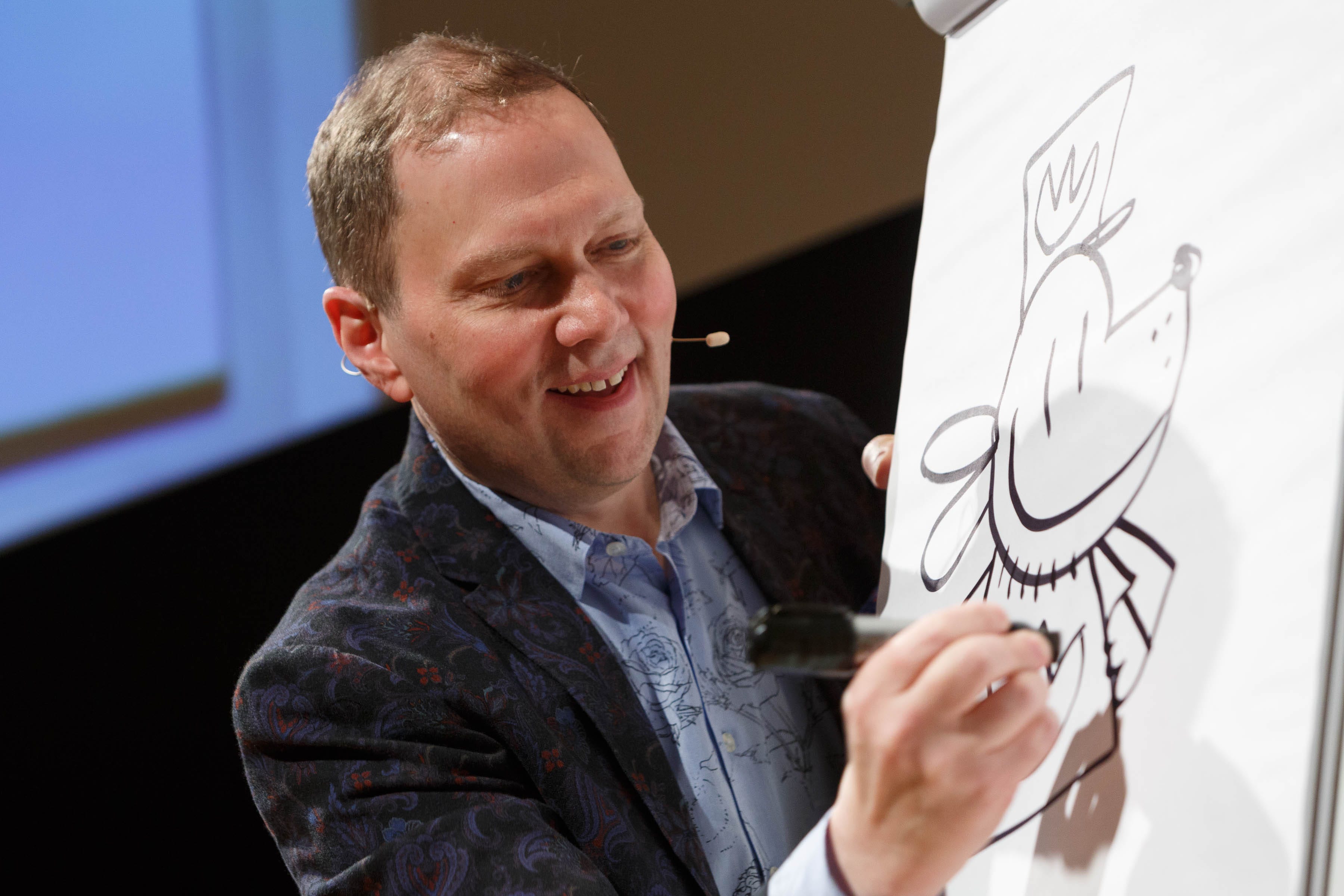
If you’ve read any of my historical novels (or even some of my contemporary novels!) you’ve probably noticed that I like to drop real people into my fictional stories. Notorious Nazi concentration camp commander Amon Göth is a character in Prisoner B-3087. Michael is on hand for a speech Adolf Hitler gives to his Hitler Youth group in Projekt 1065, while Amy Anne has a far happier experience when kids book author Dav Pilkey (above) speaks to her class during an author visit in Ban This Book.
I figured my all-time record would be The Brooklyn Nine, which features a veritable parade of real people. It’s got cameos from Alexander Cartwright, Abner Doubleday, King Kelly, Cyclone Joe Williams, John Kieran, Pepper Paire, Connie Wisniewski—not to mention more Major League players than you can shake a baseball bat at. But it turns out I put even more real people into my historical fantasy novels! The kid heroes in The League of Seven series run into Nikola Tesla, Thomas Edison, Luis Senarens, Madame Blavatsky, George Armstrong Custer, Marie Laveau, Jean Lafitte, Robert E. Lee, Jesse James, Black Kettle, and the Dog Soldiers, just to name a few.

I don’t quite top that in my new book War Games, but it does have a few real people in it. Hitler shows up again, as do notorious German filmmaker Leni Riefenstahl, US Olympic Chairman Avery Brundage, track star Jesse Owens (above), and a few other members of that year’s American Olympic team.
I’m writing fiction, so I get a certain amount of latitude when writing real people into my books. But I always try to be careful not to stray too far from what a person really did or said. Jesse Owens has to win his four gold medals, for example, and he has to do it exactly the way he did it in 1936. But I don’t worry too much about what days he wins those medals, or even if I’ve put them in the right order. (Except for the last, which was significant for other reasons.)
As for what my real life characters say, I try to use actual quotes where I can. Like the speech Adolf Hitler gives to Michael’s Hitler Youth group in Projekt 1065. It isn’t a real speech he ever gave, but every single line in that talk was something Germany’s führer said or wrote somewhere else. (I figured Hitler said enough awful things in his life that I didn’t need to make anything up for him.)
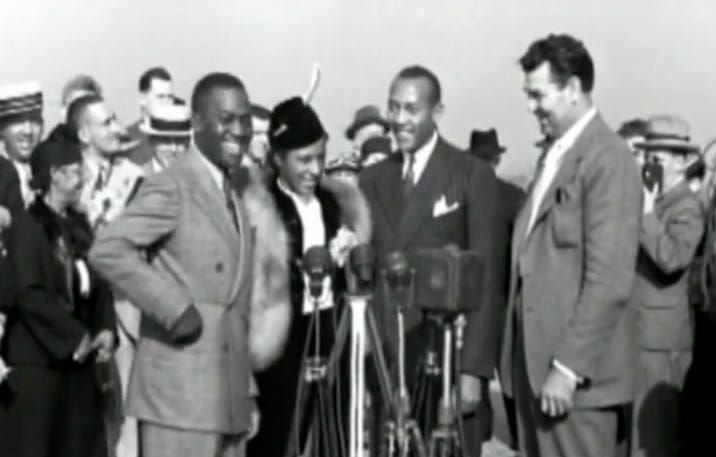
When I don’t really know what a real person in one of my books might have thought about a particular situation, I try to use similar sentiments that person expressed in other situations.
For example, there’s a moment at the beginning of War Games where the American athletes are about to enter the Olympic stadium for the first time. Originally, I had Jesse Owens (third from the left in the foreground, above) telling his fellow athletes, “Let’s go show this Hitler guy who’s boss.”
But in interview after interview once the Olympics were over, Owens and most of the other athletes said that while they were in Germany, they mostly weren’t thinking about Hitler, or international politics, or the rumors of Nazi crimes. They were just focused on competing as athletes. So a few drafts in, I changed that line. Now Owens tells his teammates, “Let’s go make history.” Which I think is far more aligned with what he (and most of the other athletes) were actually thinking and feeling in that moment.
I always have to be careful not to put my own thoughts into real people’s mouths—or write their dialogue with too much of a wink and nod to what I know is going to happen. The fun of it though is that I get to lend my stories a sense of verisimilitude by having real people show up to interact with my fictional characters!
You can preorder War Games today from any of these fine booksellers:
Preorder War Games from Amazon
Preorder War Games from Barnes & Noble
Preorder War Games from Bookshop.org
Preorder War Games from Green Bean Books
Remember, all copies of my books ordered from my local indie Green Bean Books come signed!
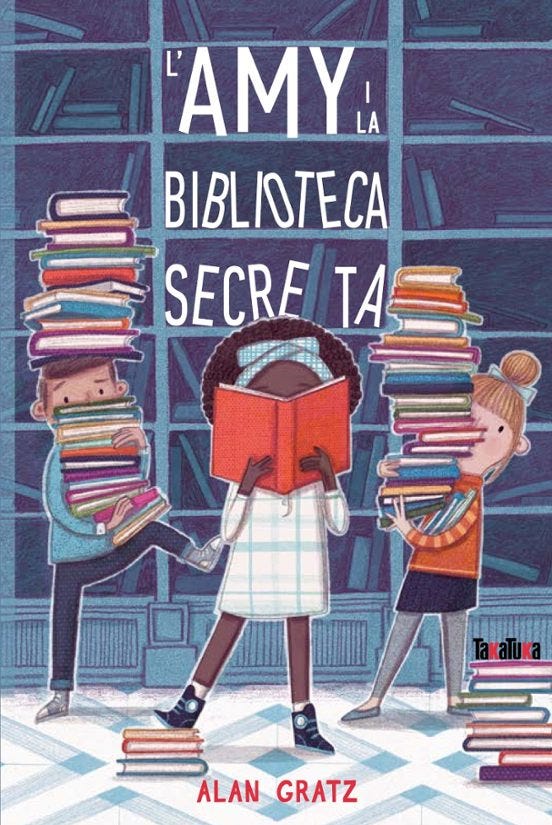
That’s Catalan for “Free books!” At least that’s what Google translate tells me. I wouldn’t know—I don’t speak Catalan! Which, if you don’t know, is the official language of Andorra, and three autonomous communities in eastern Spain: Catalonia (home to Barcelona), the Balearic Islands (home to Mallorca), and the Valencian Community (home to Valencia). (Boy, Wikipedia is getting a real workout from me today!)
The Catalan translation of Ban this Book—or Amy and the Secret Library, as they call it—has been very popular in Spain, and was in fact a finalist in the 2022-23 Atrapallibres book awards given by the Consell Català del Llibre Infantil i Juvenil (CLIJCAT). I didn’t win, but as they say in Barcelona, “va ser un honor ser nominat.”
I have a few author copies of Amy and the Secret Library in Catalan to give away to good casas, so now you can win a free copy! Once again, I’m asking that you enter to win one only if you or someone you know reads Catalan, or is trying to learn. I’d love for these books to reach people who can really use them! I have no way of knowing, of course, so you’re on your honor.
Oh, and I’m sorry for any readers checking in from outside North America—it’s far too expensive for me to send freebies to you. I apologize! If you’re interested, I hope you’ll support independent bookstores in your region by buying one locally instead. In the meantime, North American entrants only, please.
The deadline to enter is July 6, 2025. Click the link below to enter. Bona sort!
Enter to win Ban This Book in Catalan
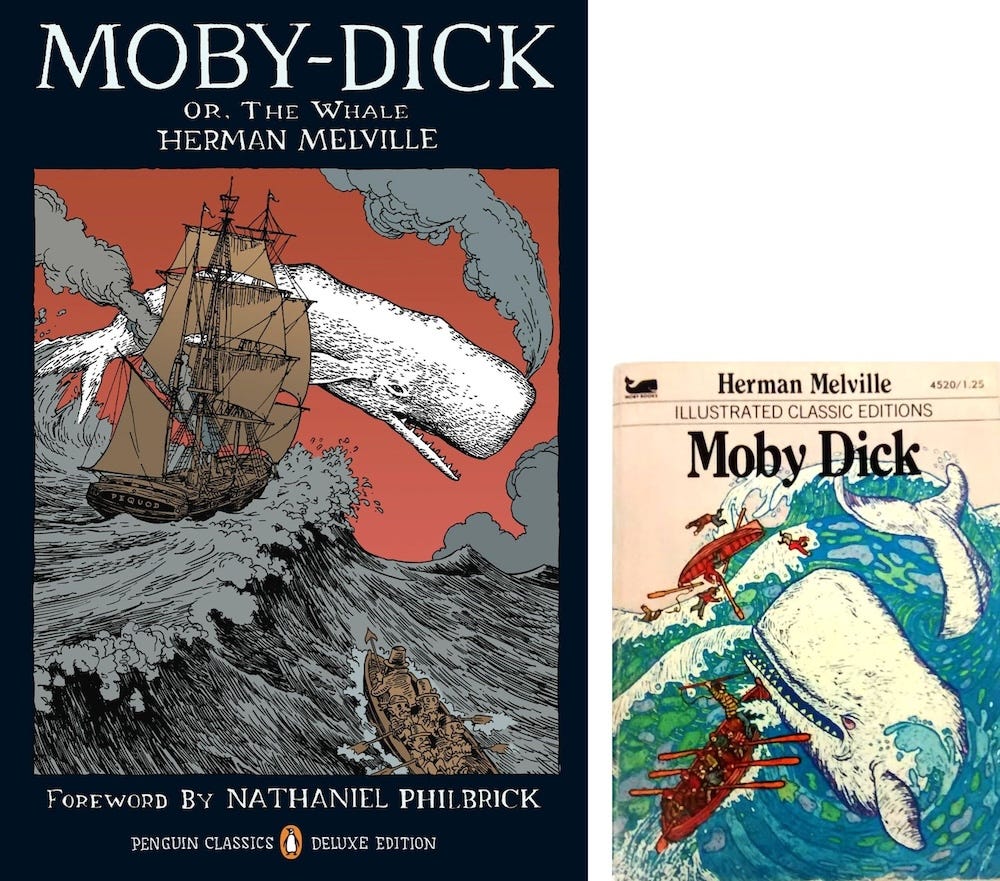
For the past month and a half, I have read pretty much nothing but Moby-Dick by Herman Melville. Jo and I signed up for a six-week class with Portland’s Literary Arts, taught by a retired professor from Portland State University. Each week we’d read a hundred or so pages of Moby-Dick, then meet for two hours on Saturday morning to talk about it.
I’d never read Moby-Dick before. Well, not the unabridged version. I did read an Illustrated Classics Edition of Moby-Dick as a kid—and I still have it! I put the unabridged edition we used in class against the abridged version I read as a kid in the pic above, for reference. And not to start a Moby-Dick measuring contest, but you really need to see a side-by-side comparison to understand the difference:

Let’s just say that I don’t think I was getting the total “Moby-Dick experience” as a kid.
I never had to read Moby-Dick for a class, and though I’ve had a full-length edition on my bookshelf for years, I was always a little scared to try it. For one thing, I am a slow reader, and a six hundred page book is a commitment for me. But the novel also had a reputation for being as dense in a literary sense as it was in a physical-mass sense. All I ever heard was how the whaling chapters were super-detailed, and never-ending.
But Jo and I decided to sign up and have fun with it, and it turns out…Moby-Dick was kind of amazing? It’s thoughtful, and prescient, and philosophical, and challenging (intellectually), and intentionally contradictory, and has great characters and dialogue, and action and adventure, and is also really funny. Like, laugh out loud funny at times. On purpose! And yes, there are a lot of chapters about whaling. But as our teacher told us the first day of class, the whaling chapters are the point, not the plot-driven chapters. And she’s right! Those chapters were the best chapters. At least until Ahab goes all Wrath of Khan at the end in his final confrontation with Moby-Dick:
Towards thee I roll, thou all-destroying but unconquering whale; to the last I grapple with thee; from hell’s heart I stab at thee; for hate’s sake I spit my last breath at thee.
Honestly, I never thought I would have this much fun reading a 600+ page novel about whaling written a decade before the American Civil War. But I am a convert. I’m even thinking about re-reading it (something I almost never do, with any book) and blogging about each chapter as I go. Moby-Dick isn’t for everyone, for sure. I find that most people who’ve had any experience with it either love it or hate it. You can now count me among the former.
Oh, and besides the Illustrated Classics edition I read when I was young, Moby-Dick has lived rent free in my head because of this television commercial I saw over and over again as a kid:
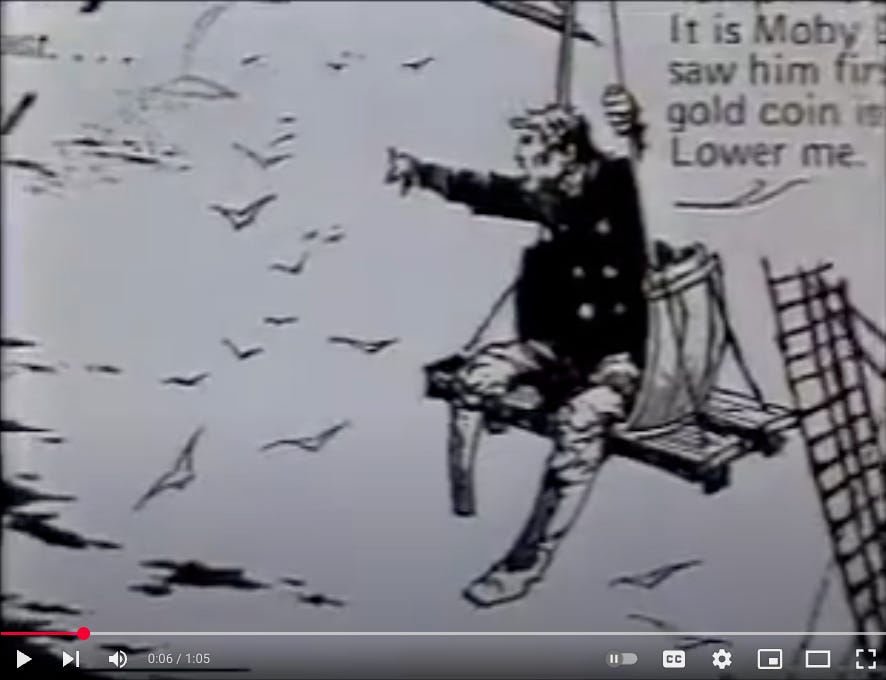
The opening line of this ad is a guy with a raspy voice yelling, “Thar she blows! A hump like a snow-hill. It is Moby Dick!” I can still, forty years later, recite these lines word for word, in the exact intonation as the actor in the commercial. And you can believe I did, every chance I got, for the entire month and a half that Jo and I were reading this book together. I know she appreciated it, because every time I did it she said, “OH MY GOD.” So I count myself a pretty good dad in that respect.
If you liked this newsletter, please share it online, or with anyone you think would be interested:
And if you’re not already a subscriber, and would like to be, you can sign up here:
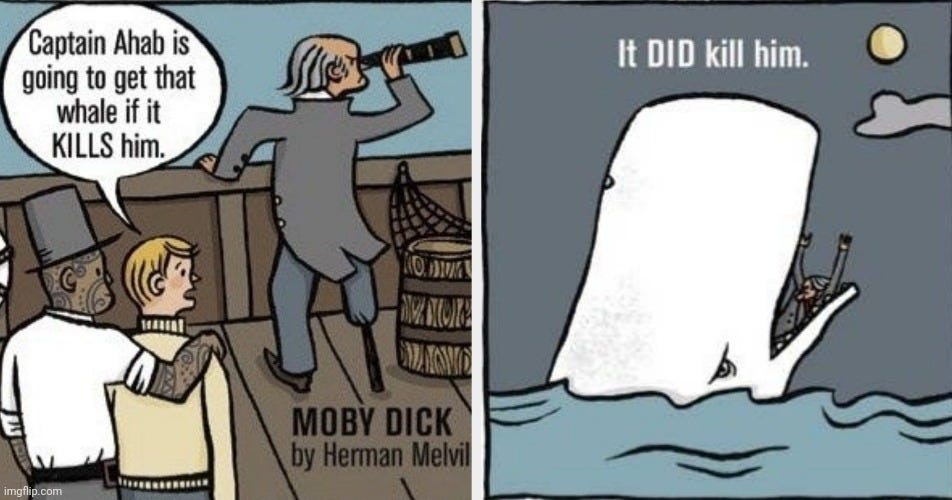
I leave you with the super-abridged version of Moby-Dick:
No posts
Comments
Nothing yet. Say the first thing.
Sign in to join the conversation.