
Alan Freeman, Geopolitical Economy Research Group, University of Manitoba. Speech to St Petersburg Economic Conference, 26 March 2026
Note: the images in this text correspond to the slides that accompanied this talk.
My aim is to explain a curious fact: the enormous influence of Soviet economists on the economic practices of the United States of America. This includes household names among economists, notably Leontief and Kuznets but also the likes of Kondratieff, Slutsky, Gershenkron, and Lyapunov.
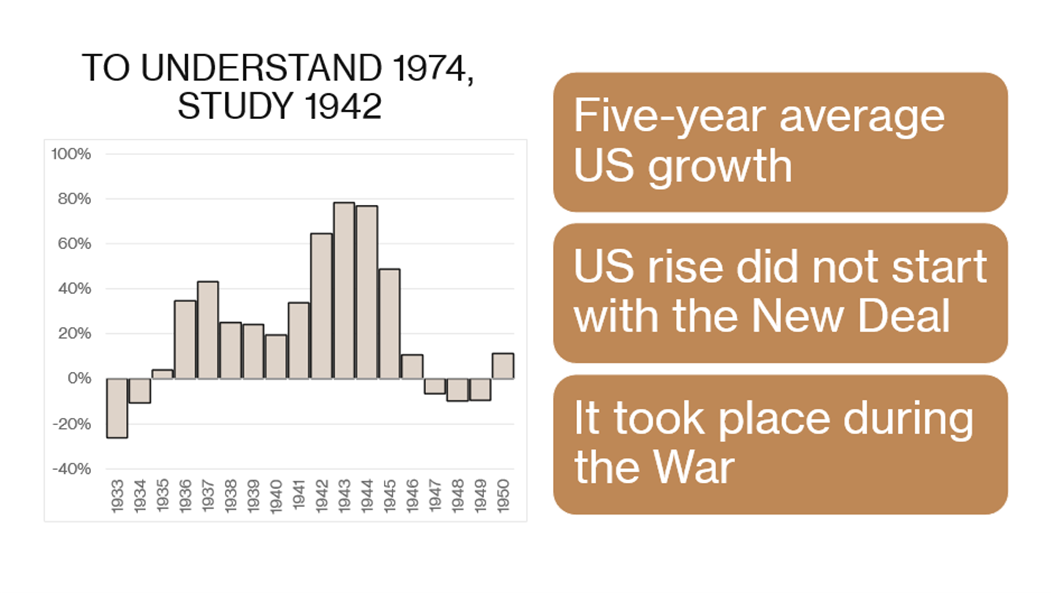
This is part of a project which I call an alternative history of economic thought. Central to this project is the USA’s dramatic growth in World War II.
I start with a chart of the growth in real net domestic product of the USA. It shows clearly that the birth of United States economic world dominance took place during the Second World War, faltered in the Korean War and resumed when the US made itself the ‘workshop of the western world’
It was stopped by an event which Ernest Mandel termed the second great slump of 1974, after which the western economies turned to neoliberalism. This decline was self-inflicted and has never ended.
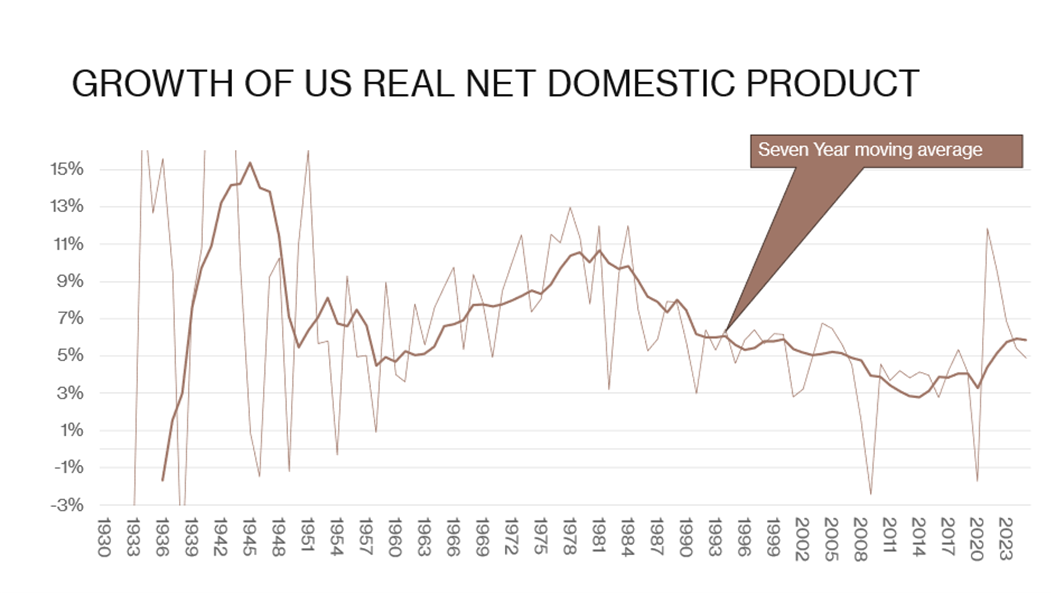
In this respect, note that the so-called ‘neoliberal recovery’ of the 1980s is a myth. Also, the recent uptick is a ‘dead-cat bounce’ following the deep crises of 2008 and the COVID years.
This brings me to my most controversial point; modern macroeconomic management methods were not produced by John Maynard Keynes and European welfarist practices but by US wartime economic management.
This is clear from my second chart which shows the centrality of the war to this recovery.
It brings me to the main paradox of this study: the empirical basis for this transformation was the work of Soviet emigres. This is, generally speaking, dismissed by economic historians and attributed to the general mythology surrounding America’s Great Past. It can only be found in the works of war historians, on which I have drawn extensively for this talk.
The conventional story is that these emigres were refugees fleeing chaos in Europe, integrated into the US melting pot. According to this myth, their input was the simple result of the US citizenship.
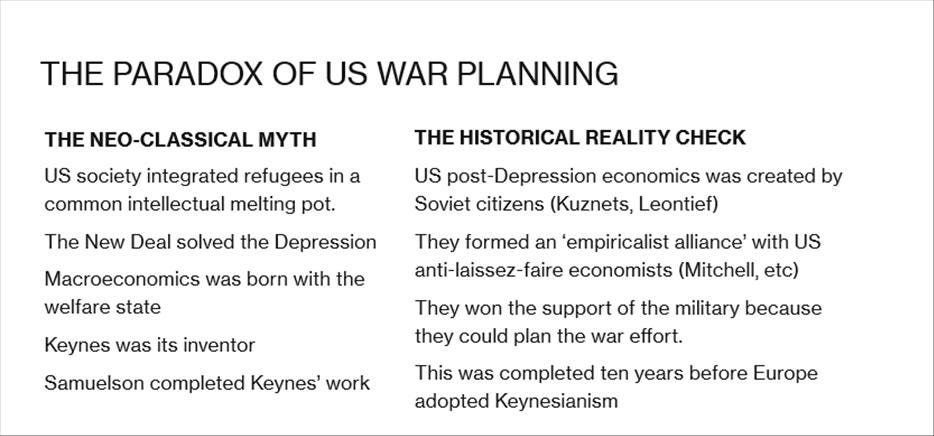
But what they actually did was make it possible for the government to run the economy. This transformation took place in wartime, as my next two slides show.
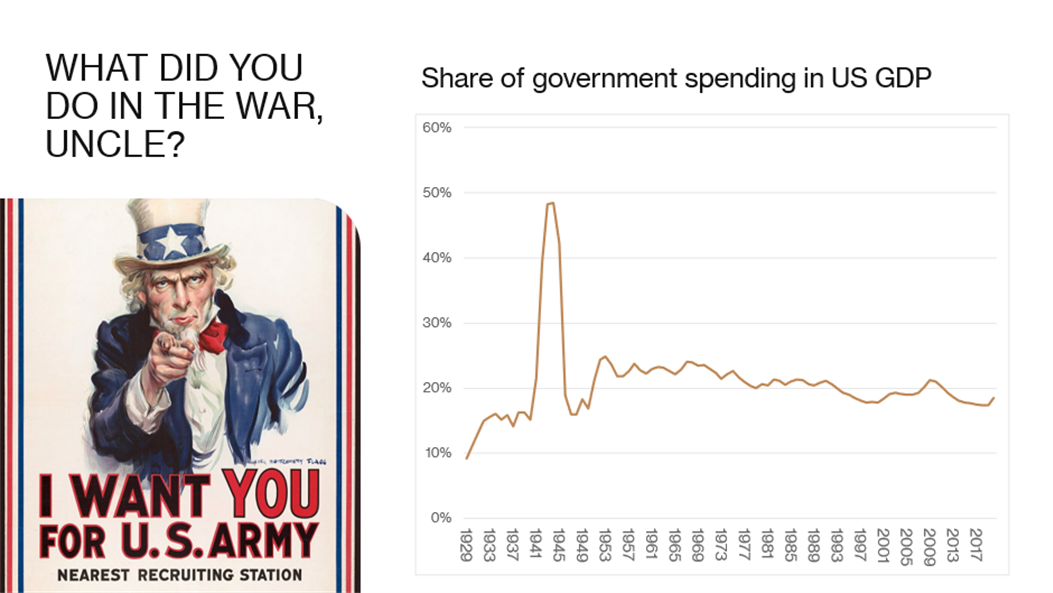
During the war US government spending rose to over 50% of GDP. By the end of it, 85% of this was spent on defence procurement and over 35% of the entire US economy was devoted to arms production. This became the major source of US growth.
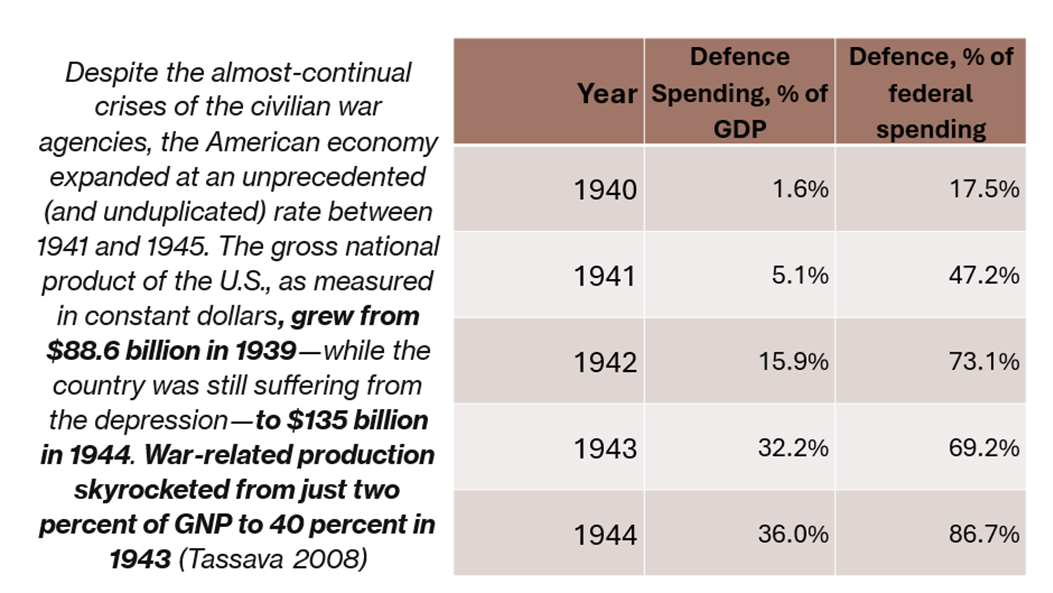
In short, the result was not just a war industry but a war economy.
This was done by placing the USA on a planned war footing. Uniquely this was done not by converting it into a centrally planned economy but by placing the military in charge of it. In Keynesian terms the effect was to remove the demand problem from the management of the economy. The military provided an unlimited source of demand.
This brings us to the role of the Soviet emigres. Their contribution was not minor; it was to create the empirical foundations of this transformation, in effect, the machinery of US planning.
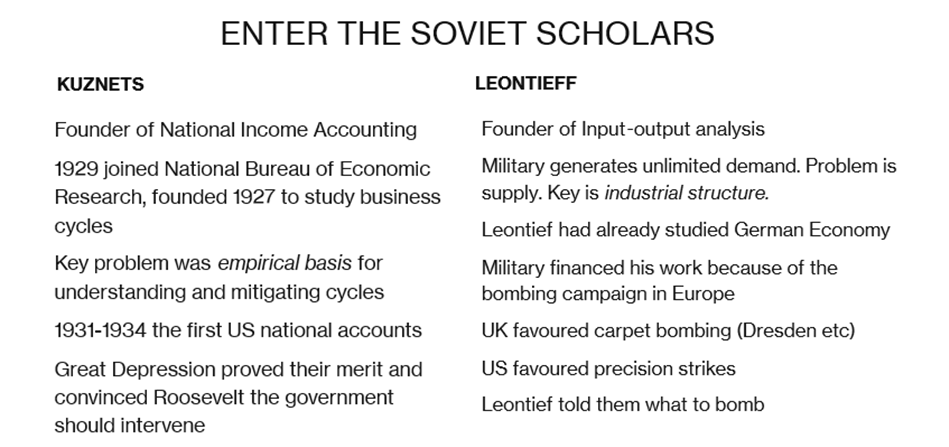
The key to this transformation was the management of supply. Outside of war, the principal problem affecting all capitalist economies is excess capacity, manifesting itself first and foremost in unemployment and, in consequence, a chronic failure of demand. During the war this was inverted; there was no limit to demand; the key problem was managing supply.
This required what amounted to capitalist planning.
Kuznets initiated the transformation. He invented the national accounts. After joining the newly formed National Bureau of Economic Research in 1927, he produced these between 1931 and 1934, fully 10 years before Keynes became interested in national accounting and national accounting became accepted generally in the western world.
But Leontief’s contribution should not be underestimated. By inventing input-output analysis he solved the key problem of wartime planning, namely to know in advance how much each industry needed to expand, in order to produce the final product, munitions.
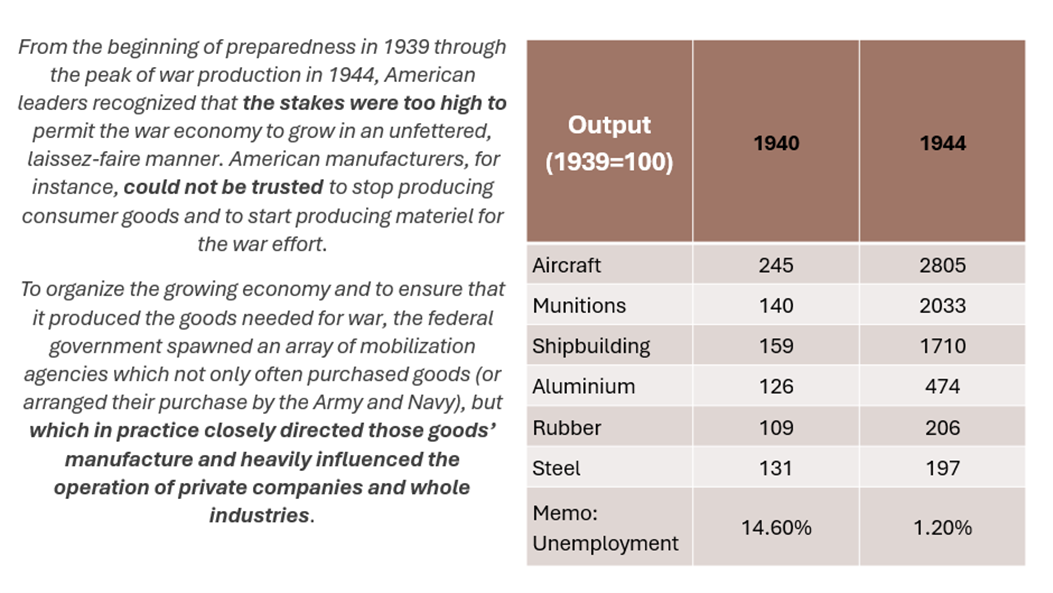
The next table shows how important this was.
Aircraft, ship and munitions production multiplied by ten, but to make this possible aluminium and rubber production trebled, while steel output rose by fifty percent, all in four years. This required a deep understanding of industrial structure, which Leontief almost single-handedly introduced.
How was this possible? The last place on earth it could have arisen was the USA, whose economic tradition is clear from the bombastic words of its most prized economist John Bates Clark. It was completely and utterly ideological, disconnected from anything to do with reality.
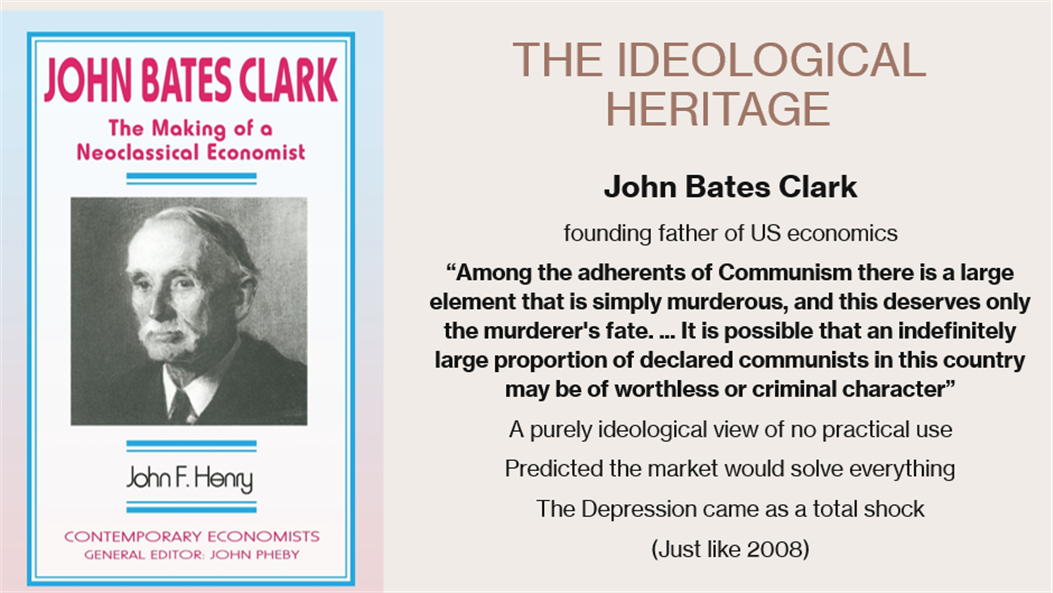
In contrast, Leontief and Kuznets were profoundly influenced by the Soviet experience. They were both in their way dissidents; it is however a great mistake, is conventional among Western Historiographers, to deduce from this that their seminal influence was a mere byproduct of their integration into the ‘American Dream’. Both worked as practicing economists within the Soviet system and both shared the commitment to a new and better world which fired the generations of 1917.
Their views were also marked by over 30 years discussion amongst Russian economists of Marxist ideas. In contrast with Austria, Germany, and Britain, Russian economists showed great interests in Marx’s studies of social reproduction. This is because writers like Tugan Baranowsky wanted to replace the creaking and collapsing Tsarist economy by a modern industrial system.
These writers were fully aware of the risks of economic crisis from the experience of the first ‘Great Depression’ which lasted from 1870 until 1890 and indeed, Tugan’s signature venture into Marxist economics was an analysis of England’s commercial crises in this period.
Thus, even before the Soviet experience began, the Marxist critique of the dominant orthodoxy of the time was well-known to Russian economists. It is easy to forget that these two brillant Soviet emigres, dissident and independent to their core, were as sceptical of the new world as of the old. In particular, they had no faith in the idea that the capitalist economy could simply run itself without any government intervention.
They entered the USA with eyes wide open to the limits of the prevailing orthodoxy, and aware of the dangers of intractable economic crisis that would result if the government steered clear of economic management. This expressed itself in a deep commitment to set economic theory on a sound factual basis.
This commitment was shared by an undercelebrated pioneer of empirical Economics called Wesley Clair Mitchell, who presciently founded the National Bureau for Economic Research (NBER) in 1927 with the intention of creating an empirical foundation for the study of business cycles and gave Kuznets his first American job. The NBER put on its masthead the principle of independence from government and business and to this day, remains the primary authority on the dating of Business Cycles.
Together, these pioneers engaged themselves not in the reform of theory, but in the creation of facts. Their great contribution to economic theory was to place it on the foundation that any science needs, namely that of practical empirical data.
Kuznets, having joined the National Bureau for Economic Research, almost single-handedly created the modern system of national accounts, while Leontief devoted himself to the factual study of industrial structure. His success was less immediate but his influence during the war was so great that his primary work, published in 1954 at the height of McCarthyism, was financed by the Rand Corporation and the US military establishment.
To no small degree this support was due to his success, during the war, in providing the information which the US military required to pinpoint the bottlenecks in German war production that it needed to target.
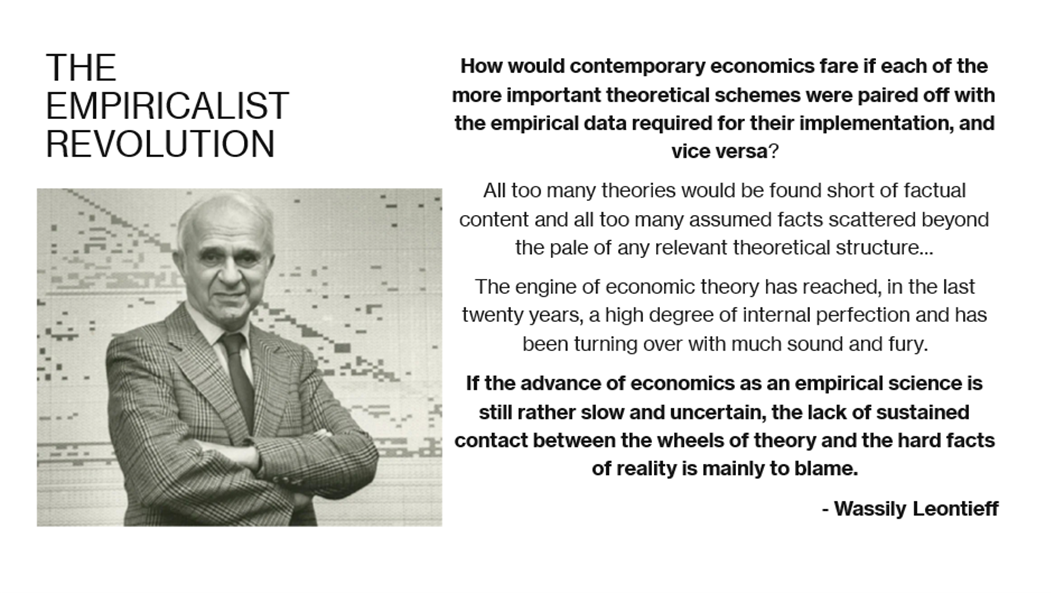
I will finish with the following paragraph which Leontief wrote in his introduction to the 1954 report on input analysis, commissioned at the height of McCarthyism by the department of the army. Need I say more.
Comments
Nothing yet. Say the first thing.
Sign in to join the conversation.