
I gave this talk to the World Socialist Forum in Beijing on November 2, 2025, just after the announcement of the Nobel Peace Prize, which caused Donald Trump some annoyance. It was originally entitled ‘What would Alfred Nobel Have Thought?’. It is based on a longer paper, kindly published as a pamphlet by MidWestern Marx, and can be purchased from them at Alan Freeman | The Continuation of Class Struggle by Other Means
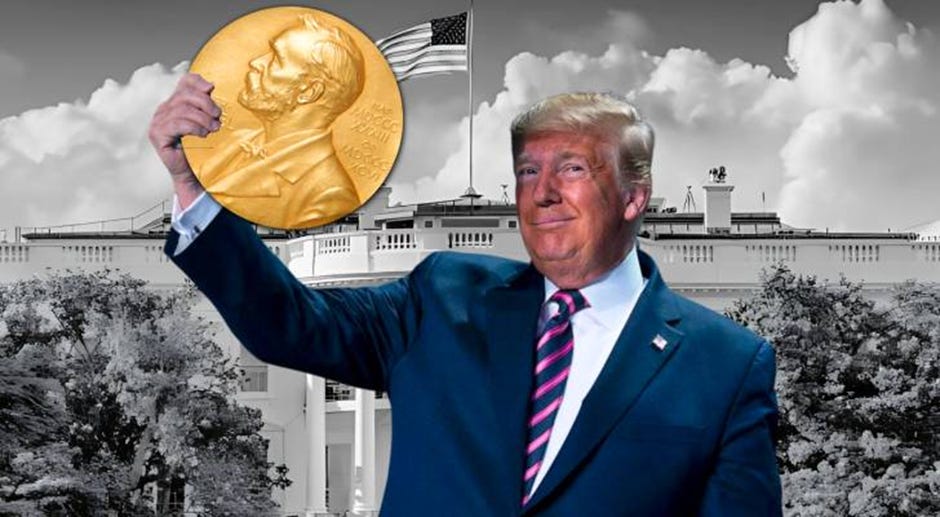
As everyone knows, Donald Trump is a disappointed man. Among his many disappointments, he did not get a Nobel Peace Prize.
This introduces a conundrum, which this talk is about: why does the USA’s most warlike president in history think he should be celebrated for his contribution to Peace?
I call this belief the ‘Columbian Delusion’, named after Christopher Columbus, pioneer of modern colonialism; it boils down to the idea that humans are naturally warlike and violent, and that the only way to stop them killing each other is for a superior power to make war against the inferior nations they live in. The US being the greatest nation on earth and Donald Trump its greatest president, his job, according to this delusion, is to bang together the heads of all the squabbling leaders of the world until they stop.
However, the delusion is not just Donald Trump’s. He shares it with, and inherited it from, the standard view of postwar history provided by Western Historians, Social scientists, and Philosophers, which refers to the world order that started in 1945 and ended with the unipolar ‘moment’ of the 1990s, and which they call ‘Pax Americana’ (Nye 1990), because during these years, there were no major wars between so-called Great Powers.
My main point is that this is a profoundly false idea; what stopped these Powers going to war with each other after 1945 is their fear of the punishment their own workers would inflict on them for so doing. The honour of achieving this respite, with all due respect to the war dead of all nations, belongs not to US military might but the sacrifices of the peoples who brought about the Soviet and Chinese revolutions.
The primary proof of this argument is that these same Great Powers had no hesitation, after 1945, about making war against the nations of the rest of the world – China itself, Korea, Vietnam, Africa, the Caribbean, and West Asia. ‘Pax Americana’ was no more peaceful than American. It was an alliance of the colonial powers under US leadership, to put down resistance to their aggression abroad while staving off the risk of communism at home. A condition for success was that the Great Powers would refrain from making war against each other.
This alliance, today, is breaking down and as a result, the threat of a major world war, with all the horrors that this would involve, once again haunts us.
Understanding the cause of war, and the means to stop it, is arguably therefore today the greatest challenge facing humanity.
Figure 1: US troop deployments (total) abroad since 1950
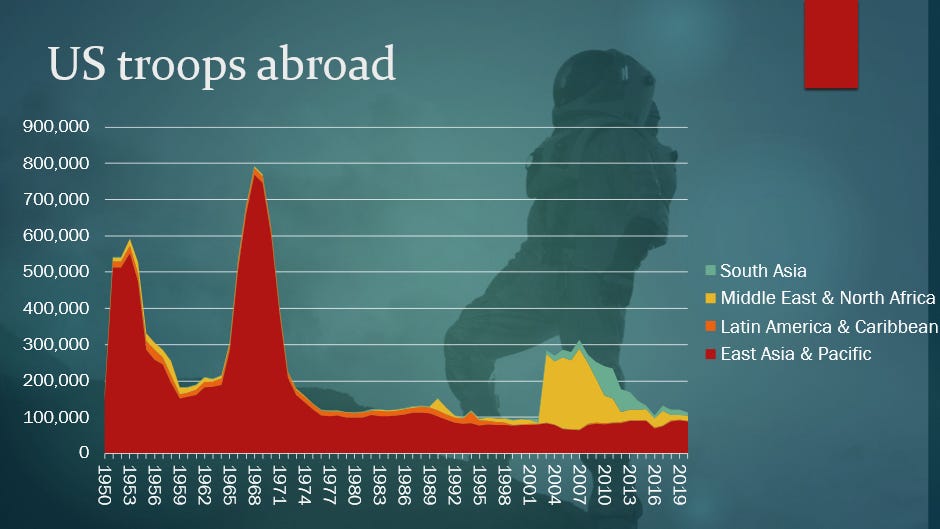
Source: Allen et al. 2020. Congressional Research Service report RL30172
I start by noting that the Nobel Prize committee clearly does not understand the causes of war. Indeed, it has lost sight of Nobel’s original aims and become a political football, along with international institutions like the International Atomic Energy Authority (IAEA) and the Organisation for the Prevention of Chemical Warfare (OPCW), which have lost the trust of participating nations, fatally undermining their intended role. A reform of the Nobel Prize process is therefore required, and this should be part of the more general discussion on the functioning of the world’s international institutions, notably the United Nations. Indeed, a look at the history of those awarded the Nobel Peace Prize reveals that it was actually a pioneer in this respect: one of the earliest recipients, a bare ten years after Nobel died in 1893, was Theodore Roosevelt, without doubt the USA’s most expansionist and warlike president until Truman and possibly of all time. It was Roosevelt, essentially, who invented neocolonialism by waging systematic and regular wars against any government in the USA’s Latin American neighbourhood which had the temerity to stand up to monopolist exploiters like the United Fruit Company. He virtually created the USA’s War Department; it is ironic that Donald Trump has the singular merit of returning, a century later, to rename the Defence Department with this legacy title.
I suggest it is time for a team of good lawyers to take a careful look at Alfred Nobel’s Will and instigate concerted legal action to defend that Will against its current executors.
The most evident symptom of their dereliction is this year’s recipient of the Prize, Maria Corina Machado, who has consistently called for war against the people of Venezuela and has personally led many violent actions against its elected government. The committee’s motivation is instructive: she receives the award not for opposing violence but for ‘advancing democracy’. Her use of violence to do so receives neither mention nor consideration; nor does the actual character of the government she seeks to impose in the name of ‘democracy’.
The committee moreover supplies its own highly contentions definition of democracy, which excludes the most basic democratic right of all, the right to live. It is because Venezuela’s governments, since Chavez first became president, have defended this right against the Machados, their corrupt allies and their terrorist supporters, that the people of Venezuela have voted time and again, in countless elections, in favour of the political leaders against whom Machado and Trump are set on going to war.
The definition pays no attention to widely respected definitions of democracy including that of Western experts, such as the ‘Varieties of Democracy’ project, and steadfastly ignores the evidence of Nobel Peace Prize winner Jimmy Carter himself, who described Venezuela as having ‘the most democratic voting system in the world’.
Now, democracy is very desirable, but it is not the same as peace; indeed, most modern wars are fought in the name of democracy. This is because nobody agrees on what it is. In contrast, there can be no doubt about what peace is: it is when people stop killing each other.
This is why Nobel prescribed in his Will that the Peace Prize should “honour the person or organization who has done the most or the best work for fraternity between nations, for the abolition or reduction of standing armies and for the holding and promotion of peace congresses”. It is pretty difficult to see any relation at all between the actions of Maria Corina Machado and Nobel’s ideal.
In fact, awarding a peace prize on the basis of a definition of democracy is, in essence, an invitation to make war. It is the opposite of what Nobel stated in his Will.
As if to welcome the invitation, President Trump, commander of the largest standing army in the world, who had already launched a series of attacks on Venezuelan shipping, killing eleven entirely innocent civilians, dispatched a Carrier group to Caribbean waters, mobilized 10.000 troops to make for the Caribbean, and signalled the US government’s intention to make war on Venezuela and, for good measure, expanded this to Colombia. A good start for a Peace Prize candidate.
This brings me to my central issue: why does Trump, and more generally, his team of advisors, his government, and the finest intellects that Norway appears to be capable of offering, see no contradiction between making war and promoting peace?
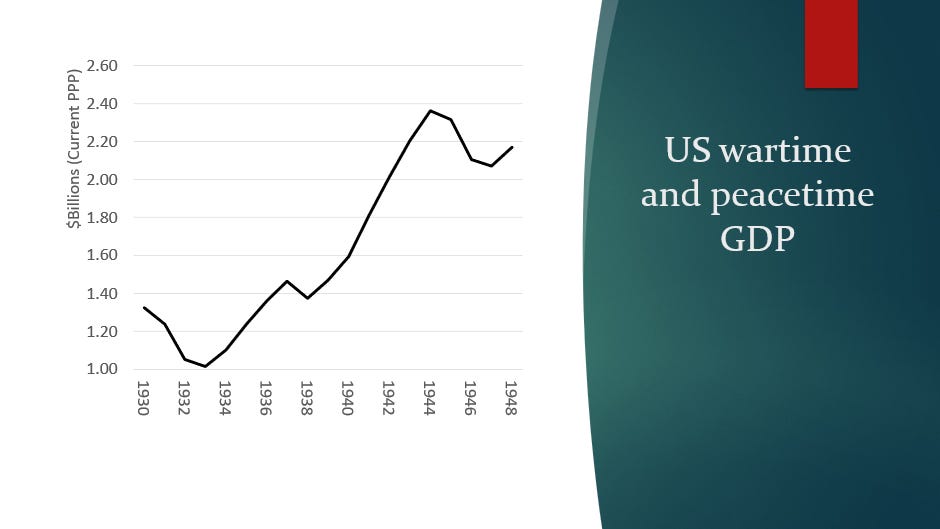
Source: Maddison Data Project (Bolt et al 2018)
The first question to ask is what actually causes war? Unlike democracy, most people agree on what war is: reduced to essentials, it is when nations kill each other’s citizens for political ends.
They do this in very large numbers. According to the most authoritative figures available, the first World War cost over 13 million battlefield deaths and the second nearly 20 million (Showalter and Royde-Smith 2025, Chmielewski 2025). If civilians are included, these wars alone killed or maimed up to 100 million human beings. If in the run-up to them we include actions such as the Japanese invasion of Manchuria, not to mention the division of the world between the Great Powers during the ‘New Imperialism’ we should add at least 50 million more. In short, in during the lives of people still with us, war has killed at least 150 million people.
Compare this with Spanish Flu (about 20 million), HIV (35 million), COVID (7 million) and we can see that next to famine, war is the greatest threat to human life in the world today – even setting aside the much greater numbers, which would probably number billions, who would die if World war III involved nuclear exchanges. So why do it?
The most basic error in the Columbian delusion is the fallacy that it is impossible for a nation to make money by going to war with another nation.
Sadly, this is not true. Nations can, and do, make money by making war against other nations. To those who have the opportunity so to do, the only restraint is the political risk to their rulers of the death and suffering that this causes. It follows that the greater the store which a nation sets on the safety and well-being of its people, the less likely it is to go to war, and the more it is driven by the pursuit of profit, the more prone it will be to do so.
In particular this applies to the bloc which I term the ‘Colombian Nations’, being those whose wealth arose from the outcome of world created by European colonialism. This consists of Western Europe, the USA, the settler colonies, and Japan. That is because these nations were able to secure the ultimate prize in modern war, which is the conquest of other nations, and as a result, the economic enslavement of their peoples.
To make this point clear, let us consider the Second World War. It is a common illusion that this was not profitable. This is not so. What was unprofitable was not making wars but losing them.
Between the onset of war preparation in 1938 and 1944, US GDP rose at an average of 10% per year. In contrast, between the crash of 1929 and 1938, it hardly rose at all. Indeed it was the war, not the New Deal, that got the USA out of the Great Depression.
Figure 2: GDP of the major war power
Source: Maddison Data Project (Bolt et al 2018)
As figure 2 shows, defeat is indeed profoundly unprofitable. The mystery is, then, why capitalists are willing to risk it. This mystery vanishes once we recognise war as just a form of competition. In competition there are winners and losers, so for the capitalists, it’s just another gamble. And the rewards are great, because the winner takes all. War, in short, is just the highest form of capitalist competition.
But this tells us the real risk facing a colonial nation which goes to war, which is revolution. These happen when its own working people, instead of fighting their sisters and brothers in other countries, choose to stop the slaughter by depriving the warmongers of the right to make war.
The risk of revolution is greatly increased in war, because workers don’t just lose money; they lose their lives. It follows that workers, in the broadest sense of humans without property, comprise the only force that can finally put an end to war, because they make up the only classes with an interest in doing so.
This also accounts for a paradoxical fact: when the victims of colonialism go to war, there is almost no limit to the sacrifice they will undertake in defence of their sisters and brothers, as we see today from the heroism of the people of Gaza. That is because to submit to conquest, above all economic conquest, has been proven by bitter experience to cease being human and be reduced to the status of a beast. This heroism, and its success in withstanding onslaught after onslaught of the most technologically advanced military machines in the world, confirms that the working class is not just theoretically capable of putting an end to war but practically offers the best, and only, chance of doing so.
The next question is, therefore ‘who do nations go to war with?’
The answer is that rich nations go to war with poor nations, and poor nations resist. However, until 1945, the rich nations also regularly went to war with each other. The political history of Nineteenth Century Europe is nothing more than a list of such wars: think only of the Napoleonic Wars, Crimean War, the Austro-Prussian and Franco-Prussian Wars, and the War of Italian Unification – not to mention the First World War itself.
The myth of Pax Americana is based on one single fact; in the eighty years of US ascendancy among the Great Powers, so far there has been no major Great Power conflict.
Yet the picture changes once we look at the rest of the world. The USA has been at war for all but fifteen years since 1776 involving 104 countries including itself and has stationed troops in every country in the world except Lichtenstein, Bhutan and Andorra (World Population Review 2025). This did not stop in 1945; it got worse, with major wars in Korea, Indochina, Afghanistan, and Iraq, and countless ‘minor’ invasions; it has garrisons in more countries than anyone else in history. Moreover once the restraining influence of the USSR was removed, the USA immediately expanded its military presence and its participation in foreign wars, as figure 3 shows.
Nor are the Europeans any better: the colonial legacy of the Spanish, French, British, Dutch, Germans, Portuguese and Belgians are bywords for barbarity.
Finally, the Pax Americana narrative runs up against another fact: neither the postwar political system nor its world economic order is uniquely capitalist. Both arose from a compromise between the US, the UK and the USSR and China.
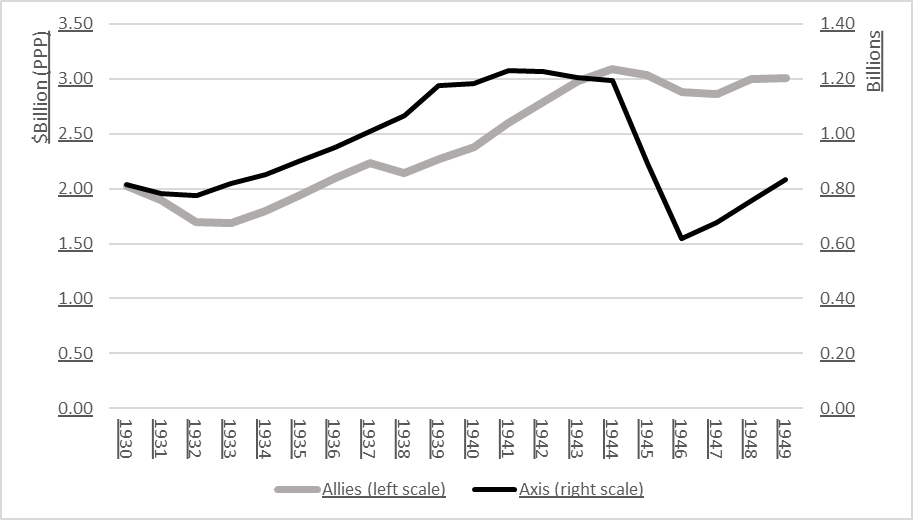
Figure 3: GDP of USSR and Germany since 1930
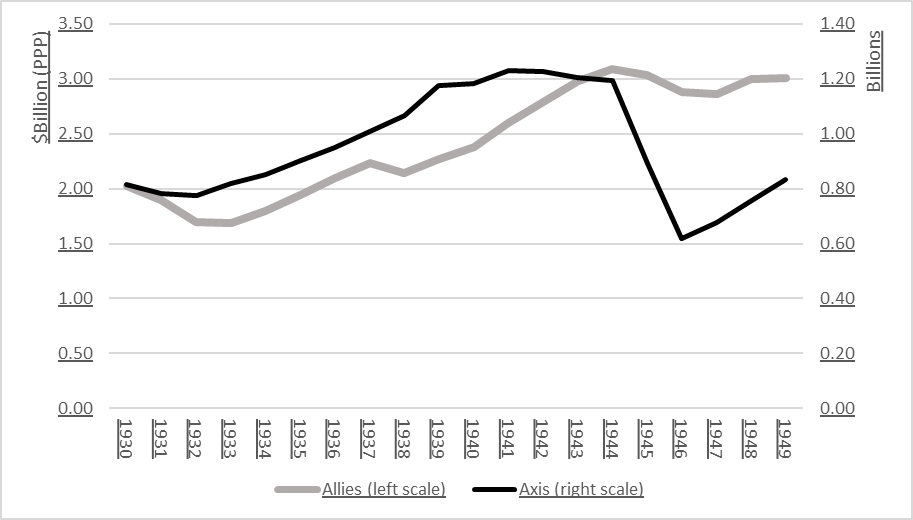
Figure 4 thus illustrates the most fundamental outcome of World War 2: Germany, Europe’s dominant capitalist power, was displaced not by another capitalist country but by a non-capitalist one: the USSR. This strongly reenforces my principal claim: peace arises from the effect of war on workers. When radicalised by the sacrifices war imposes on them, they become an existential threat to capitalist states. What led to the ‘Peace’ of 1945 was neither capitalism’s economic achievements, nor the USA’s astute world leadership, but the tremendous sacrifices of the peoples of the USSR and China.
In this respect, it is important to recognise the extent of the sacrifices made by those who were resisting colonial conquest, and compare them with the deaths of those who undertook it. Figure 5, showing losses on the Allied side, gives some indication. This is entirely taken from authoritative sources and the figures if anything understate the issue.
In world war II 11 million Soviet citizens died. There is no comparison outside China. 1.3 million from the British colonies; from the UK, 260,000 and from the US, 290,000. The figure for China at 1.3 million is a huge understatement because it omits the tens of millions who died before the war even started.
Figure 5: Allied world war II battlefield deaths (killed, died of wounds, or died in prison)
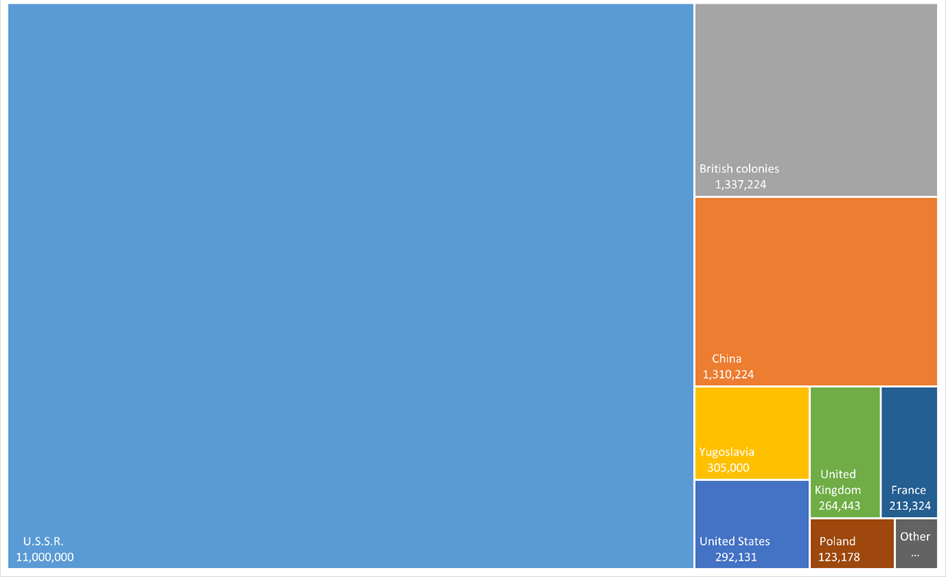
Source: Chmielewski (2024), author graphic
This gives us cause to reflect on what war really consists of. I argue that it is an extension of class struggle. The colonialists fight for money while workers and peasants fight for their lives. This multifaceted struggle takes a different form in each specific war and each specific country, but certain basic features apply in every case. Not least, workers go into battle and die while capitalists stay at home and make money. This makes war a crucible of class consciousness: it drives the victims to all the radical conclusions which the capitalists blame on extremists.
The mystery of capitalist war thus begins to clear once we recognise it as a form of competition. But what is competition? As Marx tells us, it is a struggle over the distribution of the fruits of labour. Why should this provoke war? Because the capitalists of the ‘Great Powers’ do not merely make profits from their own workers, but from the value produced by the workers of other nations, as explained in the theses on the Eastern Question adopted by the Third Congress of the Communist International, drafted by Indian Communist M. N. Roy (1920):
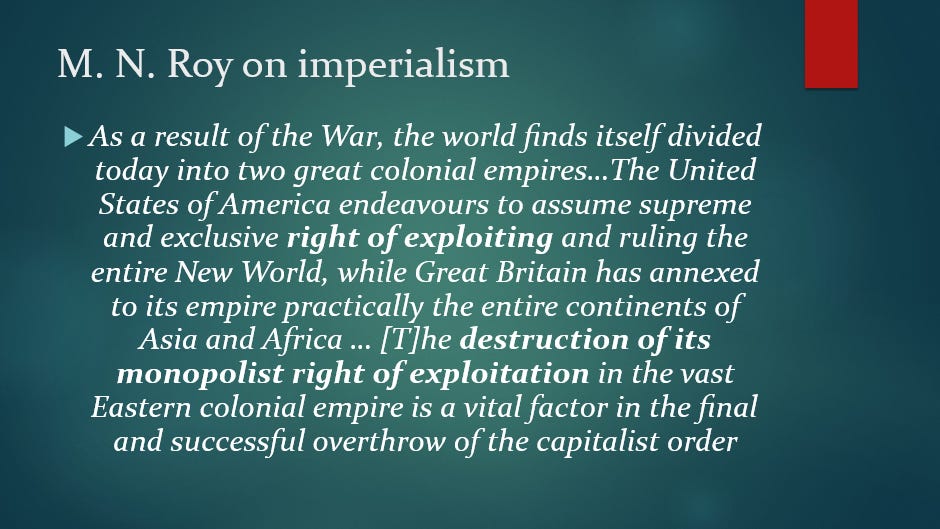
This 1920 description of reality provides a theoretical question at the heart of deciding what to do in 2025: which nations exercise Roy’s right of monopolist exploitation? As the very word ‘monopolist’ tells us, there are not many of them. A small group has jealously and fiercely clung, at great cost to those who dare to resist, to the exclusive right to exploit the labour of other nations.
They used to call themselves the Great Powers or sometimes the ‘Civilised’ nations. Their opponents once called them the colonial powers but by the turn of the 19th Century both the socialists and the once-influential anti-imperialist League, founded in 1897 to stop the US expanding into the Philippines, called them the imperialist powers. Nowadays they have nicer names: the collective West, the global North, the first world, or even the ‘advanced’ nations.
I call them the Columbian nations (Freeman 2022). Together they constructed the imperialist system (Freeman 2019), concentrating power in the hands of a disintegrating club that reigns over no more than a fifth of the world’s population. Its composition has hardly changed since King Edward ruled the British Empire: South Korea and possibly Singapore have been added, one-time claimants such as Argentina have been firmly put in their third-world place, and that’s it.
The sheer scale of their robbery explains the role of pure greed in war: the average GDP of the global North, by 2000, was twenty times greater than in the rest of the world excepting China. As a consequence, imperial capitalists can squeeze 5-10 times more profit from foreign workers than from their own.
Imperialist competition is thus a fight between national capitals for a share of the labour of other nations.
Not surprisingly, since its profits swamp all other, imperial capital dominated those countries which pioneered it, giving rise to specific types of state, dedicated to creating, defending and exploiting the monopolies over resources, markets, and technologies on which imperial superprofits depend. Such states compete with each other for ‘spheres of influence’: just as capitals within a single nation act as a ‘band of brothers’ to protect their share of nationally produced value while competing for a share of it, the imperialist states combine forces to protect their superprofit but battle each other for a share of it. They make war on the nations where the creators of this profit live, and on each other over the right to exploit them.
This is the cause of war.
The system that sustains it is decomposing – not just or even primarily because of external resistance but because of its own internal weakness.
How may we best perpetuate Nobel’s legacy? His moral agony arose because he had made a large fortune by discovering chemicals such as dynamite, which were being used very systematically both in the wars between the Great Powers, and in their wars against the rest of the world, to kill human beings.
But he did not write his will because he suddenly suffered from a fit of remorse, some kind of epiphany when he suddenly realised war was bad. He never thought war was good. His research was driven by the desire to develop the peaceful applications of explosives. And they made enormous contributions to human life, not least that of that most oppressed and put-upon section of the working class in all history since antiquity, miners. Let us never forget the sacrifice of the dead of Potosi, of the slaves of antiquity, of the diamond and gold miners of Africa and the world, and all who go down underground that we may live from what the earth has to give us. Let us all strive also for a world in which we have made our peace with nature and found ways to live with our earth without raping it.
Today, we see the massive expansion – sadly, driven as much by the imperatives of war as by the demands of life – of technologies that can be used for war or for peace: nuclear energy, drones, bio-engineering, pharmaceuticals, hypersonics – the list is a huge one. These technologies cannot be simply suppressed. Pandora’s Box can never be closed. The real task is to ensure they are used only to enhance human life, and never to destroy it.
Marx taught us that there is only once force in history that can accomplish this task: the working people of the earth. History, since he died, has only confirmed this judgement.
Let us honour both Marx, and Nobel, by abolishing the pursuit of death from our world, and dedicate ourselves to ensuring that science, technology, and knowledge, are used only to preserve, extend, and enhance life.
Beuck, C. 2020. ‘Only 15 Years of Peace In The History of the United States of America’ https://medium.com/traveling-through-history/only-15-years-of-peace-in-the-history-of-the-united-states-of-america-c479193df79f Accessed 6 May 2025.
Bolt, J., R. Inklaar, H. de Jong and J. Luiten van Zanden, 2018. The Maddison Project Database.
Chmielewski, K. 2024. ‘casualties of World War II.’ Encyclopedia Britannica, May 15, 2024. https://www.britannica.com/event/casualties-of-World-War-II-2231003
Comintern. 1920. Preamble to the Statutes. https://www.international-communist-party.org/basictexts/english/20PreSta.htm
Freeman, A. 2019. ‘The origins of Western Hubris and the destiny of Northern exceptionalism’. Lecture at Beijing Sports University, December 2019. Accessible at https://www.academia.edu/41755158/The_origins_of_Western_Hubris_and_the_destiny_of_Northern_exceptionalism
Freeman, A. 2022. Theses on the warfare state: new data on the profit rate, causes of the present crisis, and Marx’s Theory of Value. https://www.academia.edu/74615059/Theses_on_the_warfare_state_new_data_on_the_profit_rate_causes_of_the_present_crisis_and_Marxs_Theory_of_Value
Nye, J.S. 1990. ‘The Changing Nature of World Power’. Political Science Quarterly, Volume 105, Issue 2, Summer 1990, pp177–192.
Roy, M. N. 1920. Theses on the Eastern Question https://www.marxists.org/archive/roy/1921/roy03.htm
Showalter, D.E., Royde-Smith, J.G. 2025. ‘World War I.’ Encyclopedia Britannica, May 7, 2025. https://www.britannica.com/event/World-War-I/Killed-wounded-and-missing
Wikipedia contributors. 2025. ‘List of wars involving the United States’. https://en.wikipedia.org/w/index.php?title=List_of_wars_involving_the_United_States&oldid=1289289382 (accessed May 8, 2025).
World Population Review. 2025. https://worldpopulationreview.com/country-rankings/how-many-countries-has-the-us-invaded#the-ultimate-list-of-countries-invaded-by-the-united-states
Comments
Nothing yet. Say the first thing.
Sign in to join the conversation.