
Introduction: a necessary update
This paper was originally submitted to a conference at North East University, Shenyen, China, on 8 July 2025. It summarises some recent advances in the study of the Creative Economy, including the ongoing discussions between British, Russian, Chinese and Australian experts.
It seeks to recentre these discussions by a deeper look at the underlying technical processes at work. Its focus is therefore those commodities which economic theory designates ‘intangible’, produced in the sphere it calls ‘services’. These terms are both outdated and imprecise. At the same time, the A better description, corresponding to modern developments, is,
It argues for a collaborative effort to extend the existing evidence base to a range of countries including China and Russia, to inform policy, to provide for the exchange of ideas and experiences between countries, and to provide a sound foundation for further research.
My fundamental point is that economic theory has failed to catch up with technology. Modern economies in both the global North and the global South have undergone a long and inexorable transition during which employment in services, most of which results in intangibles, now constitutes 80% of all employment. This is a qualitative transformation. It calls for a qualitative, critical, and profound re-examination of the concepts of production and use on which economic theory, as a whole, rests.
Economic theory, to date, has responded to this qualitative transformation in ways which, I will argue, are superficial and inadequate. These include not only such notions as the ‘knowledge’ or ‘information’ economy; the ‘digital age’ or ‘post-industrial society’ but the widespread yet misleading idea that so-called ‘mental’ labour can be distinguished from so-called ‘mental labour’ when in fact, all human labour unites mental and manual aspects and, moreover, this unity of mentation and physical action constitutes the essence of what is distinctively human. At the centre of all such confusion lies the category of ‘service’ itself, which originates in the feudal notion of personal service and has never been codified, nor adequately deconstructed, in a manner appropriate for understanding what modern service-based economies actually do.
I will argue that the absence of coherent and thorough-going approaches to the foundations on which such generalities rest leaves a policy gap: we do not know, or to be precise, we have an insufficient understanding, of how to manage and plan economies, the major part of which are dedicated to the production and use of immaterial objects. Above all, notwithstanding significant progress in constructing and amassing data that shed light on such issues, we lack a sufficiently comprehensive evidence base to manage and plan the allocation of creative human labour, which, I will finally argue, is emerging as the key resource of the economies not just of the future, but the present.
I will argue that recent progress allows us to begin correcting for all the above deficiencies and set the theory of the modern economy on a sound footing.
I will focus on two bodies of theory which stand at the front line of research into the nature, and the means of managing and planning, societies in which these activities play a central role. Such societies include not merely the so-called ‘advanced’ or ‘industrialised’ economies, but China, Russia, and a growing swathe of the economies of the global South. Moreover, since development is a major if not the chief task of modernisation in the present unequal world order, the issues raised are of critical importance both to those economies in which industrialisation is an established fact, and those in which it remains a major task.
The first such body of research, with which I am most familiar, is the theory of Creative Industries. This emerged in the 1990s and is now widely recognised as a major concern of economic policy at governmental and international levels including notably the United Nations and the statistical agencies of the UK and Australia. Professor Cheng Enfu and his colleagues recently published an important work on the subject. Though the theory of this sector of economic activity is a topic of much debate, therefore, it rests on an evidence base sufficiently large to begin drawing conclusions.
The second area of research arises in Russia from the work of Professor Sergey Bodrunov and his colleagues in the Witte institute for New Industrial Policy, who have articulated the theory of ‘Noönomy’. Briefly put, Noönomy addresses the issues of both theory and policy which concern the governance and organisation of a society in which knowledge, creativity, and mental activity play a central role.
In recent years, an exciting collaboration has emerged as a result of the encounter between these complementary bodies of research, which we are hopeful will lead to the establishment of international institutions to support and build on both fields of research and the synergies arising therefrom. This paper reports on the preliminary results and invites participation from interested partners.
Our enquiry is not constructed ab ovo, but rests on two sources of evidence. Research into the Creative Economy has created datasets covering, principally, the industrialised economies of the UK, Australia, the USA and France. Data have also been collected by researchers in Hong Kong and Singapore. These cover a (relatively) short time span starting in the mid-1990s.
Much more comprehensive historical data are available, from official sources such as the United Nations, the IMF, the World Bank and the International Labour Organisation, concerning the relative weight of agriculture, industry and services in the economies of the world’s nations. To set the creative industry data in perspective, I will begin with the second.
An initial, and basic point, which will be a subject of concern in this paper, is simply to state what we mean by the quantity of an intangible object, or indeed, if it is even possible to speak of such a thing. We are emerging, I and Radhika Desai argue from an era of mechanical production – the creation of material things by means of material things. In such an era, it was intuitively easy, if somewhat slipshod, to speak of the output of an industry as measured by the sheer natural or physical quantity of what it produced – tons of corn, barrels of oil, yards of linen, kilowatts of electricity, miles of travel, and so on. But what is the unit of output of the publishing industry? Do we really think that a writer of the pulp fiction industry which dominated mass production in the last century, is as productive as, say, Rainer Maria Rilke? Judged either by the quantity of words, the number of works, or the popularity of sales, the pulp fiction writer wins hands down. Even more pertinent: what is the output of the software industry - lines of code? The industry, with which I have been familiar since the 1960s, has yet to answer this question.
There are many traps for the unwary. For example, what is the unit of output of policing? I confronted this issue while working for the Mayor of London, in an interdepartmental discussion on the evaluation of service output. The customs officials explained the difficulty of measuring success by the number of drug busts – because the cheapest and quickest way to raise productivity, according to this measure, would be to finance the drugrunners. An arrest is only the outcome of a social process in which the true measure of a successful policy is not that criminals are caught, but that there is no crime.
The answer to which such problems point us is that the quantity of a service should be measured by its social usefulness. And in fact, when we confront a problem of reasoning that has been presented to us in the present moment, it is always fruitful to take a step back and ask whether we really did resolve this problem in the past. The true measure of the output of agriculture is not mere tonnage, but the capacity of this tonnage to support human existence. Marx’s category of use-value is, therefore, of fundamental importance in any system for planning, accounting for, or governing societies in which the production of services constitutes the primary activity of the human, labouring workforce.
Yet, beyond such important developmental indicators as years of scholarship, life expectancy, or not least, quality of life, we have almost no serious measures of the social usefulness of any of the multifarious products of which our technology is now capable.
Yet despite this, we have two fundamental quantitative measures of productive activity which are provided by the existing accounting systems, however inadequate, that were constructed by scholars of the capitalist system of commodity production. These are the number of people engaged in a given sphere of production, and the money paid for the product.
On these grounds I present figures showing what people are employed to do, subdivided into the three main categories that we have inherited from the accounting practices of the present age. These categories are industry, agriculture, and services.
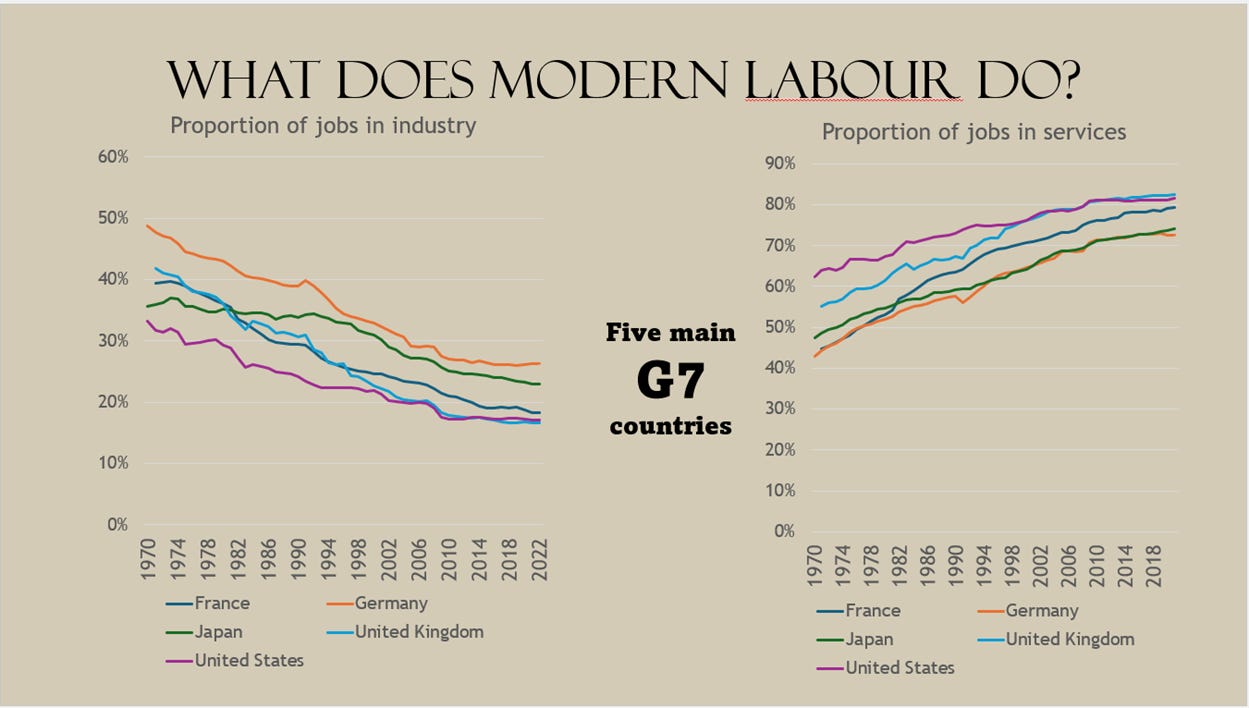
The first set of charts presents data for the five main G7 countries. In making this selection I am conscious of the risk of supposing that these countries point the way to a valid modern mode of existence. In the course of history, it is quite frequently found that a decadent or exhausted civilization gives way to another, having served however the not unimportant function of bequeathing, to its successors, the knowledge and understanding that it stumbled upon in the course of its brief existence.
The question of modernization may therefore, indeed, be posed in the following manner: what should a modernizing civilization aspire to, in order to make best use of the understanding to be acquired from both the achievements, and the limitations, of its predecessors? The most convincing proof of success would not be the defeat of these predecessors but their gracious and peaceful acceptance of the fact that there is a superior way to achieve what they only aspired to, nevertheless based on what they actually achieved. History offers many unexamined examples of such acceptances, but unfortunately, they have for the most part been based on participation in new modes of conquest. The real task is, therefore, to identify those achievements of the industrialised world which may justifiably serve as the platform for a new world civilization in which conquest is a thing of the past.
In order to achieve this, however, it is necessary to subject any factual claim based only on the experience of the advanced capitalist countries – which is to say, the imperialist countries - to the scrutiny of such factual evidence as may invalidate these claims, above all the experience of the non-imperialist countries.
This discourse is the backdrop to the manner in which I investigate the data.
The data in figure 1 convey a pronounced and irreversible historical trend towards the replacement of industrial production by service production. This is not a future eventuality, as in countless utopian or dystopian narratives. They present to us the state actually existing capitalism.
To put it baldly, the great majority of the labour force of the ‘advanced’ or ‘industrialised’ world is no longer engaged in producing material things. In fact, the proportion of that labour force engaged in what is normally termed ‘industry’ is so small, that no significant change in the nature of human society is to be achieved by quantitatively improving what they do. We should not expect that increasing the number of cars, the amount of energy, the quantity of food or the tonnage of timber, produced by a modern society, will do anything to make that society more economically effective. We have reached the limits of what quantitative expansion can achieve, not for the reasons dictated to us by ecological necessity but for the inherent limitations of capitalist mechanical production, namely, no more people will find employment doing it.
This is such a strong conclusion that it must surely be subjected to severe and merciless scrutiny. The first question then to ask is whether the circumstances of the industrialised countries is confined to them, or represents a general technological and social trend.
Let us first ask how geographically universal they are. Do we observe the absolute dominance of the trend in employment, in the service industries, in those countries which, according to conventional Western economics, have yet to achieve the nirvana of industrialized civilization? Figure 2 deals with this point.
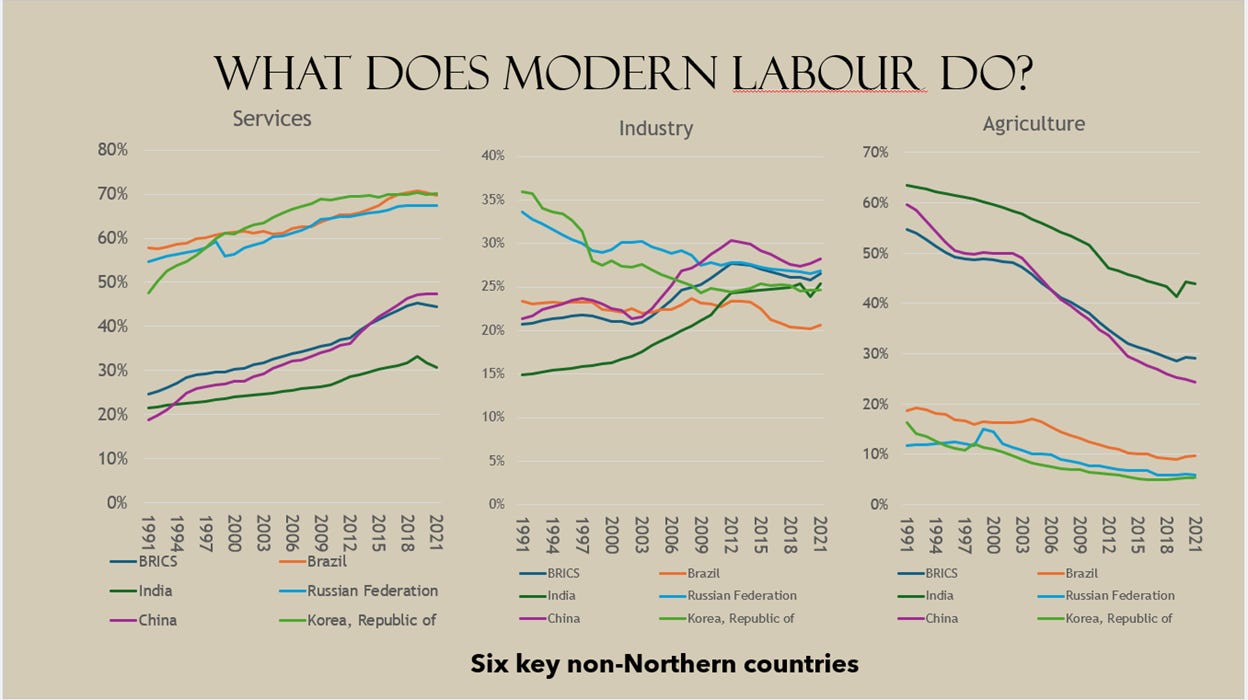
In order to examine what is taking place, it is necessary to include the third of the standard three major sectors of economic activity that are recognised in economic theory, which is agriculture. We see, I would argue, two trends, being the absolute dominance of employment in services over that in the other two sectors combined. The second is the relative status, within this general trend, of the relation of industry to agriculture.
To deal with this question I have included South Korea in the non-Northern economies under scrutiny, because the comparison sheds substantial light on the transitions involved. First, it can be seen that in all economies of the world, employment in services is rising continuously and over a long period, relative to both industry and agriculture. Second, in all countries in the world, employment in agriculture has fallen continuously, to the point where the agricultural workforce of the world is no longer the absolute majority of the population. This is a rather fundamental demographic transition, though space does not allow us to develop it. It should not blind us to the important fact that the decline in the agricultural workforce has bottomed out in those countries – Brazil, Russia, South Korea – where its decline is most advanced. This also is of fundamental importance, but again, space does not allow its development.
Thus in all countries, to repeat, service employment is rising whilst the combination of industrial and agricultural employment is falling. However, these countries fall into three quite distinct groups. In South Korea and Russia, industrial employment fell in parallel with agricultural employment. In China and India, industrial employment grew until about 2010 and then took on the same pattern as in the BRICS as a whole. In Brazil, which is representative of Latin America (space does not permit us to prove this point) industrial employment is in general decline with no clear trend, but the already low level of agricultural employment, combined with its continued decline, leads to the remarkable result that service employment at 70% has reached the levels of the global North.
Without any further theoretical analysis, it should already be clear that this is a radical transformation. Yet economic theory is extraordinarily badly equipped to understand it. Not least, we have subsisted for the entire period of this transformation working under the assumption that we know, and can define, what these the 70-80% of the human workforce is actually producing – when we don’t even know how to measure it.
In order to address this question, some basic analytical points should be made before passing on to the evidence of the creative economy.
The first basic point is that the decline in industrial employment is not ‘deindustrialisation’. That is to say it is not a fall in industrial production. It’s not a sign of decay, decadence or decline. It is a sign of industrial health, not industrial failure; it happens as a result of a rise in productivity. In fact, in the industrialised countries, it is a sign of saturation.
Employment falls, when productivity is rising, because fewer workers are required to produce the same quantity of the same objects. In particular it occurs when efficiency has risen so fast that the number of people required to make what society demands of them becomes not only small, but in the case of the most mature industries, vanishingly small. This is the reason that, in particular, the agricultural workforce is systematically declining and has done so throughout capitalist history.
There is of course a limit to this, and a certain proportion of the population will always be needed to work on the land. Likewise, we can surmise that a certain number of people will always be needed to work in industry. However. these numbers are nowhere near sufficient to absorb the whole workforce.
This basic point does not negate the fact that, in many countries afflicted by the effects of either neoliberalism or imperialism, or both, de-industrialisation has indeed taken place. But it is a different phenomenon from the world trends we analyse above. It occurs when a country ceases to employ sufficient people to meet its own needs, at which point, it is deprived of economic sovereignty and falls into spiral of dependency and poverty.as in the dog days of Brazil, or descends into hyperfinancialisation as in Argentina. Moreover, the deprivation of four-fifths of the world, by imperialism, of access to the technologies required to yield the high productivities of the global North, is one of the principal causes of dependency, which arises from the mechanism of Unequal Exchange, when goods produced with high-productivity labour exchange against goods produced with low-productivity labour.
It is not however true that the world in its entirety is deindustrialising – merely that the distribution of industrial production is inappropriate for a world system consisting of interactions between self-governing nations.
This leads us to a second vital point: at the world level, this fall in employment is not a sign of a fall in supply. There are fewer and fewer people working in industry because fewer and fewer people are needed. The proof of this point, which brings us to the role of the creative industries, is that in the global North, consumption is becoming dominated by the products of services. By 1996 UK holders in households were already spending more on what is classified as leisure than on food beverages and tobacco. In fact, average world real income is now the same as in the USA in the 1950s. The cause of poverty is not therefore a failure of production: it is a failure of distribution, which must be understood however as a problem not of the distribution of products themselves, but of access to the use of productive labouring activities.
The task of ‘modernisation’ is therefore to reorganize the entire focus of economic management to the production and use of non material goods, in such a way that the unfair and unjust distribution of industrial production, throughout the world, is rectified on the basis of national self-sufficiency and national economic sovereignty.
This leads to what is arguably the most intractable, but also the most important issue in the management of services: is it possible (and is it necessary) to raise their productivity? At first sight this appears nonsensical, since if can’t even quantify services, how can we produce more of them? This paradox lies beneath is a set of ideas which we may call fallacies rather than misunderstandings. It is often the case that theoretical understanding is best increased by confronting paradoxes and fallacies, we will make this our start point.
The first of these is what I would call the Baumol fallacy although in many economic text books, especially those dealing with cultural production, you will find this described as the Baumol theorem. I’m calling it a fallacy because it’s not true.
It is expressed as the proposition that in services it is not possible to increase productivity, because the only way you can increase production is to produce more of the same thing. Baumol notes that an orchestra cannot produce ‘more music’ – it cannot produce faster, or louder. This rests on a double misunderstanding: first of all, the measure of output of an orchestra is not how much it plays but how many people it reaches. The ICT revolution, which is the driver of the productivity revolutions now under way in services, has made it possible to reach millions instead of just hundreds of people.
But second, it rests on the confusion, already mentioned, which economic thinking has absorbed from the mechanical age: it confuses the physical quantity of a consumed object with its use. It is indeed possible for an orchestra to raise its output by improving the quality of what it plays. If this were not so, we could all satisfy our cultural tastes by listening to the productions of enthusiastic but completely untrained amateurs, or indeed, by listening to cellphone ringtones.
This increase in usefulness is registered, however, in capitalist society, in an alienated manner which fails to allocate income to the producers of the things it uses: it is registered by what people pay for it. This converts culture from the patrimony of all to the privilege of a restricted elite, and indeed, ensures that all culture in capitalist societies, save that directly produced by the people, is bourgeois culture and, indeed, plays a significant role in maintaining bourgeois hegemony and social control. An important problem in modernisation is to ensure first, that mass culture is recognised as a perfectly legitimate cultural activity and indeed a right: though this idea is constantly frowned upon by self-appointed elites, almost all art actually originated in mass popular art – think only of jazz as an example. It is then appropriated by the bourgeoisie and converted into a ‘product’, as most cultural commentators note without understanding the true causes of this process.
The second fallacy to deal with is what I call the Solow fallacy which arose from a remark made by Solow, I think in the 1990s, to the effect that you can see the effect of ICT everywhere except in the productivity figures. This also rests on the confusion between physical or material production, and the production of use. The true magnitude of the effects of ICT on production cannot be measured by its impact on material production (significant though this is) but is in the production of services.
One need only look at what the availability of online services has done to see this.
All sectors of service production, save those that directly involve the personal relation of workers to consumers, which we will come to shortly, have seen a truly massive expansion of their consumer base due precisely to the effects of ICT. This is what is driving the growth of the Creative Industries and can be seen in sector after sector in which the interaction of humans with other humans is mediated by online distribution.
This phenomenon set in quite early in industrial history, in the communication sector with the introduction of the telegraph, and then the telephone. It required the further innovation of recording to generate the mass industries of musical recording and film; the innovation of broadcasting to produce the television and radio industries. The so-called ‘digital’ revolution has, however, raised this to a new level both by the sheer volume and quality of both recording and communication, but above all by making content independent of form. That is to say it freed the musical or theatrical performance, or the literary product, of dependence on one particular material form (celluloid, the book, the tape, the CD) to the extent that this content became a product in its own right.
And this is what a mental product, in fact, actually is: it is an entity that persists, in a variety of material forms, which can be translated from one such form to another whilst preserving its identity.
The most fundamental innovation that has facilitated this process is the emergence of mental products with an active relation to their material form: that is, the software industry. It is for this reason that software plays the same role, in the modern growth of the service industries, as the factory in the industrial revolution and throughout the era of mechanical production.
Now, until quite recent times – essentially, the combination of digital integration and the generalisation of the internet, web, and audio-visual communications, mental objects existed as a wide range of separate types of object: books, messages, music, videos, scientific theories, and so on. But they certainly existed, and from a surprisingly early point in the history of capitalism. Indeed, three key moments in early capitalist history were the rise of the book with the printing press, of accountancy accompanied by Hindu-Arabic numerals (facilitating the crucial innovation of mental calculation) and the mathematical advances of navigation and gunnery without which the naval trade that lay at the heart of the emergence of world capitalism, would have been impossible.
Nor was this merely a ‘precursor’ to the industrial age. The figures below show the evolution of what may well be the first truly industrial mental product, the message – which existed first in the form of the letter, then the telegraph, then the telephone. It is worth noting that by 1970, 10% of the revenues of the British Treasury came from the activities of the Post Office.


Similar prodigious rises can be traced in the evolution of the characteristic mass media of the first half of twentieth century – the film, the musical record, and radio, not to mention the newspaper.
The ‘mechanisation of mental production’ was hence not a ‘fourth industrial revolution’ but went hand in hand with the mechanisation of material production. What has driven the emergence of its present central position of the mental production industries is hence not their own rise, but the decline of the labour requirements of material production.
This was accompanied however by two critical ‘technical’ developments: automated electronic computation laying the basis for digitization, in turn universalising the technology of mental production so that the book, the film, the musical piece, the newspaper, the message and even the lecture became simply varieties of a single technology of production, instead of separate production processes each with its own technology.
The second critical transition, and the most recent, was the emergence of a new technological basis for co-operative production, namely two-way interactions
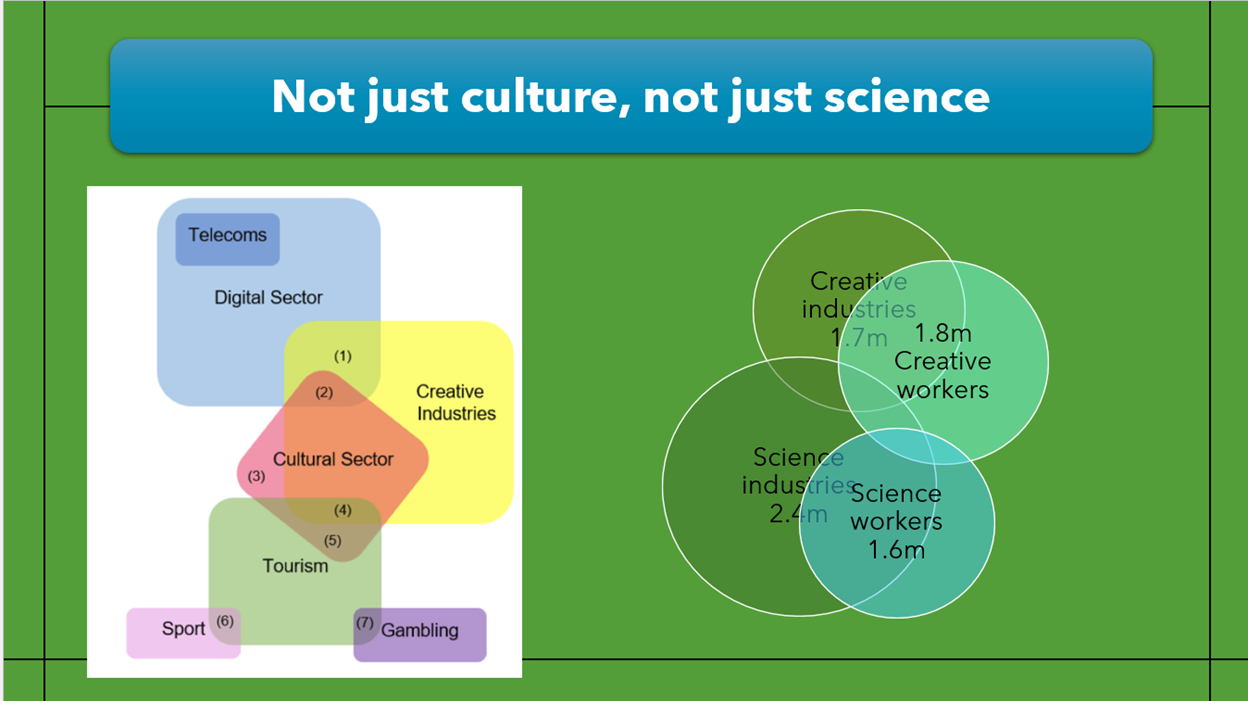
I have concluded the a proper study of these industries calls for more general strategy of what I call mental objects and these are actually the subject of what professor badrun of terms the theory of new enemy mental objects of sometimes called content and their objects which I argue exist in a variety of material forms but can be transformed from one to the other a classic example is a book a book can be printed it can exist online it can even be spoken and it can exist in the mind of the reader these are all different forms of material object but the object that is contained in these material forms preserves its identity is the same thing and in the creative industries what we find is object whose content dominates over their material form another example is a scientific theory a scientific theory exists in many different forms in the talks of lecturers in the textbooks in the applied manuals of those who use those scientific theories and in the minds of researchers who have been educated in those scientific theories so in a sense the scientific theory is that classic example of a mental object.
In order to study these I believe that creative production - by which I specifically mean origination -has to be integrated into a wider context in which mental objects are either handled or enter production and consumption.
The creative industries now have been defined using a method which evolved in two independent bodies of research: that of Australian researchers at Queensland University of Technology, and my own work at the Greater London Authority; these have now been taken on by the UK’s department of Culture, Media and Sport.
The first point I want to make which may seem a strange one but actually will turn out to be central is the relation between accounting and management well actually if you think about it the foundation of planning whether it’s an enterprise a city or a nation is actually a science of production that is the transformation of resource is planning therefore starts from the management of resource is because of that it must account for the qualitative characteristics of these resource is an their quantity now since the production and use of intangible objects is the dominant trend of technology it follows that if we’re going to plan and manage how they’re used we need to account for them so we therefore need a theory of the quality and quantity of intangible objects in mundane terms they must be accounted for.
So what is the problem in measuring immaterial things now I make a basic point we’re emerging from the age of mechanical production in mechanical production which is produced all the wonderful revolutions in productivity that we’ve seen in the era of capitalism humans use material things such as machines and raw materials to produce material things marxes Coates linnen and so on but modern production increasingly transforms immaterial resource is into immaterial objects this is widely but in my opinion misleadingly termed the knowledge economy or the information economy and I have reservations about this term I think we can do better material things are easy to quantify they come in yards tons units how can immaterial resource is be quantified if at all.
Very basic point to be made because people think of measurement terms of measuring A tangible physical object but there are two quantifiable attributes of every product including intangible products and these are its money price and the amount of labour that dictates or took to produce it.
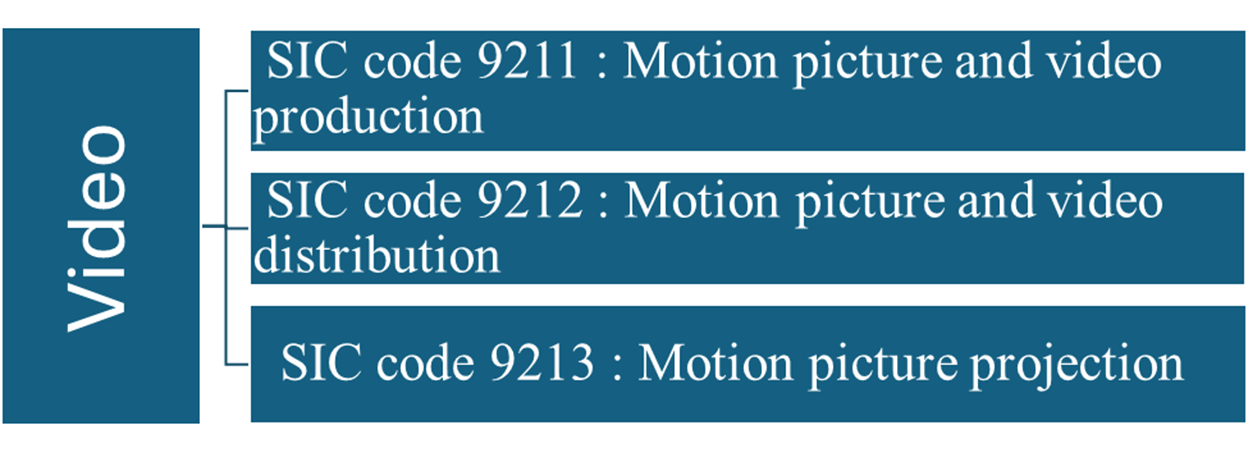
So we now turn so we now turn to what is perhaps the most controversial point which is that modern economic classification systems in my opinion don’t actually understand what services are originally it was a very small part of the classification of productive activities in the national economy it was a catch all for everything that didn’t fit anywhere else and the term services is interpreted in many different ways in economics you can find no consistent definition definition of what it is and in fact it’s an ancient term derived from servitude in feudal times so we are using a term deriving from feudalism to describe something that’s happening in the declining stages of capitalism. It’s a complete hodgepodge as we say in English it ranges from transport to financial services. And the task of an economic science of anno anomic science is to deconstruct it and reconstruct it that is to put together the small parts’cause it the industrial classification provides a very detailed classification of the activities that humans engage in to take these small parts and reorganize them so they tell us what’s really going on and that’s the method that we adopted in Speaking of the creative industries. The example I give above is the definition of the video sector of the creative industries and this is comprised of small three small sub industries which you can find in the national accounting system in the industrial classification motion pictures and video production motion picture and video distribution and motion picture projection full stop new line.
So OK why is this important I think in order to understand its importance we need to go back to the original ideas of Smith Ricardo and Marx about the source of wealth we should note that industry does not propose that creative industry research does not propose a dip Archer from industrial classification it proposes A reclassification of the areas of production to provide an efficient tool for accounting and management consequently it maintains the concept of an industry. And it treats industry as a fundamental tool of planning. Why is this?
It’s a commonplace particularly amongst Marxists that neo classical economics remembers only Adam Smith’s theory of the market the theory of the hidden hand and forget the theory of value but there’s a second principle of Adam Smith which was actually his very first one and it is also forgotten and this is the idea that the origin of the wealth of nations is the division of labour. Not only did Smith stress this but Marx himself stresses this. He speaks of the division of labour as one of the fundamental sources of the prodigious productive improvements of which capitalism was capable. Why is this full? I would argue it’s because it is the basis for specialization and specialization is what paved the way for machinery it was the twin of cooperation which is required to coordinate between specialized producers let me explain this in order to operate a machine it’s necessary to acquire particular skills associated with the particular tasks that each part of the machine requires. Cooperation therefore is naturally organized in mechanical production around the machine the people who feed linen to the weaving machine linen thread to the weaving linen thread to the weaving machine must work together with the people who produced the cloth who remove the cloth from the machine who tend to the machine and so on. But now in the service economy there is no machinery engaged in the coordination or to be precise the machinery operates in a different way in actual fact we are using when we do online production a giant machine which is the entire system of the Internet and everything associated with it but our cooperation is not governed by the material characteristics of that machinery. It is governed by the relation we have to each other. When you produce a video you cooperate not in order to make some giant machine work but in order to get a result that reflects the creative cultural activity of all the producers working as a whole. Marks gives the example when Speaking of cooperation of an orchestra. What’s required is that the instruments the players of the instrument should work with each other not that they should look for some giant machine to organize their relation to each other. This is one of the fundamental reasons that capitalism is inadequate to the new technology and why the appropriate form to manage this new mental technology as I will call it is society itself is socialism is the social organization of labour. In fact specialization is now increasing. The requirement to organize the cooperation between specialists is therefore an ever greater function of social organization. But this does not have to be organized by a single coordinating entity but by the cooperative activity of the producers themselves, as Marx himself describes the ultimate goal of socialism.
This brings me to a very important point which is a critique of the concept of the knowledge economy I would argue that what we should actually be talking about is a skill economy the difference being the following I’ve already said that mental objects of which knowledge is 1 are a form of object that is produced and reproduced but which maintains which exists in a material form but which can produce can exist in a number of material forms but preserves its identity regardless of the material form what is distinct about knowledge in this respect it’s in my opinion the same as the difference between a computer program and a scientific theory which is that it has an active relationship to the material object in which it is embedded this is a fundamental knew stage in productive activity and in fact The Pioneers of computer science fully understood but this was the case but knowledge doesn’t reside in a machine a machine simply repeats the actions programmed into it knowledge resides in the human brain and it manifests it in the form of capability the ability to affect material transformations.
It is in fact the human principle of production and this remains when the machine ceases to be master it’s the general feature of all production so there’s no point at which we can say that mental labour was distinct from manual labour in fact all labour from the time of the transition from 8 to man always involved a combination of mental and manual capacities coordination of brain eye and hand for this reason and likewise specialization there’s a human principle of production and it remains when the machine ceases to be master of course we can all generalize the number of skills that we choose to master. Indeed marx saw this as the capabilities that socialism should foster filled stop but in any actual SoC involving human beings with limited lifetimes we should expect and even welcome the fact that people can develop particular capabilities in particular areas and we find that this is a feature of all production. So driving building caregiving child rearing astrophysics shopkeepers teachers lawyers gardeners violinists writers makeup artists barristers cleaners these are all specialist branches of production. The many cited development of humans requires the greatest possibility facility not for the acquisition of knowledge but the acquisition of skills that is the use of knowledge by humans. So with the passing of the mechanical age the essential measure of the productive resource of a nation is the degree of specialization the variety of specializations and the depths of the skills thus acquired alongside the extent of the cooperative relations between these specialists producers.
Now let’s just finally look more closely at the decisive role that creativity plays in the creation of mental products what was the great achievement of machinery it was the repetition of identity the huge strides in productivity that capitalism has been capable of was its use of machinery to do the same thing many times and thereby greatly cheapened the cost in terms of human labour of producing it. This was the real technological basis for the success of capitalism. The owner could outcompete all handicraft production there a vast increase in labour productivity. The means of production bracket Smiths stock of capital closed bracket could then be identified as an independent source of wealth. The capitalist by acquiring ownership of the means of production could command labour to do his will. But in the post mechanical age the repetition of identity gives way to the extension of variety. This is why creative production is coming to dominate all sectors of production. Design is entering the production of everything not just books or poets or videos but cars in which design is actually becoming the principle thing the producers compete around.
This brings us to a wider method for classifying the so-called service industries first of all of course we have to recognize that a substantial proportion of service activity consists of what Marx called nonproductive activity I’m thinking specifically of the banking and financial sector and of the commercial sector as such by which I mean not the logistic side transport and warehousing side but the simple business of managing the transactions that take place in an exchange economy. Setting these aside there is a second layer of distinction that we need to make. Which is what I call non substitutable labour. Labour for which a machine cannot substitute. Now in the creative industries this is very clear. There is no substitute for an artist for a singer for a poet or a sculptor. This isn’t becausr a machine can’t do art. It’s because we as humans seek out and prefer the work of artists over that of computers. We would rather hear a song sung by a person with vocal cords then articulated by an artificial voice producer. However this is not only the case in the creative industries. There is also no substitute for a mother well for a hockey player a nurse a dancer or a teacher. So therefore labour is non substitutable for two related reasons one that it cannot be mechanized because it is originated by humans that is it’s a product of creative labour and the second is that SoC SIM prefers things that are produced by humans.
Want to know more? I try to keep my website at www.movingfinger.org updated with past creative industry research (but it’s hard to keep up). If you have a specific query, drop me a comment - and others might respond too.
Comments
Nothing yet. Say the first thing.
Sign in to join the conversation.