
This is part one of three posts that make up a talk on 10th July 2026 at an international summer school organised by Fudan University in Shanghai
Part 2 is called ‘What is the Left?’
Part 3 is called ‘What is Imperialism?’
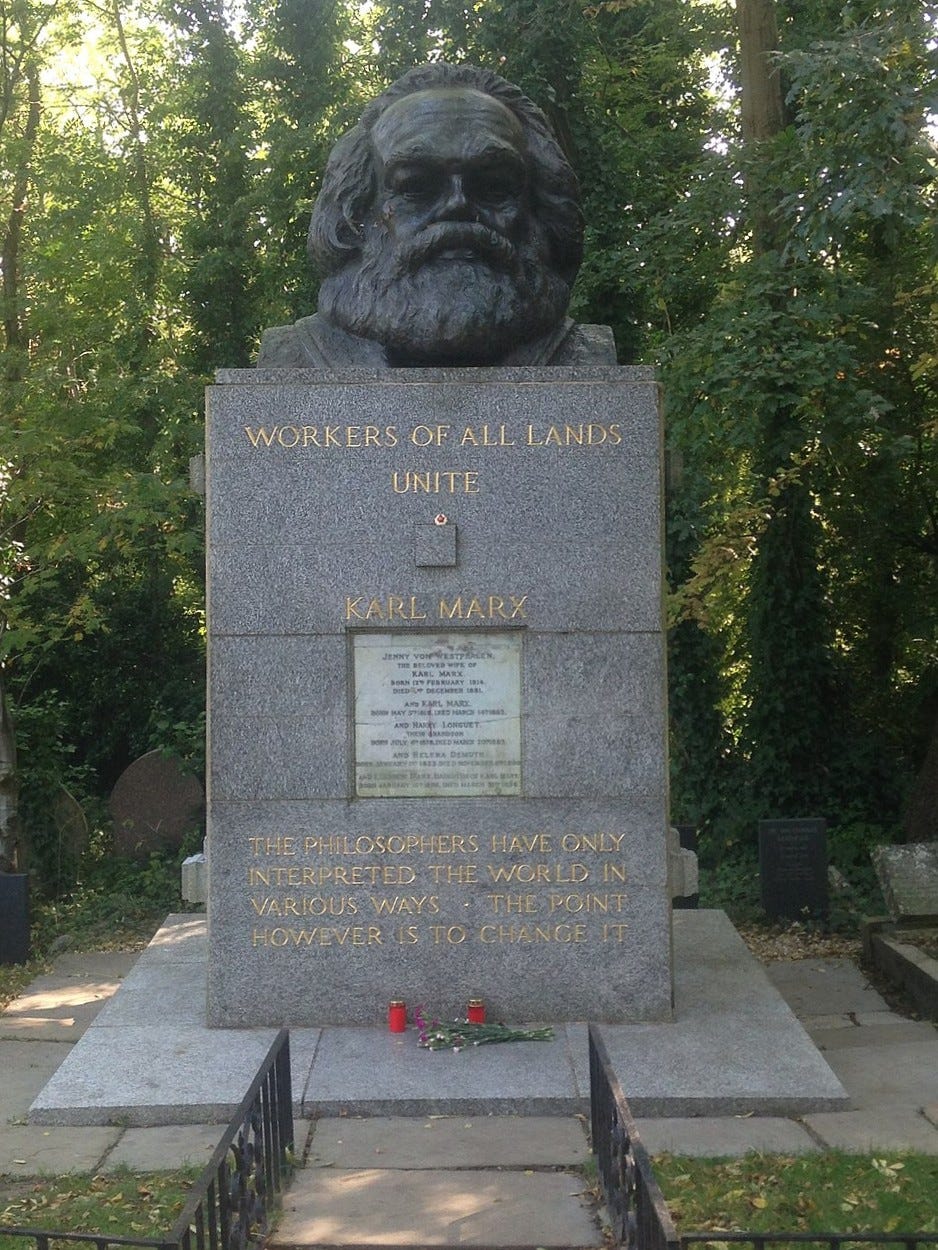
Let me begin with a single picture, the grave of Karl Marx in Highgate Cemetery, London. On it we can see the ringing call which ends the Communist Manifesto: “Workers of all lands unite.”
In this talk I will ask one question: how can the workers of the world unite, given the gaps that divide them?
The issues that swirl around this problem are overshadowed by one further single question: what is the relation between the struggle against imperialism and the struggle for socialism? Or, to put it in terms that even liberals should recognise, what is the relation between political liberty and economic well-being?
Let me first get out of the way an issue that sometimes obstructs discussion: what does the word ‘worker’ mean? My answer, which I believe was also Marx’s, is ‘anyone, in a commodity-producing economy, who doesn’t earn a living by owning property’. This includes all members of workers’ families; all sick, old and unemployed workers; most peasants; many students and all slaves. In short, everyone except the exploiters. You may or may not agree with this definition, but it’s the one I’m going to use.
With that out of the way, let me turn to my first point, which the rationale behind Marx’s slogan: the working class is the only class with no interests separate or apart from humanity as a whole. It is therefore the only class that can bring about genuine and lasting progress. In contrast, history drives all the exploiting classes of society, which is to say the landlords, capitalists and financiers, including of course the oligarchs, to defend their own interests at the expense of humanity.
This is what makes the slogan both relevant and urgent. Whether or not the workers succeed, they have a job which nobody else can do.
This was what Marx thought. He certainly did not treat the slogan as utopian. It was a practical working proposal and he devoted most of his time to it, devoting enormous attention to the formation of the First International in 1864. He was a member of its General Council, and corresponding secretary for Germany and he attended all its meetings which were sometimes held several times a week. He showed a rare diplomatic tact in composing differences among various parties, factions, and tendencies.
Nor was the International a tiny sect. It grew in prestige and membership to 800,000 by 1872 when, in the wake of the Paris Commune, it disintegrated as a result of the split between the Communists and Anarchists. However it paved the way for the Second International which at its peak had three million individual members and 12 million affiliates.
Like the First, the Second International was destroyed by a political event – the First World War. Its parties with only two exceptions voted to support their own capitalists in the First World War. The International ceased to exist as a distinct organisation and only its national parties remained. This was a far more serious blow to workers’ unity, because these parties, by supporting their governments, were sending workers to kill each other.
Yet by 1919, the longest-lasting, and arguably the largest international had been created, taking the name of the Communist International. Its Sixth Congress in 1928 reported over four million Communists and near Communists from 57 countries.
The Comintern, as it was known, was dissolved in 1943 and nothing has replaced it; so for over eighty years, there has been no international organisation of workers except the so-called Socialist International, which was created in 1952 at the height of the Cold War and was, to put it frankly, a child of the CIA. It has nothing to do with the original Second International other than stealing its name.
Since then there have been many initiatives of an internationalist character, for example the first Tricontinental movement, and the world Social Forum. The Communist Parties of the world maintain friendly relations. However these fall well short of an ‘international organisation’ of the workers.
More recent times have seen some serious attempts in this direction such as the ‘Progressive International’ and the ‘Sovintern’ initiative of the Just Russia party. It remains to be seen where these will lead but the mere attempt is to be welcomed.
Here, I want to talk about the basic principles on which any such international organisation should base itself if it wishes to bring about the worldwide unity of workers. I start from an instinct that remains alive in the workers’ movement worldwide, namely solidarity. And I am going to argue that in fact, solidarity is the binding principle on which international relations between workers’ organisations should be based.
Now, solidarity is often reduced to economic support, for example when there is a strike in one place and workers in another place support it. But that is not actually the most important form of solidarity. Let’s take the Vietnam War. Clearly the war itself was one by the Vietnamese people under the leadership of the Vietnamese Communist Party. But what greatly assisted that victory, eased the burden of the Vietnamese people, and spread its effects on struggles elsewhere was a massive worldwide movement in their support and against the aggressors and occupiers.
It’s important to note what the demands of that struggle were in the imperialist heartlands: it was not that those countries become socialist, or join the resistance, but that they should stop making war.
The anti-Vietnam War movement in the United States was a huge movement which combined with the civil rights movement to create fundamental difficulties for the government of the United States. In the UK, whilst they did not prevent the government giving verbal support to the USA, they helped make it impossible for the UK to send troops and take part militarily.
The first part of my argument is that today, the importance of solidarity is once again coming to the fore, and this is of course most obvious in the huge wave of sympathy and support for the struggle of the Palestinian people. The heroism of the Palestinian people is unrivalled; and has dealt the repression significant defeats, but the forces stacked against them are huge. Not only are the IDF and the illegal settler colonialists lined up against them, but the whole of the western arms industry and no small part of its military, along with the financial and business interests on which Israel’s economy depends, while the gulf and other Arab states of West Asia have remained resolutely complicit in the unfolding genocide.
Solidarity is therefore of central importance if this horror is to be ended, if the Palestinian people are to win their rights, and if justice and security for all peoples of West Asia are to be obtained.
Yet this illustrates a critical point: what does solidarity consist of? The answer is that it is different in each country. One reaction is the simplistic idea that the duty of workers in every country is simply to make revolution in their own country. I have no hesitation in defining this idea, which is unfortunately common in the western far left, as not just ultraleft but contrary to the interests of the Palestinian people. What the Palestinian people now need is for workers in the West to stop their own governments supporting the genocide; to stop the flow of arms to the Israeli regime, to end financial support; and to take legal measures against the crimes they have committed.
This leads to a critical notion: the tasks of the workers are different in the oppressor and oppressed nations. This was a fundamental principle of the Communist International which Lenin vigorously articulated and I will come back to it. Support for peace and antiwar movements in the west are not reactionary pacifism; they are the most fundamental requirement of solidarity and in fact, the ‘super-revolutionaries’ who abstain from these struggles on the grounds that they are not ‘socialist’ are objectively on the side of reaction.
This is especially evident in those so-called ‘socialists’ of the West who spend their time denouncing the alleged human rights violations of the very countries that their governments are attacking; who held back from opposing the war against Iraq on the grounds of the reactionary character of the Saddam Hussein regime, and who now produce learned screeds to tell us that Russia and China are actually new imperialist countries and should be opposed by Western Communists just as vigorously as their own regimes.
This kind of practice is sometimes attributed to the malign influence of the Trotskyist movement, but in fact it is perfectly widespread in the Communist movement, the best example being the Greek KKE. It is actually the most serious consequence of the lack of a vigorous and active international organisation of the working classes of the world, whose result is that each separate left party falls under the constant pressure of its particular national circumstances – in other words, of its bourgeoisie.
What this fake leftism actually does is provide the imperialists with the excuses they need to conduct their wars, punitive sanctions and colour revolution régime change operations.
In fact, even if all these accusations were true – which I vigorously dispute – the task of the workers in the West should still be not to add fuel to the propaganda of their militarists against the governments of other countries, but to put a stop to the militarist activities of their own governments.
This brings me to the second aspect of solidarity, which is the need for clarity and mutual understanding which can only be arrived at through direct contact between the representatives of workers’ organisations, and through debate and engagement leading to mutual understanding and common action. Actually, this event is but one example of the growing urge for such forms of solidarity and the yearning for workers’ unity that exists and is rapidly expanding throughout the world.
To put it another way, internationalism is on the rise.
This then brings me to the obstacles to internationalism.
The clearest and most tragic manifestation of the difficulties is complete inability of the western left – that same left which has clearly grasped the importance of the Palestinian struggle - to understand what is happening in Ukraine. It is absolutely clear to anyone who simply studies the facts and history of the conflict, or who even just looks with a sober mind at what the Western nations did to Yugoslavia. to realise that the goal of the West is and remains the genocide of the slavic peoples of the east, the division of the lands they populate into many tiny parts in order to rule over them, and the realization of Hitler’s stated goal of converting Asia into a hunting ground for colonisation by Caucasian peoples.
After the USA’s rulers promised the rulers of the USSR that in response the dissolution of that country, there would be no further expansion of NATO to the east, they wasted no time in moving military forces up to Russia’s borders. It took them only a couple of decades to install what is in all but name a Nazi regime in Ukraine, which they have used to provoke and sustain a proxy war against the peoples of Russia and Central Asia.
Yet the left parties of the ‘Collective West’ including too many far left parties, delude themselves into thinking that because Russia no longer has a socialist constitution, somehow Russia is at fault for its solidarity with the oppressed native Russian speakers of Ukraine - and for defending itself against a war that has become the main vehicle for aggression from the military bloc that cements the Collective West and whose aim is clearly and consistently to destroy it and its peoples.
In consequence, once again workers in the West through their organisations have been lined up to support the cruel and deceptive proxy war which is sending hundreds of thousands of Ukrainian workers to serve as cannon fodder against their Russian-speaking sisters and brothers.
These two failures of international solidarity and of international understanding exposed the gap created by the dissolution of the last remaining international workers organisation in 1943.
They demonstrate the necessity today for the conscious reconstruction of international mechanisms through which workers of all countries can reach a common understanding of the world they live in and can act together, and act in solidarity with each other.
The task is made easier, yet also more complicated, by the existence of nations, notably China but also Cuba, North Korea, Vietnam and arguably Laos, in which working people exercise power over their capitalists, governed by socialist principles of economic organisation. It is made easier both because of the example that such countries give, and because of the support that they are able to give to all and every progressive developments throughout the world.
But a problem is revealed by another form taken by ultra leftism, which demands of the socialist countries that they should render direct and open military and financial support to struggles at the front line of the battle against imperialism. I don’t need to explain that this is not something China can do. This is because a nation is not a political party.
China is playing a decisive progressive role on the world stage. It does this through its strategic initiatives, providing preconditions for the security of these peoples under attack from the imperialists by promoting development, government, and civilization and principles of international governance. But it exists in a pluripolar world of nations that do not as yet implement these proposals. It cannot simply impose them and if it did so, it would contradict them, since such open intervention in the affairs of other nations would violate the very principles of sovereignty and mutual respect which it seeks to secure from all nations including the aggressor nations.
It is, therefore, precisely the task of the workers, and their progressive organisations, to act, as Marx and his successors intended, in their own capacity, to secure that which is not the task of nations alone, no matter how progressive. To this end, their organisations must act jointly and, critically, they must create organisations which earn the right, through their actions, to solicit the solidarity of their sister organizations in other lands.
This now brings me to the core point of this talk: who should be engaged in such international collaboration, and what should they be doing?
I can illustrate the difficulty by referring to a straightforward paradox. Who is at the front line of the aggressive wars that imperialism is waging against the workers of the world? The answer is obvious. Is the people who faced the most direct onslaught of its military machine. That is, the people of Iran, the people of Russia, the Russian-speaking people of Ukraine, the people of Venezuela. More widely it consists of all the victim of imperialism’s prolonged and never-ending campaign of punitive and illegal financial sanctions, which amounts to the illegal war crime of attempting to starve civilian populations into submission.
Now to put matters bluntly, the organisations of those on the front line of this assault are not communist. In Iran they do not come from the traditional left at all. In Venezuela, perhaps most recognisable to classical Communists, the founding principles of the PSUV are not those of Communism but of the native Bolivarianism of Latin America’s venerable history of anti-colonial resistance. In Russia, the dominant political parties, whilst they are all offshoots of the Communist Party of the Soviet era, quite explicitly reject not just the USSR but the whole idea and legacy of Communism.
The Left therefore needs to face up to a new problem. What is its position in a world struggle against imperialism that is clearly not led by the Left?
I want to put forward an uncomfortable proposition, actually two interlinked, and equally uncomfortable propositions. The first is that the principal struggle which should today unite the workers of the world is the battle against imperialism. On the one hand, therefore, the anti-imperialist struggle cannot be subordinated to the struggle for socialism. On the other, the struggle for socialism can and should be subordinated to the struggle against imperialism.
Therefore, and this is the second proposition, the Left, by which I mean the genuine Left as I will shortly define it, will for some substantial period of time form a minority in any practical international world movement of the working class.
This idea will doubtless be denounced by the Western far left as ‘campist’ or ‘Third Worldist’. But actually, I’m going to argue, it is in complete continuity with the original project of Marx and the Communist League, the founding principles of the First, Second and Third Internationals. And it flows from a clear and scientific assessment of the actual historical conditions of today.
A key initial point, necessary to avoid trivial misrepresentation, is that this proposal does not in the least imply that the struggle for socialism should be abandoned. It means that in order to achieve it, the workers of the world must first unite against imperialism, without imposing the prior condition that their allies must be socialists. Nor does it mean that the Communists should abandon their identity. It simply means that the basis of unity, for a substantial period, will be to achieve the elimination of imperialism. From this, the conditions for socialism, on a world scale will emerge, for the precise reason that Marx identified; because it will create the best possible conditions for the working classes of the world to act, and to act together.
The scientific basis for this assertion is twofold. The first point is that capitalism has only survived past its sell-by date because of imperialism, and the second is that, as a result of imperialism, the majority of the world working class, in the broad sense that I have defined it, no longer lives in the imperialist countries. Removing imperialism therefore dismantles the single biggest obstacle to the worldwide replacement of capitalism by just and equal societies governed by the majority of their peoples, and creates the best possible conditions for the world’s workers to act together to identify, and meet, the needs of their whole peoples.
The second argument in favour of the above proposal is an entirely practical one: most reliable forces to be found worldwide in battling imperialism are, precisely, the working class of the countries in the frontline.
My third point is less controversial, but it is the lynchpin of the entire argument. It is that the issue of political power cannot be confused with the issue of economic power. Political power is, as the Communist Manifesto clearly states, the first step in the achievement of economic power. The fundamental confusion to get out of the way is therefore the entire idea that this sequence can somehow be reversed; that workers can achieve lasting and sustainable economic changes without political power.
I will address this in the next part of this series, in which I ask what the ‘Left’ really is.
Comments
Nothing yet. Say the first thing.
Sign in to join the conversation.