
As a young musician I traveled to Vancouver in the summer of 1975 to take some theological courses at Regent College to support my understanding of the Scriptures and enhance my ability in writing theologically attuned song lyrics. During that summer I took a course on Christian apologetics with a dynamic young theologian named Clark Pinnock. A few years later as an MDiv student in Toronto I studied with him again on the “nature of the church” and participated in a small group that he and his wife were hosting in their Annex flat. He was an intriguing person. A passionate biblical scholar endowed with a charismatic heart. Furthermore, he loved to worship God in an expressive manner which from my Pentecostal upbringing I found refreshing! His mix of brain and heart was appealing to me as a young musician interested in exploring the biblical text.
A few years later Pinnock wrote a book entitled The Wideness of God’s Mercy which encouraged the Christian church to seek a broader understanding and engagement with other faith traditions. For Pinnock, this was an urgent matter in striving for peace and overcoming the growing rifts within a broken world. To that end allow me to share a passage from his book that remains relevant some 35 years later:
The small world is fast disappearing. Increasingly all nations are inhabiting a single world they have to share in common. Living in isolation has become impossible. Countries are compelled, for example, to belong to trading blocks and to form alliances. They are being impacted by people movements (often unwillingly), and the electronic media make it impossible to hide away in a corner. The twentieth century has seen a historic leap forward (not that the world was necessarily ready for it, spiritually or morally!) into what is fast becoming a single-world culture. Humanity is becoming one again and the situation is developing in which we will either learn how to get along with one another or simply perish. (Clark Pinnock, A Wideness in God’s Mercy).
Having re-read his work recently it doesn’t seem that we have heard his message of working for peace and learning to get along. Alternatively one can argue that we are closer to perishing as a global community. Alienation, acrimony, and anger are evident on every plane of existence. A failure of meaningful dialogue with a vast number of people who express their faith in ways other than our own is a demonstration of such rancour.
Joyce Wieland’s art piece “Reason Over Passion” perhaps can prod us in the direction of mutual understanding:
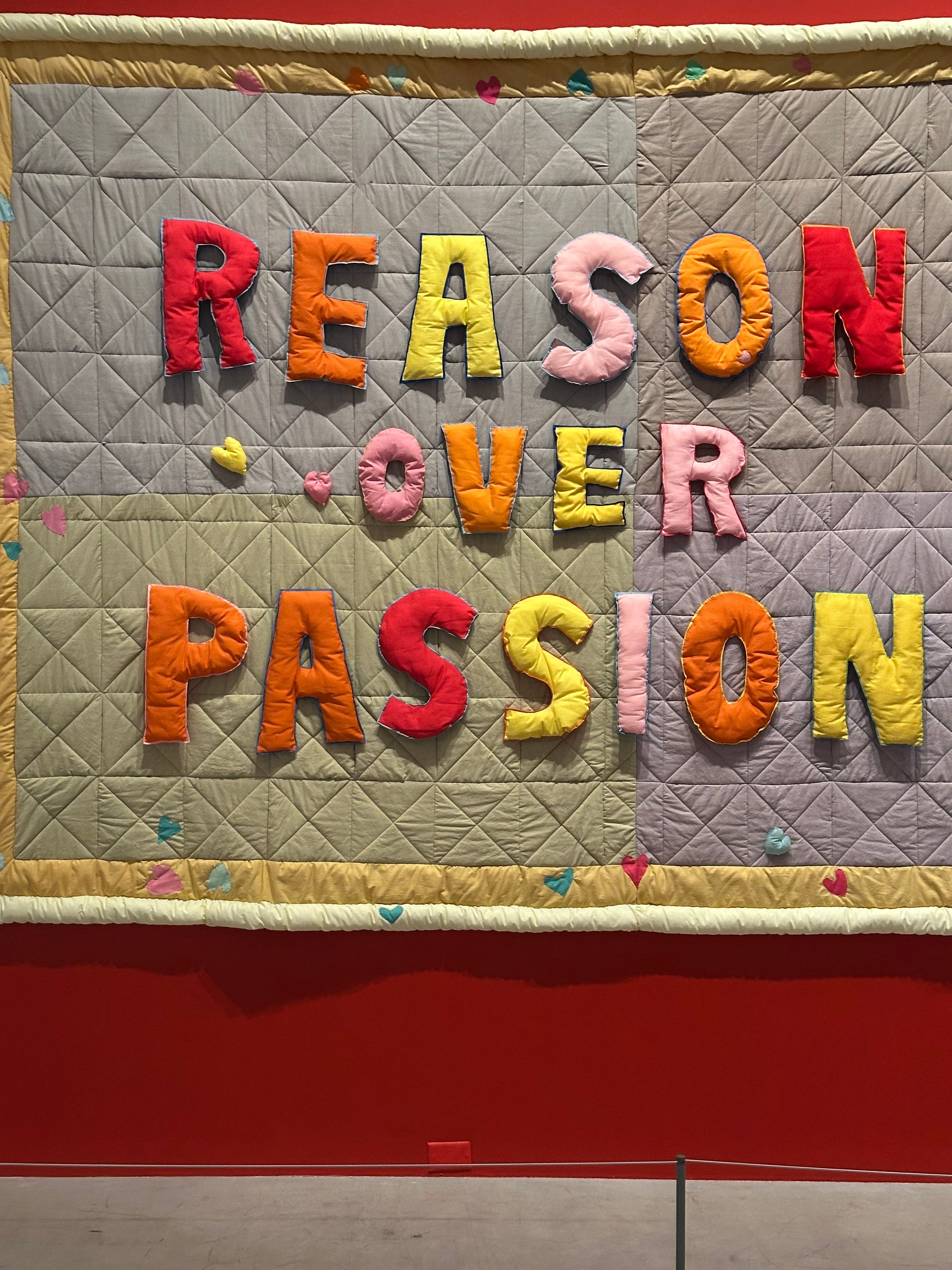
Let us turn down our judgemental heat dial and turn up our dial for peacemaking so that we diminish the increasing possibility of global chaos and destruction. It is self-evident that a commitment to mutual understanding (actually talking with one another and not simply yelling at them!) is a first step in fostering a path of true shalom.
Thanks for reading Musings on the Spiritual Journey! Subscribe for free to receive new posts and support my work.
Comments
Nothing yet. Say the first thing.
Sign in to join the conversation.