
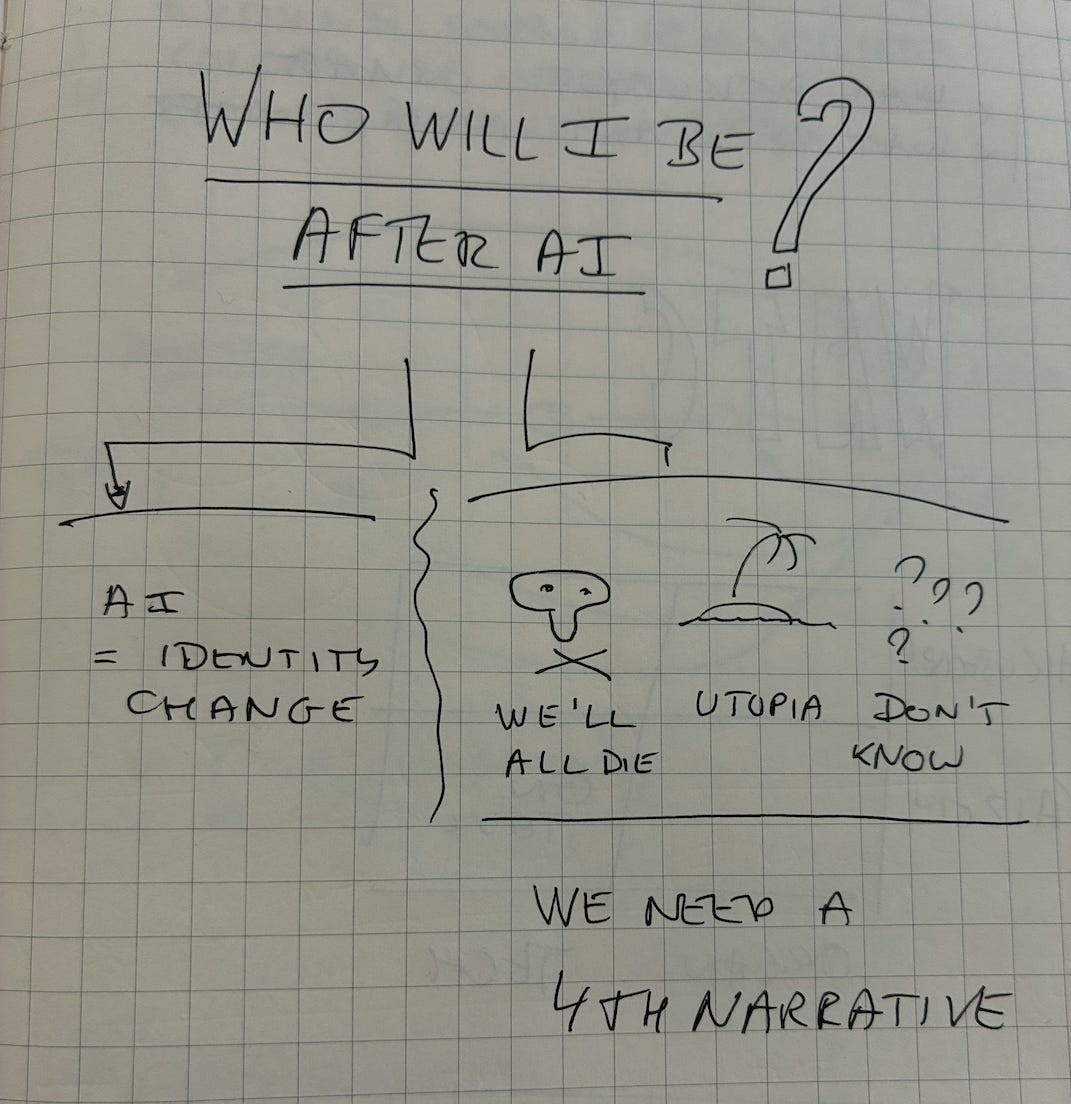
A couple of months ago I wrote: Who will I be after AI?
It was one of those existential moments where I wondered whether my expertise, or even I as a human, would still be needed in a world filled with machines.
It became one of the deepest transformation rabbit holes since finishing my book.
It changed how I look at AI, identity, and storytelling.
And it led me to what I now believe to be the most important success factor of any AI transformation: a Story of a future people actually want.
I had just finished work on the AI transformation of a global retailer, and was meeting a new prospective client whose digital team had moved beyond the hype of burning tokens to look at some truly interesting use cases.
But the people who had to feed the new technology with their knowledge weren’t playing ball. There was no outright rejection or sabotage, but feet were being dragged and a lot of questions were being asked. Meanwhile, these same individuals were privately using Claude and ChatGPT for everything from curry recipes to career advice, to sneakily polishing their PowerPoint slides.
The conversation came back to me when I read a report finding that 29% of all employees (and 44% of Gen Z!) admitted to actively sabotaging their company’s AI strategy. Interestingly enough, they aren’t alone. The same report found that 75% of executives believe their AI strategy is “for show”.
I can’t resist numbers like that, so I started exploring.
Taking some of my own Transformation Code medicine, I’m increasingly convinced that the root cause problem is the AI stories that get told.
Stories that can make resistance or even sabotage look like perfectly rational human behaviour.
As humans, we don’t mind transformation.
AI or otherwise.
We do it all the time.
Even if the journey is hard, we can persist. Provided that the end goal is worth it.
We run to get fit. Study to succeed. Women suffer through childbirth in ways I can’t even imagine. As long as the gain outweighs the pain, we’re willing to take on a lot. For a long time.
But this is exactly where the dominant AI narratives offer a poor bargain, as they typically present us with three types of future:
Doom: AI will lead to lost jobs, commoditisation, pension fund crashes and automated warfare. In the words of Sam Altman, Artificial General Intelligence (AGI) could lead to the end of humanity itself.
Utopia: AI will make us happier, healthier, richer, and more fulfilled than ever before. It will solve the climate crisis, fix cancer, world hunger and ensure we can all just lie back while the machines do the laundry. Solar-powered and with a smile.
Uncertainty: None of us knows where the technology will take us. But resistance is futile, so we better run faster than our competitors, as we may not all survive the AI Hunger Games. Especially should the AI players crumble under their debt, bots hack everything, and total chaos ensues.
The first future, no one wants.
The second, no one believes.
The third, our uncertainty-hating brains like even less.
Spend 10 minutes on LinkedIn and even the most optimistic mind gets depressed: Embrace AI, and you’re a slopper. Ignore it, and you’re an idiot.
While in our bones we know that AI adoption comes at a price.
We rationally see the gains, but also feel AI erode parts of our professional and private identity. Deplete our personal energy levels.
By becoming the human-in-the-loop, we accept the unspoken contract that the AIs are in charge. We sense them modifying the value of our knowledge and skills. Reshaping expectations. Reconfiguring relationships. The way we think. Write.
And the three dominant AI narratives offer very little on the things that really drive us as humans: hope, growth, skill, connection, direction, passion. The stuff that makes life worth living and work worth working.
They may not have rational explanations, but the neurons in their hearts and guts are screaming that the AI Stories being told don’t align with the life they seek. And as these neurons are both older and deeper ingrained than those in our head, they often win the game.
Think I’m ranting?, have a real conversation with your colleagues over your beverage of choice.
Or talk to my 25-year-old son and his friends. And his friends’ friends.
Even though it’s politically more elegant to look away, this is real.
And if you’re running an AI transformation, you need to address it.
Head on.
The dominant AI stories all treat technological progress as an indisputable force of nature, against we are powerless. In which change is coming so hard and fast that we don’t really have time to focus on more than where the IPO-and-consulting-fee-incentivised AI sales-folks direct our attention: the use cases, operating models, software, the data, and governance programmes.
Yet by running with the existing stories, we effectively skip the step of defining the future we want for ourselves. Implicitly outsourcing our agency over the future we want to Silicon Valley.
solving problems based on what AI can do, rather than for what the business, customer proposition, or operating model really needs to become.
locking ourselves into workflows and vendor infrastructures based on today’s assumptions, while tomorrow the world may - or better will - be different.
ending up in the same place as competitors who use similar models, vendor advice, public datasets, and efficiency criteria
flattening the human nuances of our business: the engagement, the tacit knowledge, the customer connection, the sense of team identity.
But most of all, offering an obviously unfair bargain where teams, suppliers, and distribution partners are asked to make sacrifices today for a future that may not benefit them tomorrow.
Your teams all know that AI can be used to multiply your organisation’s impact, or make it more efficient at what it does today. So if you don’t explicitly present your teams with an expanded future, they can only assume that you’re asking them to run harder to teach machines that will eventually replace them.
Or that you don’t really know where you’re going and you’re all just drifting along.
And the promise that “they’ll be able to let go of the annoying parts of their work and focus on better things” won’t survive the math in their heads. If machines absorb 20% of the work, one in five jobs will disappear - unless you clearly say what comes in their place.
They won’t say it. But they’ll think it.
Yes, I know the board or C-suite is breathing down your neck expecting you to “make moves”.
New models appear weekly.
Microsoft keeps asking you to buy more Copilot licenses.
The business wants you to write checks your data warehouse can’t cash.
Your consultants look at you as an open money faucet with the message “move now, or else”.
And if you’re leading or sponsoring an AI transformation, you also have to align twenty different departments, agendas, data flows, and a spaghetti of technology.
AI success requires more than use cases and operating models.
Sure, keeping up matters. But real, long-term success and differentiation comes from taking back agency over the future we want instead of accepting the default options.
So, momentarily park the conversations about tech stacks, data, and governance to:
Not just ask: “How can we thrive in the age of AI?” or “What is the use case?”
But wonder: “Who do we want to become, as a business and as people? What is the world we want to build? How will AI help get us there? Or not?”
Offer your people, your business, and yourself a fourth option beyond doom, utopia, or confusion.
Not as a fairy tale or communication exercise, but as a clear 3-5 year strategic narrative of:
The world your business wants to help create, regardless of the technology.
How it will help customers, teams, partners, and shareholders achieve their goals.
How you will differentiate in a world where technology commoditises your industry, and customers pay a premium for outcomes, experiences, and transformations.
Where you want technology to augment, and what should absolutely stay human. Which red lines of efficiency and use you won’t cross.
How your people’s work, skills, and identities will evolve. How they can contribute, and who will not be able to join you on the journey.
In short, create a fourth narrative that may continuously evolve, but that gives your people a future to desire and work towards because they want it, not because you tell them to.
So AI becomes generative, not extractive.
But it will help you have a real conversation with your team about how their jobs and identities will evolve. And be honest about it, if the answer is “nowhere”.
It may even clarify your own role as a leader.
Give you a simple North Star to help navigate all the commercial narratives that are thrown your way and build a strategy that is a lot more convincing than one rooted in doom, utopia, or confusion.
You will. You may even hit your automation, cost, or ROI targets.
But you may also sacrifice the hard-to-measure essence of our company’s success.
You may have evolved. But end up in a place you didn’t want to be.
I applied it to myself.
As a professional advisor, or “expert,” I also worried about the impact of AI.
Would I still have clients tomorrow?
Should I streamline myself more?
Should I give in to the pressure and become an AI-slopper?
But then I mapped the future I wanted AI to help me create.
Where I was willing to let it into my life and what use cases were out of bounds.
Not tactically based on whatever new technology came about, but based on first principles.
I described where I wanted to go and how AI fit in.
Accepting that I cannot control my reality and will need to keep evolving my views. But that I can choose my own professional and personal direction.
It’s a work in progress, and I’m still clarifying it.
But I noticed I’m much more relaxed whenever Claude comes up with a new skill.
I’ve created my own Fourth Story and reclaimed my agency.
Hit that AI transformation pause button, if only for a day.
Create your fourth Story and test it with your people.
Make them part of the journey rather than cascade AI from above.
Yes, it may be uncomfortable and require new ways of managing.
But it’s better to confront uncertainty today than efficiently scale in a direction you may not want tomorrow. And lose the hearts of your people in the process.
Or, as I asked one CEO of an international firm: “Who will your business be when AI grows up?”
Or, for that matter, who will you be?
Get in touch if you want to make your AI transformation real
We’ll discuss your challenges and ambitions, and figure out how to make the best possible future emerge.
For your customers, your teams, your business, and yourself.
How AI was used in creating this article
This article was completely written and edited by me. AI tools have been lightly used for research and developmental editing. Everything has also been spell- and grammar-checked.
Comments
Nothing yet. Say the first thing.
Sign in to join the conversation.