
At this very moment, I have a full draft of a fantasy novel manuscript sitting on my computer (and in my agent’s inbox). I will pretend for a second that I can hear the distant applause travelling through the virtual network of my reader base. I receive your congratulations with grace. In the spirit of speaking of things that are not (yet) as though they were, I am eager to share news with you in the near future of a career-making book deal with a publisher whose vision aligns with mine and who will treat me and the work that I have created with care, kindness, and professionalism. There is money and literary success in my future, amen? Amen.
“What’s the book about?” is the inevitable question I hear you asking. It is about a West African girl who despises injustice and has suffered too much of it, and a West African god who creates injustice for fun and who has never suffered anything close to enough. It is a characteristically fast-paced (readers may be growing to expect this from me), plot-twist-filled speculative novel whose worldbuilding is steeped in Ewe and Akan cosmologies. At the same time, the philosophical questions it tackles are ones that are, or should be, of deep concern to anybody who subscribes to Judeo-Christian faith systems—and I say this with full admission of my author bias, as a person who has been Christian for the last 15 years and who will likely remain in the faith for the foreseeable future.
The creation of this manuscript aligns in many senses with the maxim attributed to Socrates (via Plato) that the unexamined life is not worth living. But it also aligns with my personal belief that a life devoid of adrenaline-inducing adventure isn’t particularly worth living either. So, yes, the manuscript is thematically serious but plot-wise, is very, very fun.
One day, when this book is published (so be it, see to it), someone will ask me about the process of writing it. Therefore, I have decided to preemptively document the process. By the time this novel hits the shelves (so be it, see to it), the creation timeline would have spanned no less than five years.
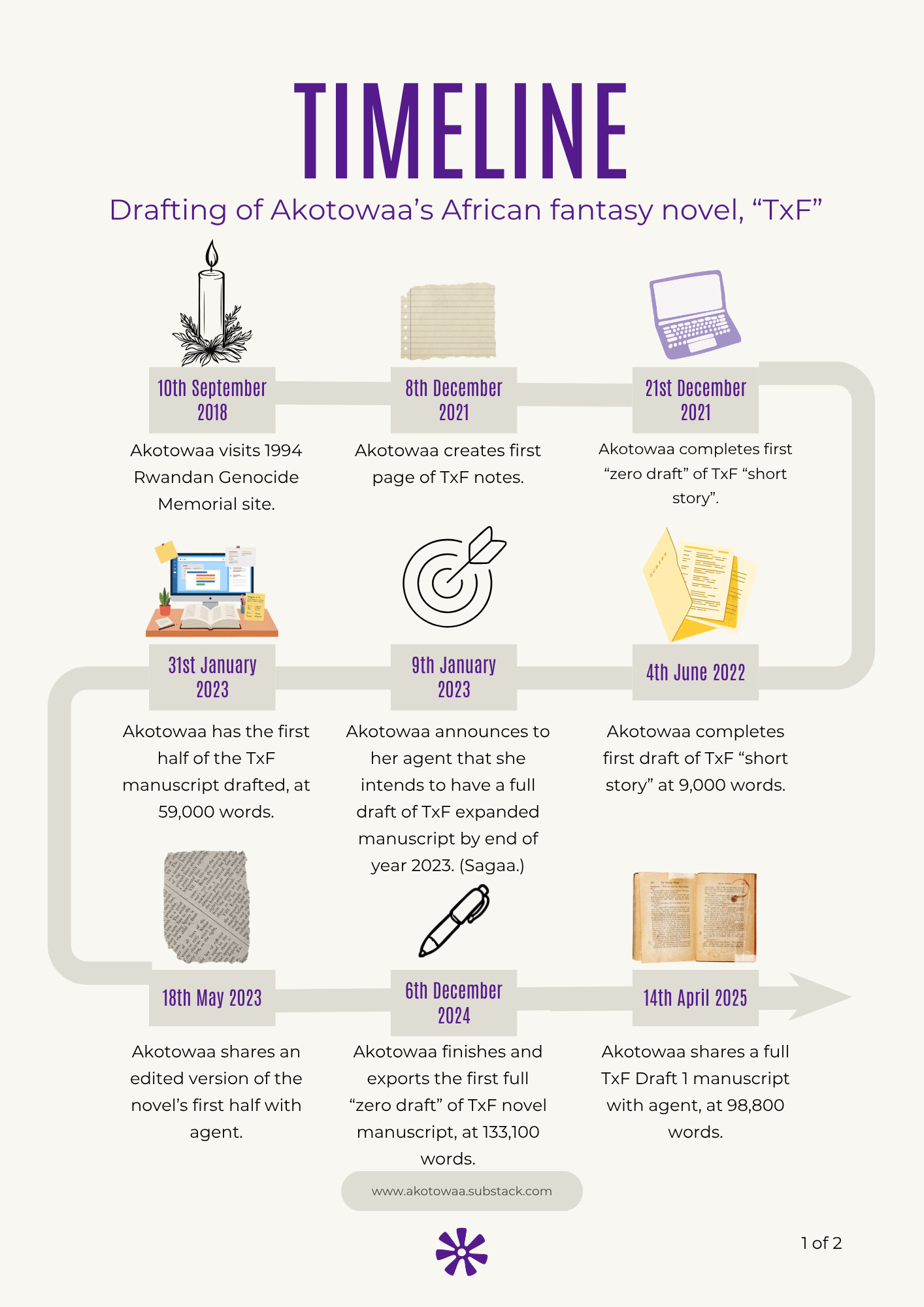
At some point near the tail end of 2021, there was a call for short story submissions for a competition, on the theme of spirituality. That was what provoked me to start putting the first words of this manuscript down. My OneNote records show that my very first digital page of notes for this story was created on 8th December 2021. Readers, I never did submit to this competition. It was a combination of not being able to make the deadline, my story tragically exceeding the competition’s word count, and my worldbuilding feeling too expansive for the initial “short story” draft to feel complete.
Delulu is sometimes the solulu, in ways we do not expect. It was a similar situation with my debut novella, The Year of Return (which has since been translated into German!), which was also initially meant to be a short story. It was delusional to think that I could fit such big ideas and such heavy themes concerning the trans-Atlantic slave trade into a maximum of 6,000 words with TYOR. It was almost as delusional to think that I could create a satisfying trajectory for a character who had just lost everything and everyone she holds dear to a pointless genocide, in under 6,000 words. Nevertheless, allowing myself to believe that this was possible gave me the seeds for a full-length manuscript that has (sub)consciously been percolating since 2018.
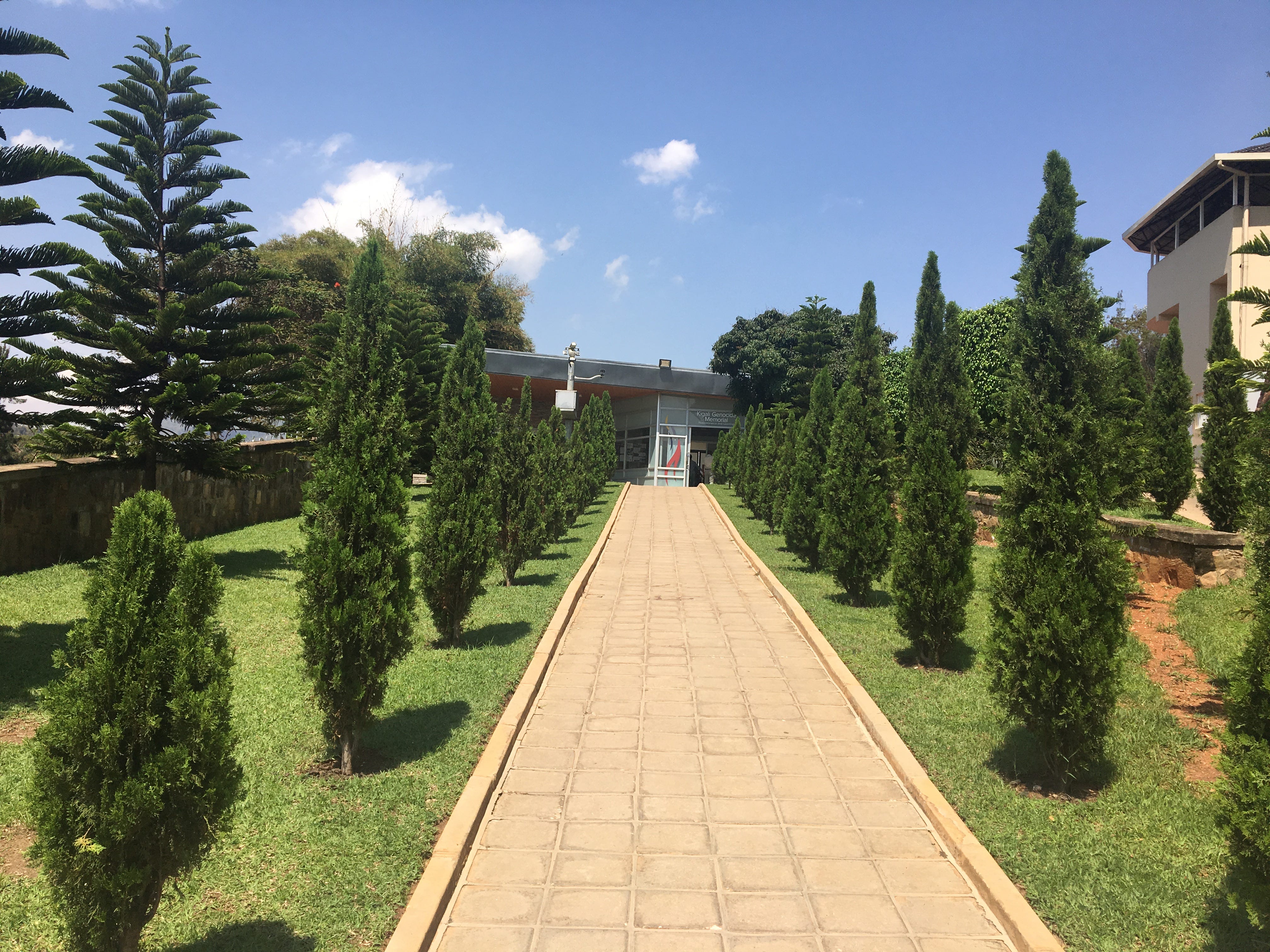
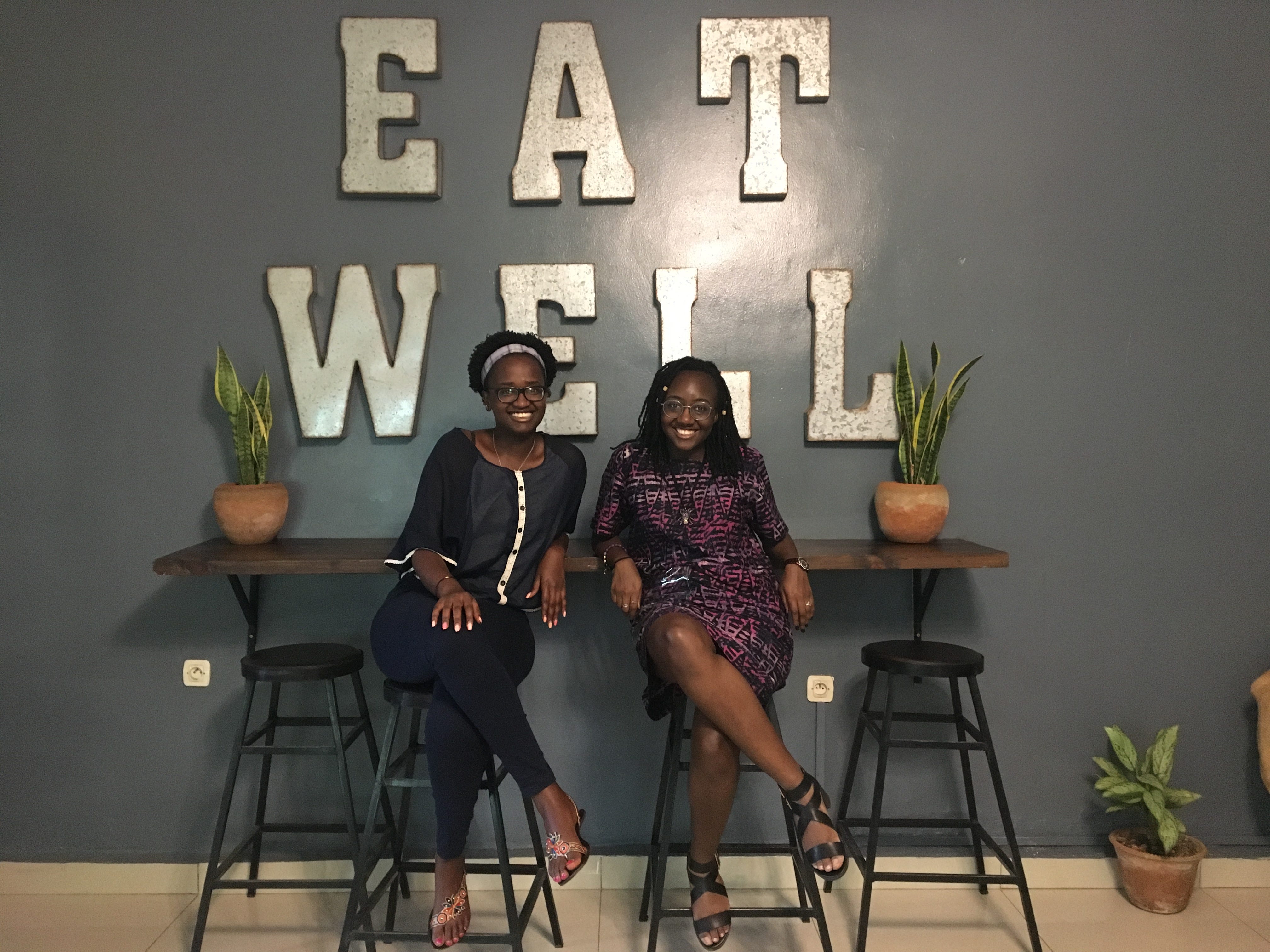
In 2018, during a mid-term break, I seized the opportunity to visit a dear friend of mine, Manywa Amandine—and by extension, her home country, Rwanda, for the first time. There was no way I would visit Kigali and not be taken to the Genocide Memorial, just as a first-time visitor to Accra is almost bound to end up at some point at or near the Independence Square. As you might expect, visiting that memorial site shifted me spiritually, and I can’t be certain I will ever fully recover. Yes, yes, I know how much I sound like just another sentimental tourist. There is, however, no way around my horror and my subsequent awe that a population was able to rebuild itself, however rockily, from that. It was inevitable that what I experienced there would be transmuted into art. Even if I chose the wrong format to begin with.
By 21st December 2021, I had the first zero draft of the “short story” I intended to submit for this competition, at 6,600 words. Unrefined, emotionally incomplete, fit for no eyes other than my own. So, in between distractions and other life circumstances, I worked on it some more.
On 4th June 2022, I had a draft that was readable, at 9,000 words. I shared it with some friends in my circle of trust, as well as with the editor who works with my agent. In hindsight, it is obvious to me that I had unconsciously tried to replicate the winning short story formula I had applied intuitively in “Principles of Balance” (the first work of mine to be nominated for a Nommo Award), but with this story, it didn’t work. Like I said earlier, my worldbuilding was too complex, and my attempted cliffhanger didn’t work nearly as well with this story as it had in the previous one. My early readers had far too many questions after reading what I had thought was close to a finished draft. Consistently, I received one of the most crushing and yet frequent pieces of feedback I have been plagued with over the last few years: that the thing I thought was a short story felt more like the first chapter of a novel. Unfortunately, my critics were correct, and I had to commit myself to the daunting task of expanding this fake short story into a much longer one.
It was stupidly difficult. And also, loads of fun.
Untenable circumstances in my household made it virtually impossible to get any writing done there, and I ended up moving into the incomplete house one member of my circle of trust—and one of my earliest readers for this manuscript—was living in at the time. I didn’t have a bed, but I did have a couch which I had scavenged from my ex’s apartment shortly after we broke up and just before he moved out of Accra to his home country. I remember days with purple sheets of poster paper laid out on the floor of this unfurnished bedroom, me crouching over them and rearranging post-it notes to see how I could get the ideas in my head to make sense. Me calling my housemate/friend in to talk through plot snags with me as we both surveyed the mess on the floor. Me listening to the ravings of my then-boyfriend (not the same as the one from whom I got the couch) to see if I could sift any gold from his verbal sludge. I made a few breakthroughs and hit some more roadblocks.
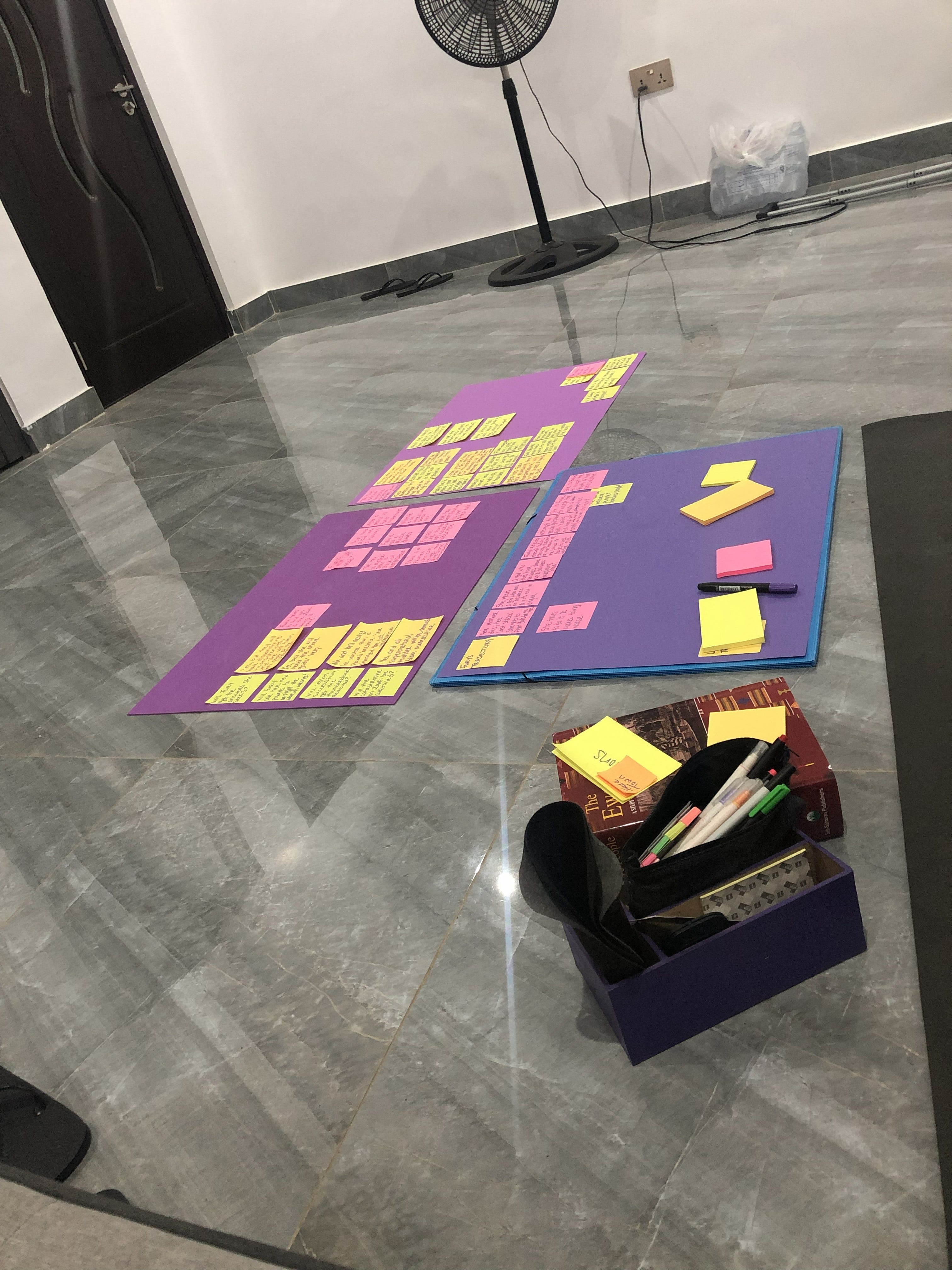
As of 9th January 2023—more than a year after I’d first started working on this story—I ambitiously declared to my editor that I planned to complete a novel-length draft of this manuscript by the end of that same year, 2023.
As of 31st January 2023, I had 59,000 words down. I was maybe halfway through getting down the full story that existed in my head. And then I started cleaning it up, removing the clutter, tightening things, for two reasons: (1): so that it would be of share-able quality; (2): so that the way forward would become clearer to me.
On 18th May 2023, I shared this first half of the novel manuscript with my agent and editor, at about 55,000 words.
At this time, it still seemed feasible that I would have a complete zero draft done by December 2023. But life happened. Clarion West 2023 happened. The Milford SF Conference happened. I needed money and launched myself into freelancing. I did not have a full zero draft by December 2023, to my personal shame. But I continued to work, putting down over 17,000 new words between January and February 2024 before I had to devote all my creative focus to finishing up my commissioned text for the Anansi: New & Ancient Tales book project.
I was back to my work-in-progress manuscript (my shorthand for this project’s title is TxF, so let’s use that henceforth) in April 2024, and then some emotional scatteration happened. You know the kind—the type that sends you straight into the gym to become the hottest version of yourself as some sideways, self-edifying form of revenge. In the meantime, the US edition of The Year of Return came out, in May 2024. And then, in September 2024, the Ghanaian edition of The Year of Return came out.
I did not touch my TxF manuscript again until November 2024, but by that time, I was already close to the finish line for getting the broad strokes of the story out onto the page (and into a Scrivener file).
On 6th December 2024, I finished with and exported the first full draft of the TxF novel manuscript, and I was very, very pleased with myself. One year later than the timeline I had given my agent in January 2023, but I had finally done what I had felt at certain times was going to be impossible: reaching the end of the idea alone. This big “idea” ended up being 133,100 words long.
It was not shareable, as is characteristic of zero drafts. It was full of holes (what an interesting oxymoron), the prose was unrefined, and I’m pretty sure I had changed some characters’ names and some word spellings halfway through the manuscript without changing their previous iterations in the first half. Thus, the editing process—far less excruciating than drafting, in my experience—began.
By this time, I was working a full-time office job (in the name of the God of Creativity, may I just say, #NeverAgain… having a salary can be nice but if I die and was too exhausted and uncomfortable to achieve what I was put on Earth to do, what’s the point?), and so, from January 2024, my lunch hour became a matter of religious sanctity, during which I would disappear to the staff room, try to finish eating as quickly as possible, and then get to editing on my tiny and beautifully portable Surface Go 2 tablet (Dear Microsoft, would you like to sponsor my creative career? I’m serious about this). This was also about the time when I started instituting a weekly Saturday Sabbath, and the rhythm and flow this brought me has been unmatched before and since.
After three and a half months of working my substantial behind off with edits, physically printing and rearranging more than 10,000 words of misplaced scenes using scissors, tape and staples, I finally sent a full TxF Draft 1 manuscript to my agent and editor on 14th April 2025, at 98,800 words.
Then followed a few weeks of silence as my editor worked through the manuscript. Lord, I needed that break.
In early June 2025, editor’s notes made their way back to me, but guess who didn’t have the time or energy to attend to them because she was busy finishing up an entirely separate book commissioned by her corporate job (very proud of what I accomplished there, against all odds!), participating in the Schomburg Centennial Festival in New York, curating the African Book Festival in Berlin, launching the German translation of The Year of Return in Berlin, doing a book reading in Münster, visiting family in Basel, helping put together a gala for her corporate job back in Accra. Friends, I did not touch the TxF manuscript again until the third week of September 2025.
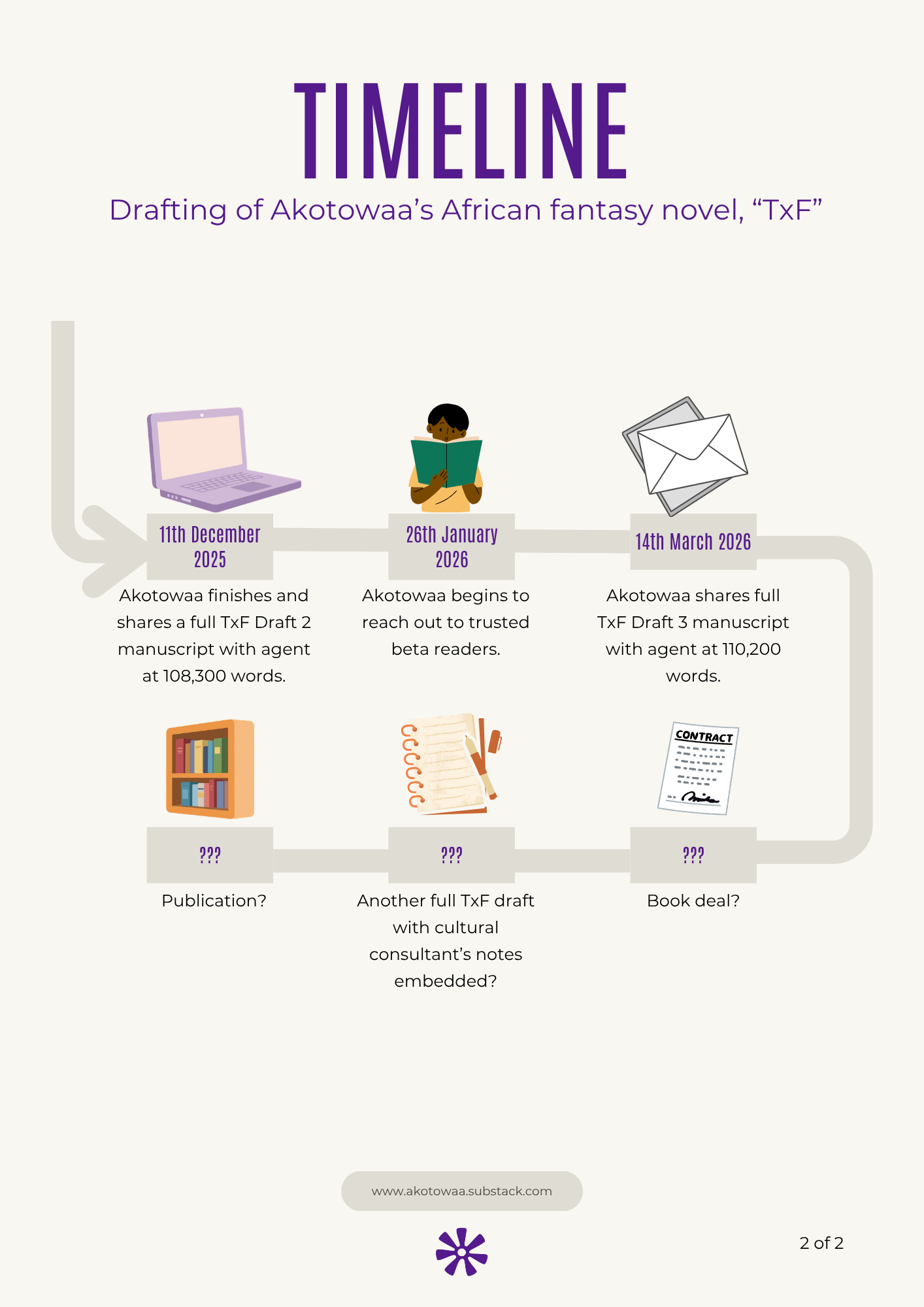
Finally, on 11th December 2025, I finished and shared the TxF Draft 2 manuscript with my agent and editor, at 108,300 words. It took me at least 6 more weeks to start sharing the TxF Draft 2 manuscript with the handful of people I trust to be my beta readers, beginning in the final week of January 2026.
I received enough feedback between January and February 2026 to allow me to complete a third full draft of TxF on 14th March 2026, at 110,200 words.
I am confident about the structural integrity of the story I have written, the messages it contains, its emotional core, and the adventure it promises. Where the manuscript has not yet fully reached the level of quality that I desire is in its ability to honor and accurately represent (to the extent that it is possible to do so in a work of fantasy fiction) some of the African cultures and worldviews upon which my worldbuilding is based. Thankfully, I have been in touch with a person who has precisely the cultural background, intimate knowledge, and extensive education I would need to bring the manuscript up to the desired quality. But this kind of work is work, and it takes a lot of time and attention (I know this from personal experience), and naturally, it costs money—thousands of cedis above what I can afford right now. It is, nevertheless, work that deserves to be paid for. So, this is my appeal for funds. If anything I have said about this project appeals to you, if my work and my existence appeal to you, if you want to be a part of bringing this project into the world at the highest level of quality I can achieve, if you care about fair and researched representation of the African continent and its cultures, and if you have the means, please consider putting something towards my ability to afford this consultant’s time and energy! You can support me through this page: https://paystack.shop/pay/ontheceiling.
And finally, if you are—or know—a well-established traditional publisher who might be interested in any aspect of the manuscript I’ve described so far, feel very free to get in touch! I already have ideas for publishers on the continent with whom I’m interested in working as far as West African rights are concerned, but I believe in the strength of this project’s potential impact across the diaspora and the globe. So, well-established traditional publisher, please find me. The work is good. The work must live. The work shall thrive.
“So be it. See to it.” –Octavia Butler
No posts
Comments
Nothing yet. Say the first thing.
Sign in to join the conversation.