
April is over halfway through now – heavens! – so here’s my monthly round-up of news of exhibitions, literary events, a sneak preview of our next 20th-century book club novel and more. In this ‘Letter from Cambridge’ series I usually start with a letter from someone who lived here (you can find a letter from Sylvia Plath here and from the photographer Lettice Ramsey here). This time it’s from a New Yorker who in surprising ways was greatly influenced by the writings of a famous Cambridge professor, and there’ll be a celebration of her life and work next month at another bookshop on Charing Cross Road. Before we get on to that, I just wanted to say a huge THANK YOU to all of you who joined or upgraded to paid subscriptions last week, it is so fantastic to have your support.
(I have edited this post to include a link to Adrian Barlow’s blogpost and a fascinating Substack Note about the commemorative bronze plaque at 84, Charing Cross Road from Jean Hanff Korelitz).
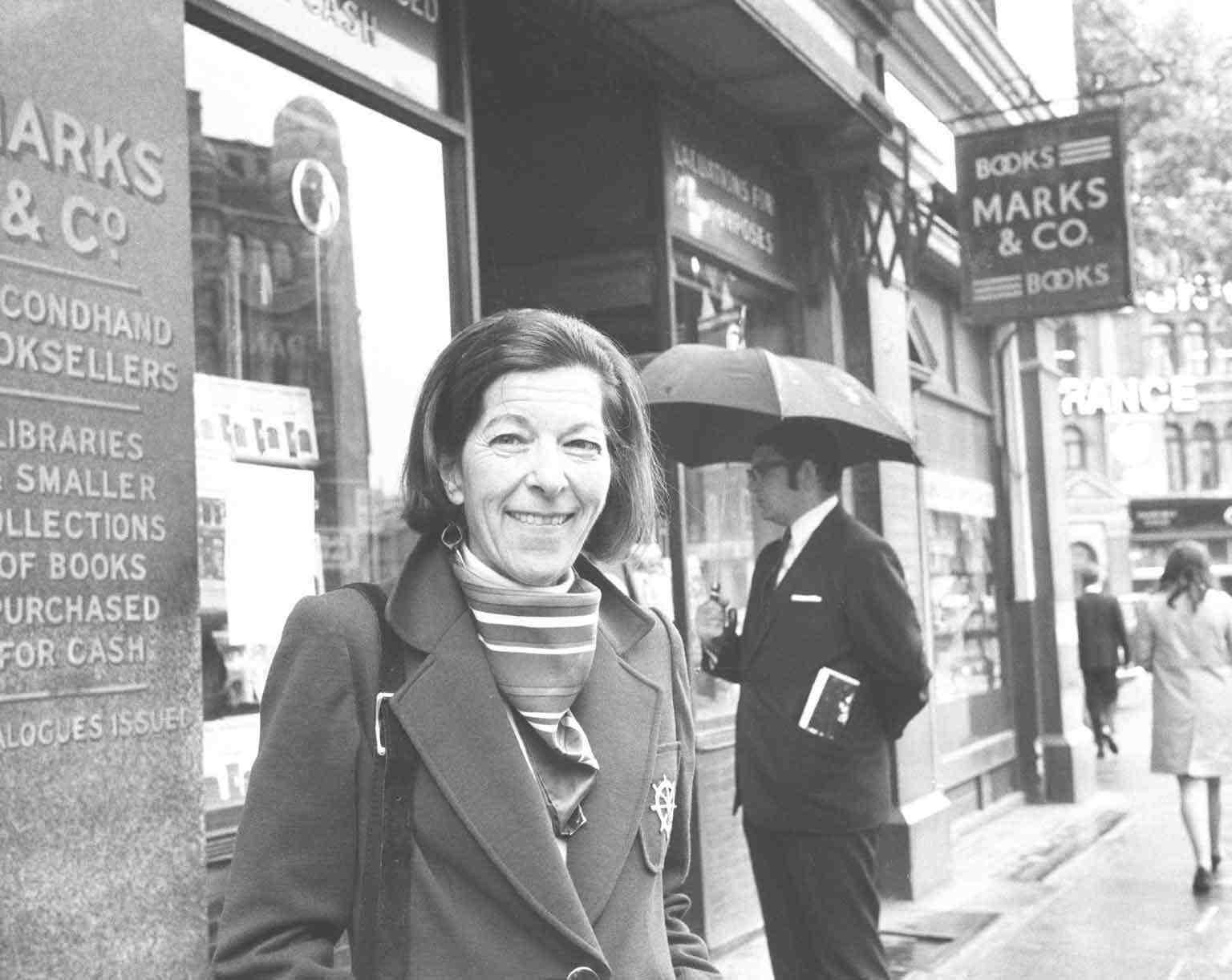
Although the letter I’m highlighting this month was posted from New York in April 1950, it definitely has a Cambridge connection. It’s from the much-loved 84, Charing Cross Road by Helene Hanff, first published in the UK in 1971. It tells the story of how, in October 1949, the scriptwriter Hanff wrote to the London antiquarian booksellers Marks & Co. with a list of out-of-print books she badly wanted to buy, as long as they were in good condition and less than five dollars each. For the next 20 years the bookshop’s manager Frank Doel did his best to find the books she asked for, she wrote funny and at times excoriating letters back, and over the years the two struck up a warm epistolatory friendship. As time went on, this included Doel’s wife and daughters as well as the bookshop’s staff, to whom Hanff regularly sent parcels of food that was rationed in postwar England, and nylon stockings.
Early on, Hanff’s requests for rare editions of poetry, essays and books by Cardinal Newman and John Donne convinced the staff that she must be a highbrow scholar. Hanff was keen to put them straight (‘I’m so unstudious I never even went to college’) explaining that she was a freelance writer, struggling to make ends meet, and living in a rented bedsit.
14 East 95th Street, April 10, 1950
‘…I just happen to have peculiar taste in books, thanks to a Cambridge professor named Quiller-Couch, known as Q, whom I fell over in a library when I was 17. And I’m about as smart-looking as a Broadway panhandler. I live in moth-eaten sweaters and wool slacks, they don’t give us any heat here in the daytime. It’s a 5-story brownstone and all the other tenants go out to work at 9am and don’t come home until 6 – and why should the landlord heat the building for one small script-reader/writer working at home on the ground floor?’
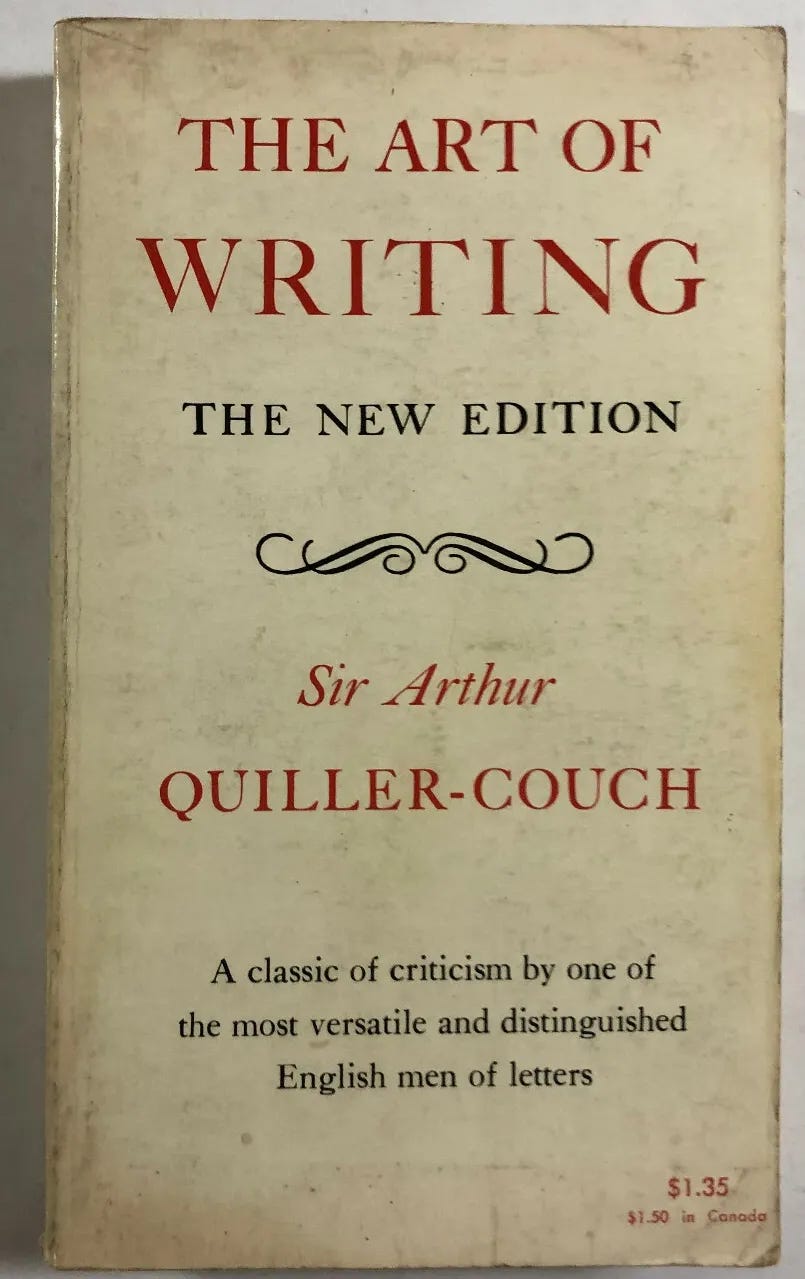
What was the Cambridge connection in all this? Well, as she says above, the book that the teenage Hanff stumbled across as a teenager was On the Art of Writing, first published in 1916. Its author was the distinguished Professor Sir Arthur Quiller-Couch (who incidentally also coined the phrase ‘murder your darlings’, as I wrote here). Many of his books were based on his English lectures to Cambridge University students, where, it has been said, he refused to acknowledge women in the audience by beginning each lecture with the word ‘Gentlemen’.
So I was glad to come across this article by Jane Prince ‘Helene Hanff and Q’s Legacy’, setting the record straight (and incidentally also mentioning Hanff’s visit to Cambridge to meet Q’s widow Muriel Brittain in 1978, which I hadn’t previously known about). It’s well worth reading in full, but I’ll just quote this bit. ‘The famous cartoon ‘Gentlemen’ published in The Cambridge Magazine on 2 May 1914, which depicts Q addressing a lecture hall comprised almost entirely of females as ‘Gentlemen’, was probably partly responsible for his reputation for misogyny’, Prince writes.
‘F. Brittain, his biographer, and one of the people who knew him best, confirms that it was this practice which first gave rise to the legend. He states: “If it had been so, he could have refused admission to all women other than the members of Girton and Newnham Colleges, but he did nothing of the kind. On the contrary, he admitted everyone who cared to attend, whether they were men or women, and he frequently did this against the wishes of the administrative staff of the University, whose duty it was to see that outsiders did not attend lectures without special permission. He also admitted women as freely as men to his informal evening discussions [which he was not obliged to do].” (Frederick Brittain, Arthur Quiller-Couch, a Biographical Study of Q, 1947, pp. 65-66).
You can find out more about Q, Cambridge and Cornwall in the author and English literature specialist Adrian Barlow’s delightful blogpost here.
Incidentally, it’s worth pointing out that most recent-ish UK editions of 84 Charing Cross Road (my secondhand copy is from Cambridge’s Amnesty bookshop and was published in 1976) also include Hanff’s 1974 memoir The Duchess of Bloomsbury Street. It’s about her long-deferred trip to London when her book was published in 1971, and how at last she explores the places connected to the literature she loved. Well worth requesting from your own local secondhand bookshop.
There was a lovely article a few years ago about Helene Hanff in The Oldie magazine by Valerie Grove; you can find it here. Now a distinguished biographer, Grove was formerly a journalist who features briefly in 84 Charing Cross Road as what Hanff describes as a ‘bouncy girl reporter’. She accompanied Hanff to the bookshop she had long dreamed of visiting: Marks & Co. In her article, Grove describes her own memory of the occasion.
‘The day before the book’s British publication, in June 1971, I went by cab with Ms Hanff to Charing Cross Road. Number 84 was, as we had been warned, padlocked. Frank Doel had died from peritonitis in 1968, and the owners, Messrs Marks and Cohen, had sold the shop for redevelopment. It had closed six months before.
It was a poignant moment. Ms Hanff had so often promised Frank Doel she would come to London as soon as she could afford the trip. Peering through the letter box, we saw only dusty floorboards and piled-up mail.’
Grove describes how, ten years later, Hanff returned to London in 1981 and went once again to the site of Marks and Co. (now a MacDonald’s) where a commemorative bronze plaque had been installed in honour of the bookshop she had made world-famous. “Imagine it,” she said. “That a plaque should go up on a London building, just because I wrote letters to it. And I never even went to college!”
*Shortly after publishing this post I was delighted to receive this note, with a glimpse of the bronze plaque to Marks & Co., from the writer Jean Hanff Korelitz. She has written the introduction to Underfoot in Show Business, Helene Hanff’s memoir newly published by Manderley Press, and will be introducing it at Foyles next month (see below for more information and a link to book tickets).
On 16 May there’s an event at Foyles bookshop (appropriately situated at 107 Charing Cross Road, London) to mark the 55th anniversary of 84, Charing Cross Road being published in the UK. There will be a discussion with Jean Hanff Korelitz and Emma Gannon about the life and works of Hanff as well as the continued relevance of, and interest in, her most famous work, some five decades after its initial publication. Tickets for ‘Helene Hanff and 84, Charing Cross Road: A Celebration’ are available here.
I was delighted to receive this comment last week from Elissa Altman.
‘I was the paperback reprint editor for 84 Charing Cross Road when it came out in 1986, and I devoted myself to finding every bit of writing produced by Hanff during the course of her lifetime. I adored her then and I adore her now.’
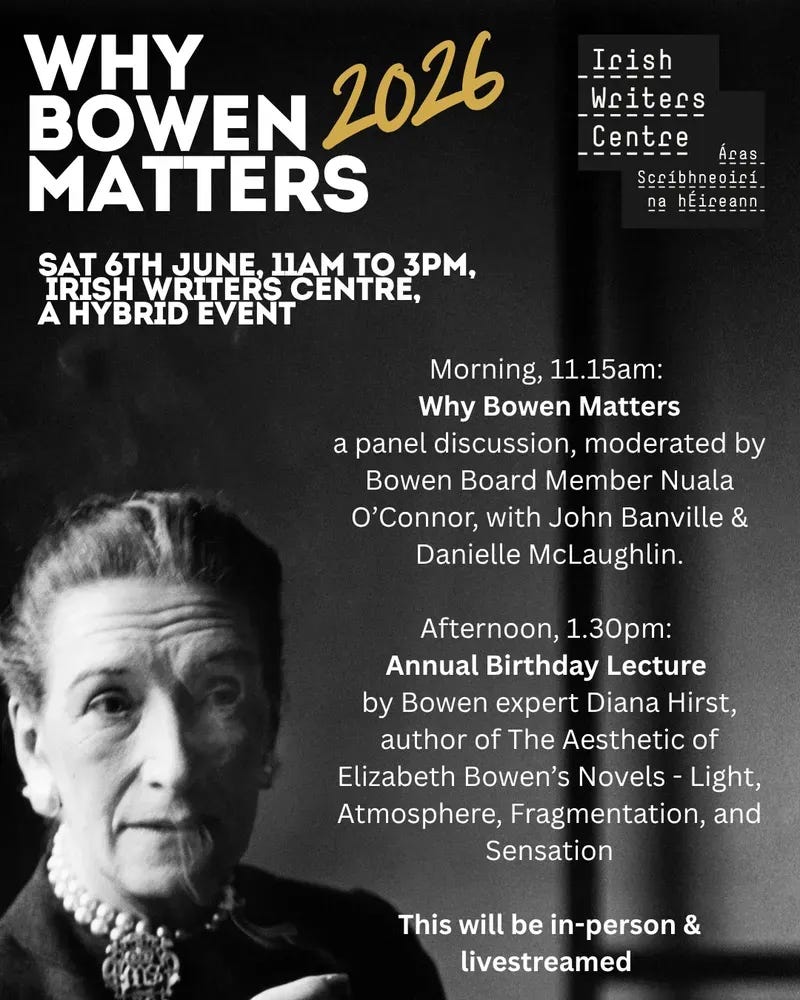
Another bookish date for your diary is an event called ‘Why Bowen Matters’ on 6 June, which takes place in Dublin and will also be live-streamed on the day. The Irish writer Elizabeth Bowen is celebrated for her short stories and novels including The Death of the Heart. Previously I’ve written about her friendship with the English writer Elizabeth Taylor, and Bowen also features in a memoir by another mid-century writer, Elizabeth Jenkins. More on this soon.
We’ll be reading The Tortoise and the Hare by Elizabeth Jenkins, first published in 1956. In her memoir, The View from Downshire Hill, Jenkins reflects on how the novel was perceived by certain critics as being about the problems of a privileged set of people.
‘This was, in terms of financial success, my best novel, but I encountered some severe, personal criticism from readers who felt that the interest of the book was too much confined to one class, not to say one income bracket. I was told by a young man, a student in a university society to which I had been asked to give a talk, that what was wrong with the book was that it wasn’t about anything that really mattered. As I felt that the suffering caused by the break-up of a marriage was something that did matter, I asked him, in surprise, what were some of the things that really mattered? After a pause, he said: “Well, trade unions.”’
‘The moon wanes and the wild goose flies high’ Jeffrey Streeter on the life and work of Japanese writer Fumiko Hayashi.
There is so much treasure to be found in India Knight’s series ‘Me and My Desk’. The most recent features Mark Diacono, and I love his description of his dog Harris, who ‘moves a fleece around the floor so that he may always lie in a rhombus of sunshine.’
Sam Leith whets our appetite the forthcoming Baillie Gifford nonfiction prize, and suggests 25 books that you should, in an ideal world, read before you’re 25. Let’s hope The Guardian features a ‘never-too-late’ list soon, or even books that are most enjoyed when you’re over 50.
Jo Thompson’s delightful gathering-up of distractions this April
And finally, Helene Hanff’s 84 Charing Cross Road pops up in this round-up of novels, old and new, chosen by Sarah McCraw Crow, who was inspired by the recent success of The Correspondent by Virginia Evans. ‘The epistolary novel is indeed an old-fashioned form (Mary Shelley’s Frankenstein, for example), and yet somehow it keeps on going, even in our fragmented 21st century.’

Letters from Cambridge
A Cambridge letter for a Spring morning
·
Mar 1

It’s been spring-like weather this week here in Cambridge, and I enjoyed a brief outing this weekend past, travelling eastward to the Norfolk coast. Walking with my dog along the wide, almost empty and softly windblown beach of Wells-next-the-sea was such a treat.
Comments
Nothing yet. Say the first thing.
Sign in to join the conversation.