
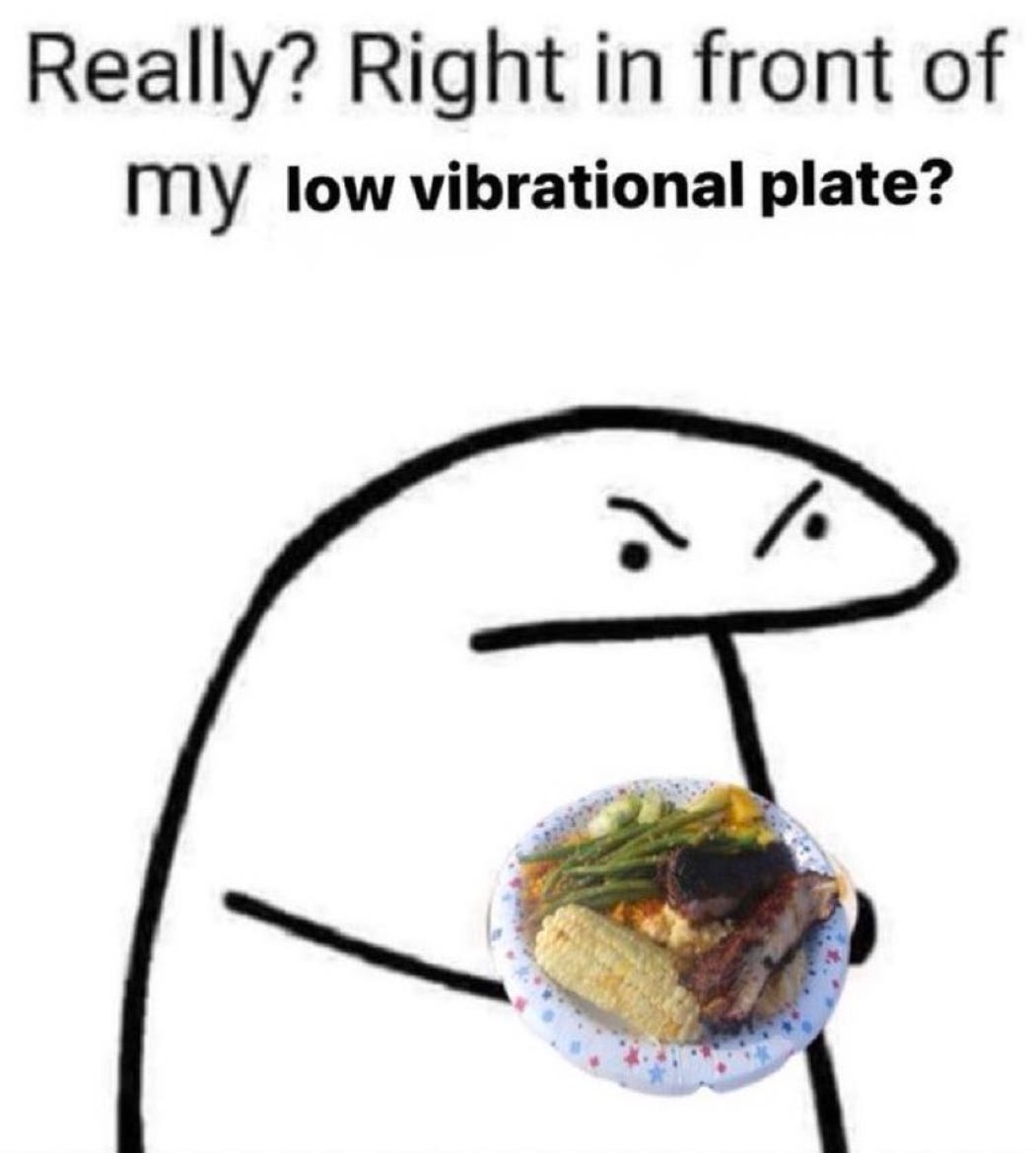
One thing I will never not find absolutely hilarious was the ‘low vibrational plate’ era on social media. In fact, I periodically burst into fits of laughter while writing this post. As ludicrous as the concept of a ‘low vibrational plate’ or ‘hood rat plate’ sounded then, to the black collective, to shame someone for eating a plate of barbeque wings, grilled burgers, shrimp, and corn on the cob, the same can be said about how ludicrous it sounds to dictate which foods one’s spiritual court are allowed to enjoy.
I have heard all manner of “I’m eating [xyz diet], so therefore my ancestors will get what I give them. They don’t need that low-vibrational food anyway - we are free now!”

Setting the extreme condescension and incalculable anti-blackness aside, the same folks espousing that logic are often the same ones running to their cards (or from one religion to another) asking for clarification on why their petitions have fallen short, or in some cases go unanswered completely. While I have seen a few cases of people who have been able to finagle a compromise with their ancestors (people who don’t give alcohol in offering to maintain integrity in their sobriety journey, for example), for the most part, denying ancestral forces their food preferences is strange behavior.
What a shame to be ashamed of the ancestors who have our backs, regardless.
Ancestors + what they asked for = You getting what you asked for, realistically speaking.
Ancestors + What they did not ask for = You getting what you did not ask for.
Ancestors + the gall to dictate to them what they will or will not get for something as simple as a plate of food they specifically requested = Tricky circumstances.
Ancestors + Ignoring their requests ≠ A strong relationship or mutual assistance.
I would even go so far as to say one should reevaluate if this practice is suited for them if they start it out in strong opposition of the simplest aspects.
We can investigate how this aspect of spiritual bypassing works against effective ancestral veneration and building the lives we seek to improve and secure.
I will answer that with another few questions for my hoodoo practitioners who may be reading: Did not Isaac offer a lamb to God? Secondly, did not the God of the Christian bible request a male goat in sacrifice for Passover? Of what use is a lamb to a God who owns everything? Why a goat specifically?
To be fair, the intent behind the food offering is just as important as the food itself, re: Cain and Abel, but we can get into that another day.
Anyway, let's get into various reasons why.
First, what does food mean to the living?
What does the act of breaking bread with someone symbolize intrinsically for us? It is a means of connection, hospitality, bonding, and setting aside a part of one's day to enjoy a home-cooked meal that nourishes the body in many ways. For many people, the only time they see their extended family communally is through a shared meal at an event such as a birthday, baby shower (Hello, baby shower meatballs and freshly starched Burberry short set!), holiday, family reunion, or funeral. Hell, even in business, partners forged and cemented agreements over a mid-afternoon lunch or end-of-day dinner engagement. Food and what it means is essential to us collectively; take, for instance, the following photo; what does it mean to you, and where would you typically see these foods?
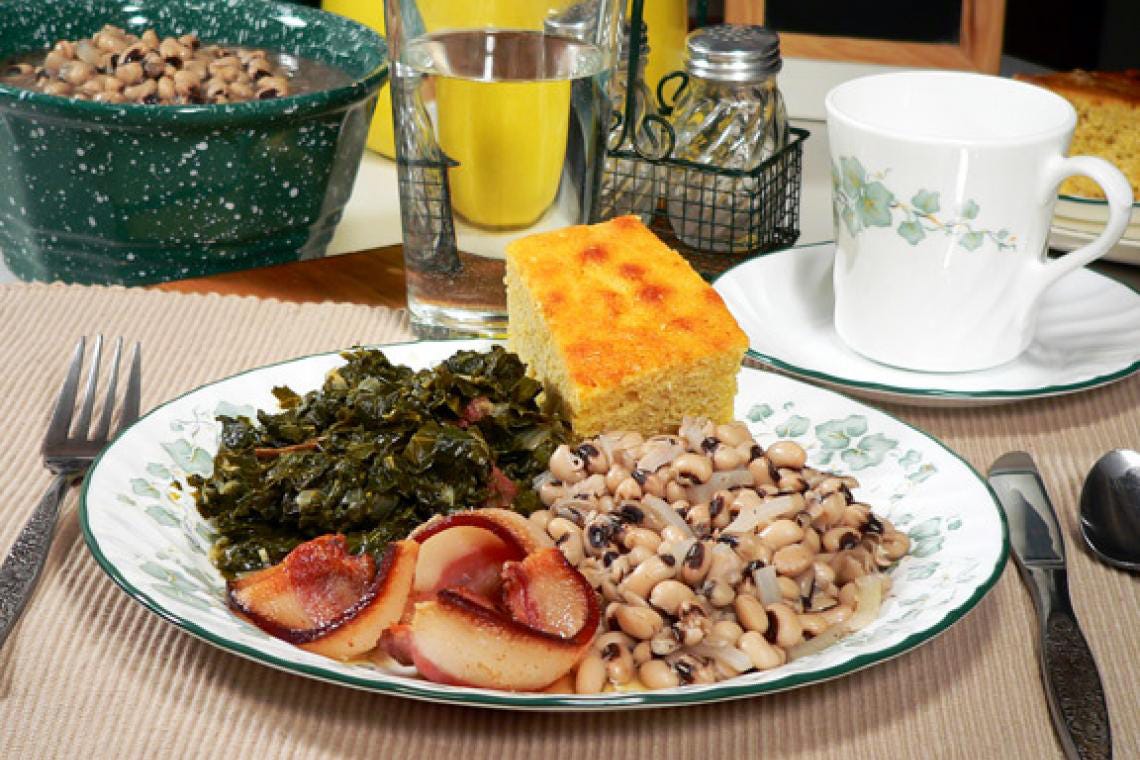
Keep that meaning in mind— I want to explain a few collective meanings of each food depicted here, why they have been assigned those meanings, and what that created as a result.
Cornbread, for many, represents gold and prosperity as corn kernels, previously, have represented gold coins.
Pork has represented progression and good fortune.
Black eyed peas represent coins, good luck, resilience, and the community's resourcefulness in hard times.
Greens represent financial wealth, such as in the fact that they are like "folded dollar bills," but for many, they also represent the blessing of good health, given the widely touted health benefits of pot liquor.
Fun fact: On the first day, many don't eat seafood such as lobsters, crab, or shrimp because they don't want to eat things that 'move backward' or walk sideways since they want to progress or move forward into the year.
Metaphysical meanings aside, we must also acknowledge the origin of this meal which dates back to Watch night, The National museum of African American History and Culture writes, ” The Watch Night service typically begins around 7pm on December 31 and lasts through midnight, as faith leaders guide congregants in praise and worship. Many congregants across the nation bow in prayer minutes before the midnight hour as they sing out “Watchman, watchman please tell me the hour of the night.” In return the minister replies “it is three minutes to midnight”; “it is one minute before the new year”; and “it is now midnight, freedom has come,” to bless their transition into the new year. — The occasion is customarily marked by celebrations of fellowship and a worship service, followed by a fortuitous meal on New Year’s Day. Celebratory foods include a diverse collection of culinary traditions that can be traced back to Southern superstition, influenced by beliefs across West Africa. Chief among these foodways is the practice of eating collard greens, representing the promise of prosperity, and eating black-eyed peas with rice, also known as Hoppin’ John. Traditionally, Hoppin’ John consists of black-eyed peas, rice, red peppers, and salt pork, and it is believed to bring good fortune to those who eat it.”1 Additionally, Alexandra Foster of the Food Network writes, “Indeed, historically, black-eyed peas were seen as a throwaway food for enslaved people and livestock. The crop was brought by enslaved Africans in the 1600s as they were transported to the Americas. West Africans have long considered black-eyed peas a good luck charm that warded off evil spirits, and they are often served on holidays and birthdays.” 2
“Well, pork was a throwaway food that slave owners didn’t want to eat and neither is it a staple food in West Africa, so why should we eat it?” is an argument I have heard in various online circles as well.

First, I feel it is important to clarify that pork is not a staple food in the Muslim population of West Africa. Considering Islam was practiced pre-slave trade (dates back to 800 C.E.) as well as the role of The Nation of Islam within the black community, which played a significant role in civil rights efforts, , as well as the Rastafari I-tal belief system that prohibits pork and shellfish (dietary laws outlined in the Book of Leviticus) you will find a great many black people across the diaspora who do not eat pork as a result. Pigs, however, have been an offering in rituals regarding the dead (including funerals) both in the Diaspora and in some ethnic groups native to continental West Africa, such as the Arada and Nago-Yoruba people. Hell, the Voodoo ceremony at Bois Caiman on August 14, 1791, that began the Haitian Revolution, saw a black pig sacrificed, and with its blood, a commitment to freedom was signed, sealed, and delivered.
Additionally, about 20% of enslaved Africans were brought from the Bight of Benin Region and were transported to the United States, Brazil, and Haiti, and with them brought an cultural appreciation for pigs, “Regarding ancestral practices, the pig, in particular the local breed, has great importance in tradition in Benin. Thus, pig breeding in Benin is not only intended to produce to feed the population but also for homage to the dead through funeral ceremonies, and to deities through offerings and libation sacrifices as a worship in Southern Benin. These results confirmed those observed in Cameroon, more precisely in High Relief of Western where the pig plays a predominant social role in the tradition [17]. The authors reported also that pigs were used for offering to deities through funerals and various social events such as nuptials and baptisms. In Congo Brazzaville, pigs had long been used as an exchange for men between the Beembe and other ethnic groups including Kaamba, Doondo, and Suundi, but also more and more among the Beembe themselves, with other uses later [18]. The same author reported that the pig was currently included in matrimonial compensations, conflict settlements, funeral meals, and religious rituals. In Benin, the use of pigs in traditional ceremonies has already been mentioned by Djimènou et al. [19] in the Southern region. For certain ethnic groups in Southern and central Benin, the pig was considered a sacred animal, a god worshipped by a certain fringe of the population.” 3
With the forced cultural immersion and admixture of that time that created the creolization of the African Diaspora as we know it today, it is safe to say many descendants of enslaved African peoples may have an ancestor or two who dig on swine (and very likely some who do not, but that is for the ancestors in question to determine). I should also note that there are many things the ancestral forces can and will eat that we personally will not (or can’t) eat. My folks like oranges, but I can’t eat them— but I still purchase them when they ask for it.
Back to the point.
These New Year foods specifically were seen as guaranteed sustenance because they traveled well, re: Great Migration, and they brought with them comfort and flavors that reminded the people of “home,” allowing the traditions/memories of the past and symbols of black resilience to come with them when they moved to a new place. This repetition, in turn, created an easily recognized tradition for both the living and the dead. Such is the case for many cultures with traditional foods to mark a special occasion.
Sociologists say that three things are necessary to make something a tradition:
A large group of people participating in the activity
The activity being passed from one generation to another,
And honor, respect, or acknowledgment of the past.
The foundation of many African Diaspora religious traditions is in following the protocols set forth by our ancestors because not only does it show respect to those who came before us, but it also respects the requests of the spirits in the specific way they requested to be venerated, and is the most effective in terms of receiving a response.
Giving your ancestors the food they asked for, in straightforward terms, is showing respect. Just as you would not want to be disrespected for your faith or spiritual beliefs, do not, in turn, disrespect their requests and the preferences they developed as a result of their upbringing.
I know when I am made an ancestor, my holiday plate bet not lack a fried catfish sandwich, fried hard, or there will be hell to pay! I kid, I kid or do I.
This is a term I’ve been developing in my mind, theoretically, for a while. My personal definition is that collective meanings derive from traditions or perpetuated beliefs that have been repeated and venerated in one form or another and are then imprinted into the collective consciousness of that community or family lineage as symbols for that meaning; which is why even if you have never physically heard of a specific concept or symbol and it’s meaning before, it can pop up in your spiritual investigations, dreams, divination. An example would be dream meanings; in my studies, they appear to be specific to communities and are thus made egregores in their own right, making appearances when their purpose is necessary or marked as an omen. An example of this is the black community’s understanding of dreaming about fish. This almost universally signifies pregnancy to us, so collectively, if the ancestral forces would like to impart a message about someone being pregnant, they may deliver an astral message vis-à-vis in the dreamscape. This doesn’t mean fish can’t mean something different to you and your family specifically, but in terms of collective meaning and understanding, it is widely respected as a general meaning. More on this later. (Can you tell I have a lot to say by how often I say that lol.)
What about repetition?
In many religious practices, globally, repetition in an act gives it more light, power, and continued thought, which spans time and space, which then impacts the subconscious mind, which exists without physical limitation. The subconscious mind, in my opinion from studying the New Thought Movement of the early 19th century (though the central point of this phenomenon can be traced to the inception of the majority of known religious practices), is the place where you can effectively communicate with the source of creation, i.e., God, and by extension, your ancestors, such as through all the clair-cognitive senses, or astral travel.
With this basic understanding of repetition, coupled with a few common meanings of the aforementioned foods, we can reasonably draw the conclusion that:
The act of giving the ancestral forces the food they ask for, which they have recognized, traditionally eaten while living (no matter the circumstance or time period), and maintained through multiple generations as a call back to memory, events, or comfort, serves a specific purpose identified in the meaning of each food, such as the process of doing any kind of spiritual work.
Lord, am I making even a lick of sense here?

In practice, let’s say they request a bowl of greens with pork as payment for a petition you made about needing to improve your finances because, to them, that food offering holds the energetic properties and meaning towards manifesting that specific goal in your physical reality. Now, I don’t eat pork myself (it is a taboo for me, though I was previously known to get down on a pork chop sammich with a piece of white bread and hot sauce), but you can bet your last dolla that I will be divvying up a bowl of greens with a ham hock when they ask for it if it means my ass ain’t living on the street!
The spiritual or energetic meaning, such as the meaning of the color of a candle, or the meaning behind giving water instead of alcohol, cannot be discounted here. It is not a haphazard choice. Everything they do, ultimately means something.
Take Buddhism for example, Buddhists give oranges on the shrine of Buddha, why? Because the color represents Buddha Ratnasambhava, who represents the wisdom of equality and equanimity. It also represents spiritual enlightenment, illumination or the highest state of perfection, purity, prosperity, renunciation of the outside world (for Tibetan monks), and the orange tree itself represents a spiritual concept in Tibetan Buddhism, known as Maitreya, who represents the alleviation of conflicting emotions. All of this meaning belongs to the simple orange fruit in their tradition, well, also the color, but still!
And our foods, no matter what respectability politics people have assigned to them, have significant meaning in our collective and individual tradition(s).
More common examples found amongst ATR/ADTR practices:
Hot peppers and/or extremely spicy food given to heat up a spirit (who requested it, mind you, don’t go giving hot peppers to a spirit who doesn’t like hot things) to do ‘hot’ workings that require more force.
Cool water given to ‘cool’ a spirit down or foster clarity, depending on the form given, to the recipient or the spirit that is caught in confusion or the messages are obscured.
Sweet herbs, candy, syrups or specially prepared treats given to sweeten a spirit or give them the food needed to bring sweetness to a situation.
Specified preparations identified to serve a purpose, for example, let’s say hypothetically, one of your folks asks for a cup of coffee to be put to them when you are to complete divination because this gives them energy, then you will put it. Or, alternatively, they ask for a slice of cake, some sweet tea and a piece of hard candy on Sundays to represent rest and peaceful times for the week, that’s what they need to do that for you — so you do it.
Watermelons, or melons in general, have commonly been associated with water/agriculture related spirits. Watermelons are a symbol of fertility, industriousness, resilience, financial abundance, prosperity, harvest, and much more, but bigotry both internal and external would have many shy away from this perfectly normal (and delicious!) fruit for fear of being maligned.
Each spirit has their tools, rules, protocols and sustenance to manifest the way they see fit. I wrote this piece, in part because the concept of ‘low vibrational’ food is funny to me in a sardonic way, but also because I wanted to clearly illustrate why using this pejorative rhetoric, in the same conversation of service to ancestral forces, is counter-intuitive (and in many ways a form of self-sabotage on the basis of a false sense of moral high ground), to creating a strong and reliable relationship. That kind of thinking is not founded in any kind of logic. Yes, I know spirituality can appear outside the realm of materialistic logic, but the history of why we do what we do is there. Just because one might change the verbiage to something more ‘woowoo’ doesn’t make it any-less rooted in white supremacy.
The ancestors are not ‘low-vibrational’ for requesting pork, chitlins, or any other food they have come to enjoy or recognize as useful, just because it gets a racially charged bad rep, or inherited resentment.
They are dead, they died for us, and at that point, they deserve what they asked for— barring the tricky, negative or afflicted spirits (another convo for another day, I know y’all tired of hearing that lmao), just give them the food they asked for.
Y’all be blessed,
-Lolu
S. (n.d.). The Historical Legacy of Watch Night. Nmaahc.si.edu. Retrieved February 4, 2025, from https://nmaahc.si.edu/explore/stories/historical-legacy-watch-night
Foster, A. (2023, December 2). Why We Eat Black-Eyed Peas and Collard Greens on New Year’s Day. Foodnetwork.com. Retrieved February 4, 2025, from https://www.foodnetwork.com/fn-dish/holidays/why-do-you-eat-black-eyed-peas-collard-greens-new-years
Djimenou, D., Adoukonou-Sagbadja, H., & Koudande, D. O. (2023). Uses of local African pigs in food and traditional practices in Southern Benin. WJARR. https://doi.org/10.30574/wjarr.2023.19.3.1284
No posts
Comments
Nothing yet. Say the first thing.
Sign in to join the conversation.