
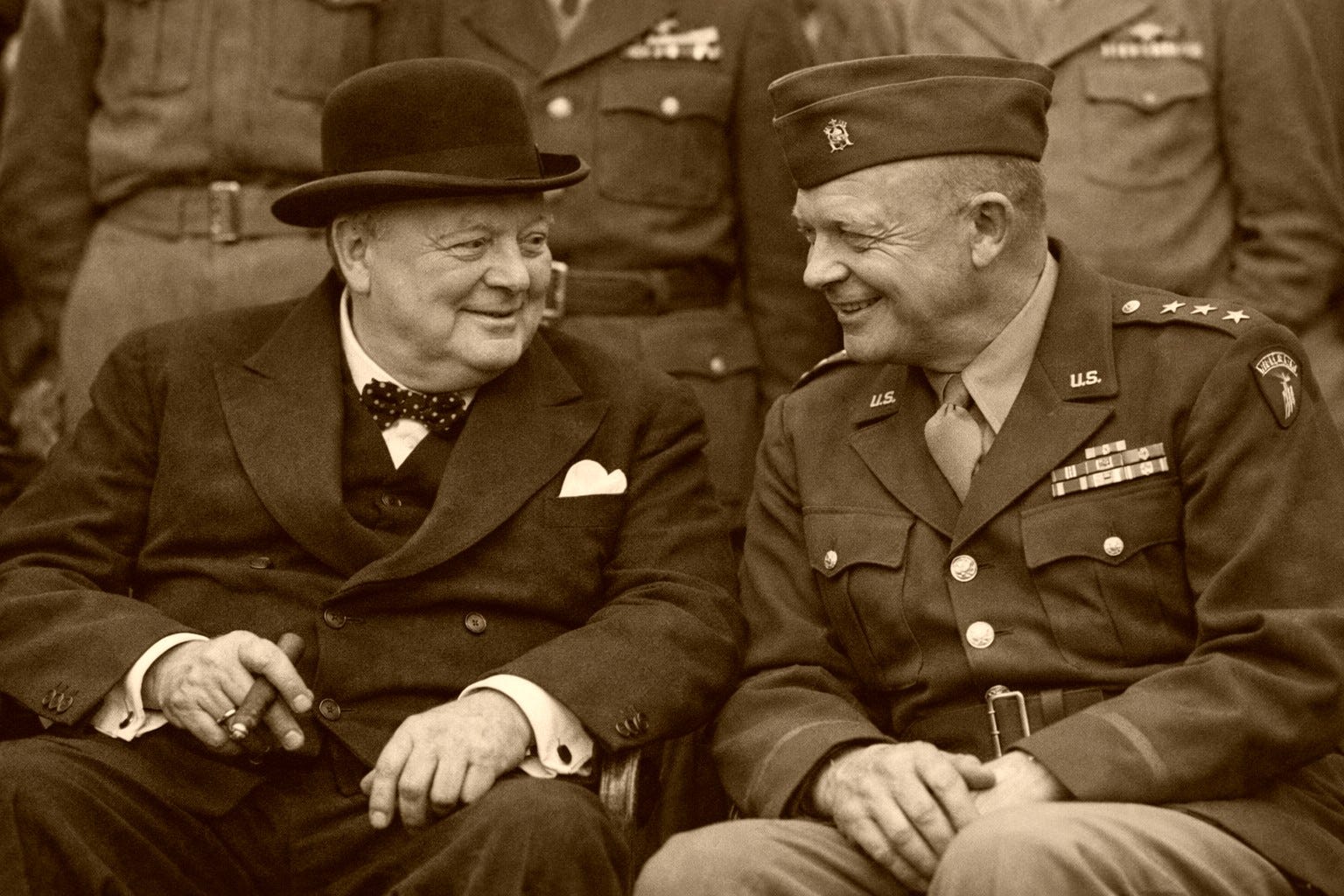
When Winston Churchill became Prime Minister in May 1940, his cabinet pushed for peace negotiations with Hitler. France was collapsing. Britain stood alone. A negotiated settlement seemed like the only realistic option for survival.
Churchill refused. He committed Britain to fighting on despite overwhelming odds, risking invasion, total defeat, and the destruction of the British Empire. If he’d been wrong, historians would’ve condemned him for dooming Britain when a negotiated peace was available.
VISIT MY SUBSTACK HOMEPAGE FOR MORE FREE ARTICLES >
Four years later, Dwight Eisenhower faced a similar moment. On June 6, 1944, he approved the Normandy invasion, knowing it could fail catastrophically. The weather was terrible. The element of surprise was uncertain. A failed invasion would’ve killed tens of thousands of Allied soldiers and possibly extended the war by years.
He even drafted a statement accepting full responsibility if the invasion failed.
Both leaders succeeded. But here’s what matters: when they made those decisions, they couldn’t know they’d work. They just knew that avoiding risk guaranteed defeat.
Playing It Safe
We’ve built entire careers around risk avoidance. Strategic planning. Consensus building. Careful analysis. These aren’t bad practices, but they’ve created a dangerous illusion: that we can eliminate risk through better process.
We can’t. Risk isn’t a flaw in the system. It’s the system.
Every major advance in business history came from someone betting on an uncertain future. Ford’s assembly line. Amazon’s move into cloud services. Apple’s iPhone. Each decision involved massive risk. Each could’ve failed catastrophically.
What separated these leaders from their competitors wasn’t better information. They faced the same uncertainty that everyone else did. What separated them was the willingness to act despite that uncertainty.
Why AI Changes Everything
Artificial intelligence hasn’t just introduced new risks. It’s fundamentally altered the relationship between leadership and risk.
Here’s why: AI demands involvement from leadership in ways previous technologies didn’t. You can’t delegate AI strategy to IT and hope that it works out. The decisions about where to apply AI, how to govern it, and what risks to accept require judgment that only leadership can provide.
Consider what happens when you deploy AI in customer service. You’re not just automating responses. You’re deciding what level of accuracy you’ll accept, what mistakes matter, and how much autonomy to give the system. Get it wrong and you’ll alienate customers. Get too cautious, and competitors will eat your lunch.
These aren’t technical decisions. They’re business decisions with technical components. And they require leaders who understand both the potential and the peril.
The Three Risks Leaders Need to Embrace
1. The Risk of Being Publicly Wrong
AI amplifies mistakes. When your AI system makes an error, it doesn’t fail quietly. It fails at scale, often in ways that go viral. Every deployment is a referendum on your judgment. But hiding from this risk means never deploying AI at all. And that’s a bigger mistake than any individual failure.
Look at how financial services companies approached AI-powered fraud detection. Early systems made mistakes. They flagged legitimate transactions and missed actual fraud. Banks that deployed anyway learned from those errors and built better systems. Banks that waited for perfect solutions are still waiting, losing billions to fraud while their competitors’ systems get smarter every day.
2. The Risk of Obsolescence
AI moves faster than any technology in business history. The competitive advantage you build today might evaporate in six months. The system you invested millions in might become outdated before you’ve recouped the cost. This creates a brutal calculus: invest heavily in something that might not last, or fall behind competitors who are willing to take that chance.
The only viable response is to accept that some investments will fail. Build that into your planning. Don’t try to find the perfect AI solution that’ll last five years. Build capacity to evolve every six months instead.
3. The Risk of Ethical Failure
AI systems can perpetuate bias, invade privacy, and make decisions that harm people in ways we don’t anticipate. As a leader, you’re responsible for outcomes you can’t fully predict.
This is the hardest risk to embrace because it involves potential harm to others, not just business consequences. But avoiding AI entirely doesn’t eliminate this risk. It just transfers it to competitors who might be less careful than you’d be.
What Embracing Risk Actually Means
Let’s be clear: embracing risk doesn’t mean being reckless. It means accepting that uncertainty is permanent and building systems that can handle it.
Start with small bets. Deploy AI in limited contexts where failure is survivable. Learn what works and what doesn’t. Scale what succeeds and kill what fails quickly.
Be transparent about limitations. Tell customers when they’re interacting with AI. Explain what it can and can’t do. Build trust by acknowledging uncertainty rather than pretending you’ve eliminated it.
Create feedback loops. Don’t just measure whether your AI works. Measure how it fails. Build systems to detect problems early and respond fast.
Most importantly, stay involved. You can’t embrace risk you don’t understand. If you don’t know how your AI systems work, what decisions they’re making, and what could go wrong, you’re not embracing risk. You’re just being negligent.
The Cost of Caution
Every leader claims to value innovation. Few are willing to pay for it. And the price of innovation is always risk.
Companies spend millions studying AI without deploying it. They form committees. They write white papers. They conduct pilots that never scale. They’re doing everything except the one thing that matters: making decisions under uncertainty.
Meanwhile, their competitors are learning. Every failure teaches them something. Every success compounds. The gap widens not because the cautious companies lack capability, but because they lack courage.
Here’s what happens when you prioritize safety over progress: you don’t stay safe. You just fall behind until you’re no longer competitive. Then the market decides for you, and you’ve got no control over the outcome.
Leading Through Uncertainty
The leaders who’ll thrive in the AI era aren’t the ones with the best predictions. They’re the ones who can act decisively despite imperfect information.
This requires a different mindset than traditional strategic planning. You can’t wait for certainty. You have to develop conviction through action, learning faster than the pace of change.
It also requires humility. You’ll be wrong sometimes. When you are, acknowledge it, learn from it, and move forward. Your team will respect honest failure more than they’ll respect paralysis disguised as prudence.
Most of all, it requires accepting that leadership is inherently about risk. You’re paid to make judgment calls when the data’s incomplete and the stakes are high. If the right answer was obvious, they wouldn’t need you.
The Choice
Eisenhower’s choice wasn’t brave because he knew it would work. It was brave because he knew it might not, and he committed anyway.
That’s the choice every leader faces now. Not whether to avoid risk, but which risks to embrace. You can choose the risk of action or the risk of inaction. Both are risky. But only one gives you control over your future.
VISIT MY WEBSITE >
Comments
Nothing yet. Say the first thing.
Sign in to join the conversation.